


The United Arab Emirates (UAE) is leveraging digital technology to redefine corporate governance. In recent years, government initiatives have encouraged organisations to digitalise several functions, particularly tax compliance, internal audits, and board oversight.
Guiding this transformation is the “We the UAE 2031 Vision”, a long-term national strategy that promotes public-private collaboration to build an innovation-driven economy. Complementing this is the Digital Government Strategy 2025-2030, which aims to modernise government services for a more efficient, future-ready business environment.
As these government initiatives take hold, the private sector is expected to follow by modernising corporate governance and treating it as a strategic priority rather than merely a compliance checkbox.
With this context in mind, this article explores the evolving corporate governance UAE, specifically how digital transformation is redefining the roles and responsibilities of boards.
Why is the UAE digitalising corporate governance?
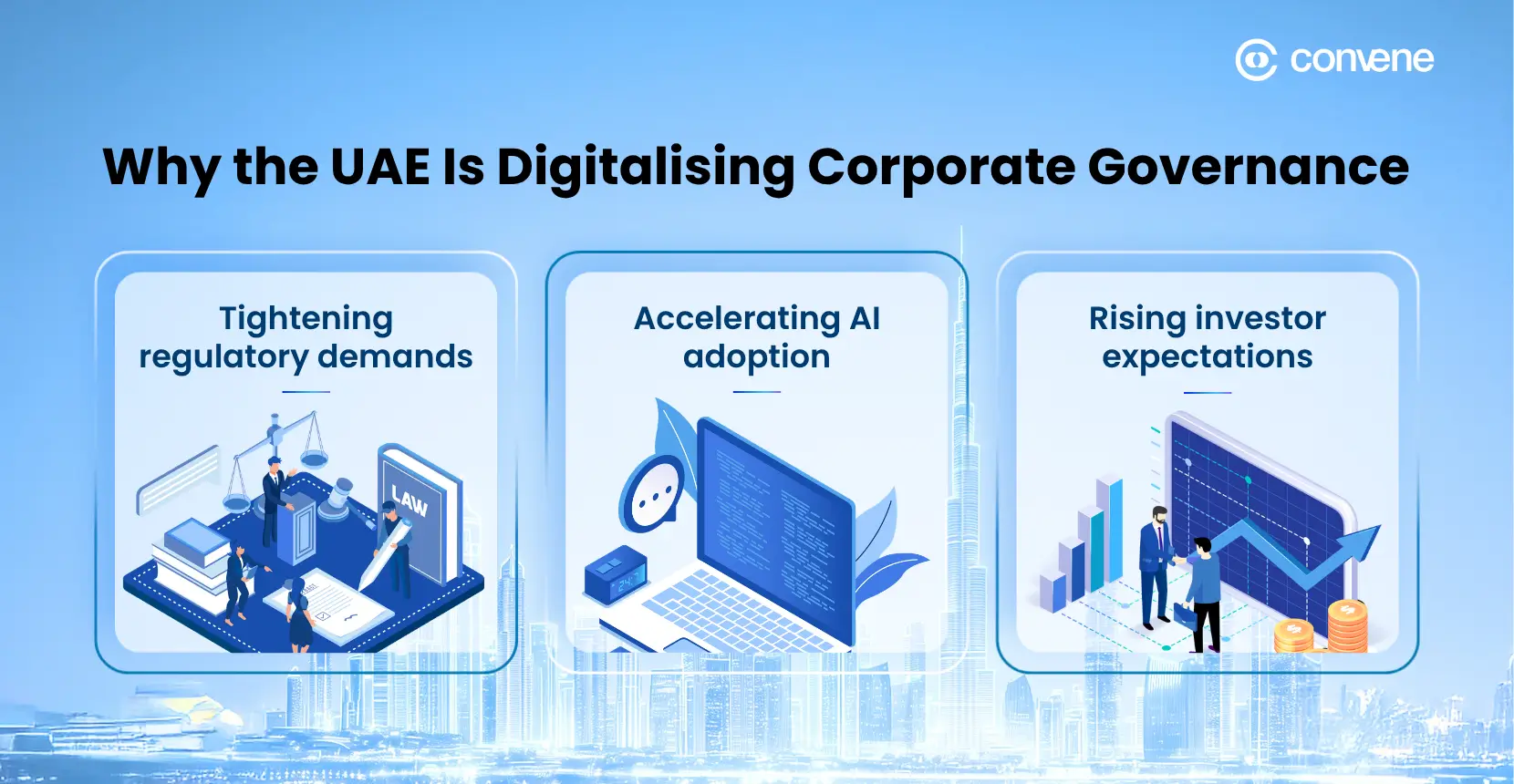
The digital shift in the UAE’s corporate governance is influenced by interconnected factors: tightening regulatory demands, accelerating AI adoption, and rising investor expectations.
1. Tightening regulatory demands
Between 2020 and 2025, the UAE introduced the following legislation and amendments to strengthen transparency and accountability.
| Protection of Personal Data (2021) | The UAE’s first comprehensive data privacy framework that aligns data handling and protection standards with the General Data Protection Regulation (GDPR). |
| Federal Decree Law No. 34 on Combatting Rumours and Cybercrimes (2021) | Amended Federal Decree-Law No. 5 of 2012 to address digital threats arising from social media and digital services, including deepfakes, automated misinformation, and financial fraud. |
| New Companies Law (2021) | This allowed 100% foreign ownership of mainland companies. It also refined several corporate governance UAE requirements, including board composition, general assembly, minority shareholder protection, and audit obligations. |
| Decision No. 2/R.M. (2024) | Introduced changes to the Governance Code by amending guidelines on internal controls, risk management, and audit committee reporting. |
| New AML Law (2025) | Implemented stricter anti-money laundering and counter-terrorist financing framework by expanding rules to cover virtual assets. |
Collectively, these have increased compliance obligations, marked by the need for more comprehensive governance documentation and stronger internal controls.
To avoid overlooking updates, organisations must shift from periodic to continuous oversight. However, tracking and cross-checking amendments usually take longer when done by hand. This pushes leaders to adopt digital tools, such as automated regulatory tracking and compliance dashboards, to enhance visibility and agility.
2. Accelerating AI adoption
The UAE’s AI initiatives are anchored in the National Strategy for Artificial Intelligence 2031, a long-term plan launched in 2017. Since its roll-out, the government has encouraged organisations to adopt AI and digital technologies while also strengthening AI Governance, Risk, and Compliance (AI GRC) frameworks.
As AI adoption accelerates, organisations face increasingly complex digital risks. To ensure resilience, organisations need equally advanced digital systems, such as GRC platforms, to equip UAE boards with tools to monitor algorithms, safeguard data, and detect security breaches in real time.
3. Rising investor expectations
Investors today do not solely rely on financial performance to evaluate long-term growth. According to the 2025 Kearney Foreign Direct Investment Confidence Index, they assess business scalability, AI readiness, and sustainability practices when making investment decisions.
The UAE strives to meet these evolving expectations by officially moving ESG reporting from a voluntary exercise to a regulatory obligation with the implementation of Federal Decree-Law No. (11) of 2024 on the Reduction of Climate Change Effects.
As sustainability reporting becomes a regulatory requirement, organisations need a digital-first ESG framework that supports continuous data collection, year-round monitoring, and data-driven reporting.
How is digital technology reshaping corporate governance in the UAE?
AI, Robotic Process Automation (RPA), and data analytics are transforming critical governance processes for UAE boards by automating internal audits, tax compliance, strategic planning, data management, and stakeholder engagement.
Here’s how they are impacting corporate governance UAE.
1. Automated Internal Audit
AI-powered audit tools have significantly reduced fraud detection time and widened coverage of assessments. Within minutes, boards can identify anomalies, patterns, and high-risk items that would normally take longer or be easily overlooked with traditional sampling methods.
Moreover, AI integration has significantly changed the audit cadence. Boards no longer have to wait for annual reviews because AI-powered audit tools improve accessibility and continuity. This enables boards to conduct year-round evaluations without straining physical resources and employees.
2. Digital Tax Administration
One of the recent advancements in the UAE’s fiscal governance is the Electronic Invoicing Systems, a digital platform that digitalises business-to-business (B2B) and business-to-government (B2G) transactions.
Now in its pilot phase, the Federal Tax Authority (FTA) will only accept digitally transmitted invoices, eliminating PDFs or physical papers in the invoicing processes. The system then automatically reviews every transaction, efficiently monitoring for VAT compliance and preventing financial fraud. The EIS supports both the government and organisations in improving compliance, closing tax gaps, and reducing administrative burdens.
3. Board Maturity
According to KPMG in 2025, more than half of CEOs in the UAE identify AI integration as a top strategic priority for the coming years. Building on this, 84% expect workforce expansion, while 80% are already redesigning roles to integrate AI-driven workflows across operations.
These reflect the growing confidence of UAE business leaders in AI integration. They are increasing their commitment to embedding AI into core governance functions, including governance, strategic planning, and decision-making.
Related Reading: AI Third-Party Risk Management: Benefits, Perils, and Best Practices
4. Unified Data Regulation
The UAE took a significant step toward evolving its digital regulation through the establishment of a new government agency, the Federal Artificial Intelligence and Data Authority. The authority unifies oversight of AI, data governance, and e-governance initiatives under a consolidated framework.
To meet the legislative and governance demands of digital transformation, the agency will be pivotal to shaping related national policies and strategies.
As the government consolidates its AI governance efforts, organisations should mirror these initiatives at the organisation level by creating AI governance frameworks and implementing robust internal data privacy policies.
5. Real-Time Stakeholder Engagement
The ongoing digital transformation is also reshaping how UAE boards communicate and demonstrate accountability to stakeholders. Digital platforms like board portals enable leaders to share updates in a timely manner and with greater transparency. As a result, stakeholders gain more accessibility to information, enabling them to discuss and decide in real-time.
Find the best board portal using this guide!
How can UAE boards prepare for digital governance?
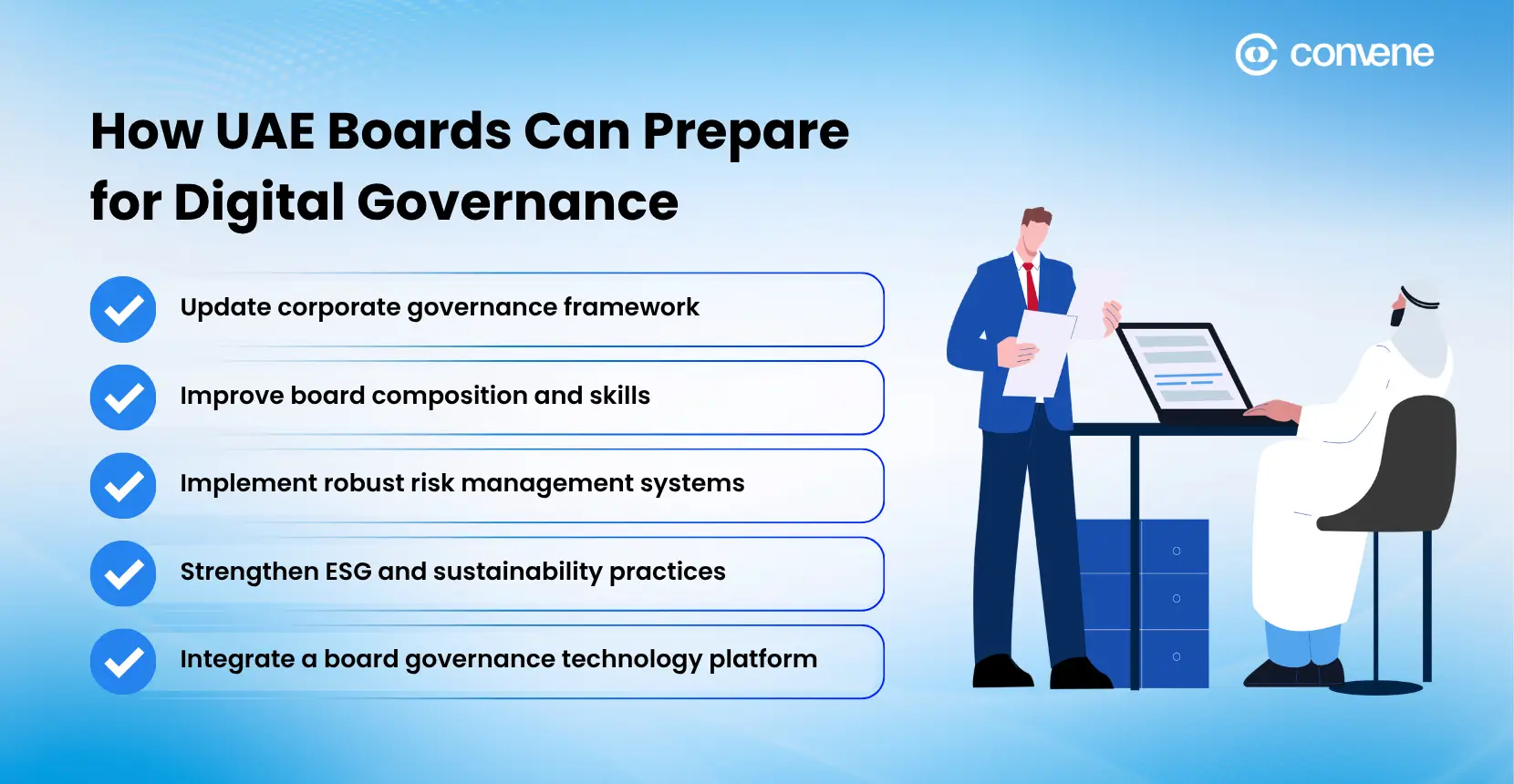
The board of directors must focus on these key areas to strengthen readiness for digital governance: corporate governance framework, board composition and skills, risk management, sustainability practices, and the integration of technology.
1. Update corporate governance framework
Ensure that the corporate governance framework is updated to address digital accountability, AI governance, cybersecurity, and data privacy. Organisations that stick with outdated corporate governance frameworks heighten risks to conflicts over responsibilities, cybersecurity vulnerabilities, and ethical issues from using AI.
To enhance readiness, boards should map their existing UAE corporate governance framework and compare it against recent legislative and regulatory amendments to identify compliance gaps. This promotes alignment, allowing boards and other leaders to adjust their roles and responsibilities based on the evolving digital economy and regulatory requirements.
2. Improve board composition and skills
Seek board members who possess digital competencies for effective oversight of digital transformation. UAE organisations do not necessarily expect boards to be IT experts. However, directors must understand the operational, governance, and financial implications of technologies.
This approach aligns with Resolution No. 40 of 2023, which requires organisations to form boards with diverse composition and skills. Boards should employ the right mix of skills, experience, and attributes required for effective board performance, including digital capabilities.
3. Implement robust risk management systems
Establish robust risk management systems by integrating AI-powered monitoring dashboards. These tools provide early-warning signs that enhance foresight and risk-response rates, which enable boards to detect emerging risks before they escalate.
Beyond tools, embed risk management into operations by including it in the board agenda and corporate governance framework. Implement comprehensive risk management policies that address threats across AI use, cybersecurity, third-party vendors, regulatory compliance, and data privacy as part of a long-term digital governance strategy.
4. Strengthen ESG and sustainability practices
Consider AI risks and data privacy concerns as part of ESG concerns rather than treating them as a separate aspect. The increasing reliance on data analytics and AI across UAE organisations raises concerns about energy consumption, data privacy, algorithm biases, AI hallucinations, and the ethical use of AI — all of which should be closely monitored and regulated.
5. Integrate a board governance technology platform
Include board governance in your digital transformation plan to effectively strengthen security and collaboration among directors. AI-powered board portal software consolidates all crucial board member functions in one encrypted environment, helping eliminate fragmented communication and scattered documentation.
The tool supports practical activities of the board, such as amending internal policies or passing resolutions. It’s typically built with features like e-signatures, voting, and meeting conferences that allow boards to make decisions in real-time.
How Board Portals Improve UAE Corporate Governance
Board portals are platform-based solutions that centralise board governance processes into one secure channel. Much like how the UAE government is transforming its public services, adopting a board portal aligns with the objectives of Vision 2031 by accelerating digitalisation and modernising corporate governance.
Here’s a breakdown of how board portals can help UAE business leaders improve corporate governance.
1. Support continuous governance
Board portals streamline the flow of information and improve directors’ access to it. In board governance, the speed and accuracy with which a director receives information are critical to maintaining continuous oversight.
As corporate governance continues to evolve in the UAE, having real-time visibility of decisions and risk reports is essential for boards to make timely decisions. With board portals, they don’t have to worry about important information falling through the cracks because it’s securely collected and monitored within an encrypted environment.
2. Strengthen regulatory readiness
The security framework of board portals is designed to comply with data privacy standards. Organisations can rely on them to strengthen management over documents through features such as audit trails, document versioning, and secure data hosting.
These capabilities provide boards with clear, traceable governance records, making internal audits and compliance with internal policies easier. This improves accountability and transparency across the board, significantly reducing digital risks of fraud and breaches.
3. Improve board effectiveness
Board portals are all-in-one platforms for board meetings. Features like video conferencing, automated meeting minutes, and a document repository make discussions more efficient and productive.
For decision-making, built-in voting and e-signature enable boards to finalise resolutions, approve action plans, and document decisions securely in one app.
4. Scalable for future governance demands
Modern board portals are adaptable to the evolving landscape of corporate governance and regulatory compliance. As AI integration rises globally, several software like Convene Board Portal have explored intelligent capabilities to further streamline board workflows and deliver seamless platform use.
This is reflected in the experience of ESOM Holding, which elevated its board security and efficiency with Convene Board Portal. The company leveraged the platform’s robust security framework to ensure only authorised users can access sensitive documents across the board.
In addition to security and workflow, modern board portals also offer flexible data hosting services. Providers typically offer on-premise or cloud hosting to meet the data storage requirements of scaling businesses.
Frequently Asked Questions About UAE Corporate Governance
Are companies in the UAE legally required to adopt digital governance practices?
The UAE does not have a single law that explicitly mandates digital governance. Instead, there are several laws, frameworks, and policies that collectively form the country’s digital governance. Examples include the Personal Data Protection Law (PDPL), the Cybercrime Law, the Child Digital Safety Law, and the Electronic Transmission Law.
Do free zone companies in the UAE also digitalise their corporate governance?
Yes. Similar to mainland companies, many freezone companies are also modernising their corporate governance practices, although the extent usually varies by area.
For example, the Dubai International Financial Centre (DIFC) and Abu Dhabi Global Market (ADGM) have online incorporation portals for submitting documents, licence applications, and renewals. The Dubai Multi Commodities Centre (DMCC) also offers a digital member portal where organisations can manage licensing, visa processes, and other administrative processes.
Strengthen Digital Governance Readiness with Convene Board Portal
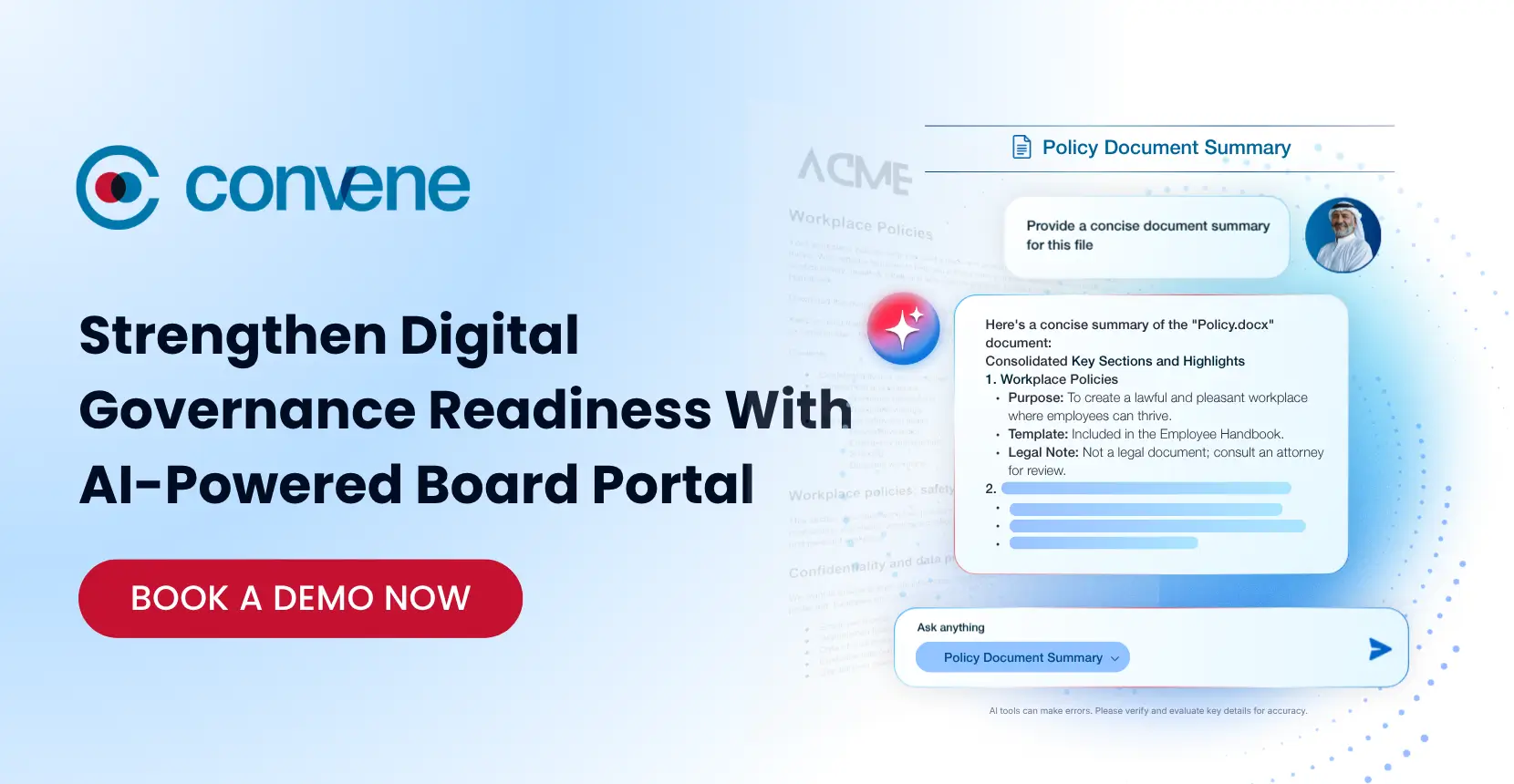
The UAE’s evolving e-governance requires agility, security, and data-driven decision-making. To remain competitive, organisations are moving away from legacy systems towards advanced digital technology.
Convene Board Portal is an award-winning board management software that provides a secure platform for UAE boards that are transitioning to digital governance.
The platform unifies critical leadership functions within a single encrypted ecosystem. Built with enterprise-grade security features, such as multi-factor authentication, remote data wipe, and flexible data hosting, Convene Board Portal offers a comprehensive approach to data protection that is designed to meet the rigorous demands of corporate governance UAE.
Beyond security, the platform also integrates intelligent features powered by Convene AI to assist directors in navigating complex discussions and tasks.
Book a demo today to see firsthand how Convene Board Portal transforms board efficiency and improves compliance workflows.



Jean is a Content Marketing Specialist at Convene, with over four years of experience driving brand authority and influence growth through effective B2B content strategies. Eager to deliver impactful results, Jean is a data-driven marketer who combines creativity with analytics. In her downtime, Jean relaxes by watching documentaries and mystery thrillers.
- Connect:
-

-