


The corporate governance in South Africa has undergone rapid evolution over the past decade. Rising global and local trends in sustainability, technology, data governance, and digital risks are reshaping stakeholders’ expectations, demanding greater transparency and responsible business conduct.
Since 1994, the King Code of Corporate Governance has introduced governance frameworks that guide the board of directors on how to uphold ethical and effective leadership. Over the years, it has refined governance and disclosure practices to adapt to the evolving business realities of South Africa.
With the release of the King V report, the code marked a major shift in corporate governance. Organisations are provided with a more inclusive governance model that compels boards to incorporate societal and technological considerations in business oversight. Discover in this article what is King V, its implications, and how it differs from King IV.
What is King V and why does it matter for boards?
King V report is the fifth iteration of the King Code of Corporate Governance for South Africa. It was issued in October 2025, nine years after King IV. Published by the Institute of Directors South Africa (IoDSA) with the help of the King Committee, it aims to reflect the significant changes occurring in the country, defined by the worsening climate crisis, evolving risks, and growing social and economic inequalities.
According to its drafters, King V corporate governance is established to address the following overarching goals:
- “Aligning with recent legislative reforms and global governance and reporting developments.
- Simplifying the Code’s language, structure and presentation to make it more accessible and practical across sectors.
- Standardising disclosure requirements through a dedicated King
- Disclosure Framework, promoting consistency and comparability across organisations.
- Refining principles and practices.”
King V took effect January 1, 2026. Early advisories were sent to organisations so they could assess and prepare for its implications accordingly. Some of the critical actions taken include:
- Identifying the gaps between current practices and new recommendations;
- Adapting their existing governance frameworks and policies to the new code; and
- Educating leaders and management on the upcoming changes.
King V maintains the outcome-based approach of King IV. It discourages “tick-box” compliance and prescribed governance practices. Instead, it permits flexibility for organisations to adopt the framework in accordance with their size and specific circumstances.
Related Reading: Achieving King IV Code Compliance with Board Management Software in South Africa
What does this mean for the South African board of directors?
King V corporate governance has heightened the need for boards to evaluate the interrelationships between the financial and sustainability impact of businesses, rather than viewing them individually. It advocates for double materiality in ESG disclosures and encourages a more principled and integrated approach to governance.
Who needs to comply with King V in South Africa?
The primary audience of King V is the organisation’s governing body, along with its management and shareholders. It applies to all organisations, including private companies, non-profits, state-owned entities, municipalities, healthcare groups, and higher education institutions. The King Committee aims to broaden the practice of good board governance across all entities through King V.
What are the four governance outcomes of King V?
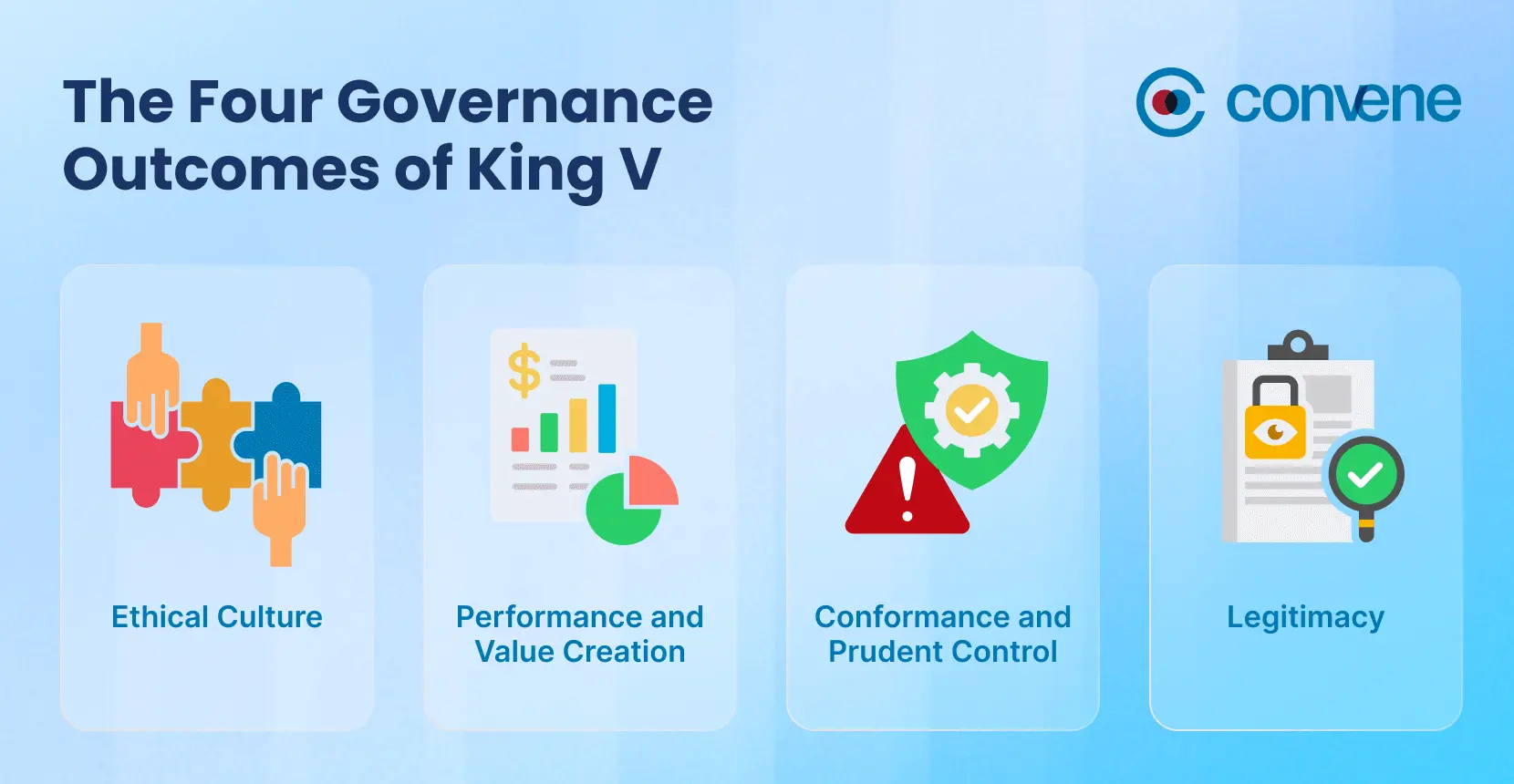
King V emphasises that results are more important than rules. For King V, sound corporate governance in South Africa entails a holistic system that considers economic, social, and environmental aspects.
Specifically, it aims for organisations to achieve these four governance outcomes:
- Ethical Culture: This refers to the cultivation of shared values, beliefs, and practices that guide ethical behaviour and decision-making.
- Performance and Value Creation: Strategic direction should consider both immediate and long-term objectives to create sustainable value.
- Conformance and Prudent Control: Complying with state and internal standards while maintaining strong internal controls, risk management, and transparent reporting.
- Legitimacy: Build trust and confidence of stakeholders by operating responsibly and transparently.
King IV vs King V: Reframing Board Focus and Governance Practices
To help you grasp how the King Code has evolved, the table below highlights the key shifts from King IV to King V.
| King IV | King V | |
|---|---|---|
| Purpose | Focused on enhancing the approach to capitalism, increasing compliance requirements, and new technologies | To address modern challenges, such as sustainability, widespread use of AI, and fair governance pay |
| Format | Presented in a single report, which contained the Code, glossary, practices, and principles | Deconstructed into four standalone documents for easier usability: the foundational concepts, Code, glossary, and disclosure framework |
| Structure | 17 core principles and 215 governance practices | 13 core principles and 150 governance practices |
| Approach | Compliance-driven and detailed | Outcomes-based, practical, and flexible |
| Alignment with Laws and International Standards | OECD Principles of Corporate Governance and ISO 37000 | Companies Act 2004 and the European Union’s Corporate Sustainability Reporting Directive |
| Disclosure | Narrative-style | Standardised Disclosure Template |
Core Principles of King V for South African Boards
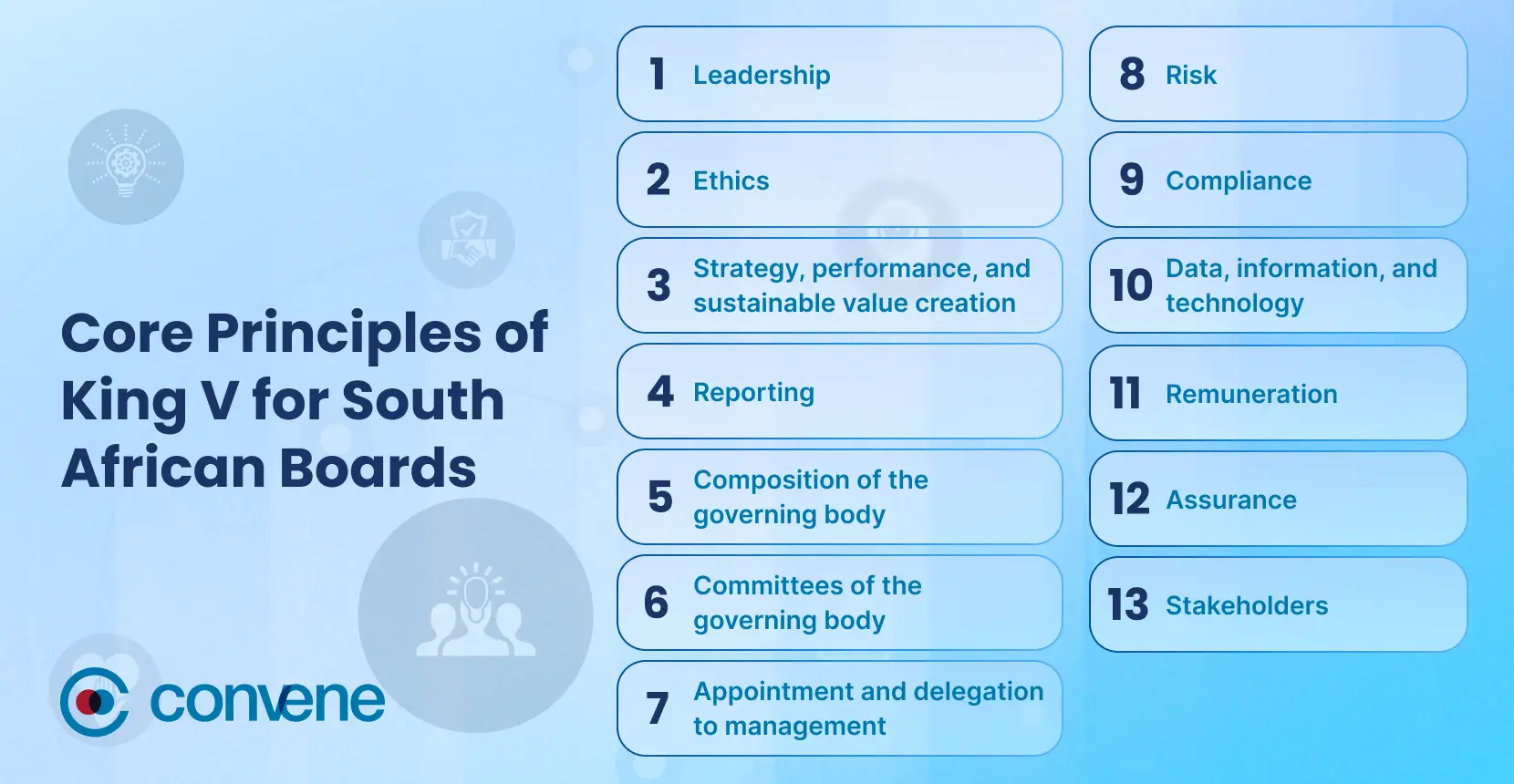
King V corporate governance has a leaner set of principles, down from 17 in King IV. It consolidated several principles and removed some, including those on Institutional Investors and Sector Supplements.
Learn about King V’s 13 principles and how they’re meant to guide governing bodies in strengthening oversight and improving organisational performance.
Principles 1-2: Ethical Leadership and Corporate Citizenship
These principles set the moral foundation of King V by directing focus on:
- Leadership: Exemplify positive characteristics such as integrity, competence, responsibility, accountability, fairness, and transparency, individually and collectively.
- Ethics: Lead strategic direction and be accountable for the business’s ethical culture.
Principles 3-4: Strategy and Performance
King V strongly advocates for organisations to embrace sustainability. Here are two principles that highlight the importance of integrating sustainability into strategic planning and reporting.
- Strategy, performance, and sustainable value creation: Ensure that strategies employ integrated thinking to understand the interdependencies between financial, environmental, social, and economic factors.
- Reporting: Produce audit-ready reports that follow the concept of double-materiality — a reporting framework that captures both the financial and non-financial impacts of an organisation’s activity.
Principles 5-7: Governance Structure
These principles guide how to establish a robust and effective governance framework by emphasising the importance of:
- Composition of the governing body: Build a board that is balanced and respects a mix of competencies and diversity.
- Committees of the governing body: Exercise judgment in delegating decision-making authority, whether to a standing or ad hoc committee, or to an individual. This clearly defines roles and helps prevent conflicts.
- Appointment and delegation to management: Participate in the selection process of the CEO. The governing body should proactively engage with candidates throughout screening, from interview to appointment.
Principles 8-10: Risk, Compliance, and Digital Governance
These highlight the need for proactive oversight and ethical management across risk, compliance, and information systems.
- Risk: Implement an effective organisation-wide risk management system. This includes creating internal policies, frameworks, or standards to define the strategic direction.
- Compliance: Promote responsible corporate citizenship by overseeing compliance with applicable laws, adopted policies, non-binding rules, codes, and standards.
- Data, information, and technology: Create effective, ethical, and compliant management over the use of data and information.
Principles 11-13: Stakeholder Engagement
To achieve fair and accountable governance practices, King V lays out the following guidelines:
- Remuneration: Provide fair and transparent remuneration to employees.
- Assurance: Uphold strong internal controls over functions and services to safeguard the integrity of external reports.
- Stakeholders: Adopt a stakeholder-inclusive approach in executing fiduciary duties.

How King V Shapes Board Responsibilities and How Board Portals Can Help
How can boards meet the standards set in King V? They need more than a sound plan. They should be equipped with the right tools, such as board portals, that help them translate principles into governance outcomes.
1. Purpose-Driven Governance
Under King V, ethical and effective leadership are prerequisites for sound corporate governance. It urges boards to move beyond “tick-box” compliance by embedding shared values into their strategy and decision-making. This approach helps boards cultivate a stronger sense of purpose among stakeholders and improve their relationships with investors and regulators.
How can board portals help?
Board portals provide centralised access to critical organisational documents, including board papers, policies, charters, and business plans. Cultivation of shared values and practices becomes easier when boards have equal and improved access to information. Moreover, board portals come with built-in collaboration tools, such as annotations and voting, to help decision-makers drive clear actions.
2. Transparency using the “Apply and Explain” model
Building on King IV, the King V report on corporate governance reinforces the “apply and explain” approach. Governing bodies are now required to use the Mandatory Disclosure Template to explain how the principles have been applied in practice. To produce accurate reports, boards have to embed documentation in daily governance rather than being a periodic practice.
How can board portals help?
Board members don’t need to worry about missing out on crucial updates to policies and resolutions. Board portals automatically track every change made, even more, recording information on what, when, and who edited them. Features such as audit trail and document versioning provide instant, verifiable proof of how every decision was developed and approved. This avoids confusion and ensures boards produce accurate and compliant disclosures.
3. Integrated Thinking
The new corporate governance code for South Africa advocates that boards assess the relations among factors in the environment, society, and economy. By aligning strategy, risk management, and sustainability, organisations gain a clear advantage in enhancing resilience amid the rapidly changing business landscape.
How can board portals help?
Board portals are designed to manage large volumes of data across key functions, including finance, strategy, human resources, marketing, IT, and risk management. By breaking down information silos, boards can view the bigger picture and assess how business areas interrelate. This enables them to effectively link strategy to risk management and respond faster to emerging risks or opportunities.
4. Strong Digital Risk Oversight
The growing AI and digitalisation risks have intensified the need for robust risk governance. King V responds to this by outlining guidelines for a full risk management plan, including strategic direction, implementation, and monitoring. Boards can refer to them to improve readiness to market volatility and shocks.
How can board portals help?
Modern board portals are developed with enterprise-grade security for safe digital governance. With multi-factor authentication, document encryption both in transit and at rest, secure cloud or on-premise hosting, and a real-time audit trail, boards can protect sensitive data from evolving cyberthreats around the clock.
5. Inclusive Stakeholder Engagement
King V articulates that stakeholders shouldn’t be viewed only as instruments for value maximisation. It encourages the boards to form balanced relationships with all stakeholders by considering their interests before taking action. This puts pressure on boards to adopt more inclusive decision-making and justify how their actions affect different stakeholder groups.
How can board portals help?
The role-based access control feature of board portals enables boards to conduct secure stakeholder engagement. Target users can view or receive specific documents without getting exposed to the full board environment. This ensures sensitive information is only shared with authorised readers, upholding data privacy and confidentiality.
Frequently Asked Questions About the King V Report
Should I use King IV or King V?
Organisations should now refer to King V, as it supersedes King IV. The latest code became effective on January 1, 2026, and organisations were informed to prepare in advance to ensure a smooth transition. King IV may still be used as a reference, but updated compliance and governance best practices should be based on King V.
Is King V a law?
King V isn’t a law. It’s a voluntary code of corporate governance for South African organisations. Although it’s not legally binding, major business entities, such as the JSE-listed companies, are highly encouraged to follow its principles.
Achieve Holistic Board Governance using Convene Board Portal
With all that’s explained, it’s clear how the King V report on corporate governance raises the bar for corporate governance. It urges South African boards to be more critical in decision-making and view matters in a holistic manner.
What the board of directors needs is a secure and intelligent governance platform where they can merge strategic oversight, compliance, risk management, and stakeholder engagement.
Convene Board Portal equips South African boards with the digital infrastructure to help boards translate King V principles into actual governance. It centralises documents that board members can locate, view, and edit anytime — achieving uninterrupted collaboration and decision-making.
At the same time, the platform automatically records every action, offering a verifiable history of board activities, which improves transparency and accountability.
Beyond oversight, Convene Board Portal ensures every data and information circulating in the space is safeguarded with enterprise-grade security that includes reliable on-premise or cloud hosting, role-based controls, data encryption, and multi-factor authentication.
Contact our team to book a Convene Board Portal demo and discover how it improves decision-making and compliance in boardrooms.



Jean is a Content Marketing Specialist at Convene, with over four years of experience driving brand authority and influence growth through effective B2B content strategies. Eager to deliver impactful results, Jean is a data-driven marketer who combines creativity with analytics. In her downtime, Jean relaxes by watching documentaries and mystery thrillers.
- Connect:
-

-