


Key Takeaways:
- Business ethics refer to the moral principles that guide a company’s operations and decision-making.
- Business ethics help organizations navigate complex situations where the “right” choice isn’t always clear.
- Ethics focus on fairness, honesty, and integrity in business conduct, while social responsibility emphasizes positive contributions to society and the environment.
- Upholding ethical standards fosters trust, mitigates legal and reputational risks, and enhances long-term competitiveness.
It’s usually very clear what the right thing to do is when you have to choose between good and bad. But in the real world, not every choice is as simple as black and white. Sometimes you find yourself in the gray area, where it’s not always obvious what the “right” choice is. What should you do in these situations? Where do you go for help?
These moral crossroads can affect businesses, too. Companies face ethical problems every day, like making sure employees are treated fairly or finding a balance between making money and helping society. Fortunately, their business ethics help them make these tough choices.
So, how do you define business ethics?
In this guide, we’ll discuss what are business ethics and the importance of business ethics in daily operations, explain the difference between ethics and social responsibility, and provide you with valuable tips on how to put ethical principles into practice.
What are business ethics?
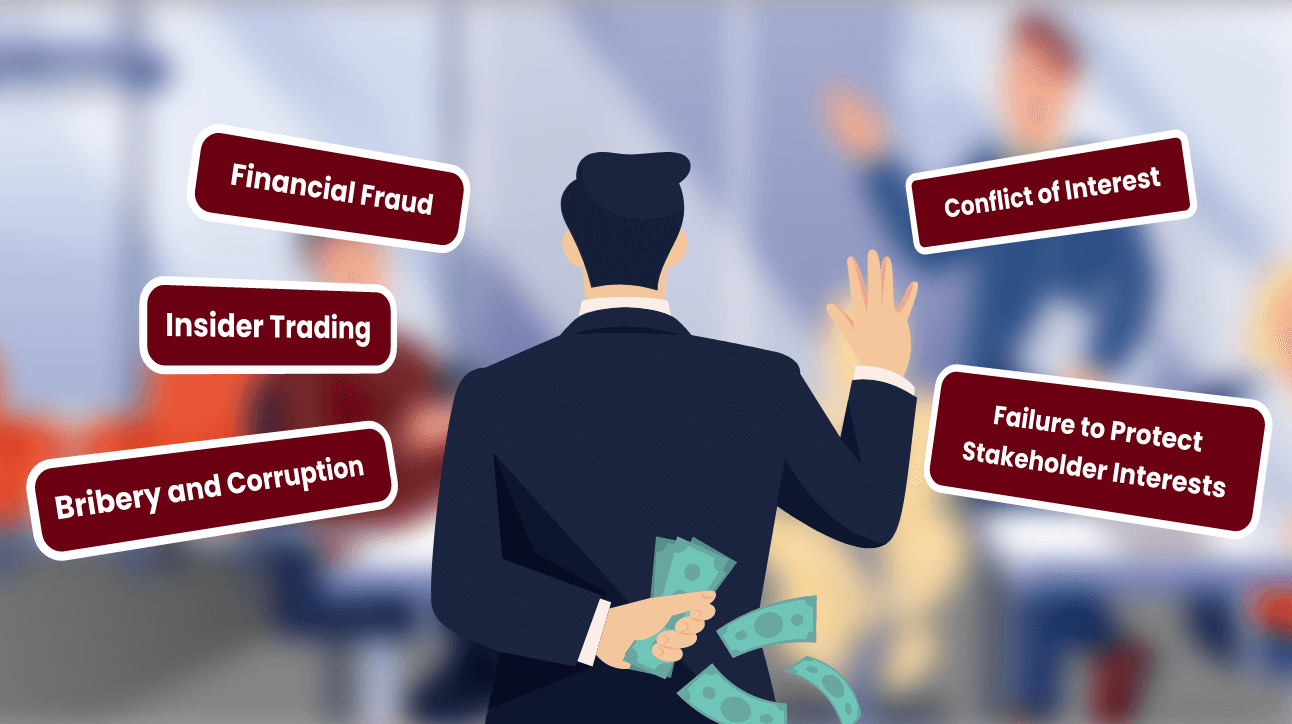
Business ethics are the moral standards that guide a company’s decisions and run its daily operations. It often addresses controversial corporate topics, such as bribery, discrimination, conflicts of interest, social and environmental responsibility, and even questions about the use of new technologies like artificial intelligence (AI).
How do ethics affect a business? Picture a tech company developing an AI tool that can significantly improve customer experience but has the potential to infringe on user privacy. On one side, the company wants to push through with its innovation and gain profit. However, the company also recognizes its duty to protect the confidentiality and trust of its loyal customers. In this gray area, business ethics, often outlined in a code of ethics, provide the framework for making balanced and responsible decisions.
What is business ethics and social responsibility?
To put it simply, business ethics is about doing what is right, while corporate social responsibility is about doing what is good. Although closely related and often overlap with each other in terms of guiding business conduct, they are not the same. The table below highlights the difference between ethics and social responsibility:
| Business Ethics | Social Responsibility | |
|---|---|---|
| Focus | How a company behaves internally, and how decisions are made | How a company impacts the community and the wider world |
| Goal | Ensure fairness, honesty, and integrity in decisions | Contribute positively to society and the environment |
| Example | Avoiding deceptive marketing or biased treatment | Donating to charities, reducing carbon emissions |
Why is business ethics important?
A recent MDPI study found that ethical leadership leads to better sustainability and financial results, such as higher return on assets and increased market value. It then results in a stronger long-term competitive advantage. Aside from that, why should businesses be concerned with ethics?
- Reduce risks and liabilities: Companies that uphold ethical standards are less likely to face lawsuits or regulatory penalties.
- Support responsible and compliant operations: Clear policies on compliance, anti-corruption, data protection, and fair stakeholder treatment help prevent costly errors and organizational misconduct.
- Build trust across teams and stakeholders: A culture grounded in ethics strengthens confidence in leadership and improves collaboration throughout the organization.
- Improve employee satisfaction and retention: People are more engaged and motivated when they work in an environment that values fairness, transparency, and integrity.
12 Principles of Business Ethics
While each organization may have its own ethics guidelines, there are twelve key principles that guide ethical business conduct. These principles apply to everyone, from the board and senior leadership to managers and staff:
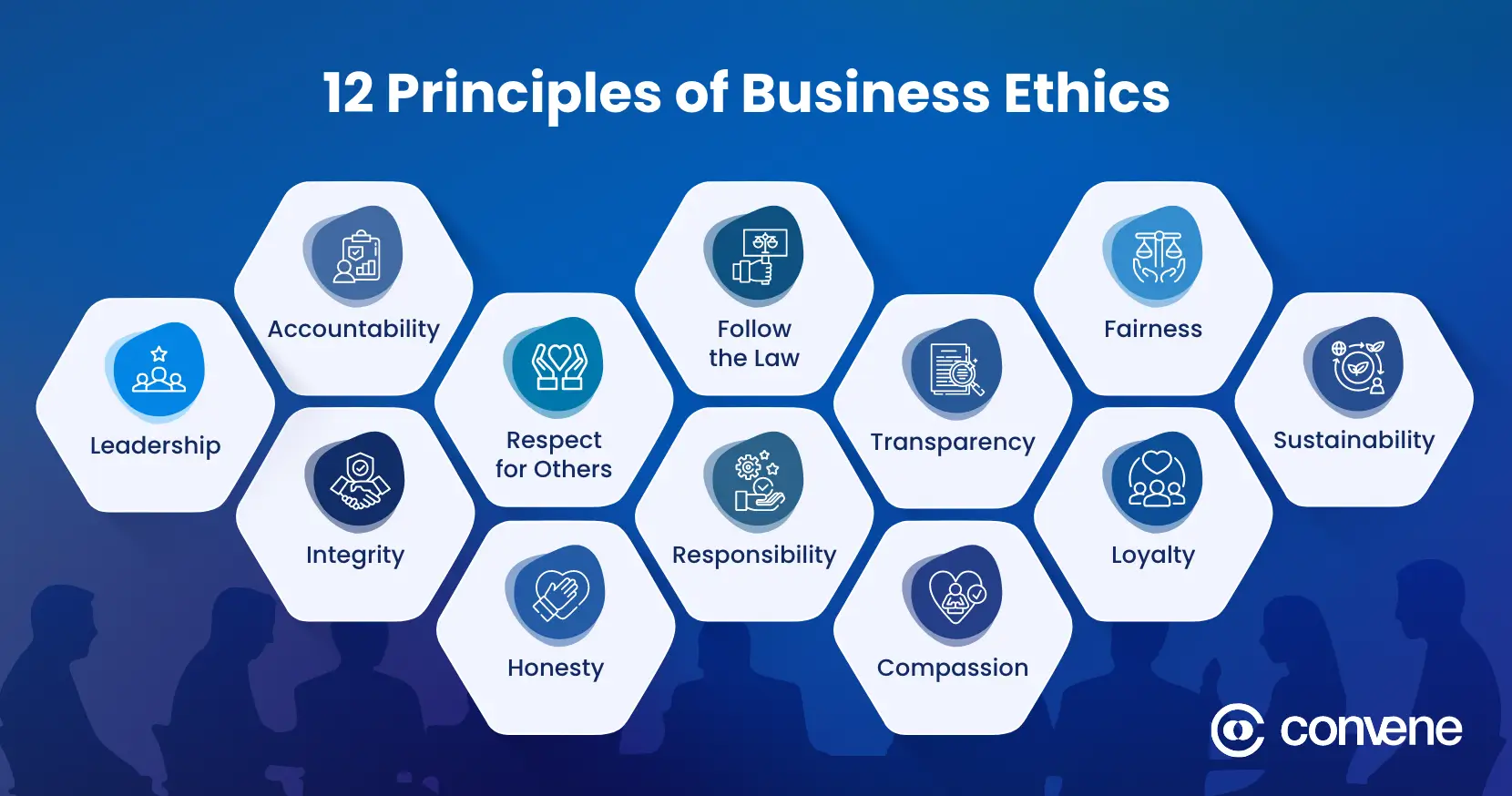
- Leadership: Ethical behavior begins with those at the top. Business leaders set the standard through their actions and decisions, modeling the values and behaviors they expect from their teams.
- Accountability: This means admitting mistakes and learning from them. Building a culture of accountability helps everyone understand the impact of their choices, enabling them to be more careful and considerate.
- Integrity: Acting with integrity means being honest and consistent, even in the face of challenges. Making the right choices, especially in tough situations, helps build trust within your organization and with those you serve.
- Respect for Others: Treating others with respect is essential for a healthy workplace. This includes valuing diversity, listening to different perspectives, and treating all colleagues, customers, and partners with dignity and fairness.
- Honesty: Avoiding exaggeration, refraining from withholding critical information, or giving misleading statements are all indicators of a healthy workplace. When there is a culture of honest communication, it fosters open dialogue, constructive feedback, and more effective problem-solving.
- Follow the Law: Compliance with applicable laws and regulations is a fundamental component of any ethical business. Failing to adhere could result in penalties or damage to reputation.
- Responsibility: Taking responsibility means accepting ownership of your work and decisions. Encourage your team to be reliable, complete tasks carefully, and recognize how their efforts contribute to the organization’s success. When responsibility is an integral part of your culture, teams perform better and mistakes are less likely to occur.
- Transparency: This principle refers to sharing important information clearly and openly with stakeholders, while still protecting sensitive data. Companies should communicate financial results, policies, and decisions in ways that build trust.
- Compassion: Ethical organizations prioritize the well-being of their employees, customers, and the broader community. As a leader, consider how your decisions impact others and seek ways to balance business goals with people’s needs.
- Fairness: Your decisions should be free from favoritism or bias, and resources should be distributed in a way that respects everyone’s rights and contributions. Fair practices help build trust and morale within the workplace.
- Loyalty: Loyalty is about being committed to your organization and your colleagues. Show loyalty by supporting your mission, respecting your team, and focusing on long-term success rather than short-term personal gain.
- Sustainability: Your organization is responsible for considering the environmental impact of its actions. Therefore, it is vital to focus on reducing waste, conserving resources, and finding sustainable solutions. It will also help to encourage your team to look for ways to protect the environment and support long-term sustainability.
How to Develop an Effective Code of Ethics
A well-written code of ethics shows what your company stands for and how you expect your team to act, even when no one is watching. Here are some steps to create a code that is both effective and authentic:
1. Identify core values
Start by identifying the values that define your organization’s identity. These values are the foundation for your code of ethics. For most companies, this includes honesty, fairness, accountability, inclusion, and respect. Make sure these values match your mission and guide your daily operations.
2. Consult with employees and stakeholders
A code of ethics is most effective when it addresses the real-life situations employees encounter every day. Involve teams from HR, compliance, sales, and operations to make sure the code is practical and relevant. This collaboration builds ownership and accountability. For example, you can use focus groups or surveys to learn about the ethical challenges employees encounter, then use their feedback to make the code more useful for everyone.
3. Make it practical and easy to understand
Use clear, simple language in your code of ethics so employees can easily understand and remember it. Include examples of what is acceptable and what is not. For example, a section on conflicts of interest could describe situations like accepting gifts from vendors or investing in competitors. Companies like Google and Microsoft make their code user-friendly and easy to access, using real-life scenarios to help everyone understand the rules.
Once you are done with the draft, run it by the board of directors and senior management for approval.
4. Update regularly
Ethics change as new laws, technologies, and social expectations develop. A code written five years ago may not cover current issues like data privacy, remote work, or AI ethics. That’s why it’s vital to review and refresh the document regularly, ideally every year or after major regulatory changes.
How to Implement Ethics into Business Operations + Examples
Integrating business ethics into a company’s culture requires consistency, clear communication, and accountability at every level of the organization. Introducing small, repeatable habits can help reinforce these principles. One such habit could be starting meetings with a quick ethics check-in, which not only keeps ethics at the forefront but also encourages open dialogue about values. Here are some other ways to make sure ethical principles guide your everyday operations:
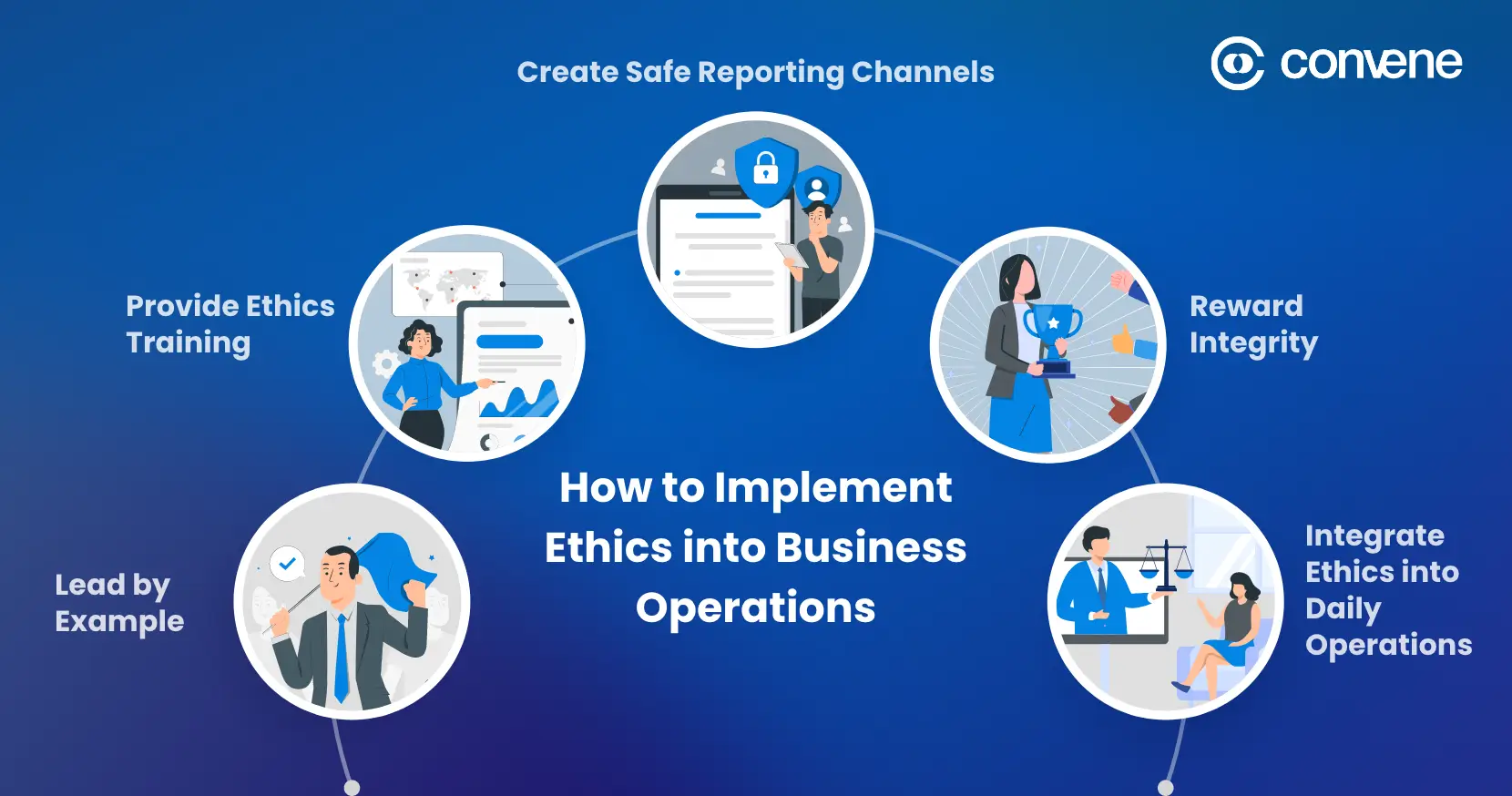
Lead by Example
Leaders and executives should always show integrity, honesty, and fairness in their decisions and actions. When employees see management following ethical standards, it reinforces the importance of these values and encourages everyone to do the same. Leadership sets the tone for the whole organization, making ethical choices the norm.
Example:
At Patagonia, leadership has long modeled environmental and social responsibility, even encouraging customers to buy less and repair old products instead of purchasing new ones. Their long-running Worn Wear program, launched in 2012, allows customers to trade in or buy used Patagonia clothing and gear, which cuts down consumption. This helps reduce waste, extend product life, and minimize the company’s overall environmental footprint. This top-down example has shaped a strong culture of sustainability and authenticity that guides every business decision.
Provide Ethics Training
Employees need support to handle ethical dilemmas. Regular training sessions, workshops, or online modules help employees understand your company’s moral standards, policies, and how to report concerns. Training also demonstrates your commitment to ethics and provides employees with practical tools to make informed decisions every day.
Example:
Lockheed Martin operates a robust ethics program called Ethics Awareness Training, which annually trains employees to handle real-world scenarios involving conflicts of interest, compliance, and corporate responsibility. This consistent training ensures that ethics are part of everyday decision-making across the organization.
Create Safe Reporting Channels
For a code of ethics to work, employees need to feel safe reporting unethical behavior. Set up confidential hotlines, anonymous forms, or digital platforms so concerns can be raised quickly and securely. In extreme cases, it also helps to implement a clear policy for whistleblowers that protects them from retaliation. Safe reporting channels help you spot problems early before they escalate into a major company concern.
Example:
Unilever operates an independent Speak Up hotline where employees, suppliers, and even customers can confidentially report concerns about misconduct. This open channel has strengthened transparency and accountability, fostering a workplace culture in which employees feel empowered to voice their ethical concerns.
Reward Integrity
Recognize and reward employees who act ethically to show that values are just as important as performance. Celebrating integrity, fairness, and accountability encourages everyone to make the right choices, even when it is difficult. Use incentives, recognition programs, or public praise to highlight ethical behavior as a key part of success.
Example:
Salesforce integrates ethics and equality into its performance reviews, recognizing employees who exemplify its core values of trust and inclusion. The company’s Ohana culture publicly celebrates those who make decisions that prioritize integrity and people over financial outcomes.
Integrate Ethics into Daily Operations
The importance of business ethics is found in everyday business processes. As such, make sure that HR policies, procurement, and financial procedures all follow your ethical standards. When ethics are integrated into daily operations, employees receive clear guidance and expectations, which helps prevent problems and fosters a strong culture.
Example:
Starbucks integrates ethics into its supply chain operations through its Coffee and Farmer Equity (C.A.F.E.) Practices, ensuring coffee is sourced responsibly and farmers are paid fairly. This alignment of daily operations with core ethical values has strengthened both brand reputation and supplier trust.
Strengthen Ethical Governance with Convene Board Portal
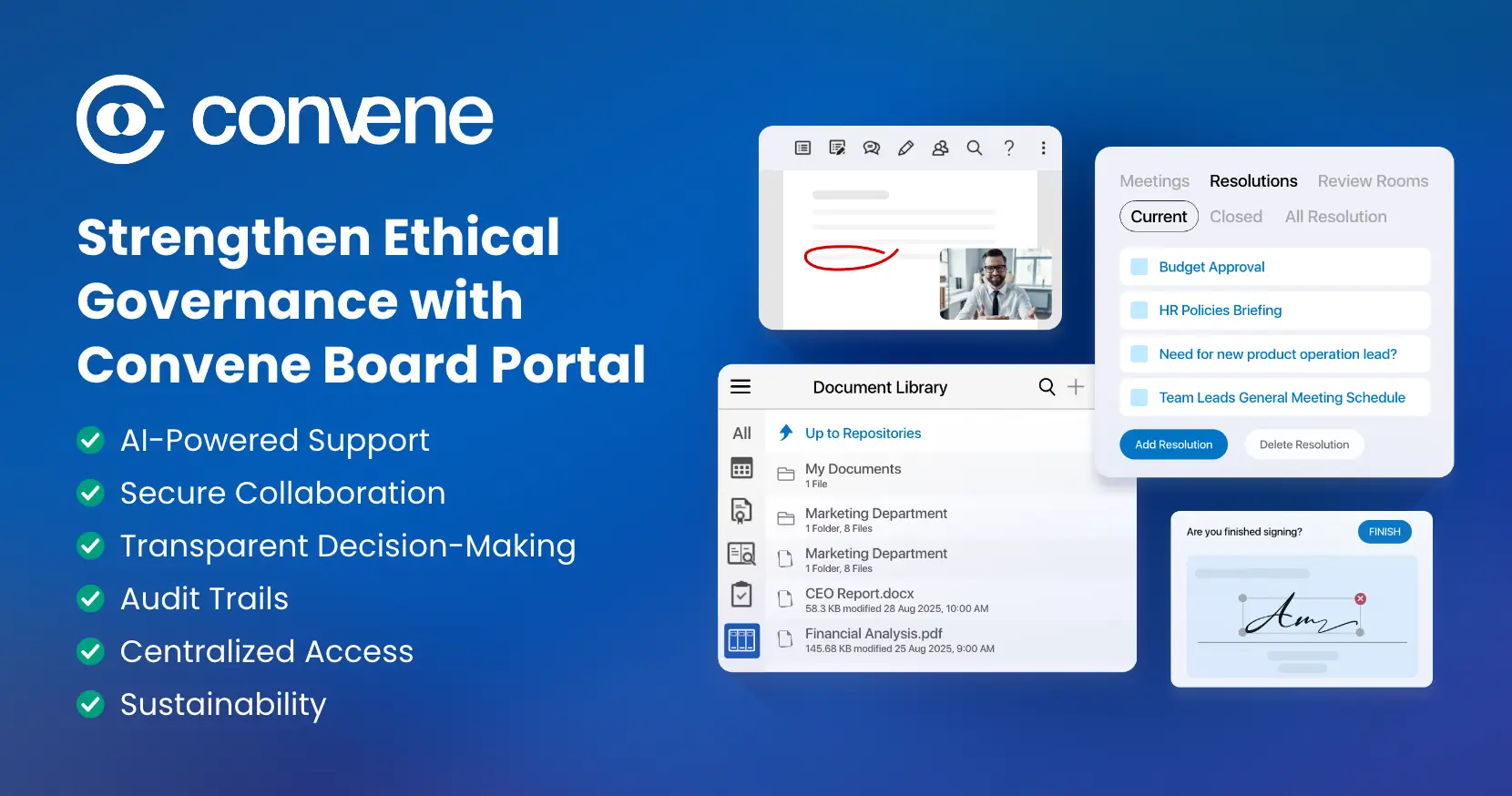
Building an ethical organization takes the right mindset and the right tools. More than the will to make better choices, boards need a secure, transparent, and efficient way to manage governance activities. This is where Convene board portal comes in handy.
A globally recognized board management software, Convene, is designed to help leaders put ethical governance into practice through:
- Secure Collaboration: Documents and decisions stay confidential with end-to-end encryption. To add, Convene has partnered with Amazon Web Services (AWS) to ensure that customer data is protected at every level.
- Transparent Decision-Making: Built-in voting and resolution tracking make every board action accountable.
- Audit Trails: Automatically record meeting activities for compliance and ethical oversight.
- Centralized Access: Store and share your company’s code of ethics, governance documents, and reports in one secure Document Library, wherein users can configure access based on roles.
- Sustainability: Go paperless and never miss any sustainability reporting requirements and deadlines through Presgo (formerly Convene ESG).
As part of Convene’s advanced governance suite, Convene AI enhances board effectiveness with features like automated meeting minutes, smart summaries, and an AI Companion that helps board members quickly find information and stay aligned on decisions.
Your organization is just one step away from responsible governance. Book a personalized demo with us today to start your journey.



Jess is a Content Marketing Writer at Convene who commits herself to creating relevant, easy-to-digest, and SEO-friendly content. Before writing articles on governance and board management, she worked as a creative copywriter for a paint company, where she developed a keen eye for detail and a passion for making complex information accessible and enjoyable for readers. In her free time, she’s absorbed in the most random things. Her recent obsession is watching gardening videos for hours and dreaming of someday having her own kitchen garden.
- Connect:
-