


Key Takeaways:
- AI in corporate governance helps organizations strengthen decision-making, risk management, compliance monitoring, and board reporting through data-driven insights and automation.
- Organizations typically progress through five stages of AI maturity, from early experimentation and informal AI use to enterprise-wide innovation and fully embedded AI governance.
- While AI offers significant benefits to boards and teams, it also introduces governance risks related to transparency, bias, cybersecurity, regulatory compliance, and workforce readiness.
- Strong AI governance requires clear policies, cross-functional oversight, ethical safeguards, continuous monitoring, and ongoing AI literacy at both the board and organizational levels.
AI has changed and is changing how organizations function and compete in an increasingly digital market. As AI’s role grows across the company, the link between AI and corporate governance is becoming increasingly hard for business leaders to ignore. A McKinsey study found that 88% of organizations use AI in at least one business function, underscoring the growing need for stronger AI governance.
In this article, we look at how AI is revolutionizing corporate governance, the primary benefits, the top challenges in implementing AI governance, and what boards can do today to prepare.
What is AI and corporate governance?
AI in corporate governance is the integration and use of AI to support governance, risk, and compliance management across the company. It combines AI, enabling machines to perform tasks that would typically require human intelligence, with organizational processes to streamline and strengthen governance.
This integration helps organizations identify and reduce risks earlier, strengthen regulatory compliance through automation and monitoring, and reduce operational costs.
The crucial term here is support, not replace. New research from ScienceDirect finds that AI is most effective when used to enhance human oversight and accountability rather than to replace decision-making altogether.
In practice, the integration of AI in corporate governance means using AI corporate governance tools for:
- Data analysis in large sums
- Automating recurring processes
- Monitoring regulatory updates
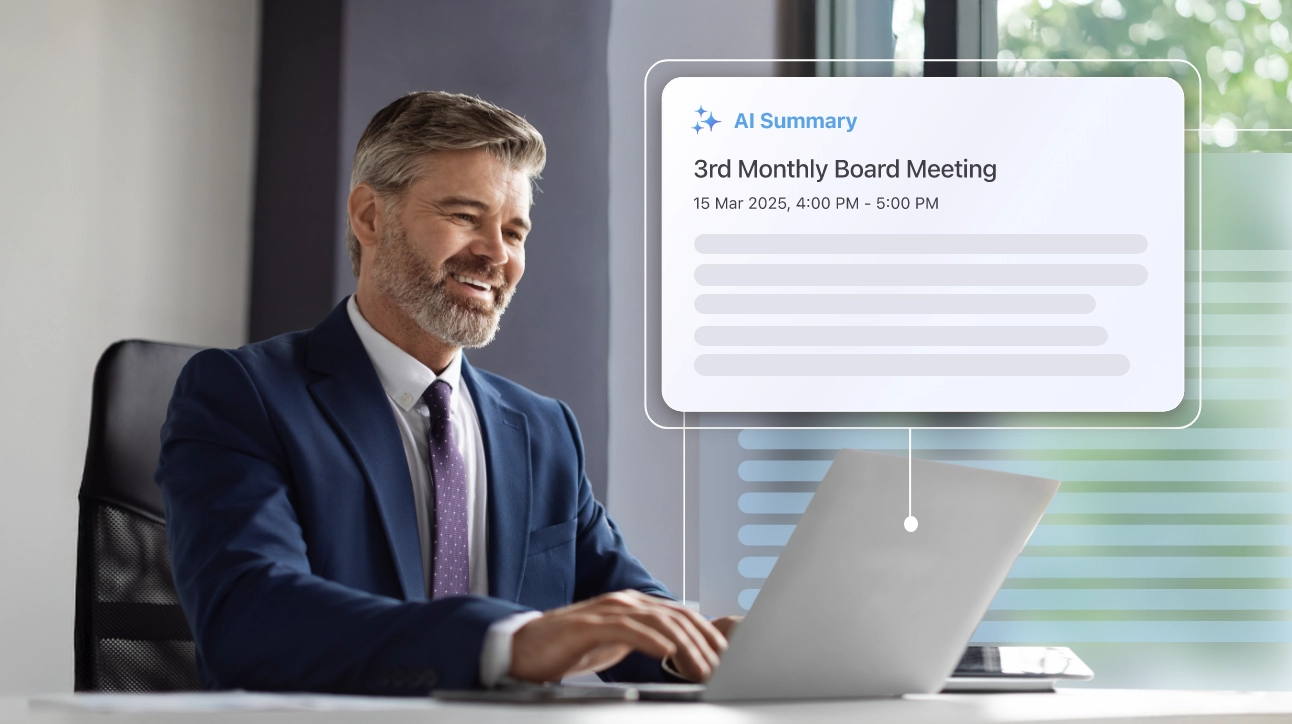
- Generating board reports and meeting summaries
- Identifying new and potential risks
Key Benefits of AI Adoption in Corporate Governance
More than AI digitizing existing governance processes, its growing adoption is changing how oversight and risk management are performed, how compliance is managed, and how decisions are informed in modern organizations. Major benefits include:
1. Data-driven decision-making
Boards and executive teams often receive large volumes of reports and updates. Therefore, the challenge is rarely a lack of information but rather identifying what matters most.
Going through the reports one by one may take up valuable time that could be used for other priorities. AI can process large datasets quickly, identify patterns, summarize key developments, and flag issues requiring attention. For example, AI tools can compare this month’s performance trends with last quarter’s and explain the factors driving the changes in minutes. Therefore, speeding up decision-making.
In fact, a ResearchGate study shows that AI-enabled dashboards can significantly improve organizational performance by reducing decision cycle time by up to 18.2 hours and increasing forecast accuracy and financial outcomes through centralized, real-time reporting systems.
2. Predictive risk management
Traditional governance often relies on historical information, treating past performance as a learning experience for future decisions. But what if boards could anticipate issues before they escalate?
Machine learning tools can detect signals of fraud, cybersecurity incidents, and even supply chain disruptions before those risks fully materialize. This gives management and boards earlier warning signs and more time to respond. In organizations operating in volatile markets such as finance and retail, this AI business-specific governance capability is particularly significant, as predictive risk oversight can be a huge advantage.
3. Automated compliance and monitoring processes
Compliance requirements continue to expand across data privacy, ESG disclosures, and other sector-specific regulations. This often makes it hard for board directors to track changing obligations and potential gaps, especially in organizations where reviews and evaluations are conducted only periodically.
AI helps alleviate this challenge by continuously monitoring transactions, testing controls continuously, scanning policies for gaps, and tracking regulatory developments across jurisdictions. As such, it reduces manual workload while improving consistency.
4. Boosted compliance readiness
As regulators scrutinize AI use and demand stronger disclosures, organizations with mature governance practices may be better positioned to respond confidently. Mature AI governance typically includes clear, up-to-date policies on AI use, regular performance and risk reviews, cross-functional oversight from departments such as legal, IT, compliance, and risk, and established processes for transparency and accountability. Defining these traits helps directors assess where their own organization stands and identify areas for improvement.
To help boards begin this process, here is a concise self-assessment checklist for financial institutions to evaluate AI-readiness:
Adopting AI for Corporate Governance: 5 Stages of AI Maturity
Organizations are adopting AI at different speeds, and their governance structures are evolving alongside it. But as AI becomes more embedded in daily operations, boards are increasingly expected to provide stronger oversight and more structured governance around its use.
Integrating AI into corporate governance cannot happen overnight, as there are many factors (company size, industry, budget, etc.) to consider and align on in order to move forward. As a result, companies often move through five stages of AI maturity as adoption expands across the enterprise.
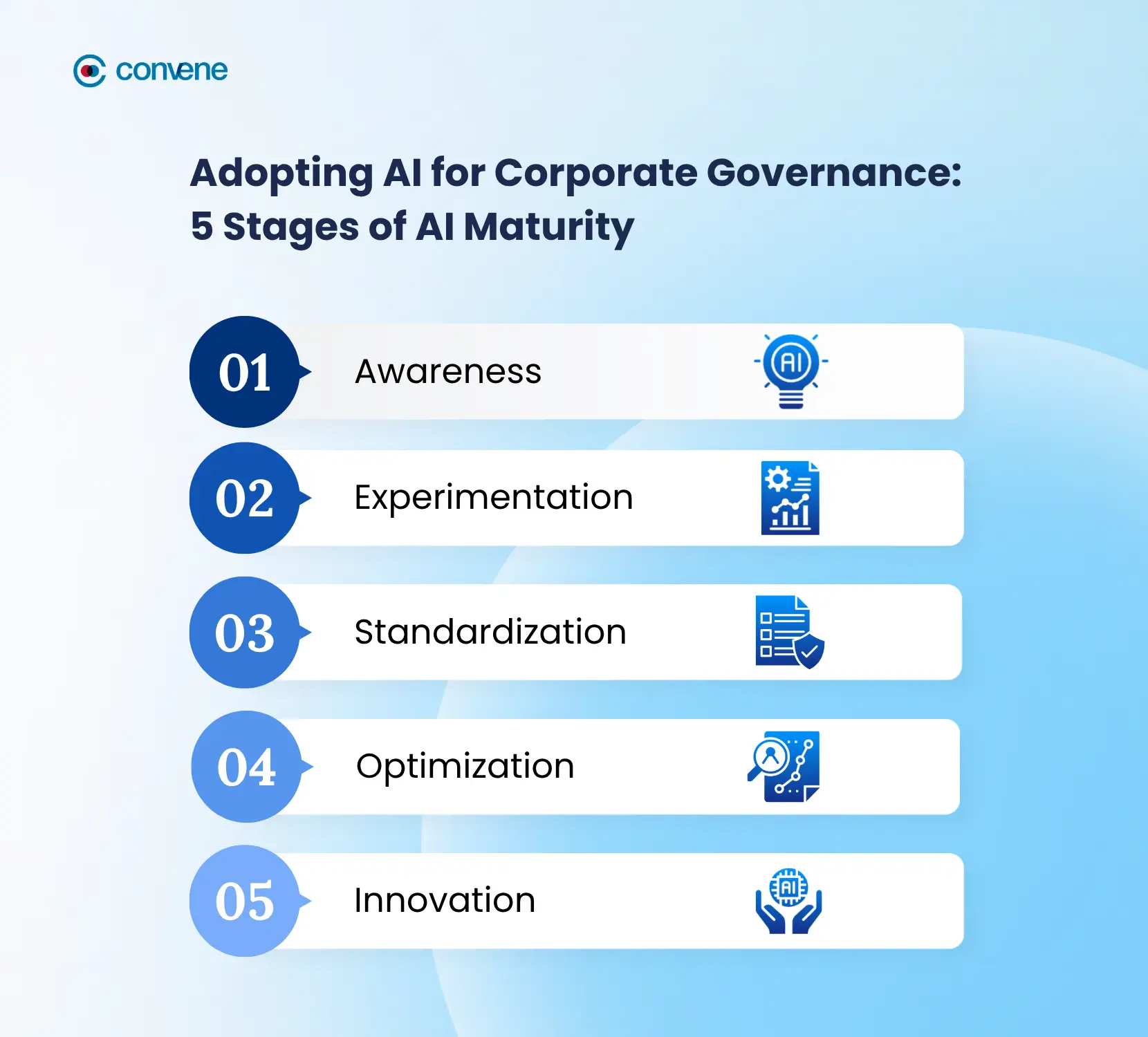
Stage 1: Awareness
During the earliest stage, AI use is often informal and decentralized. Employees or individual departments may experiment independently with large language models (LLMs) like ChatGPT or with AI project management tools like Asana. At this point, however, governance focuses more on data security than on responsible AI usage. There would be no formal AI policies yet, no oversight structures, or board-level discussions regarding AI-related risks and responsibilities.
Stage 2: Experimentation
As organizations begin to formally explore AI opportunities, which could take 3 to 12 months, they often launch pilot projects or adopt basic AI tools within selected teams or functions. This is where teams start exploring productivity tools, such as AI-powered chatbots or meeting assistants, to improve efficiency and streamline workflows.
Governance at this stage is usually reactive. Companies may introduce initial usage policies or guidelines focused on immediate concerns such as data privacy, cybersecurity, or acceptable use. This is also when boards begin to recognize that investing in AI is not only about automation but also about enabling employees to make faster, more informed decisions without having to command-and-control every move.
Stage 3: Standardization
At the operational stage, AI adoption becomes more structured and consistent across the organization. Leaders start to connect AI corporate governance tools to valuable data sources to get more accurate AI-generated results. Employees are encouraged to use approved AI tools within clearly defined governance and compliance guidelines, particularly for board reporting and meeting documentation.
This is where organizations start standardizing and scaling AI adoption across departments through formal policies and oversight structures. In the United States, many organizations at this stage also begin aligning their governance practices with frameworks such as the NIST AI Risk Management Framework, which guides responsible AI adoption.
Stage 4: Optimization
As AI becomes more integrated into core business operations, organizations begin moving beyond isolated productivity tools and toward enterprise-wide optimization. Instead of relying on separate AI solutions for different teams, leaders start consolidating data, workflows, and AI capabilities into more connected systems or unified platforms. For instance, a financial institution may use a unified AI platform that combines transaction data, compliance monitoring, customer activity, and risk analytics to strengthen fraud detection and support faster decision-making.
Stage 5: Innovation
Stage five is where AI governance has become fully embedded into the organization’s broader governance framework. AI systems are monitored continuously, oversight processes are more adaptive, and decision-making becomes increasingly data-driven.
At this point, companies that are not satisfied with generic AI platforms go further by building their own in-house AI system tailored to their needs. One well-known example is JPMorgan Chase’s flagship AI platform, the LLM Suite, which supports employees with tasks such as reporting, document summarization, and data analysis while maintaining tighter control over sensitive company information.
What is the board’s role in artificial intelligence corporate governance?
The board’s role is not to manage algorithms directly, but to ensure the organization uses AI that is aligned, accountable, and sustainable. Artificial intelligence corporate governance is not a one-man task. Instead, the OECD AI Principles emphasize that AI must be managed as an enterprise-wide responsibility embedded in leadership and oversight structures.
To manage AI and corporate governance, the board must:
Align AI with strategic objectives
Boards should assess whether AI initiatives clearly support business priorities or align with the company’s strategy and long-term objectives by evaluating whether AI projects address specific business challenges or improve overall efficiency. This can be done by setting clear performance metrics such as cost savings, productivity improvements, risk reduction, or return on investment (ROI).
Define governance and accountability
Every major risk area requires ownership, and AI is no exception. Therefore, boards understand and delegate responsibilities through a clear governance structure and lines of accountability. They should be able to assess:
- Which executive is accountable for the AI strategy
- Who oversees risk and controls
- What policies must be established
- Whether a committee has formal responsibility
- How issues are escalated to leadership or the board
Oversee responsible and ethical AI use
Boards increasingly need assurance that AI systems operate fairly, transparently, and with appropriate human judgment. To ensure it does, they must oversee governance safeguards that include some of the key areas like bias testing, explainability standards, and most especially, responsible data use.
Top Challenges in Implementing AI Governance (and How to Address)
Below are the AI governance challenges that every board must know, along with the best practices and approaches to help alleviate them:
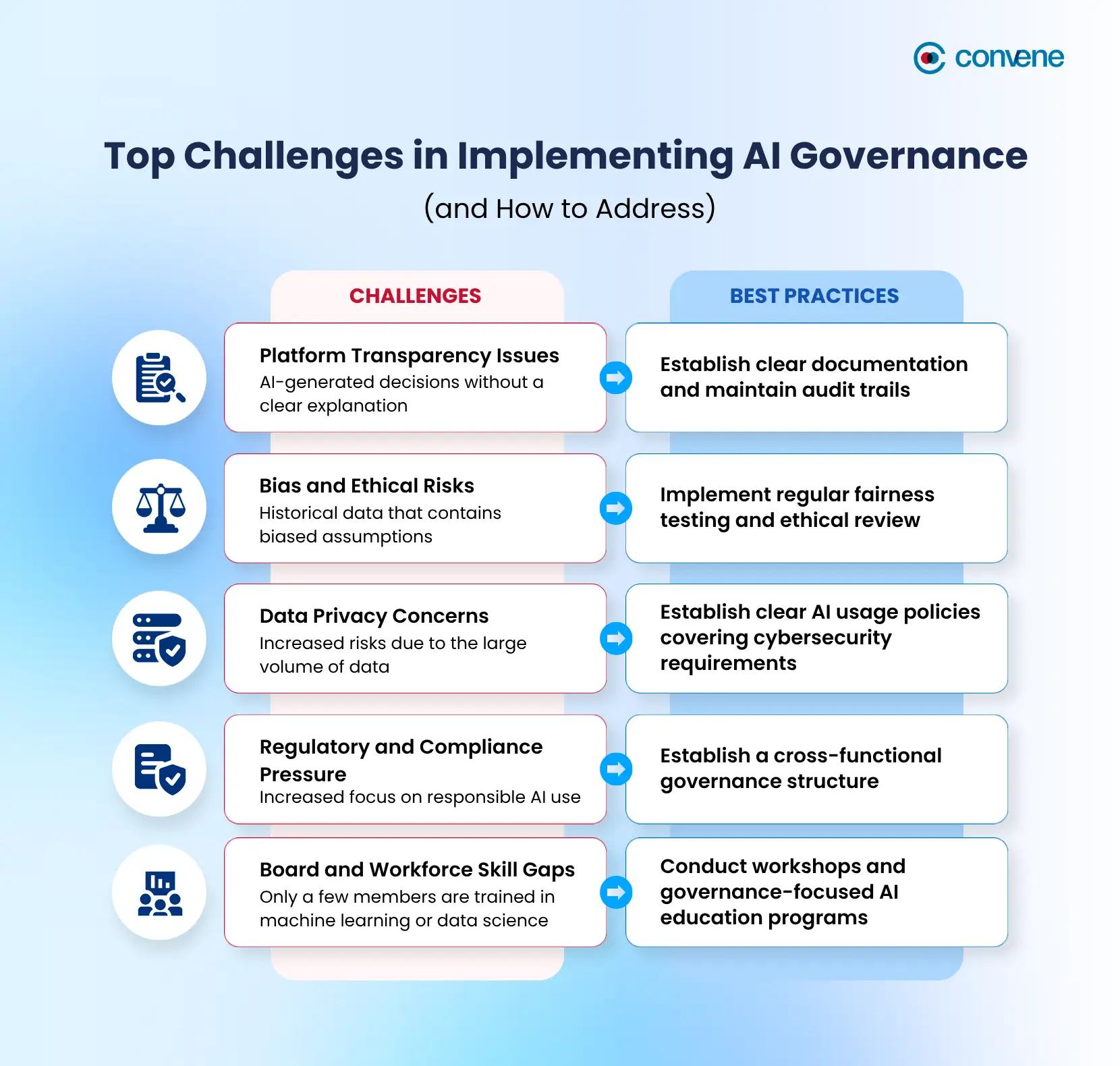
Platform Transparency Issues
One of the most common concerns surrounding AI is the “black box” problem. Some AI systems can generate recommendations or decisions without clearly explaining how they came up with that result. For boards, this vagueness creates a major governance challenge because it becomes harder to assess fairness, accuracy, and, most importantly, compliance.
Best practice:
To address this, organizations should establish clear documentation and approval processes and maintain audit trails for AI systems. Keeping records of training data sources, testing results, monitoring activities, and approval decisions helps strengthen accountability and supports regulatory readiness.
Bias and Ethical Risks
AI systems learn from historical data, and if that data contains biases or flawed assumptions, AI models may unintentionally reinforce those patterns at scale. This can lead to unfair hiring recommendations, discriminatory treatment of customers, or unequal access to products and services.
Best practice:
Organizations should implement regular fairness testing, ethical review processes, and human oversight for higher-risk AI applications, particularly in areas involving employment, healthcare, lending, or compliance-related decisions. Applying a risk-based governance model also helps organizations determine which AI systems require stricter oversight and monitoring.
UNESCO has also published its own Recommendations on the Ethics of Artificial Intelligence, which serves as a global framework for policymakers, regulators, and organizations developing AI governance and ethical oversight practices.
Data Privacy and Cybersecurity Concerns
AI systems often require access to large volumes of internal, customer, or third-party data. Without proper controls, organizations may face increased risks related to data leakage or misuse of sensitive information.
The growing use of generative AI tools has also raised concerns around employees uploading confidential information into public AI platforms. At the same time, cybersecurity teams warn that threat actors can use AI to scale phishing, fraud, and social engineering attacks, making cyber threats more sophisticated and harder to detect.
Best practice:
To reduce these risks, organizations should establish clear AI usage policies covering approved platforms, acceptable data use, and cybersecurity requirements. In addition, optimizing vendor assessment to ensure data privacy should be a priority. All of these should run through human review procedures and must be monitored regularly for assessment.
Regulatory and Compliance Pressure
Governments and regulators worldwide, including the U.S. Securities and Exchange Commission (SEC), are increasing their focus on AI accountability, transparency, consumer protection, and responsible AI use.
For example, the SEC has warned organizations against “AI washing” and continues to increase scrutiny around how companies disclose and govern their AI capabilities. With all these regulatory expectations, companies that adopt AI faster than their governance frameworks mature may expose themselves to compliance gaps and regulatory scrutiny.
Best practice:
Boards can respond by establishing cross-functional governance structures involving legal, compliance, cybersecurity, IT, HR, and business leaders. Clearly defined responsibilities help organizations manage AI risks more consistently while ensuring oversight decisions are informed by multiple perspectives.
Board and Workforce Skill Gaps
Many directors and business leaders built their expertise in finance, operations, strategy, or industry leadership, but only a few focused on machine learning or data science. As AI becomes a larger governance priority, some boards may lack confidence in evaluating AI-related opportunities, risks, and controls.
Best practice:
Organizations should therefore treat AI literacy as an ongoing priority rather than a one-time training initiative. Boards can strengthen internal capability through workshops, expert briefings, governance-focused AI education programs, and regular discussions on emerging risks and best practices.
Frequently Asked Questions on AI and Corporate Governance
Is AI taking over board decision-making?
No, AI is not replacing boards in decision-making, as directors still have fiduciary judgment and oversight. AI should aid human decision-making, not supersede it.
What is an example of AI governance?
An example of AI governance is a board creating guidelines for the responsible use of generative AI tools, including approval processes, security requirements, and compliance monitoring.
How often should boards examine AI governance?
Boards should reassess AI governance at least periodically during the governance calendar. High-risk or fast-growing AI use cases might need to be reviewed more often.
Convene Board Portal: Smarter Board Governance Powered by AI
AI may be leading the charge in the digital transformation age, but technology alone doesn’t build long-term value. Governance does. The organizations that will win in the years ahead are those that combine innovation with accountability.
The right governance tool, like Convene Board Portal, can aid you on that journey.
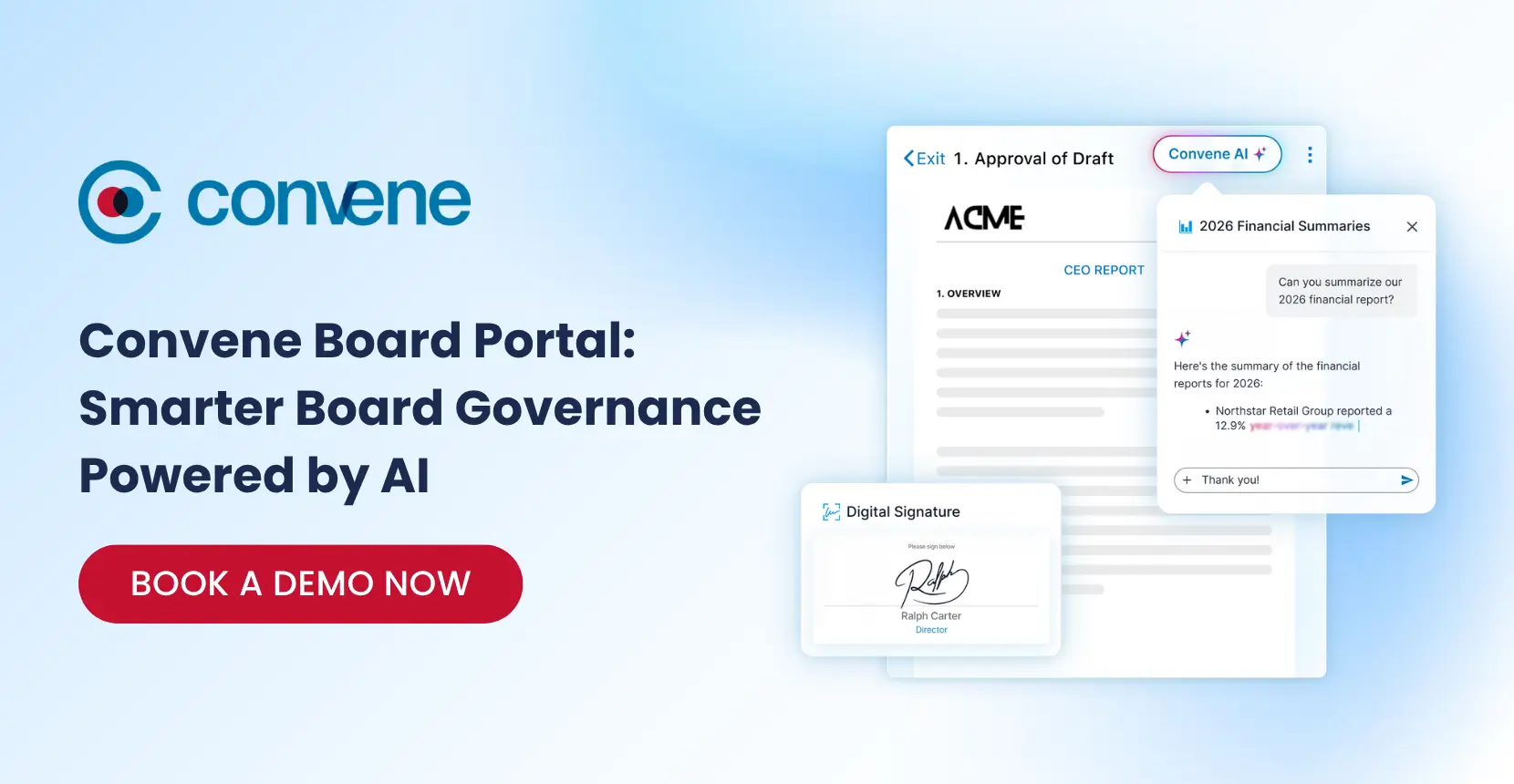
Built for modern boards, Convene combines secure governance workflows with AI-powered capabilities. With Convene AI, boards can automate meeting minutes and summaries, quickly retrieve key information through a dedicated AI Companion, and streamline meeting preparation with intelligent insights and recommendations.
Convene also supports secure and compliant governance through enterprise-grade security measures and AWS-backed infrastructure, helping organizations protect sensitive board data while maintaining control and accountability. Combined with centralized board materials, role-based access, audit-ready records, and simplified decision workflows, Convene enables more intelligent governance and faster, more informed board-level decision-making.
Give your board the tool to make board governance easier and faster. Book a tailored demo with us today.



Jess is a Content Marketing Writer at Convene who commits herself to creating relevant, easy-to-digest, and SEO-friendly content. Before writing articles on governance and board management, she worked as a creative copywriter for a paint company, where she developed a keen eye for detail and a passion for making complex information accessible and enjoyable for readers. In her free time, she’s absorbed in the most random things. Her recent obsession is watching gardening videos for hours and dreaming of someday having her own kitchen garden.
- Connect:
-