


Key Takeaways:
- GRC is an integrated approach that aligns strategy, manages uncertainty, and meets regulatory obligations by combining governance, risk management, and compliance.
- Governance, risk, and compliance break down silos and work together through shared visibility, unified policies, and coordinated decision-making across business units.
- A strong GRC strategy relies on selecting and integrating industry-relevant frameworks, such as OCEG GRC Capability Model, COSO ERM, ISO 31000, and NIST Cybersecurity Framework.
- Implementing an effective GRC strategy requires defining a clear goal, building a steering committee, integrating risk assessment, designing unified controls, leveraging technology, and conducting regular monitoring.
- Among the commonly used GRC solutions are ERM platforms, Policy and Compliance Management tools, Internal Audit Management software, User Management and Access Control tools, and Board Management Software.
Governance, Risk, and Compliance (GRC) is more than just corporate jargon. In today’s business environment, GRC sits at the center of organizational strategy and crisis-response playbooks. Its concept is simple: companies need to set direction, manage threats, and obey the rules. On the other hand, its implementation is not that easy.
According to the 2025 OCEG GRC Maturity Survey, 50% of organizations now perform formal GRC maturity assessments, and over 60% have a dedicated oversight committee for GRC leadership. The research also found that entities with documented GRC strategies are more likely to perform assessments and more confident in their ability to respond to risk, change, and scrutiny.
In this guide, we’ll discuss the GRC meaning, its benefits and challenges, and tips on how to properly implement it.
What is GRC?
GRC is an integrated approach for organizations to align strategy, manage uncertainty, and meet regulatory obligations through combining the three disciplines of Governance, Risk Management, and Compliance.
A primary focus of GRC is supporting Principled Performance, a concept by OCEG on achieving objectives while controlling potential threats and preserving legal and ethical responsibilities. By integrating all functions of GRC, organizations can reduce operational silos; provide visibility into risk exposures; and support decision-making across business units.
What are the components of GRC?
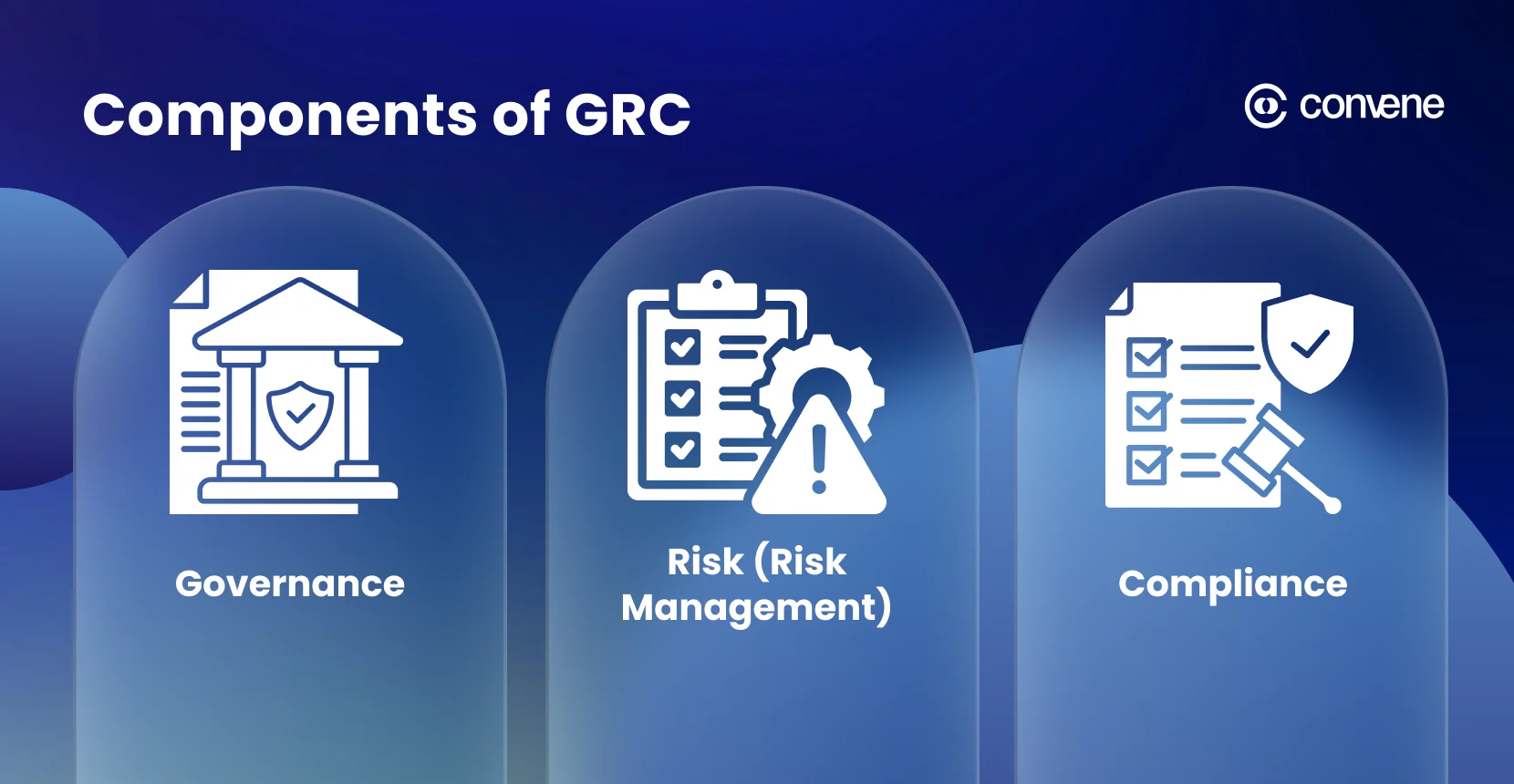
Governance, Risk, and Compliance make up the GRC concept, and here’s an overview of what their functions are and why they matter.
1. Governance
Governance refers to the system for an organization’s leadership to manage the operation of the organization through rules, processes, roles, and methods of decision-making. Ultimately, to fulfill the goals of the organization’s strategy, it shows:
- how an organization will be held accountable,
- how ethical behavior will be created and continued,
- how performance will be measured, and
- how resources will be distributed to meet the organization’s mission and the stakeholders’ expectations.
Key Functions of Governance
- Strategic Direction & Oversight: Ensures the organization doesn’t go “off the rails” while ensuring there’s continuity from a broad strategic vision to how the business operates daily.
- Ethical and Transparent Conduct: Refers to the way a company conducts its business, which reflects its ethical behavior and transparency, particularly in setting out what is considered acceptable and right.
- Accountability and Controls: Identifies who has authority at any given moment, or who makes decisions. In addition, this is crucial for maintaining accountability and aligning with the company’s standards and goals.
- Cross-Functional Coordination: Prevents departments from being siloed within their own areas and ensures they work as a cohesive unit. Doing so avoids duplicate effort, as well as wasted time and resources when completing tasks.
2. Risk (Risk Management)
Risk in GRC refers to the process of identifying, evaluating, and responding to threats that could impact the company. Such risks may be operational, financial, legal, reputational, or environmental. A proactive risk management allows companies to appropriately respond to emerging or potential threats.
Key Functions of Risk Management
- Threat Identification: Provides an overview of the types of threats organizations may face across different domains, including cybersecurity threats, market or regulatory changes, and operational failures.
- Assessment and Prioritization: Establishes the probability and potential impact on the organization, using both qualitative and quantitative methodologies.
- Mitigation and Response Planning: Applies control and security measures to reduce the severity or raise the probability of occurrence of a risk event.
- Ongoing Monitoring: Refers to the continuous monitoring of key risk indicators. If the thresholds are exceeded, an alarm will trigger; therefore, they will be evaluated as a result of changes in the risk environment.

3. Compliance
Compliance includes control and management systems that allow organizations to adhere to external regulations (legal requirements) and corporate policies (internal guidelines). External regulatory obligations may include data protection laws and frameworks used to establish the standards for compliance (e.g., ISO and HIPAA).
- Regulatory Obedience: Ensures the business stays within the law to avoid the massive fines, lawsuits, and sanctions that can follow even an accidental breach.
- Internal Policy Enforcement: Turns the company handbook into reality. It ensures that employees and automated systems actually follow the internal rules designed to keep operations consistent and secure.
- Audit Preparedness: Involves systematic record-keeping so you can prove to any auditor (internal or external) that the company has been doing things right. Think of it like a continuous paper trail.
- Gap Identification and Remediation: Acts as an early warning system. It finds where the company is failing to meet its own standards and triggers immediate fixes, such as updated staff training or better technical controls.
How does GRC work?
Governance, Risk, and Compliance approach functions by breaking down pre-existing silos and creating a collaborative workflow where all three functions are combined into one. This often begins with the establishment of a GRC framework, which serves as a master document containing universal policies, roles, and controls. It helps align policies, roles, and controls with the organization’s larger strategy so that all departments share the same risk-aware playbook.
In most cases, modern organizations now accomplish this with integrated software applications that replace disconnected spreadsheets. These platforms allow for the data and actions related to all three forms of GRC (policies, risk data, and compliance) to be available company-wide.
Why is GRC important?
Governance, Risk and Compliance (GRC) creates a structured, integrated framework that connects an organization’s strategy to its regulatory obligations, risk management, and ethical standards. Besides minimizing exposure to both current and future risks, it can also help reduce the likelihood of incurring penalties for non-compliance.
GRC can bring tons of benefits when implemented correctly, and these include:
- Operational efficiency by improving resource allocation and reducing governance overlaps.
- Smarter decision-making by creating workflows that are compliant and aligned with regulatory requirements.
- Improved risk resilience through risk management plans to prevent crises and disruptions.
- Better transparency and accountability with a cross-functional setup that allows departments to work together.
- Regulatory readiness by continuously monitoring the changing laws and standards to keep the company audit-ready.
- Cost optimization through the streamlined compliance processes and prevention of redundant audits.
What are the challenges of GRC implementation?
Many organizations face difficulties when implementing GRC, particularly if they’ve never implemented one before. Below are some common challenges that organizations may face.
- Complex integration with legacy systems: Many legacy systems do not support consolidated governance, compliance, and risk management processes. This means that there may be a need for a large amount of IT resources for data migration.
- Inadequate executive buy-in: Executive buy-in can be a challenge as GRC requires a significant commitment from senior leaders and considerable upfront investment to successfully implement.
- Data silos and poor data quality: Organizations may also struggle with the limitations of data silos and data quality, which create barriers to obtaining current, real-time risk information about the organization and to enforcing its GRC policies across business units.
- High upfront costs: In general, organizations will need to incur a great deal of expense upfront to purchase GRC software, to train staff, and to redesign business processes.
- Lack of skilled personnel: Organizations may also encounter difficulties in finding skilled resources for GRC, especially for individuals with combined expertise in governance, risk, and compliance.
- Inconsistent regulatory interpretation: Companies operating across multiple jurisdictions will find it hard to comply with varying laws and compliance requirements.
Common GRC Frameworks to Know About
Creating an effective GRC strategy requires integrating relevant frameworks for structured guidance and compliance. Frameworks related to GRC can be different depending on industry and jurisdiction, but here are some common examples:
- OCEG GRC Capability Model: Also referred to as the OCEG Red Book, this standard is used to implement principled GRC practices. It is applicable from early maturity stages to advanced GRC models.
- COSO Enterprise Risk Management (ERM) Framework: This governance, risk, and compliance framework focuses on risk appetite, risk tolerance, and performance impact. The COSO ERM framework aims to provide organizations with quantitative and qualitative lenses to assess uncertainties.
- ISO 31000 Risk Management Standard: This internationally recognized standard was developed to provide a consistent and structured methodology for risk identification, assessment, and monitoring.
- NIST Cybersecurity Framework (CSF): While initially developed as a cybersecurity standard, this framework also serves as a risk and compliance mapping tool, particularly in high-risk industries.
Besides these, several other frameworks and standards often intersect with GRC programs. These include COBIT (Control Objectives for Information and Related Technologies), ISO/IEC 27001, HIPAA (Health Insurance Portability and Accountability Act), and more.
Steps to Implement an Effective GRC Strategy
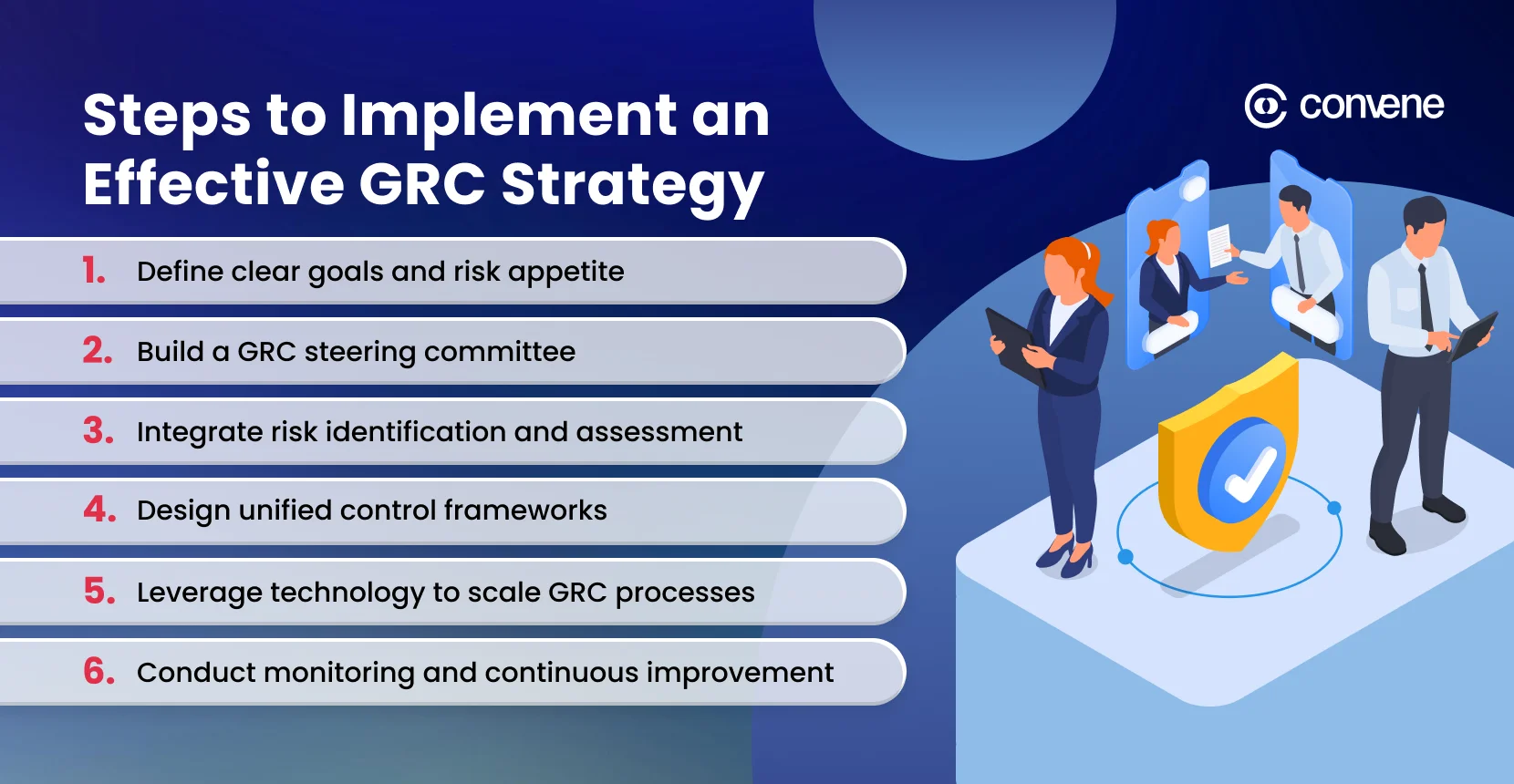
One thing to note for organizations: GRC is not a checklist. It is an actual strategic framework that can help achieve business goals, prevent and manage threats, and ensure ethical compliance.
1. Define clear goals and risk appetite
The first step in creating the GRC strategy is to set specific, measurable outcomes for the strategy itself, such as:
- improving the company’s data privacy posture,
- reducing the company’s exposure to operational risks, and
- satisfying the regulatory compliance obligations based on industry.
Each of these goals must be connected directly to the organization’s overarching strategy and must include risk tolerance levels so that prioritization of risk response can be done systematically.
2. Build a GRC steering committee
To ensure accountability and transparency, build a GRC steering committee composed of compliance, legal, IT, operations, and risk management leadership. This helps determine risks and compliance-related decisions based on information from these departments. In addition, identify roles, responsibilities, decision rights, and escalation paths to align efforts across all units.
A few actions to take include:
- Designate someone responsible for managing, monitoring, and mitigating each risk domain and compliance requirement.
- Define consistent reporting relationships with designated executive sponsors.
- Develop formalized charters and procedures in your governance committee, and document them.
3. Integrate risk identification and assessment
It is imperative that a risk assessment is an ongoing, interconnected process. A mature GRC strategy must have a central repository and categories of risk (compliance, operation, cyber, etc.), then classify them by probability or impact. This enables you to create heat maps and other visual models to show risk exposure clearly to all stakeholders.
Furthermore, by defining the risk common language and risk scoring methodology across the different departments, senior management can create a consistent and comparable risk assessment.
4. Design unified control frameworks
There are many types of controls for reducing compliance risk while fulfilling compliance obligations. Policy, procedures, system checks, and technical safeguards are a few examples of controls. That said, it is recommended to develop a control library that:
- Consolidates control requirements from multiple frameworks and standards.
- Map controls to risk and regulatory requirements.
- Provides ownership, evidence requirements, testing frequency, and success criteria for each control.
By centralizing control requirements into a unified library, redundant testing is avoided (e.g., ISO 27001 and PCI DSS with similar controls), and audit readiness is also expedited.
5. Leverage technology to scale GRC processes
A successful culture of risk awareness and compliance ownership requires more than just technology and process. Successful implementation requires onboarding and ongoing training for everyone involved — from the executive level to the frontline, including all staff.
This requires tailored training programs for different job functions (e.g., board members, management) that provide skills and knowledge about compliance policies — the what and the why. It is also vital to recognize those who demonstrate positive compliance behavior that can further reinforce cultural change.
6. Conduct monitoring and continuous improvement
Last but not least, make sure to conduct regular, ongoing monitoring and testing of your GRC strategy. It is important that company practices are adjusted as regulations change, operations change, and new technologies or threats arise. Establishing an operational cadence that includes:
- a quarterly review of risk and control tests on the risk controls in place,
- annual reviews of policy and policy updates, aligned with regulatory changes, and
- annual scenario planning and tabletop exercises.
These are critical to acquiring relevant feedback on how to improve the GRC process and tools. Continuous improvements to GRC strategies are vital to preventing complacency and ensuring continued relevance.
Five Common GRC Software Solutions for Modern Businesses
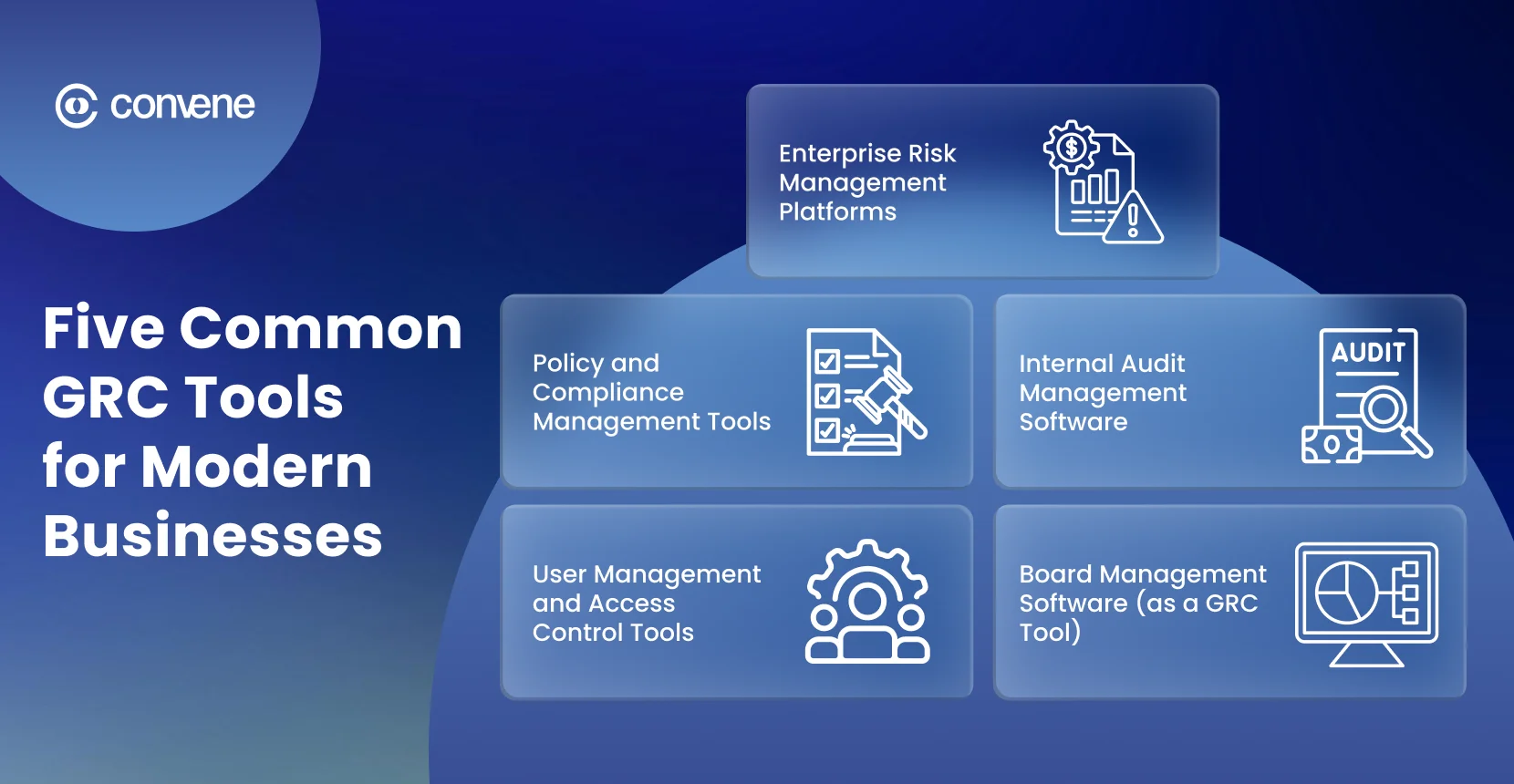
For future-forward businesses, GRC tools are the technological backbone that transforms siloed processes into data-driven workflows. At the same time, they play an important role in navigating the regulatory environment and systemic risks. Among the most common GRC software solutions are:
1. Enterprise Risk Management Platforms
ERM software collects and stores all data pertaining to the company’s “risk universe” in one centralized location. It enables organizations to take into account the relationship between individual risks rather than solely viewing each risk as an isolated incident. Most ERM platforms also utilize a quantitative modeling approach to identify how specific risks correlate. For instance, these tools can help map the potential impact of a technical failure on a data center’s revenue.
Moreover, ERM platforms can enable risk officers to move from reactive mitigation to proactive risk forecasting. This further ensures that the organization’s risk appetite is properly enforced across its departments.
2. Policy and Compliance Management Tools
Compliance and policy management tools act as a digital repository that synchronizes internal corporate behavior with the regulatory landscape. Such tools are often associated with a traceability matrix. A traceability matrix identifies what internal controls and requirements must be fulfilled to meet regulatory compliance (e.g., the EU’s General Data Protection Regulations or the U.S.’s Sarbanes-Oxley Act).
When the regulators change their requirements, these tools can trigger an automated workflow to determine all policies that have been changed. This is beneficial for alerting stakeholders impacted by the regulators’ changes and keeping track of all the required updates to the policies.
3. Internal Audit Management Software
Internal audit tools provide businesses with an automated validation layer over their other processes. Instead of relying on sampling audits to verify process integrity, they use Continuous Auditing (CA) and Continuous Monitoring (CM) to scan the data processed by each enterprise system.
The technical aspect of CA and CM is creating either “automated scripts” or “bots” that flag anomalies (e.g,. duplicate payments and unauthorized system changes) in real time. This transforms the audit department from a once-per-year reporting operation into an ongoing provider of systematic real-time feedback regarding the status of internal control systems.
4. User Management and Access Control Tools
User Management and Access Control tools ensure that only authorized personnel can access certain areas. They utilize roles to ensure that employees have access to files and software required for their job. They take what they need but nothing more — preventing information leakage.
In addition, such tools function like an automatic security patrol. For instance, if a database is set to open for public access, the system is alerted and immediately changes it to a secure state without requiring further human intervention.
5. Board Management Software (as a GRC Tool)
Board management software is typically utilized as an executive oversight tool, designed to connect operational data and fiduciary responsibility. Most of these platforms offer highly secure environments where boards can store, access, and approve documents and files, critical for the organization’s legal and compliance requirements. Overall, a GRC system like Convene can effectively facilitate board-level decision-making, oversight, and collaboration.
Convene: Your Go-To Board Portal for Smarter GRC Implementation
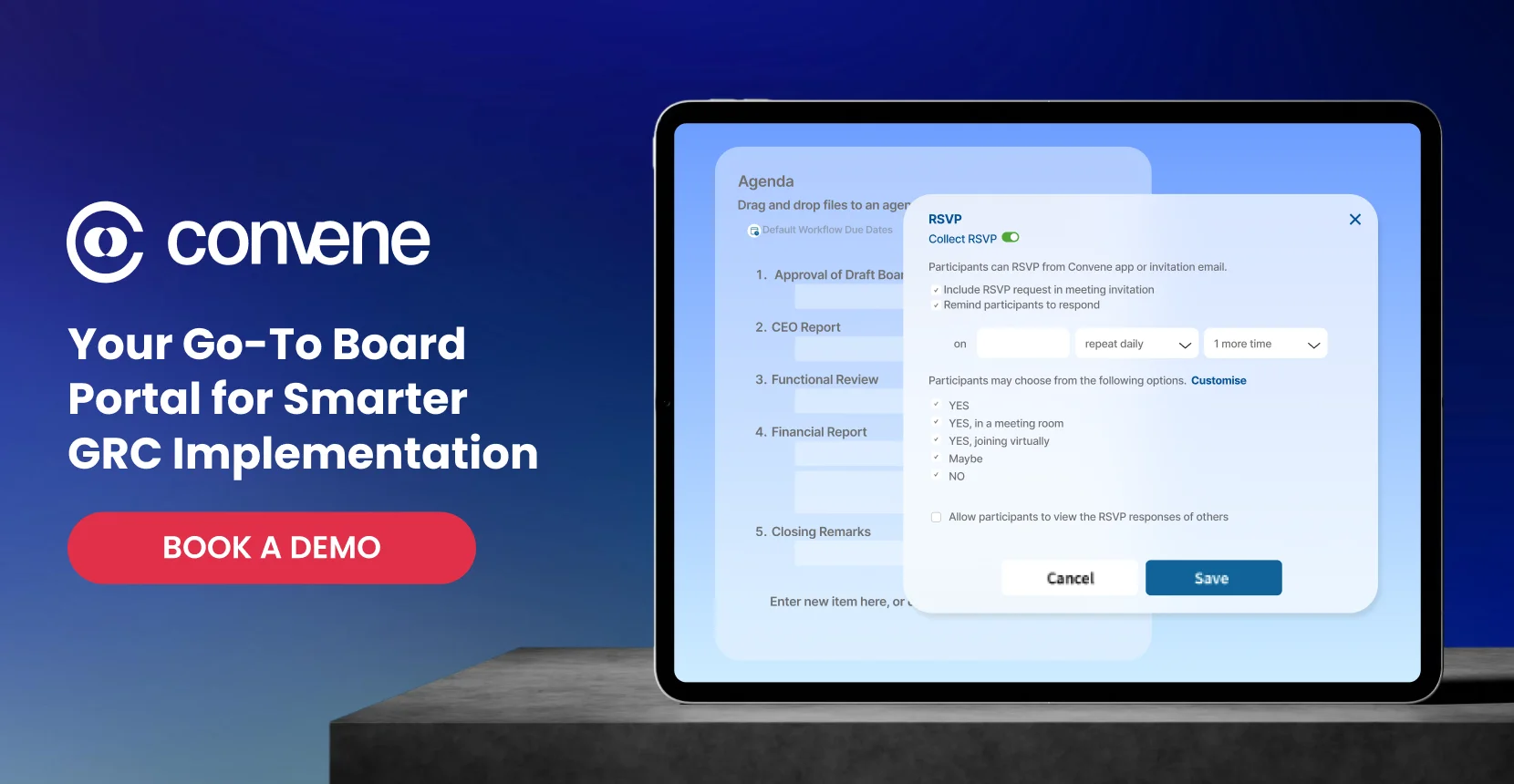
Rolling out a GRC program that actually works is rarely smooth sailing. Without the right systems in place, efforts to implement GRC can quickly turn into scattered files, time-consuming compliance checklists, or mismatched reporting. This is why investing in tools like Convene Board Portal is important.
Convene is a leading board management software designed to transform your paper-heavy tasks into streamlined, fully traceable processes. From optimizing meeting workflows to centralizing documents, our platform can guarantee accuracy, speed, and security. Get access to these game-changing board portal features:
- Agenda Builder and Meeting Scheduler: No more chaotic meetings. Plan, align, and run your meetings on schedule, and make decisions faster.
- Document Library: With Convene, you get a single hub to store company policies, risk reports, and board papers securely, while ensuring only authorized individuals get to access them.
- Audit Trail: Every click, edit, and decision made in Convene is automatically tracked and recorded. Say goodbye to manual reports.
- Voting and Resolutions: Turn your board discussions into actions instantly. Convene lets your board vote anytime, anywhere, and even track all decisions in a central dashboard.
- MFA and Role-Based Access Control: Lock down your sensitive company data like a vault. With Convene, only verified users get in, so your governance information is airtight.
Ready to transform the way your organization handles GRC? Book a demo to know more about how Convene can help.



Jielynne is a Content Marketing Writer at Convene. With over six years of professional writing experience, she has worked with several SEO and digital marketing agencies, both local and international. She strives in crafting clear marketing copies and creative content for various platforms of Convene, such as the website and social media. Jielynne displays a decided lack of knowledge about football and calculus, but proudly aces in literary arts and corporate governance.
- Connect:
-

-