



Key Takeaways:
- An executive summary provides a high-level overview that allows board executives to make informed decisions without reading the full document.
- Effective executive summaries briefly cover the introduction, objectives, analysis, recommendations, and conclusion of a board report or business plan.
- The executive summary condenses the most important insights in a single section, improving accessibility for busy board executives.
- Unlike abstracts, executive summaries are business-focused, longer, and can stand along as reference for decision-makers.
Time is a valuable resource in boardrooms. Executives and directors are expected to make high-impact decisions, often with limited preparation. This makes clarity and speed essential.
Jeff Bezos, founder of Amazon, is known for his decision-making principle — the 70% rule. It’s the idea that leaders only need about 70% of the information to make a decision, and that waiting for the rest delays progress.
This is where an executive summary comes in. The section provides executives with the most essential information, offering just enough context to derive action. It translates pages of data into action-driven insights, empowering executives to make confident decisions within minutes.
Learn more about how an executive summary bridges the gap between deep analysis and decisive action. Discover its benefits, key components, and effective tips on how to write an executive summary. What’s more, access an executive summary example template.
What is an executive summary?
An executive summary is a concise, high-level overview of a full document. Board directors can refer to it when they want a glance at the main objectives, findings, and conclusions of a business report, proposal, or plan. It’s placed right after the title page, enhancing accessibility of critical information.
An executive summary isn’t only a compilation of details. What it presents are actionable insights that empower board executives to make informed decisions and improve governance — without the need to review the entire document.
How long is an executive summary?
According to Business Daily News, an executive summary is ideally under two pages or should comprise less than 10% of the entire document. It must follow the same flow as the board report and use simple explanations to clearly convey the core message. A well-written executive summary is brief, structured, and actionable. Its length varies from one document to another, especially if the document exceeds a hundred pages.
Why should you include an executive summary?
Not everyone has time to read and absorb lengthy documents. This is particularly true for board executives who spend most of their daily work in meetings. Here’s how an executive summary helps them speed up information retrieval and understanding:
Maximizes preparation time
An executive summary outlines critical details under one section, providing a faster way to digest information. Since it filters the most important points, board executives are prevented from being overwhelmed with unnecessary information. This offers a significant advantage for those working with limited time. They can review it a few hours or even minutes before the meeting, rather than allocating an entire day to digesting a full report.
Provides actionable insights
An executive summary breaks down complex concepts found in the report into actionable insights. It’s designed to become a standalone reference, containing information essential for making effective and relevant decisions.
In 2024, the average board meeting pack for large enterprises valued at 500 million or more has grown to 294 pages, an increase from 267 in 2023. This volume requires board members to dedicate two days to digest the material and prepare for meetings. As pages continue to grow, board executives are resorting to executive summaries to find information that truly matters.
Enhances focus and clarity
The outline in the executive summary helps board executives identify the sections most relevant to them. This reduces the cognitive effort required when interpreting a full report and helps narrow the focus to priority topics. It also makes it easier to find certain information without having to go back and forth between pages, helping board meetings stay on track.
What are the five key components of an executive summary?
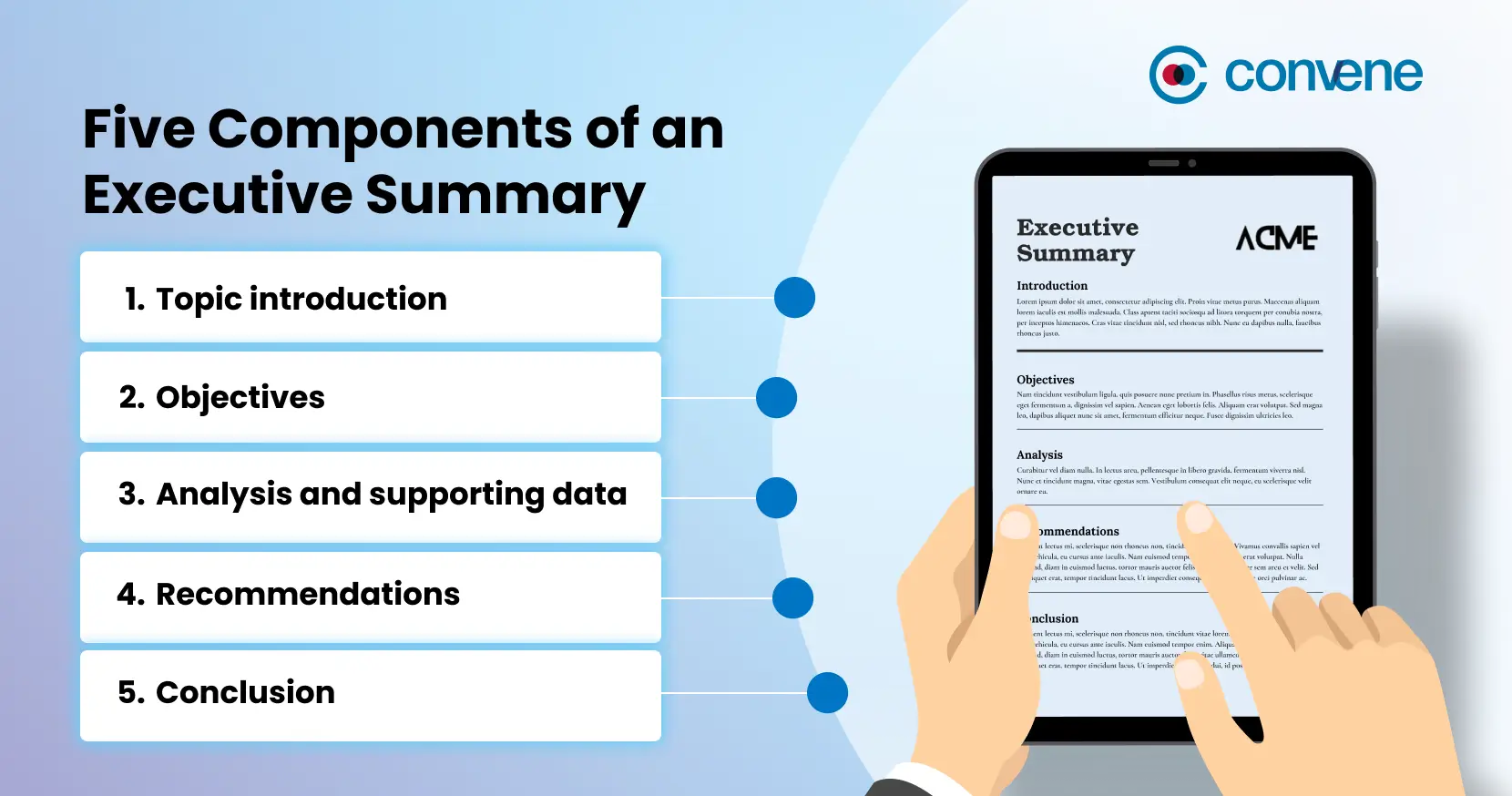
An executive summary comprises several key components to highlight actionable insights for readers.
1. Topic introduction
The first part of an executive summary is the introduction. For external stakeholders, the document usually begins with an introduction to the company, its operation, and objectives. If it’s for internal stakeholders, it would explain the purpose and the problem statement directly.
In both instances, there should always be an introduction so readers can set expectations on what they can learn from the document, justifying why it matters to the organization at this time.
2. Objectives
This specifies the objective the organization aims to achieve. By outlining targets, the standards for success become clearer for board members. It also defines how performance or progress will be measured based on established metrics.
Whether for short- or long-term goals, objectives must be specific, relevant, and aligned with the overall organization’s strategy.
3. Analysis and supporting data
Data must be translated into actionable insights to create a concise yet comprehensive executive summary. By providing interpretation early on, board executives will be more confident in the usefulness and relevance of the entire document. These analyses and data can be presented in bullet points or lists.
4. Recommendations
Propose concrete and informed actions to address the matter at hand. If possible, explain the rationale for every recommendation using evidence to persuade readers of their business value.
5. Conclusion
Finally, conclude the executive summary with a closing statement explaining the significance of the entire report. Summarize the key takeaways and reinforce the importance of recommendations. Help readers understand how the topic relates to the organization’s overall objectives.
Executive Summary Example Template
What does an executive summary look like? Below is a sample template to help you get started!
Company ABCD Financial Report 2025 Executive Summary Topic Introduction This executive summary presents an overview of Company ABCD’s financial performance for 2025. It highlights key financial results, challenges, and strategic priorities to guide leadership and stakeholders in making informed decisions in 2026. Objectives The primary objective is to evaluate ABCD’s financial health, focusing on revenue growth, cost efficiency, and profitability. The company aims to achieve sustainable growth while strengthening its market position and improving shareholder value. Analysis and Supporting Data In 2025, ABCD recorded steady revenue growth (23% YoY) driven by increased customer demand and expansion into new markets in the APAC region. Operating costs were reduced 30% through improved supply chain management, leading to higher net profit margins. Cash flow remained stable, supporting ongoing investments and debt obligations. Recommendations ABCD should continue investing in high-performing product lines and expand into profitable markets. Strengthening cost controls and increasing digital operations will further improve efficiency and long-term profitability. Conclusion Overall, ABCD showed solid financial performance in FY 2026. By maintaining strategic investments and disciplined financial management, the company is well-positioned to achieve its future growth objectives. Note: The information stated above is for sample purposes only. It does not represent the actual financial performance, position, or operations of any real company. |
How to Format an Executive Summary: Best Practices
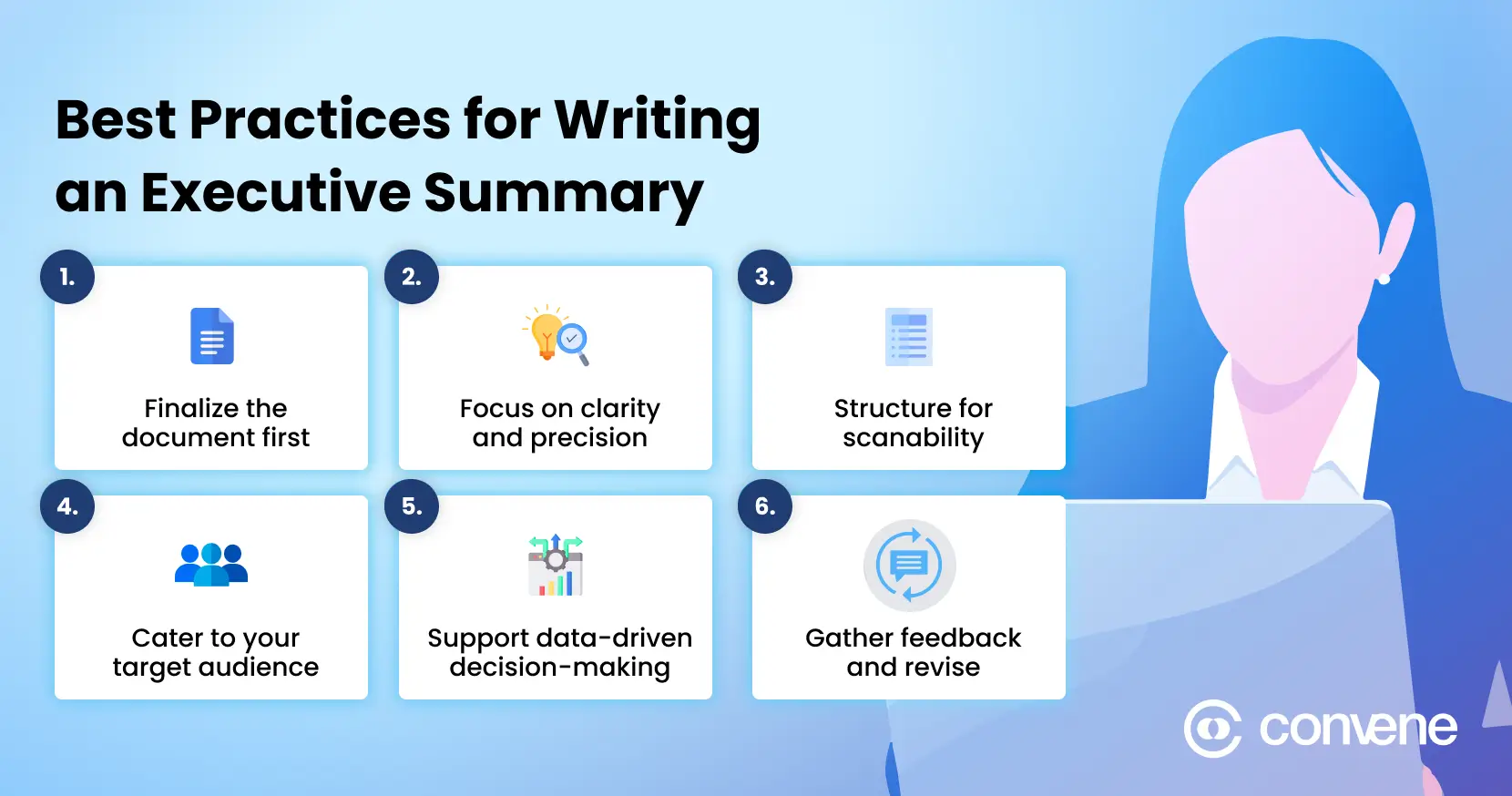
Writing an excellent executive summary involves strategy and precision. Here are the best practices for writing an effective executive summary.
1. Finalize the document first
It’s standard to finish the entire document before writing an executive summary. While it’s placed at the beginning of the board paper, it’s the final section that must be added. This ensures accuracy and alignment with the final document, preventing contradictions and confusion.
2. Focus on clarity and precision
Explain and break down critical discussion points within the ideal length of an executive summary. If the document is for public consumption, avoid jargon or complex vocabulary that would require readers to seek further explanation elsewhere.
3. Structure for scanability
Use clear headers and bullet points to enhance structure and scanability. Following a logical flow ensures that critical information stands out — where busy decision-makers can easily locate it.
4. Cater to your target audience
Consider your audience when writing an executive summary. This means using the appropriate tone, language, and readability that match the knowledge level and expectations of the intended readers. For example, senior leadership prefer concise and results-focused summaries, while IT professionals may expect more detailed summaries and data highlights.
5. Support data-driven decision-making
Build credibility by referencing relevant data points or high-level insights in the executive summary. Be cautious about putting overly technical information. Remember that the executive summary isn’t created to replace the full report. It must only highlight crucial evidence necessary for analysis and decision-making.
6. Gather feedback and revise
Lastly, seek the feedback of stakeholders or subject-matter experts when writing an executive summary. Aside from ensuring accuracy, reviewers should also assess the intent and tone to determine whether it is persuasive enough to encourage readers to engage with the full document.
Using a board portal streamlines this process by enhancing speed and collaboration. Instead of gathering feedback through email threads or unending document versions, board executives can access and comment on board resolutions in one place. Board portals also have annotation and version controls, allowing boards to track every update and enforce accountability.
Abstract vs Executive Summary: How They Differ and When to Use
It’s common for people to be confused between an executive summary and an abstract. Both provide concise overviews of an extensive document; however, they are created for different audiences and contexts.
Understand the differences between an abstract and an executive summary below.
| Executive Summary | Abstract | |
|---|---|---|
| Purpose | Used in business setting | Used in research and academic journals |
| Audience | Helps busy executives, investors, and shareholders understand the context of a proposal or action plan within the first few pages | Provide an overview of the study to specialized researchers and the broader academic community |
| Context | Guide strategic planning, business initiatives, or investments | Enable researchers to assess the usefulness of a journal article within one page |
| Length | Can cover up to 10% of the total report length | Usually under 300 words or 10 sentences |
| Placement | Placed after the title page, before the table of contents | Placed after the title page |
Frequently Asked Questions on Executive Summary
Can the executive summary stand alone without the full report?
Yes. An executive summary can stand alone. In most cases, it provides enough information for readers to understand the main points and key recommendations of the report. However, this is only suitable for readers who want a general overview. Executive summaries typically don’t cover all the technical aspects or evidentiary context, which will require readers to scan the full report.
Should the executive summary follow the same structure as the full report?
Yes. An executive summary must follow the same structure and logical flow as the report. Remember that it acts as the “mini” version of the report. This means it must reflect the same information in the same order to avoid confusion and misalignment.
Create Faultless Executive Summaries Using the Convene Board Portal
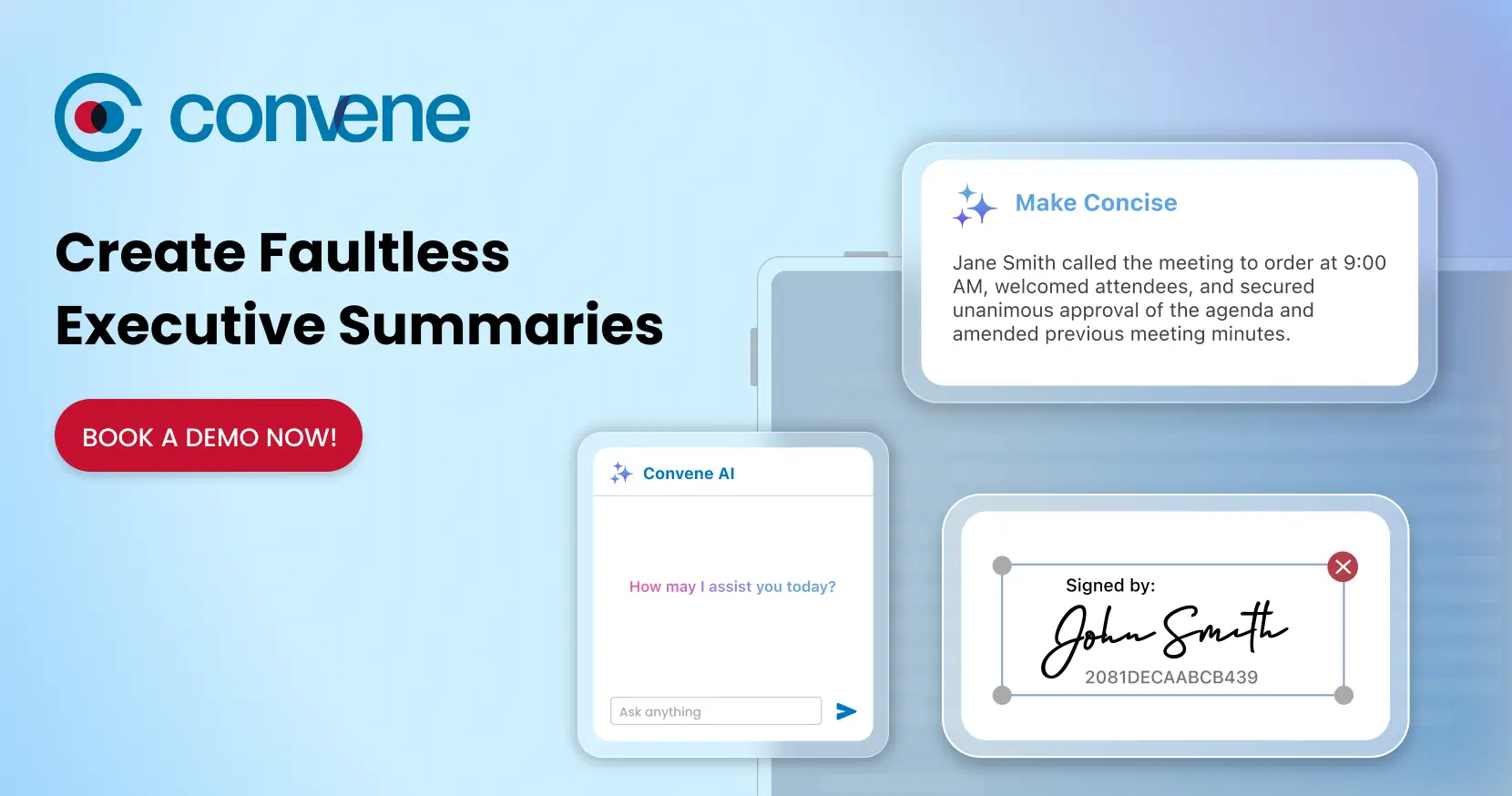
Writing an executive summary can be challenging without the right tool to streamline board paper creation. In actual board environments, this section is often rushed, causing board executives to manually stitch together information.
To reduce risks of inconsistencies and misalignment, Convene Board Portal helps optimize information flow for the board of directors. It centralizes all board materials into one secure space, creating a single source of truth and enhancing the focus of board discussions.
The digital platform offers built-in tools that allow both board members and secretaries to review, comment on, and refine content in real-time. It also supports intelligent workflows through Convene AI. With Automated Minutes and AI Companion, boards can generate concise overviews from meeting discussions and existing board documents in real-time.
Together, these features enable decision-makers to spend less time on administrative tasks and focus on strategy, governance, and informed decision-making.
Book a Convene Board Portal demo today to experience how streamlined workflows and AI-powered tools can elevate your board’s decision-making.



Jean is a Content Marketing Specialist at Convene, with over four years of experience driving brand authority and influence growth through effective B2B content strategies. Eager to deliver impactful results, Jean is a data-driven marketer who combines creativity with analytics. In her downtime, Jean relaxes by watching documentaries and mystery thrillers.
- Connect:
-

-