


Key Takeaways:
- Board assurance for People & Culture sits at 81.1%, yet Director Capability in Workforce and HR is only 47.5%; high confidence it’s being done well by Management, but a meaningful capability gap.
- Succession / Director Renewal scores just 67.7% assurance, with most boards lacking a formal, objective process for identifying skills gaps and future Board needs.
- Stakeholder Planning & Reporting is the lowest-scoring risk at 59.9%, with over 11.3% of directors unsure whether a stakeholder plan even exists in their organization.
- All three risks share one root cause: boards are aware of them but are delegating leadership to the executive rather than owning it alongside them.
- Convene Assure’s Board Governance Evaluation (BGE) and Director Skills Matrix (DSM) give boards the evidence-based tools to close these gaps with confidence.
Boards today know where modern governance risks lie. One challenge is turning that awareness into action. Convene Assure’s 2025 Top Contemporary Governance Risks White Paper identifies the six emerging governance risks gathered from over 500 directors via the Board Governance Evaluation (BGE) and the Director Skills Matrix (DSM).
Three risks are considered to be of the highest significance since they impact a board’s capacity to manage stakeholder trust and develop organizational capability:
- People & Culture
- Succession/Director Renewal
- Stakeholder Planning & Reporting
Boards persistently recognize these risks, yet they still seem to depend on the executive to manage them. Below, we explore why these board governance risks matter more than ever, their impact today, and how directors can address them.
Why do these three governance risks matter for boards?
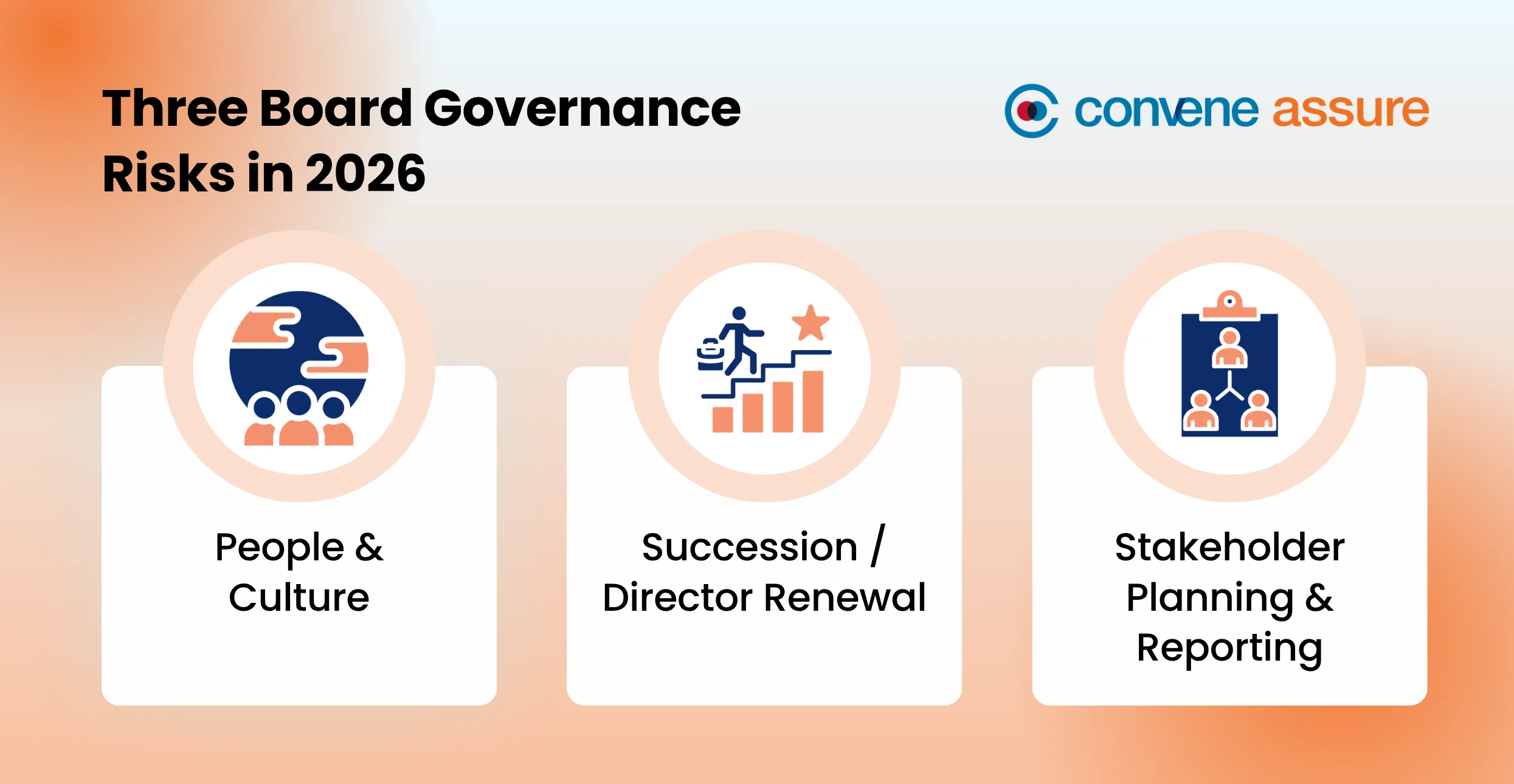
The three governance risks, People & Culture, Succession/Director Renewal, and Stakeholder Planning & Reporting, share a common issue: board accountability. Research shows that boards acknowledge their significance; however, these issues are left to the executives. While management is essential to implementing these initiatives, governance accountability is the board’s responsibility.
Governance risks taken collectively indicate the extent to which a board can go beyond oversight. On the other hand, addressing only one may leave gaps in governance that can impact long-term organization performance.
Risk: People & Culture Remains an Executive-Only Issue
Research from 2025 shows a shift in the conversation about People & Culture from an operational issue to a governance issue that demands board engagement. Although boards trust that executives are addressing workforce concerns, this trust appears misplaced.
Executives are expected to handle workforce concerns (i.e., strategies and human capital issues), while the directors must focus on strengthening management. The report refers to this phenomenon as the “bystander effect”. Directors act as bystanders because they perceive that the executives should be the ones making informed decisions. As a result, directors defer to their judgment, assuming that if executives are satisfied, they can be too.
Consequently, boards are likely to undermine their oversight responsibilities with respect to sustainability, the corporate culture, and the organization’s long-term interests and performance.
What the 2025 Assessment Reveals on People & Culture
According to the study, Board Governance Assurance for People & Culture remains at 81.1%, unchanged from 2024, while Overall Director Capability in Workforce and HR is at 47.5%, with a positive shift of 7.3% from the previous year.
While some boards are confident that workforce matters are properly handled, data shows that confidence doesn’t always reflect director capability. In fact, 34% of surveyed directors demonstrated foundational capability, 41% at a proficient level, and only 9% at an advanced level.
While awareness of executive oversight of People & Culture is apparent, the majority of directors still lack the capability to govern this area. This reflects a broader governance challenge: a Nasdaq survey found that 47% of organizations view human capital management as a board-level priority.
How to Fortify Board Oversight of People & Culture
The research reports that boards with advanced governance practices embed People & Culture in all decisions rather than viewing them as a discrete HR function. This includes all aspects of corporate strategy, service design, board reporting, and understanding of workforce trends across various age groups. Boards should also prioritise continuous director education and reskilling on emerging people and culture governance trends.
Oversight responsibility is typically assigned to a board subcommittee with clear reporting lines, and People & Culture considerations are embedded in both workforce and succession planning.
“Boards cannot credibly lead a values-driven culture if People & Culture is regarded as the Executive’s job. Authentic governance leadership means directors owning this agenda, not observing it from a distance.”
– Fi Mercer, Global Governance Director, Convene Assure
Risk: Succession/Director Renewal Lacks Structured Governance Approach
In a nutshell, Succession and Director Renewal is about ensuring boards are equipped to govern their organizations through changing strategic and regulatory expectations.
Effective renewal demands regular governance evaluations that provide an objective assessment of board effectiveness, determine governance strengths and improvement areas, and support continuous board development. Without a structured approach, risks of leadership gaps, diminished oversight, and poor resilience may occur during transition.
In a 2026 survey by Deloitte, 85% of executives agree that strategic CEO succession planning is important to long-term success, yet only 57% have established a plan and 23% are actively implementing one. This indicates that many organizations still lack a structured approach to succession planning.
What the 2025 Assessment Reveals on Succession/Director Renewal
Convene Assure’s 2025 report shows Board Assurance for Succession/Director Renewal at 67.7%, a minimal improvement of 1.8% since 2024. This means that most boards did not have formal, objective processes for assessing existing skills and determining future skills requirements.
In relation, also identified is the significant gap in oversight of executive succession, wherein some directors are unaware of CEO and executive succession plans. Such findings suggest that leadership continuity is often a governance blind spot across enterprises.
How to Construct Succession and Director Renewal Processes
Succession planning should be seen as a governance discipline practiced all the time rather than something done periodically to replace directors. Boards commonly:
- Delegate responsibility to a Nomination and Remuneration (N&R) Committee.
- Employ a Director Skills Matrix (DSM) to objectively identify skills gaps.
- Create plans for director recruitment based on present and future board requirements.
- Consider workforce and culture factors as part of broader renewal planning.
- Ensure directors take an active role throughout the transition cycle, from induction and renewal to departure from the board (exit).
Risk: Stakeholder Planning & Reporting Continues to Be Executive-Led Instead of Board-Led
Across the identified governance risks, Stakeholder Planning & Reporting received the lowest board assurance rating, suggesting a substantial disconnect between oversight and stakeholder governance. It was found that for many companies, stakeholder engagement is still largely viewed as an executive function, with boards relegated to the role of report reviewers yet absent in the engagement process.
In the 2026 Corporate Governance: Guiding Principles for Board Oversight, developed by COSO and PwC, stakeholder engagement is identified as one of the guiding principles, noting its significance to the organization’s long-term value creation and resilience.
The Convene Assure’s 2025 report, however, shows that there’s an inadequate understanding of stakeholder priorities, and minimal accountability and board assurance of governance.
What does the 2025 data reveal about Stakeholder Planning & Reporting?
Data shows Stakeholder Planning & Reporting has a Board Governance Assurance score of 59.9% (up 3% from 2024), and Overall Director Capability in Stakeholder and Community Engagement is 56.4% (up 2.9%). The findings also show that 11.3% of directors were unsure if their organization had a stakeholder plan with reporting — indicating an accountability gap, not a knowledge gap.
How to Establish and Reinforce Stakeholder Engagement
The research cites Stakeholder Engagement as a governance function for both the board and executives. Modern boards should:
- Identify key stakeholders and create strategies for authentic engagement.
- Set clear subcommittee responsibilities for monitoring and reporting.
- Update the Stakeholder and Community Engagement Plan annually.
- Report meaningful outcomes rather than only activity or event metrics.
A Common Thread Across the Three Governance Risks: Shared Ownership
Although different governance obligations are covered by People & Culture, Succession / Director Renewal, and Stakeholder Planning and Reporting, they all point to the same underlying issue: shared ownership between the Board and the Executives.
The 2025 research found that while boards generally recognise such risks, responsibility for leading them often rests with management alone. In other words, stronger governance occurs when the board provides oversight and strategic direction, while the executive leads implementation and execution.
Therefore, this shared approach enables better-informed decisions, clearer accountability, and stronger governance across all these risks.
“Governance today is no longer simply about oversight; it is about resilience. Boards are increasingly expected to lead through uncertainty, with accountability, transparency, and long-term strategy in an environment of constant change. Organisations that embed governance discipline into their culture are better equipped to respond to disruption, make confident decisions, and sustain stakeholder trust.”
– Fi Mercer, Global Governance Director, Convene Assure
Frequently Asked Questions About Board Governance
How can boards improve governance oversight?
Boards can improve governance oversight in a few ways, such as regularly evaluating governance performance, using a Director Skills Matrix (DSM) to assess directors’ capabilities, and setting clear responsibilities between the board and the executive. At the same time, objective assessments and structured action plans can help address capability gaps before they turn into governance risks.
Why should boards conduct board assurance?
Board assurance offers an independent evaluation of the board’s effectiveness in terms of executing its governance obligations. It helps recognize the strengths, weaknesses, and areas for improvement, allowing boards to make informed decisions on governance practices, succession planning, stakeholder oversight, and board development.
How often should boards conduct a board governance assessment?
There’s no universal mandate, but it’s generally recommended to conduct a formal board governance assessment once a year. Also, additional assessments may be considered after significant organizational changes, board renewals, mergers, or modifications in regulatory requirements.
Strengthen Your Board’s Governance Posture with Convene Assure
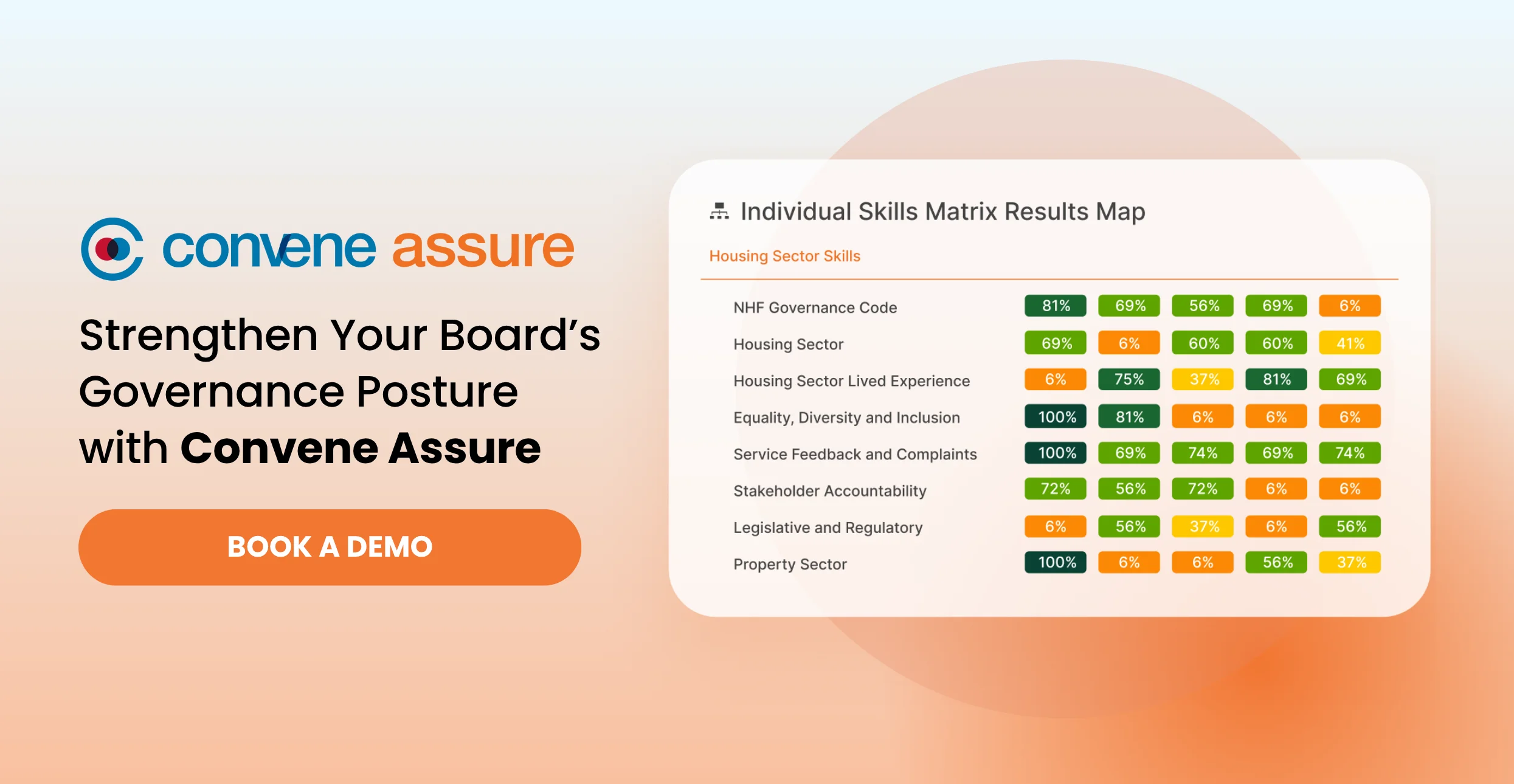
According to Convene Assure’s 2025 report, the concern is not just whether the board views People and Culture, Succession/Director Renewal, and Stakeholder Planning and Reporting as governance issues. The concern is whether this can be consistently applied as a governance practice.
Convene Assure is an advanced governance review and development tool that allows boards to determine governance maturity, pinpoint capability gaps, and create improvement plans with the help of an evidence-based framework. With features like governance reviews, skill assessments, and succession planning tools, organizations can strengthen oversight across governance areas.
- Board Governance Evaluation (BGE): Evaluate governance maturity across People & Culture, Stakeholder Planning & Reporting, and other contemporary governance responsibilities to identify assurance gaps and prioritize board development.
- Director Skills Matrix (DSM): Objectively assess directors’ skills, experience, and qualifications to identify capability gaps, support Director Renewal, and develop evidence-based succession plans aligned with future board requirements.
- Development Planning and Action Plans: Turn governance review results into structured action plans that help boards strengthen director capability, monitor progress, and address identified governance risks over time.
- Recommendations and Governance Insights: Receive data-driven recommendations and governance insights that help boards prioritize improvement initiatives, support informed decision-making, and strengthen oversight across key governance responsibilities.
Learn how Convene Assure can help your board build better governance confidence for years ahead. Request a demo now.
Download the Full Report:
Three Governance Risks Boards Cannot Afford to Ignore in 2026
About the Author
Fi Mercer, Global Governance Director, Convene Assure, MBA (Governance & Ethics), GAICD, Founder & CEO, GovernWith (Proudly now Convene Assure)
Fi is a global contemporary governance thought leader who leads the Convene Assure Strategy. She is a governance review and development specialist and works closely with boards, directors, and governance professionals across multiple jurisdictions, leading governance advisory initiatives that support organisations in strengthening board effectiveness, risk oversight, and governance resilience.



Jielynne is a Content Marketing Writer at Convene. With over six years of professional writing experience, she has worked with several SEO and digital marketing agencies, both local and international. She strives in crafting clear marketing copies and creative content for various platforms of Convene, such as the website and social media. Jielynne displays a decided lack of knowledge about football and calculus, but proudly aces in literary arts and corporate governance.
- Connect:
-

-