



Key Takeaways
- An executive director evaluation is a formal process that the board of directors conducts to assess the effectiveness of senior executives.
- A strong executive director performance review provides balanced insights by combining both qualitative and quantitative data, enabling boards to deliver 360-degree feedback.
- The executive director evaluation process generally involves defining KPIs, collaborating with governance or nominating committees, gathering and analyzing data, and discussing the results with leaders.
- Core performance criteria for executive director evaluation include project management, people development, financial management, compliance, and alignment with organizational values.
- A board evaluation platform helps simplify the performance review process by standardizing workflows. This allows boards to generate insights that support consistent and transparent decision-making.
Effective leadership is the backbone of successful organizations. For executive directors in particular, their leadership is crucial for setting priorities and running daily operations. When they fall short, it can slow down decision-making and create misalignment between governance and management.
In this context, the executive director evaluation becomes a vital tool for reinforcing accountability and task ownership. According to McKinsey in 2024, organizations that focus on their people’s performance are likely to outperform their peers by 4.2 times. This underscores the board of directors’ role in implementing consistent and actionable performance reviews for executive directors, managers, and staff.
This article discusses what an executive director evaluation is, its positive impact on organizations, and key steps to facilitate effective performance reviews.
What is an executive director evaluation?
Executive director evaluation is a formal process that the board of directors leads to assess the effectiveness of executive directors and other equivalent roles. It evaluates each director’s competence, conduct, strategic plans, and leadership effectiveness to determine if they align with the organization’s values and objectives.
Boards across nonprofits, corporations, and public organizations conduct it annually, with ongoing informal performance check-ins throughout the year.
It provides qualitative and quantitative insights into each executive’s performance on key areas, such as strategic leadership, financial oversight, governance, stakeholder engagement, and risk management. To gather data, boards typically use a multi-layered approach that includes self-assessments, performance scorecards, and stakeholder surveys.
Related Reading: What is Board Evaluation
How does executive director evaluation impact organizational success?
Executive director evaluation shows how senior executives can further deliver value to the organization by highlighting performance gaps and opportunities.
These effects are translated into the following benefits.
1. Sets leadership tone
The executive director evaluation sets the tone for the performance and accountability culture of the organisation. It defines the leadership competencies and KPIs that leaders are expected to meet. This encourages them to align their performance with these standards and promote collective accountability.
2. Clarifies roles and responsibilities
The board uses the evaluation to draw a clearer distinction among roles, particularly between executive directors and committees. It challenges the notion that leadership roles are one-size-fits-all by offering a tailored framework that reflects their actual degree of responsibility.
3. Strengthens organizational teamwork
Trust between board members and executive directors strengthens through regular performance evaluation. Constructive and transparent feedback breaks down silos and promotes positive leadership across the organization. For boards, this enhances buy-in to strategic decisions and confidence in leadership.
4. Facilitates intentional training and reskilling programs
Board evaluation of executive director identifies how well leaders are progressing towards organizational goals. This allows boards to reposition their governance strategies, enabling them to be more intentional with training and reskilling initiatives.
Additionally, evaluation helps boards make informed governance decisions, particularly on succession planning, workforce management, and compensation considerations.
5. Reinforces the board’s authority
Boards are responsible for ensuring that senior executives meet their management and fiduciary duties, and conducting a board evaluation of executive director helps fulfill this role. Through a comprehensive and actionable performance review, boards can reinforce accountability and oversight, which further strengthens their authority and governance effectiveness.
How to Conduct an Executive Director Evaluation: Key Steps
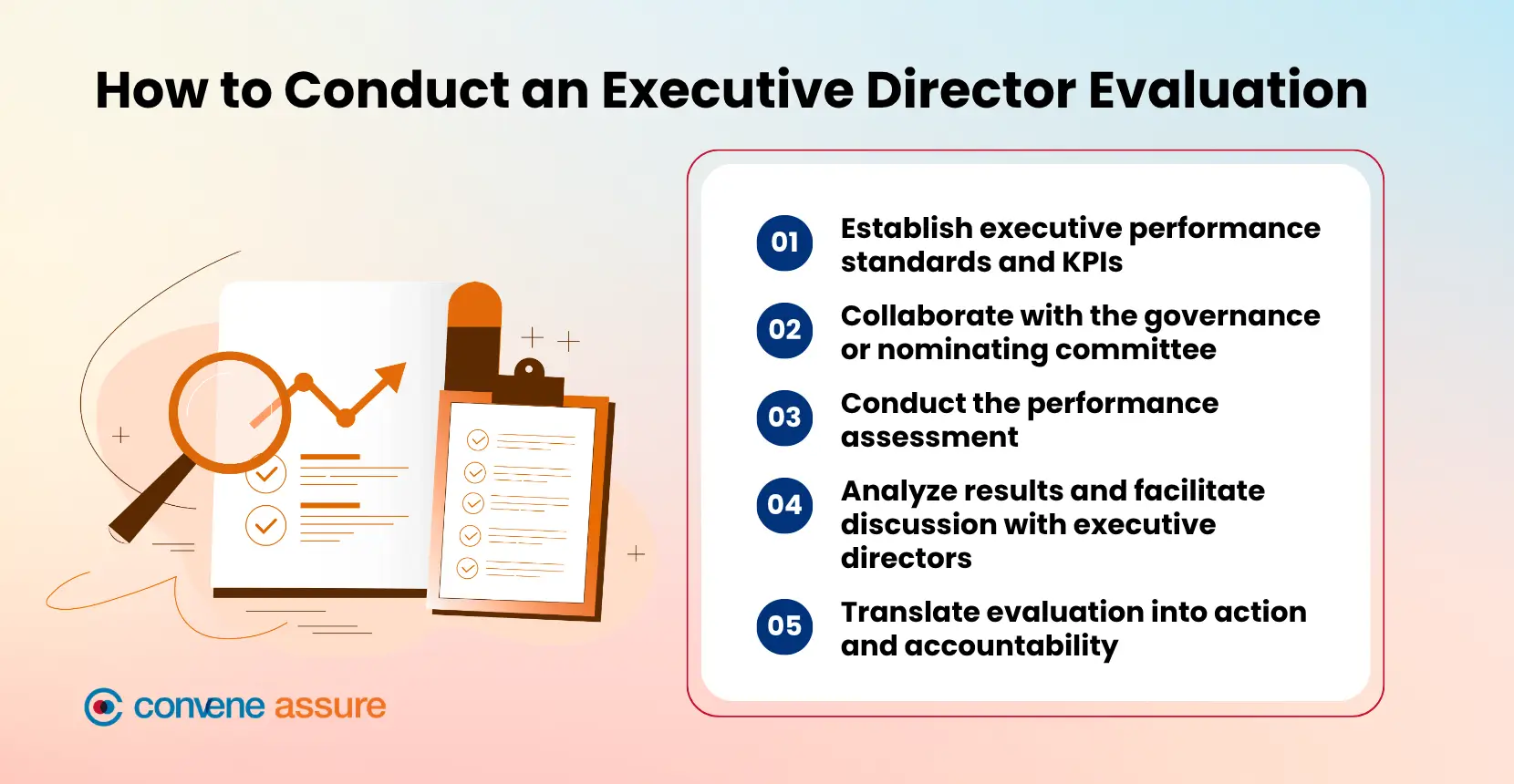
Executive evaluation is not just a procedure. It’s a governance function that directly influences an organization’s competitiveness and business continuity.
Here are the essential steps for conducting a structured and effective executive evaluation.
1. Establish executive performance standards and KPIs
First, establish executive performance standards and metrics that align with business objectives, including capital management, people development, ESG commitments, corporate governance, and digital literacy.
Define what constitutes high, adequate, or underperformance by being transparent with job descriptions, individual KPIs, and skills qualifications. To ensure fairness, align the executive director evaluation form with role-specific responsibilities across different positions.
For example, a nonprofit executive director evaluation should include fundraising effectiveness, stakeholder engagement, and donor retention. In contrast, a CEO in a corporation can be evaluated through revenue growth, profitability, and market penetration.
2. Collaborate with the governance or nominating committee
Build a performance evaluation system together with the governance or nominating committee. Given the long and tedious process involved, relying on an individual or just the board to run it is impractical. Avoid biases by assigning the committee chair and members outside the board or executive directors.
For urgent evaluation cases, boards may also form a special task force or ad hoc committee to coordinate with third-party evaluation consultants. It will be responsible for overseeing the entire process and ensuring that internal perspectives are properly integrated into the performance evaluation.
3. Conduct the performance assessment
Begin the assessment once the criteria and committee are in place. Obtain 360-degree feedback by collecting data from multiple sources. Typically, methods include executive self-assessment, board director evaluations, peer review, and objective performance data. Considering this, properly plan the logistics and sequence of data collection to avoid delays and ensure smooth flow.
Maintain objectivity by standardizing tools, rating scales, and scoring guidelines. Leveraging digital tools can further streamline the process by centralizing data collection and strengthening data protection to prevent data leaks.
4. Analyze results and facilitate discussion with executive directors
Aggregate the outcomes and compare them against the predefined benchmarks. This step doesn’t only involve combining numbers, but also demands board-level judgement to identify patterns of systemic or performance issues.
Use the results to support the one-on-one discussions with the executive directors. In addition, reinforce role expectations by also discussing development actions and evolving organizational objectives.
5. Translate evaluation into action and accountability
Performance evaluation does not end with discussion. For maximum impact, the board should lead in translating development action items into actual progress.
Have the committee formalize a follow-through system that tracks commitments and conducts mid-cycle check-ins. Keeping executive directors in the loop enhances task ownership and accountability, encouraging them to perform better.
Initiate a comprehensive executive director evaluation.
Key Performance Criteria for Executive Director Evaluation
Vagueness or shifting criteria is one of the biggest traps of performance evaluation. To ensure a consistent process, the board should agree on measurable and relevant standards that align with strategic goals.
Here are the recommended areas to focus on.
| Performance Aspect | Evaluation Focus | Key Performance Indicators |
|---|---|---|
| Project Planning, Development, and Delivery | Ability to plan, execute, and delivery projects aligned with organizational strategy |
|
| Organizational Culure | The impact of initiatives in boosting employee morale, improving performance and retention, and shaping behavior |
|
| Financial Management, Fundraising, and Compliance | Adherence to financial controls and regulations, and the effectiveness of funding strategies |
|
| Communication and Core Values Alignment | Quality of collaboration with the board and adherence to organizational values, mission, and vision. |
|
Common Pitfalls in Executive Director Evaluation Boards Should Avoid
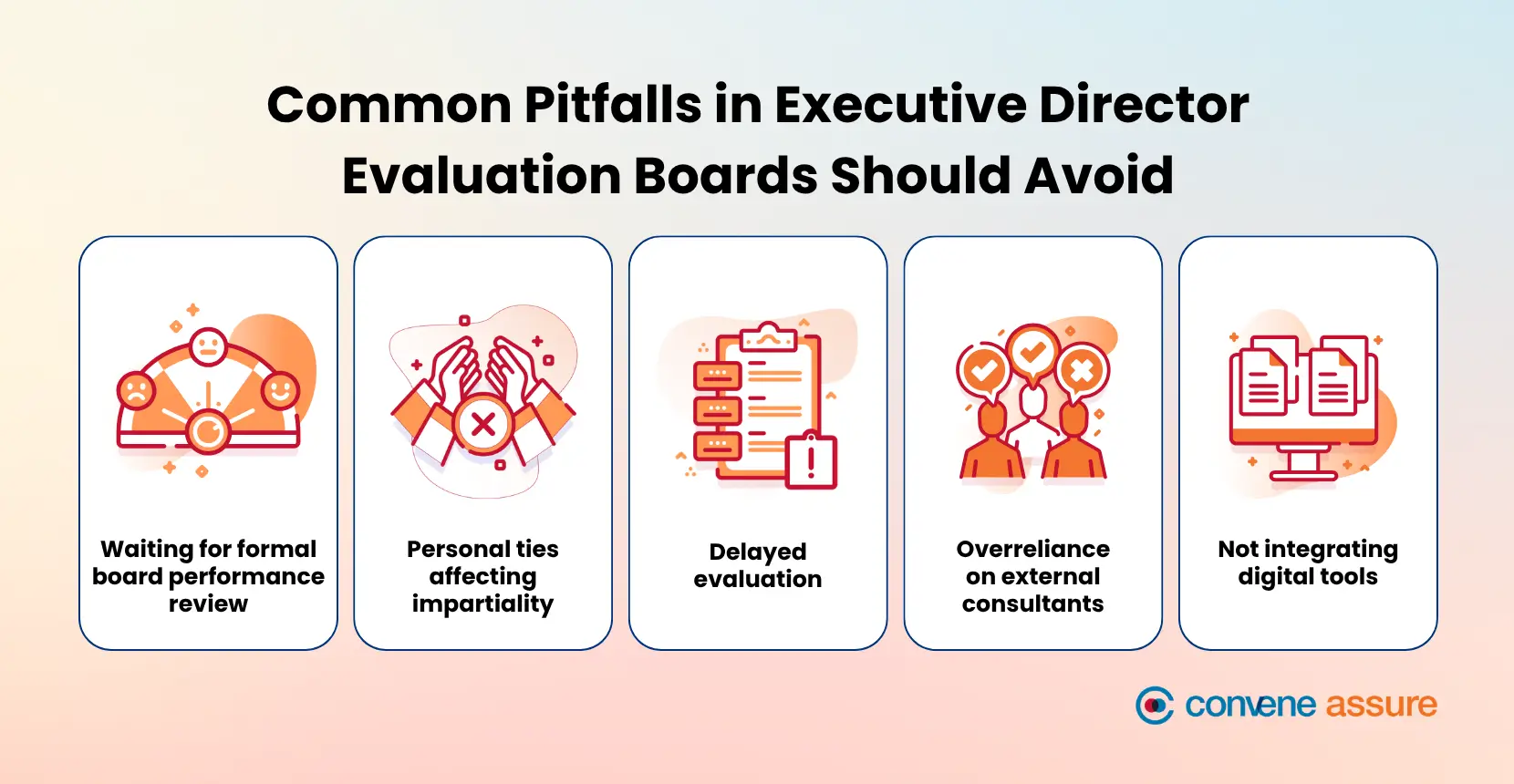
The key to a smooth evaluation is understanding the common pitfalls and proactively preparing for them. Here are key things to watch out for to achieve effective and efficient executive director evaluations.
1. Waiting for formal board performance review
Boards should not wait for formal reviews to raise concerns. Executive director evaluation is a long process, and relying solely on annual board performance review allows small issues to escalate over time.
Alongside the annual performance evaluation, boards and executive directors should engage in informal or scheduled touchpoints throughout the year. This ensures that immediate and easily addressable issues are acted upon as soon as possible.
2. Personal ties affecting impartiality
It’s common for boards and executive directors to have relationships outside the professional setting; however, these should not be used in ways that compromise objectivity. Personal familiarity must never influence boards’ performance assessments and decision-making.
To address this, organizations must have strong conflict-of-interest policies in their bylaws. Under these policies, leaders are mandated to disclose personal relationships that could affect their impartiality before assuming their positions.
3. Delayed evaluation
It’s a common pitfall for organizations to compress the whole process during compensation season or push it to the end of the year. When this happens, people are forced to complete elaborate questionnaires and surveys within limited timeframes, leading to less thoughtful assessments.
Boards should treat executive director performance evaluation as a strategic, standalone process. Preparation can start as early as the beginning of the year by defining the criteria. As the evaluation period approaches, the board and committee can just focus on refining them, allowing more time for the next steps.
4. Overreliance on external consultants
Outsourcing the discussion component of the evaluation draws the board away from its core governance responsibilities — holding executive directors accountable for their performance. Overreliance on third-party consultants, especially during one-on-one discussions, may detach them from the very process that strengthens its oversight.
External support is useful for data collection and analysis, but boards should keep active participation, particularly during discussions.
5. Not integrating digital tools
Do not be the type of boards that continue to rely on fragmented and manual processes for performance evaluations. For a meticulous activity such as this, it is essential to centralize documentation and standardize workflows.
Many organizations today leverage a board evaluation platform to enhance visibility and strengthen accountability among executive directors. It’s an all-in-one tool that allows boards to customize survey templates, visualize aggregated results in real-time, and automate reporting for a faster and more simplified evaluation process.
Frequently Asked Questions About Executive Director Evaluation
How often should an executive director be evaluated?
The boards should formally evaluate an executive director once a year. Companies generally schedule this at the end of every fiscal year so they can assess performance and outcomes over a full reporting cycle. Quarterly or periodic check-ins are also recommended to ensure alignment and prevent performance issues from escalating.
Who is responsible for conducting the executive director evaluation?
The board of directors bears the ultimate responsibility for driving executive director performance evaluation. However, in practice, the board often engages with a governance or nominating committee to help with execution. The committee supports the board, particularly with the more tedious tasks of gathering and analyzing data. Afterwards, the board takes the lead in facilitating discussions with executive directors.
What happens after the executive director evaluation?
After evaluation, the board schedules feedback meetings with executive directors to discuss key findings. Apart from tackling strengths and weaknesses, the board also reviews compensation and sets goals and development plans for the coming year.
This will be followed by regular progress check-ins throughout the year to ensure every executive director is on track with their development commitments and performance targets.
From Evaluation to Follow-Through: Simplify Executive Directors’ Performance Reviews with Convene Assure
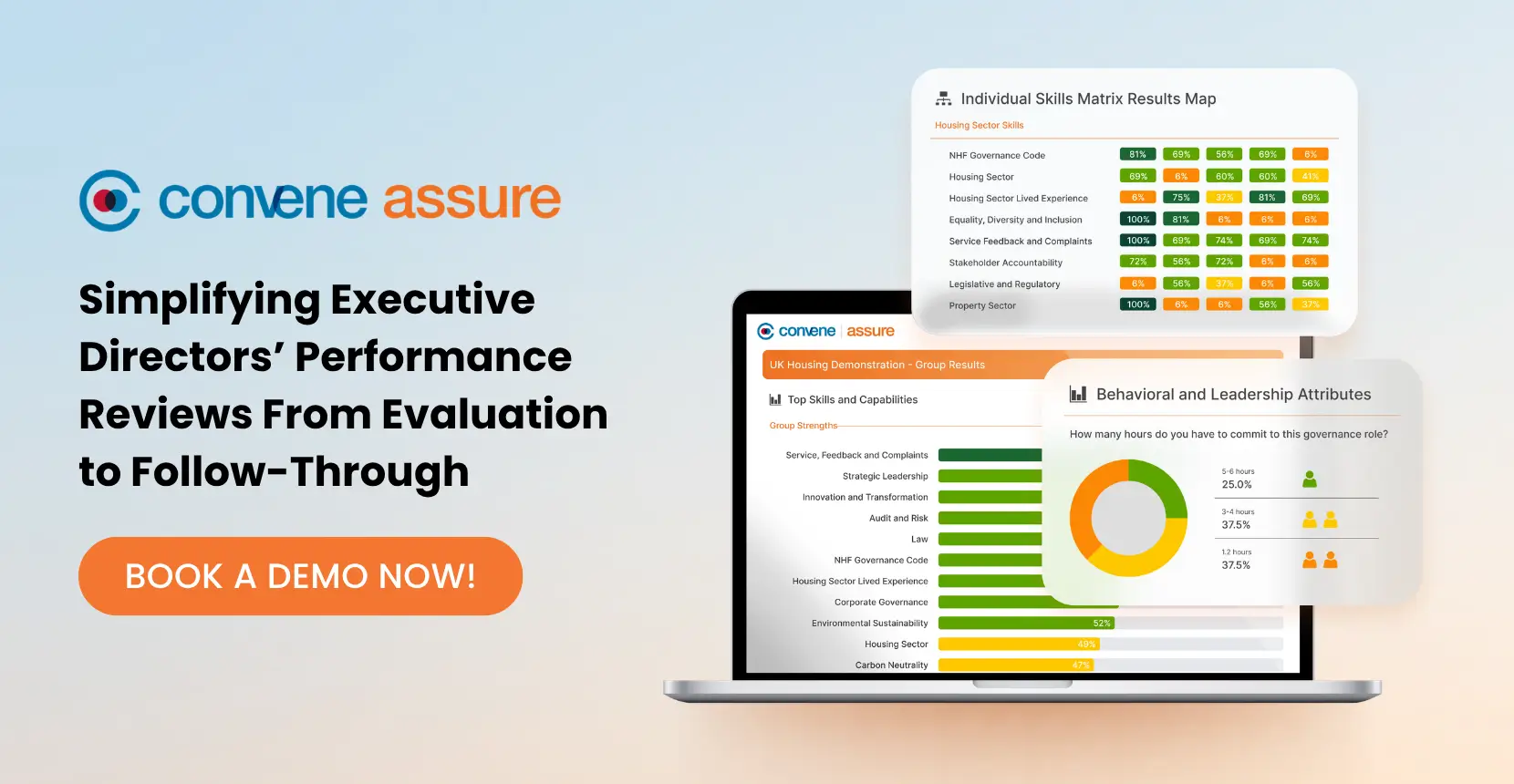
Many boards struggle to turn evaluation outcomes into meaningful actions due to the lack of continuity between insights, decision-making, and implementation. Evaluation is most efficient when supported by a unified platform that centralizes all key data into one single place.
Introducing Convene Assure, a comprehensive governance review platform designed to connect the entire performance evaluation cycle — from defining KPIs and creating questionnaires to distributing surveys, compiling results, and building improvement plans.
Convene Assure ensures that boards facilitate evaluations that meet corporate and data protection standards through the following capabilities:
- Protect confidential data using an enterprise-grade platform hosted by the Amazon Web Service (AWS) and certified under ISO standards.
- Save hours of manual analysis with customizable and regulation-aligned questionnaires and automated skills mapping.
- Nurture high-performing leaders using a structured, data-driven performance evaluation process.
- Strengthen accountability with interactive dashboards that provide real-time visibility into evaluation outcomes and post-feedback action plans.
With Convene Assure, periodic performance evaluations become more than just a checklist. It’s a digital tool that empowers the board of directors to promote a more continuous and accountable model of leadership oversight.
Book an app walkthrough today and discover how Convene Assure simplifies board evaluation.



Jean is a Content Marketing Specialist at Convene, with over four years of experience driving brand authority and influence growth through effective B2B content strategies. Eager to deliver impactful results, Jean is a data-driven marketer who combines creativity with analytics. In her downtime, Jean relaxes by watching documentaries and mystery thrillers.
- Connect:
-

-