


What does it take for a business to be successful? Innovative products? An exceptional leadership team? A bold strategic vision? All of these things help the business expand, but real, sustainable success usually starts in the four corners of the boardroom. Board members make choices that influence everyone, from stakeholders to employees. They set strategy, hold people accountable, and manage business risks.
But piecing together the board is not enough on its own. Boards need to work well together, be efficient, and regularly review their own performance.
In this guide, we’ll define board effectiveness, explain why it matters, show you how to measure board effectiveness, and share practical steps your board can take to strengthen governance and drive better results.
What is board effectiveness?
Board effectiveness refers to how well the board fulfills its governance responsibilities, whether individually or as a group. It goes beyond attending meetings or reviewing reports. It’s about bringing in the right skills and competencies to help the company achieve long-term success.
To support these responsibilities, the International Institute for Management Development (IMD) identified four key pillars to focus on: People, Information Architecture, Structures and Processes, and Group Dynamics and Board Culture. These pillars help boards stay effective and aligned with their goals.
People
The first pillar is all about the people on your board. Effective boards are made up of members who bring the right mix of expertise and perspectives. Each director should understand their role and take an active part in discussions and decisions. Having the right people sitting on the board is critical to provide strong oversight and balanced judgment.
Information Architecture
For a board to be effective, members need access to clear, timely, and balanced information. That is why directors should get both internal updates and outside perspectives to fully understand how the organization is performing and where it’s headed. Good information flows help boards make decisions that move the organization forward.
Structures and Processes
Effective boards rely on clear structures and processes. This means setting up the right committees and following set procedures for reviewing strategy, evaluating board performance, and planning for CEO succession.
Group Dynamics and Board Culture
A group of highly skilled members can only go so far without the right culture. Thus, a successful board must foster a culture in which members can speak openly and share diverse viewpoints while maintaining mutual respect. In other words, they must be able to work well together. When a board builds trust and encourages collaboration, it can avoid groupthink and make better decisions as a team.
Why is effective board governance important?
A recent study from PwC reveals that boards with greater expertise and higher oversight are better at making strategic decisions and managing risk. So, companies with good boards generally get a lot of important benefits, such as:
Stronger Strategic Oversight
Your board of directors plays a vital role in shaping organizational strategy. As they review plans, evaluate opportunities, and assess risks, they help leadership arrive at more informed decisions. At the same time, effective oversight keeps your strategic initiatives aligned with your mission and objectives.
Better Risk Management
It is your board’s role to identify and manage risks that could negatively affect the company if not handled with care and urgency. Good governance enables balanced approaches to addressing upcoming issues, whether regarding compliance, financial, cyber, or operational.
Improved Accountability and Transparency
A good board can hold management accountable for their actions. Clear governance and reporting structures also ensure the board itself remains answerable, building trust and stronger relationships with your stakeholders. As a result, this helps build a good company reputation among the clients.
More Informed Decision-Making
Diversity in governance is a key to good decision-making. Boards that have a mix of backgrounds and experiences are better able to provide the company with the means to deal with complex issues. For example, a director with years of experience in the finance field can share their expertise with the board to strengthen discussions around resource allocation, financial planning, and risk management.
Board Effectiveness Checklist: Key Areas for Assessment
Use the following questions to evaluate if your board is operating effectively or needs a review and improvement plan.
| Yes | No | |
|---|---|---|
Governance Structure
|
|
|
Board Composition
|
|
|
Board Committees and Individual Board Performance
|
|
|
Meeting Management
|
|
|
Board Evaluation
|
|
|
How to Measure Board Effectiveness: Frequently Used Methods
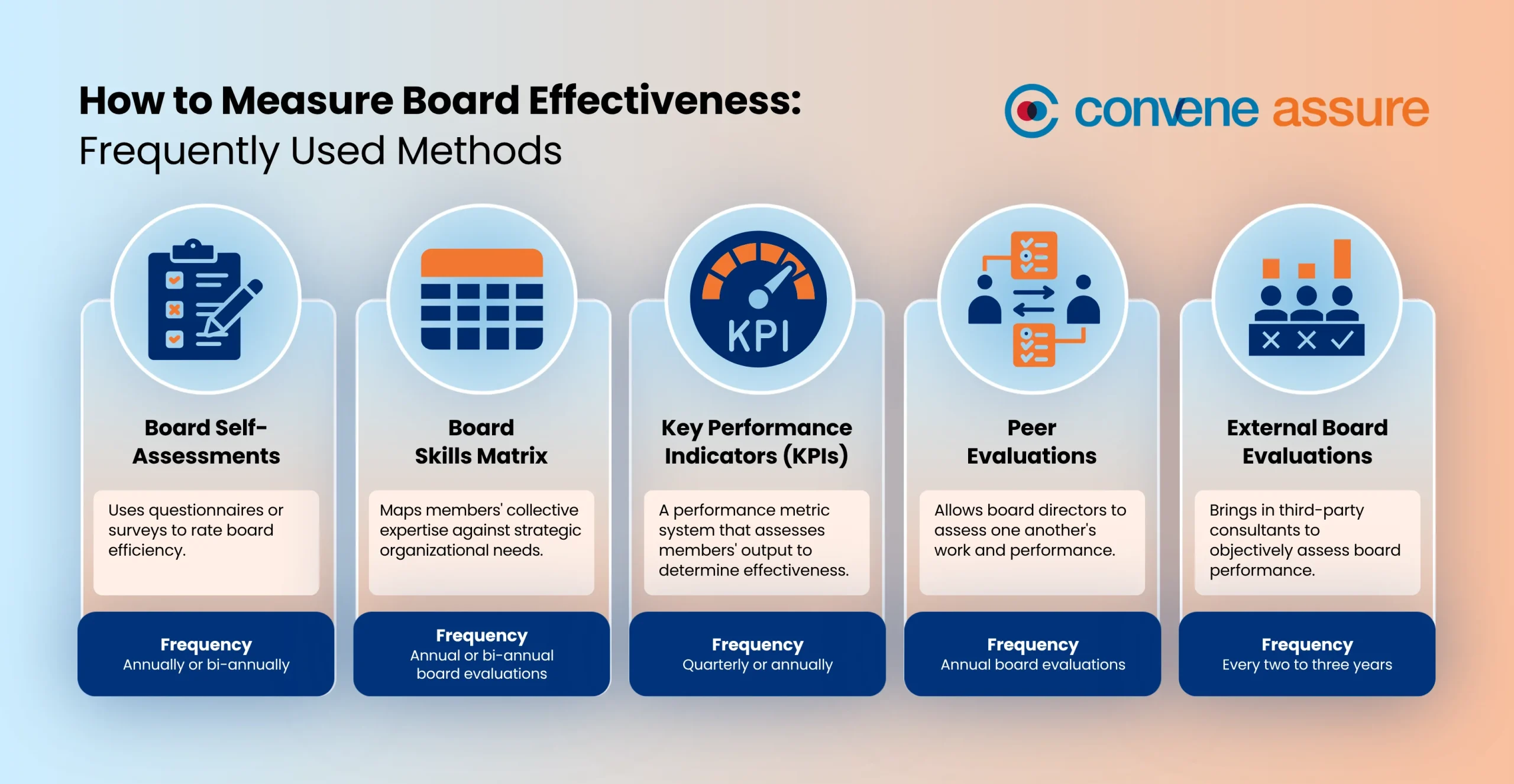
Improving board effectiveness starts with understanding how well your board currently performs. How can you do this? By conducting a structured evaluation process. Common methods for measuring board effectiveness include the following:
Board Self-Assessments
Self-assessments give directors a chance to reflect on how well the board is meeting its responsibilities. These evaluations often use questionnaires or surveys to rate factors like meeting productivity, strategic engagement, and risk oversight. This type of assessment is important for helping directors think critically about their contributions and to highlight areas for improvement.
When to use it:
Self-assessments are commonly conducted annually or bi-annually as part of regular governance reviews, and are particularly useful when organizations want a low-cost and efficient way to begin evaluating board performance.
Best suited for:
- Small to mid-sized organizations
- Nonprofits
- Private companies
- Boards starting a formal evaluation process for the first time
Common methods:
- Anonymous questionnaires or surveys
- Rating scales and scoring frameworks
- Written reflections or feedback forms
- Digital board evaluation tools
Board Skills Matrix
A board skills matrix maps the collective skills, experience, and expertise of all board members against the organization’s strategic needs. Using this tool can help you identify gaps in the board and develop solutions to fill them. For instance, skill gaps can be easily addressed by providing training and targeted mentoring.
Many governance experts recommend annual or bi-annual board evaluations, but the more often the better. Regular assessments help you spot performance gaps earlier and keep your board aligned with your organization’s priorities.
When to use it:
Skills matrices are typically used during board composition reviews, succession planning, or director recruitment cycles.
Best suited for:
- Growing companies
- Mid-sized to enterprise organizations
- Public companies
- Organizations undergoing strategic transformation or expansion
Common methods:
- Skills inventory questionnaires for directors
- Spreadsheet or software-based skills matrices
- Gap analysis workshops
- Strategic planning sessions
Key Performance Indicators (KPIs)
Boards can also set and track measurable KPIs, such as meeting attendance and participation, the quality of strategic discussions, and the effectiveness of board oversight of risk and compliance. Assessing members’ performance against the set KPIs helps you determine whether your board is working efficiently and supporting the company to the best of its abilities.
When to use it:
KPIs are most useful for ongoing performance monitoring, often reviewed quarterly or annually.
Best suited for:
- Enterprise organizations
- Public companies
- Large nonprofits
- Organizations with formal governance frameworks
Common methods:
- Performance dashboards
- Board meeting analytics
- Attendance and participation tracking
- Structured reporting and scorecards
Peer Evaluations
Peer evaluations offer a broader view of board performance by allowing directors to assess one another’s work. This approach promotes open communication among the team and helps you spot strengths and identify opportunities to improve engagement and expertise, based directly on the people they work with.
When to use it:
Peer evaluations are typically conducted during annual board evaluations or when boards want deeper insights into individual director performance.
Best suited for:
- Mid-sized to large organizations
- Boards with established governance processes
- Organizations seeking to improve collaboration and accountability
Common methods:
- Confidential peer review questionnaires
- Structured feedback forms
- Facilitated feedback sessions
- One-on-one director interviews
External Board Evaluations
Although boards often strive to assess their own performance objectively, internal evaluations can be limited by personal biases or internal dynamics. That’s why some organizations bring in independent or third-party consultants to objectively assess board performance.
When to use it:
External evaluations are commonly conducted every two to three years or during major governance transitions, such as leadership changes or organizational restructuring.
Best suited for:
- Enterprise organizations
- Public companies
- Highly regulated industries
- Organizations seeking deep governance improvements
Common methods:
- In-depth director interviews
- Group discussions or facilitated workshops
- Review of board documents and meeting materials
- Observation of board meetings
- Governance benchmarking and reporting
How to Improve Board Effectiveness: Best Practices
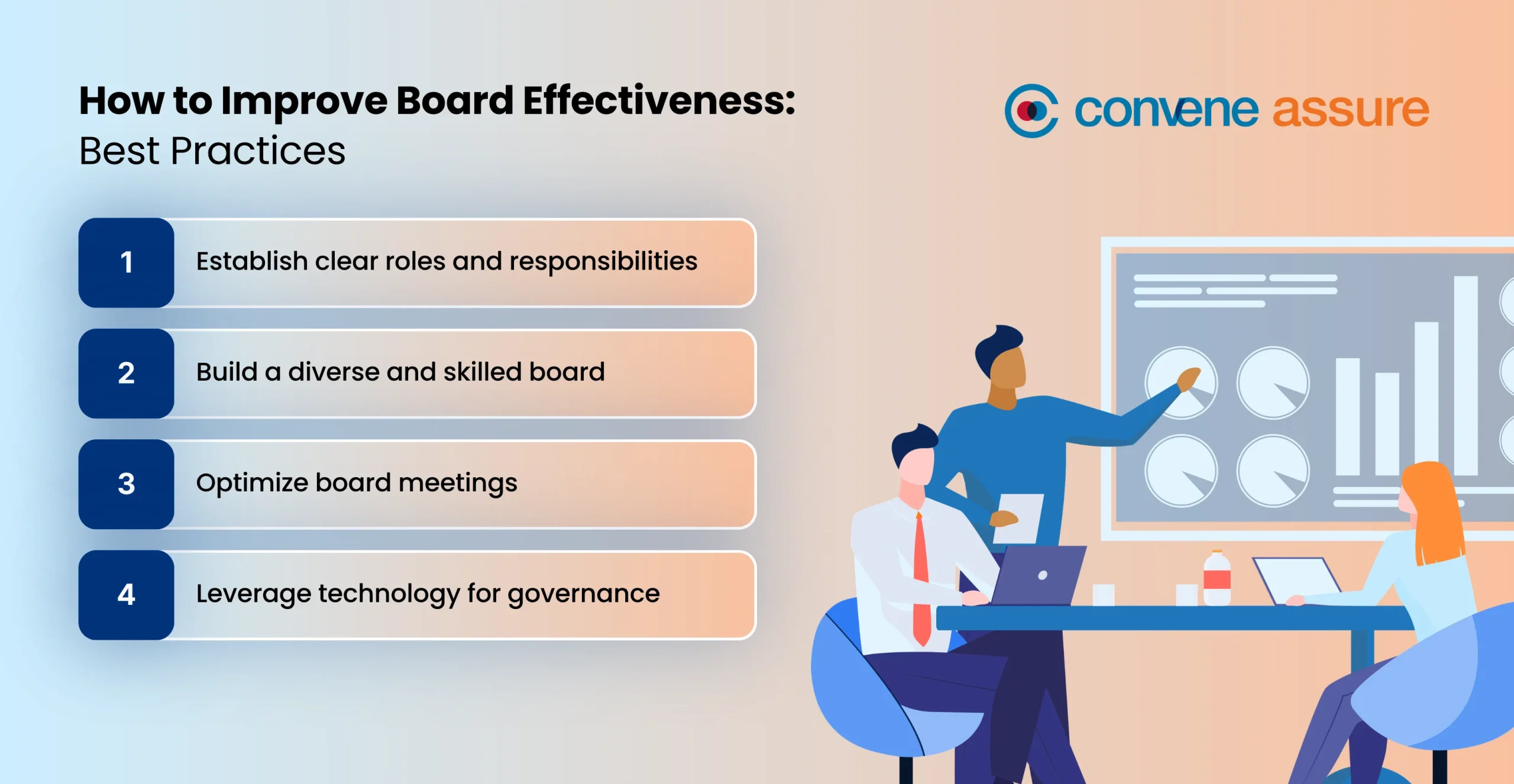
As governance expectations change, boards need to adopt modern practices that promote efficiency and strategic insight. The following best practices can help your organization strengthen board effectiveness.
1. Establish clear roles and responsibilities
Start by defining clear roles and responsibilities for your board members. Outline the specific duties of the board chair and each committee, and document these in a written charter. Make sure everyone knows what is expected of them and how they contribute to your organization’s success. Setting clear boundaries helps avoid confusion between governance and daily management tasks.
2. Build a diverse and skilled board
Build a board with members who bring a mix of skills, backgrounds, and perspectives. Look for directors with experience in finance, law, risk management, and technology. Someone proficient in cybersecurity and AI may also be a valuable addition to the team. A diverse board sparks better discussions and leads to stronger decisions for your organization.
At the same time, organizations should also focus on strengthening the existing board through continuous development. Providing board training and learning opportunities helps current members upskill and reskill in key areas such as governance best practices, emerging technologies, cybersecurity, and regulatory changes.
3. Optimize board meetings
Structure your board meetings to encourage open discussion and timely decisions. This can be done by sharing materials ahead of time, setting clear agendas with specific objectives, and focusing on strategic topics rather than routine matters. Also, make sure to document decisions and action items to keep everyone accountable.
4. Leverage technology for governance
Leverage digital tools like board management software to make your board’s work easier. These tools help you organize documents, prepare for meetings, and communicate securely in one centralized hub. Using technology improves collaboration, gives your board quick access to important information, and supports better decision-making.
Frequently Asked Questions on Board Effectiveness
What are the leading effectiveness tools for executive boards?
Many modern boards rely on digital governance platforms to improve efficiency and collaboration. Board management software like Convene helps centralize documents, streamline meeting preparation, and support features such as AI-powered summaries and board skills tracking.
How often should boards conduct assessments and evaluations?
Most organizations conduct board evaluations annually, while more comprehensive external evaluations are often done every two to three years.
How to become an effective board member?
Effective board members prepare well for meetings, actively contribute to discussions, and stay informed through ongoing governance training and professional development.
Strengthen Board Effectiveness and Performance with Convene Assure
Ultimately, effective boards are defined not just by structure but by their ability to assess, adapt, and guide your organization toward sustainable growth.
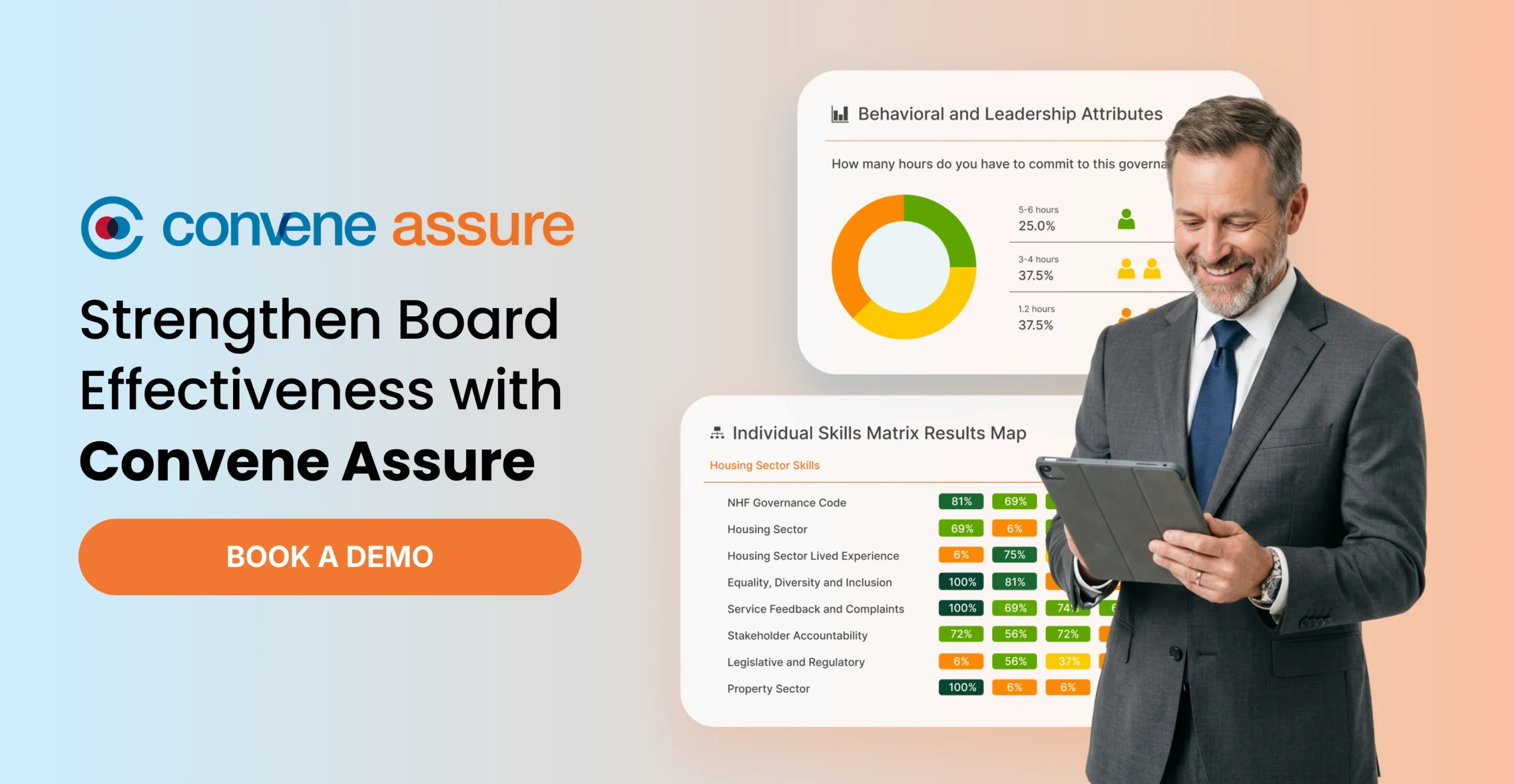
Modern boards can further boost effectiveness by utilizing board evaluation platforms like Convene Assure. Designed specifically to empower board governance and performance demands, this digital platform helps boards conduct structured, data-driven evaluations to identify performance gaps and translate results into actionable improvements.
Convene Assure supports stronger board effectiveness through features built for end-to-end assessment, including:
- Governance Review for a comprehensive, 360° assessment of individual directors and overall board performance
- Skills Matrix to map expertise against strategic priorities and resolve capability gaps
- Action Plans module translates evaluation results into clear next steps and tracks progress over time
- Annual Benchmarking capabilities to measure performance year over year and support continuous improvement
Is your board set up for success? See how a powerful board evaluation tool can help your board work smarter and more effectively. Book a Convene Assure demo today.



Jess is a Content Marketing Writer at Convene who commits herself to creating relevant, easy-to-digest, and SEO-friendly content. Before writing articles on governance and board management, she worked as a creative copywriter for a paint company, where she developed a keen eye for detail and a passion for making complex information accessible and enjoyable for readers. In her free time, she’s absorbed in the most random things. Her recent obsession is watching gardening videos for hours and dreaming of someday having her own kitchen garden.
- Connect:
-