



Key Takeaways:
- A mission statement is a public declaration of what an organization does and what purpose it serves.
- Having a strong mission statement gives organizations clarity and focus so operations remain aligned as the business grows.
- The mission statement focuses on present operations with considerations for long-term objectives, while the vision statement primarily focuses on future aspirations and motivations.
- A strong mission statement includes elements such as conciseness, clarity, measurability, alignment, and long-term relevance.
- For startups and rebranding businesses, a mission statement can help maintain focus, prevent drift, and guide alignment with new or evolving brand identity.
Any organization should have a clear view of what it wants to achieve even before it can make decisions. With a mission statement as a decision filter, it will be easier to identify which markets to enter, which products to create, and which opportunities are right to take.
Organizations rely on their mission statements to shape their culture and unify their teams around shared objectives. In this guide, we’ll explore what a mission statement is, what makes a good mission statement, examples from top companies, and how to write a good one.
What is a mission statement?
A mission statement is a public declaration of what an organization does and its purpose. It basically explains the organization’s values, culture, goals, and ethics. This statement is typically a short paragraph or one sentence that also allows the company’s leadership, employees, and customers to understand its top priorities.
A good mission statement will not just summarize why a company exists but also nurture stakeholder connections. Unlike marketing slogans or brand taglines, this statement plays a more significant role as a strategic and operational anchor. In fact, research suggests that organizations with strong mission statements tend to have better financial performance as they help in strategic planning and decision-making.
Why is a mission statement important?
A mission statement can serve as a good foundation for organizations towards growth and success. It also acts as part of the business’s public face and is sometimes used as the core of marketing and advertising efforts. A strong mission statement significantly matters for organizations since it:
- Provides clarity and focus on the organization’s purpose and primary goals so everyone, from leadership to employees, understands what it does and why.
- Guides decision-making that allows the organization to have a touchstone against which strategies or resources should be implemented or evaluated.
- Shapes company identity by communicating its values and philosophy, aligning stakeholders with a common purpose, and creating a consistent culture.
- Anchors long-term cohesion, so operations across different business units or locations remain aligned even if the company diversifies or grows.

What is the difference between mission and vision?
There’s always been confusion between a mission statement and a vision statement, even often used interchangeably. First off, a mission statement focuses on the present or what the company does now, for whom, and how. On the other hand, a vision statement focuses on the future or where the company wants to be and its long-term aspirations.
In terms of purpose, a mission guides day-to-day operations and decision-making, while a vision statement is set to inspire and motivate for future growth. That said, there’s also some distinction in their scope. A mission’s scope is generally specific about business activity or value proposition, while a vision’s scope can often be broad or more abstract and value-driven.
To put it simply:
- Mission = the organization’s what and how today.
- Vision = the organization’s where and why tomorrow.
Related Reading: Vision Statement vs. Mission Statement: The Key Differences and Why They Matter
Key Elements of a Strong Mission Statement
Understanding what elements should be incorporated in a mission statement fundamentally decides whether it’s going to be effective or not. One study found that a mission that is written clearly and easy to interpret leads to better employee understanding and alignment.
Here’s what should be included in a mission statement, helping your organization operate in the right direction.
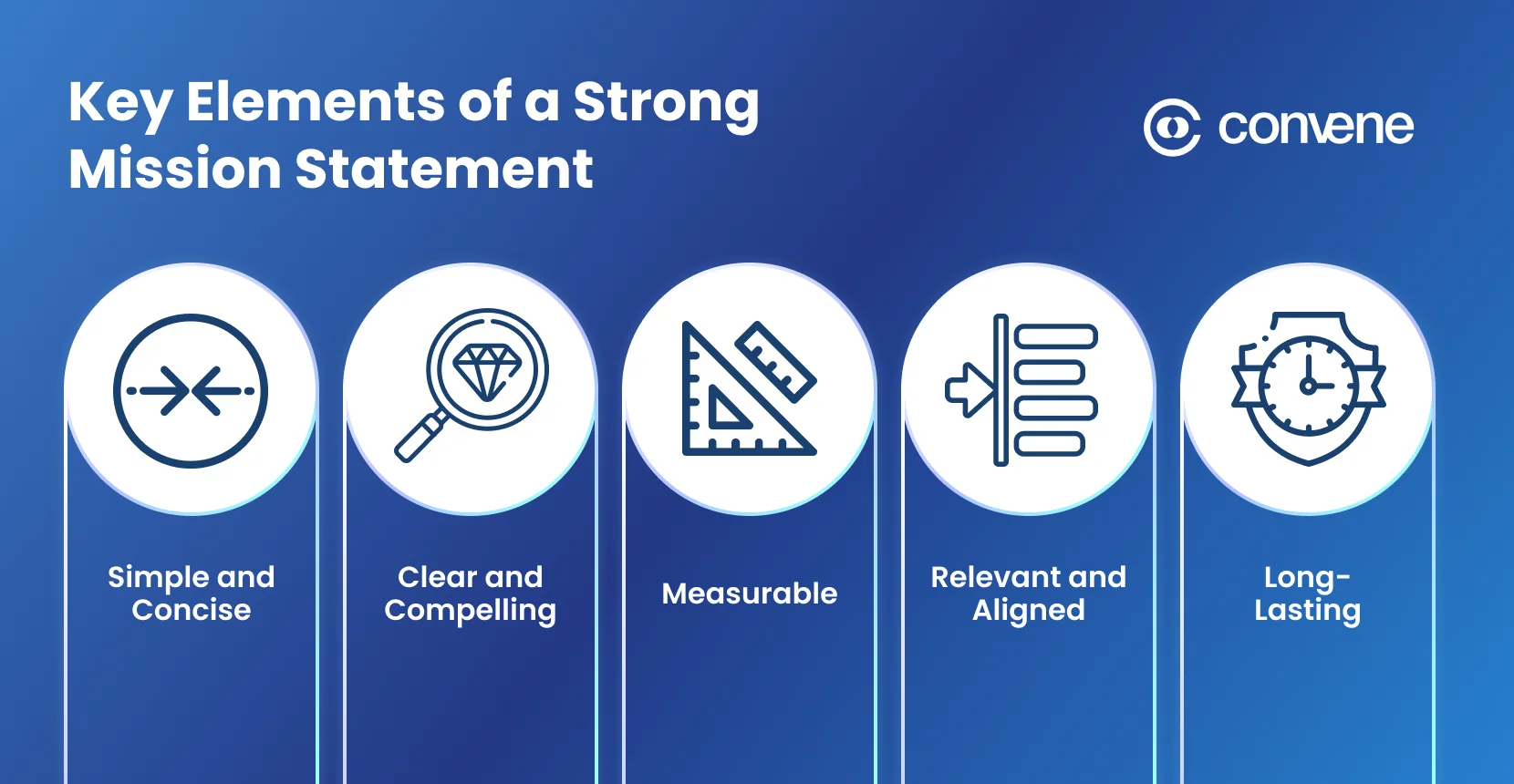
Simple and Concise
First off, write the mission statement in a language that is simple and concise. Ideally, people outside your organization should be able to grasp what your mission is all about. Some basic writing rules to follow are:
- Write the statement in one to two sentences. Do not use long sentences, extensive clauses, or semicolons.
- Use simple and active language with industry jargon, abstract terminology, and corporate buzzwords.
- Write in a language that every stakeholder can read and understand. It should not require a complex explanation.
Clear and Compelling
Clarity is what makes a good mission statement. It should clearly convey:
- Purpose = why your organization exists
- Primary service or value = what you do
- Target beneficiaries = who you serve
Your mission statement must also be compelling and motivating for employees. Utilize a language that doesn’t just reflect core values or ideals, but also resonates emotionally and inspires action or belief. But while a mission statement should be simple and clear, it must still have a distinct voice that’s far from vague business declarations.
Measurable
Another critical element of your mission statement should include measurable objectives and outcomes. This makes the mission actionable. Hence, your organization can assess if its operations or strategies align with it.
These measurable elements can be explicit (“…to serve 1,000 communities by 2030”) or implicit (“…a commitment to sustainable practices”). This helps answer an important question: What does a mission statement accomplish in a given timeframe?
Relevant and Aligned
It only makes sense that the mission statement is relevant or tailored to your organization’s nature, culture, and industry. This grounds the mission in authenticity while ensuring alignment with what your organization says and does.
Having a well-aligned mission is not only beneficial for internal teams to understand the organization better. It also enables external audiences to see why the mission matters to them. Hence, boosting resonance, buy-in, and even stakeholder trust.
Long-Lasting
While a mission statement primarily focuses on the “present”, it still should cut across short-term business aspects. You’d want it to serve its purpose even as the organization expands. Do not include specific references to products or market conditions that typically change over time. However, it is still recommended to have the mission reviewed periodically for continued relevance.
How to Write and Update a Mission Statement for Startups and Businesses
If written well, a mission statement can clarify why an organization exists and what value it delivers. Below are critical steps on how to craft a mission statement, as well as how and when to update it to ensure effectiveness.
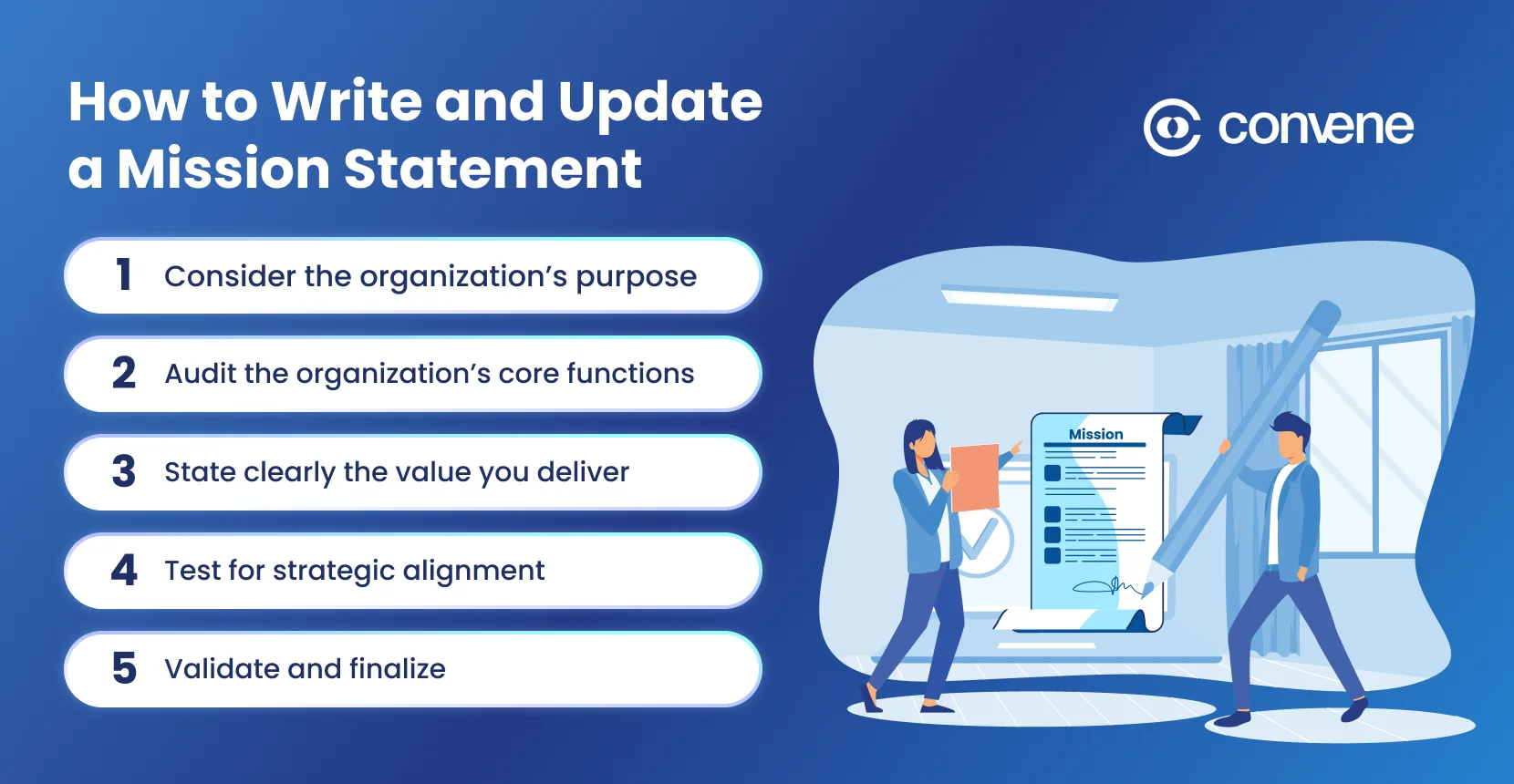
1. Consider the organization’s purpose
You could not write a mission statement without understanding your organization’s purpose. In fact, the mission is a strategic response to your purpose question, “What problems do we consistently solve?”
For instance, if you’re running a credit union, its purpose may be to expand financial inclusion for underserved communities. The key is for the purpose to be narrow enough to be meaningful but broad enough to guide business strategy.
What does this mean for:
- Startups: Prevents reactive pivots while ensuring clarity as the business grows.
- Rebranding Businesses: Make certain the new brand identity remains rooted in authentic company intent.
2. Audit the organization’s core functions
Once you have a clear view of the purpose, it’s time to start mapping what your organization actually does on a day-to-day basis. This may include review products, service lines, or core competencies.
Focus on activities that generate value and define your company’s operational identity. Your mission statement should be grounded in real functions, not aspirational language detached from actual operations.
What does this mean for:
- Startups: Should pay close attention to their minimum viable offerings and early traction areas.
- Rebranding Businesses: Must audit the specific functions that have changed or sunsetted to guarantee mission alignment.
3. State clearly the value you deliver
When drafting your mission statement, it’s important to connect your organization’s purpose to execution. Describe what value you deliver and how you do it in the operational aspect. Some examples of a mission statement that clearly state one’s values are:
- “Using evidence-based therapeutic model…”
- “Through affordable, community-focused lending services…”
Do not include abstract ideas like “innovative solutions” or “world-class services”. Instead, reference specific processes or methodologies that define the value your organization delivers.
What does this mean for:
- Startups: Helps investors, partners, and employees understand how the new business differs from others.
- Rebranding Businesses: Ensures the new brand identity is grounded in concrete strength and prevents the rebrand from drifting in the wrong direction.
4. Test for strategic alignment
Another thing to consider is to check if the mission defines the organization’s strategic limits. To easily do this, answer these questions:
- Does this mission align with your five-year strategic roadmap?
- Would it remain valid if we added or retired some product lines?
- Could employees use it to make decisions in ambiguous scenarios?
- Does it complement or support the company’s vision statement?
A strong mission statement will act as a decision filter. This is a good way to test whether a specific action either supports or contradicts your company’s identity.
What does this mean for:
- Startups: Must utilize strategic alignment testing to avoid mission drift when multiple opportunities arise.
- Rebranding Businesses: Should test whether the revised mission aligns with new brand pillars and growth directions.
5. Validate and finalize
Prior to final approval, it is better to test the draft with your internal teams, from frontline employees to the executives. If necessary, you can also send it to external stakeholders like the board of directors or advisory groups. This helps in achieving accuracy and resonance of the mission statement.
Furthermore, stakeholder validation can also support governance transparency and even reduce misinterpretation. After the revisions, the final mission statement must be ready for integration into your business documents, onboarding materials, and your website.
What does this mean for:
- Startups: Ensures alignment across their small, growing teams while preventing miscommunication as roles change.
- Rebranding Businesses: Helps maintain continuity and trust during transition, which is critical for stakeholders like tenured employees and loyal customers.
10 Examples of a Mission Statement from Top Companies
1. Amazon
“To make customers’ lives better and easier every day by relentlessly inventing on their behalf.”
2. Apple
“To bring the best user experience to its customers through its innovative hardware, software, and services.”
3. Tesla
“To accelerate the world’s transition to sustainable energy.”
4. Microsoft
“To empower every person and every organization on the planet to achieve more.”
5. Google
“To organize the world’s information and make it universally accessible and useful.”
6. Disney
“To entertain, inform and inspire people around the globe through the power of unparalleled storytelling, reflecting the iconic brands, creative minds and innovative technologies that make ours the world’s premier entertainment company.”
7. LinkedIn
“To connect the world’s professionals to make them more productive and successful.”
8. IKEA
“To create a better everyday life for the many people.”
9. Facebook (Meta)
“To give people the power to build community and bring the world closer together.”
10. NVIDIA
“To bring superhuman capabilities to every human, in every industry.”
Frequently Asked Questions About Mission Statement
Is a mission statement a legally binding document?
No. A mission statement is not legally binding and does not create enforceable obligations under contract law. It is simply a statement of what an organization intends to accomplish, based upon its purpose and values.
Can a mission statement change over time?
Yes. Revisions or updates in a mission statement typically occur during organizational restructuring or significant changes in operations or the market. Changes should then be reflected in internal documents, brand materials, and stakeholder communications.
Should a mission statement be public?
Yes, in most cases. While there’s no requirement to make it public, organizations commonly publish it on their websites and annual reports for transparency.
Can an organization have more than one mission statement?
Typically, no. It is ideal to maintain only one primary mission statement for an organization to have strategic coherence. In some cases, departments will create their supporting mission statements for role-specific identity.
Can a company operate without a mission statement?
Yes. There is no legal or operational requirement that an organization should have a mission statement. In fact, many startups or small businesses operate without one. The lack of a mission statement, though, could create cultural misalignment and create uncertainty regarding overall strategic alignment.
Translate Your Mission into Governance Action with Convene Board Portal

Translating a mission statement into governance action is rarely straightforward, even for large organizations. Many often struggle to turn their values and priorities into measurable workflows and repeatable decision-making processes. In some cases, the gap appears in daily governance operations, from inconsistent meeting follow-through, siloed documents, to slow approval cycles. This is a pain point that Convene Board Portal is meant to solve.
Convene, a global leading board portal, is designed to close this mission-to-execution gap by providing a platform that turns intentions into trackable actions. With Convene, organizations benefit from a modern governance environment that offers:
- Collaboration That Clicks Real Time: Get access to Live Meeting Tools such as Shared Annotations and Page Synchronisation, and Live Meeting Minutes and Notes for real-time collaboration, all without switching platforms.
- Accountability That Moves and Tracks: Ensure your action items don’t disappear into meeting minutes with Convene’s Action Tracker. Assign, monitor, and update action items with clear deadlines.
- Document Hub Without the Chaos: Upload business files, maintain document version control, and keep all governance materials organized with Convene’s Document Library.
- Decision-Making Without the Friction: Streamline approvals with full audit trails with Convene’s Review Room and Document Sign-Off Workflow.
Want to know more about Convene’s features? Book a demo with our team today!



Jielynne is a Content Marketing Writer at Convene. With over six years of professional writing experience, she has worked with several SEO and digital marketing agencies, both local and international. She strives in crafting clear marketing copies and creative content for various platforms of Convene, such as the website and social media. Jielynne displays a decided lack of knowledge about football and calculus, but proudly aces in literary arts and corporate governance.
- Connect:
-

-