



Key Takeaways:
- A board evaluation report is a formal, structured document created to assess the performance, effectiveness, and composition of the board of directors.
- The key elements of a board evaluation report include the executive summary, evaluation methodology, board composition and skills analysis, board responsibilities and structure, strategic oversight and risk governance, and action plan and recommendations.
- Writing a board evaluation report involves establishing its scope, determining the methodology to use, creating the key questions, collecting and analyzing the data, having actionable recommendations, and prioritizing continuous improvement.
- Ideally, a board evaluation and reporting should be conducted annually, with access restricted only to board members and the Corporate Secretary.
Board evaluations are conducted with a goal to create a high-performing board of directors, qualified to steer the organization to the right path. When done properly, such assessments can help in achieving greater clarity of responsibilities, better leadership, smarter decision-making, greater accountability, and improved board operations.
Presented through an evaluation report, the results can also help attend to the growing disconnect between boards and executive teams. In 2025, only 30% to 35% of executives rated their boards as excellent or good, expressing concerns about the skills, knowledge, and role clarity necessary for directors.
In this article, we will dive deep into what an evaluation report is, its key components, and the steps on how to write one.
What is an evaluation board report?
A board evaluation report refers to the formal, structured document created to assess the performance, effectiveness, and composition of an organization’s board of directors. It collects results from annual board assessment processes and converts them into practical recommendations that will help enhance organizational performance.
Compared to raw assessment data (e.g., surveys or questionnaires), a performance evaluation of board of directors consolidates both quantitative and qualitative findings into one coherent narrative. These reports typically include:
- Strengths in board operations and leadership
- Gaps in skillset, knowledge, structure, or processes
- Risks related to board governance effectiveness
- Recommended actions for overall improvement
What are the key elements of a board evaluation report?
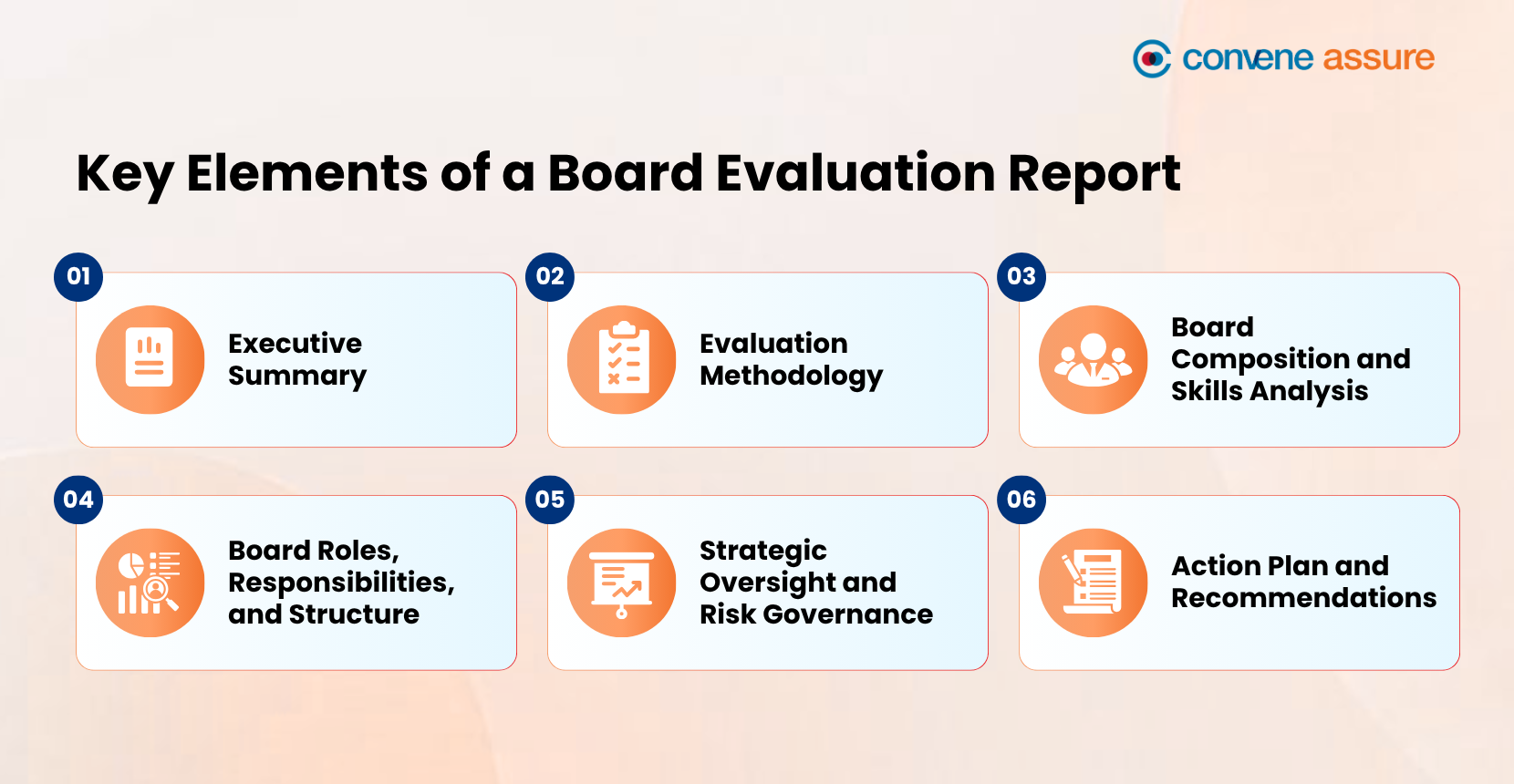
While components of a board performance evaluation depend on the organization’s structure and industry, some common ones to include are:
1. Executive Summary
One critical component of every evaluation report is the executive summary. More than just a recap, this part provides a ‘decision-enabling’ brief for board directors — specifically non-executives who didn’t entirely engage with the report. The summary is also expected to reflect performance gaps or any urgency for change.
According to PwC’s 2025 Annual Corporate Directors Survey, 55% of public company directors believe at least one of their colleagues must be replaced. Hence, this suggests that directors are now being more candid when evaluating their peers’ performance.
The executive summary usually consists of:
- Clear effectiveness conclusion, typically aligned with relevant governance benchmarks (e.g., regulatory expectations and internal performance frameworks).
- Top 3 to 5 critical issues, ranked by their governance risk or strategic impact.
- Summary of material changes since the last evaluation cycle, often including improvements in board performance or gaps in expertise.
- High-level action roadmap, frequently categorized into short-term (can be up to 6 months) and medium-term (6-18 months) initiatives.
Some boards also include trend indicators to show how their performance is declining or improving year-on-year.
2. Evaluation Methodology
The crucial section in every report evaluation is the methodology utilized to perform the assessment. This helps reduce bias, establish defensibility, and ensure multidimensional evaluation. In general, some elements to include are:
- Evaluation Design: Use of mixed approaches (quantitative or qualitative), structured questionnaires directed to governance frameworks (e.g., OECD principles), and scoring models (e.g., Likert scales with weighted categories).
- Data Collection: Anonymous director surveys, one-on-one confidential interviews by independent facilitators, and peer evaluations (or assessing each other’s contributions).
- Score and Coverage: Full board assessment, committee-level evaluations (audit, risk, nomination, remuneration), and individual director assessments.
- Benchmarking: Internal or year-on-year comparison and external against peer organizations or industry standards.
3. Board Composition and Skills Analysis
In this section, organizations typically utilize skills matrices and competency frameworks or templates for proper (almost accurate) assessment. In fact, only 32% of executives think their boards have the right mix of skills and expertise, making board composition and skills analysis even more critical. Ideally, a board evaluation report encompasses:
- Skills Matrix Mapping: Financial literacy and audit expertise, industry-specific knowledge and years of experience, cybersecurity and technological skills, and sustainability oversight proficiency.
- Independence and Tenure Analysis: Percentage of independent vs. non-independent directors, average tenure and risks of over-tenure, and rotation policies and refreshment strategies.
- Diversity Metrics: Gender diversity (aligned with regulatory expectations), cognitive diversity (like professional backgrounds), and geographic and cultural representation (important for multinational boards).
4. Board Roles, Responsibilities, and Structure
This section of the report primarily focuses on whether board governance structures are aligned with oversight demands. To ensure the board is fit for purpose, it is important to meticulously evaluate it for the following:
- Role Clarity: Clear delineation between board oversight and management execution, and avoidance of ‘overreach’ (micromanagement) or ‘underreach’ (insufficient oversight).
- Committee Effectiveness: Clarity with regulatory requirements, quality of reporting, and depth of subject-matter expertise among members.
- Governance Framework Alignment: Compliance with applicable corporate governance codes and alignment with internal policies such as board charters.
5. Strategic Oversight and Risk Governance
In a recent report by the Harvard Law School Forum on Corporate Governance, boards are facing “a period of unprecedented leadership churn, systematic risk, and technological disruption”. Hence, requiring board oversight to be active, not reactive. That said, one of the most critical evaluation areas that boards must focus on is strategic oversight and risk governance. The report should then assess:
- Strategic Oversight: The role of the board in strategy formulation versus passive approval, and the frequency and depth of strategic reviews.
- Risk Governance: Effectiveness of ERM systems, oversight of risk categories like financial and operational risks, cybersecurity and data privacy risks, and regulatory and compliance risks.
- Emerging Risk Preparedness: The ability to anticipate or respond to new threats such as AI regulation and geopolitical instability.
6. Action Plan and Recommendations
Lastly, this section is where the report is expected to deliver tangible governance value. Ideally, an effective action plan should comprise:
- Specific time-bound recommendations, such as to recruit a new director with AI expertise within 12 months
- Clear ownership, or the delegation of committee roles
- Progress tracking mechanisms, which are usually integrated into board dashboards
Some boards also adopt continuous evaluation cycles instead of annual one-off reviews and tracking of KPIs.
How to Write a Board Evaluation Report
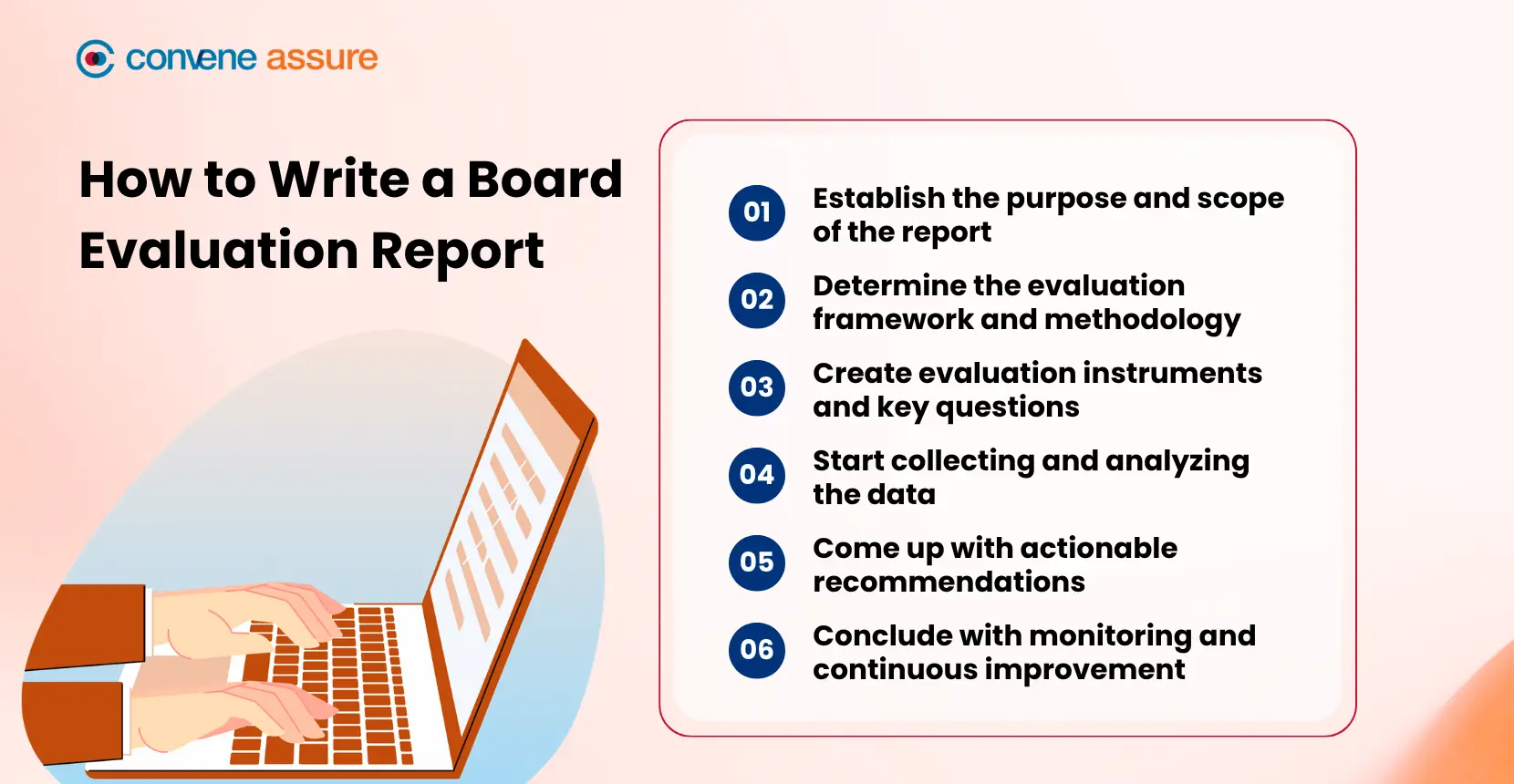
To write a board evaluation report, it takes more than just summarizing your findings. Your evaluation should follow an organized, disciplined process to develop insights that can lead to substantive ways to improve your board. Below are the steps to create a clear, well-organized board performance evaluation report.
1. Establish the purpose and scope of the report
The evaluation report begins long before writing — it starts with conceptual clarity. It requires you to define the purpose and performance areas that will be evaluated. You also have to consider whether the report will be reviewed by the entire board, committees, or just directors, like the chairman.
Well-defined goals are critical to writing an effective report. Examples of such goals include enhancing strategic planning, improving governance mechanisms, or ensuring the board’s competencies match future organizational challenges. Otherwise, the report will be more descriptive than analytical.
2. Determine the evaluation framework and methodology
The next step is to put together a framework for your board evaluation process. This will include selecting what type of research methodology you want to use. For example, self-evaluations, peer board performance reviews, external evaluations, or a combination of all three. Also, identify what types of criteria you will use to evaluate the results from these research methodologies.
A well-designed report will outline how the methodology used to collect the data was established. This includes detailing the methodological approach and rationale. For example, a survey will collect information over a wide area of data sources, whereas an interview will collect in-depth information from a single source of data.
3. Create evaluation instruments and key questions
The validity of the evaluation report of a board relies on the questions asked. To evaluate the effectiveness of the board, the questions should touch on board dynamics, effectiveness of decision-making, contributions to strategies, and culture of governance. Some examples are:
- Does the board spend enough time on long-term strategy versus operational updates?
- Do board packs provide you with the right data for effective decision-making?
- Are you (directors) comfortable expressing dissenting views during meetings?
- Is there a healthy balance of support and challenge for the CEO?
- Are the interests of key stakeholders sufficiently considered?
- What is the one change that would most improve board performance?
The board performance review itself should contain open-ended questions that focus on behaviors and include contextual information. This way, the evaluator can see not only what the board has done, but how the board has done it, and what effect it had on the organization.
4. Start collecting and analyzing the data
Sufficient evidence is necessary to support a credible board report evaluation. Data sources may involve questionnaires, interviews, document analysis (such as Board papers and minutes), and even firsthand observation of board meetings.
Following data collection, having a structured data analysis is also critical to identifying capability gaps and pinpointing areas of over- or under-representation. This may include conducting a SWOT analysis to check the board’s strengths and weaknesses, as well as creating a skills matrix to map current competencies against those necessary for effective governance. Other analytical approaches involve analysis of qualitative feedback, trend identification across the responses, and benchmarking results.
5. Come up with actionable recommendations
A performance evaluation of the board of directors should end with action, not simply recommendations that are generic, but rather detailed and specific concrete actions. Actionable recommendations must also be aligned with the data presented in the report. Some examples are revising meeting protocols, optimizing board composition, and enhancing information quality.
Finally, there should be an implementation plan. This will include the identification of roles, time frames, and the standards against which success will be evaluated.
6. Conclude with monitoring and continuous improvement
Last but not least, a good board evaluation report prompts monitoring and assessment of the proposed changes. Some ways to do so are through follow-up surveys, KPI tracking, and periodic progress reviews.
In doing so, it makes the evaluation process a continuous feedback loop, which simultaneously improves board governance. From this point of view, the report should not be seen as the end result but rather a component of performance management.
Frequently Asked Questions About Board Evaluation Reports
Who should have access to the full report?
Traditionally, the detailed report is restricted only to the members of the board and the Corporate Secretary. The management team can get a summarized report, while in some cases, the board evaluation process itself can be stated briefly in the yearly report to the shareholders.
How often should these reports be generated?
The most common recommendation according to best corporate governance practices is to conduct the evaluation and reporting annually. However, in some regions or stock exchanges, there is a requirement to do this kind of work only once every three years.
How do boards ensure the report remains objective?
This can be achieved through hiring external facilitators and consultants. In case an internal review process is chosen, using standard computer-based tools and conducting anonymous surveys reduces the chances of bias.
How should the board discuss the evaluation report’s findings?
The findings need to be part of the agenda for a specific board meeting. Normally, it is typical to conduct a workshop where the management is not involved in order to freely discuss the outcomes and the recommended action items.
Convene Assure: Your Go-To Board Evaluation Software
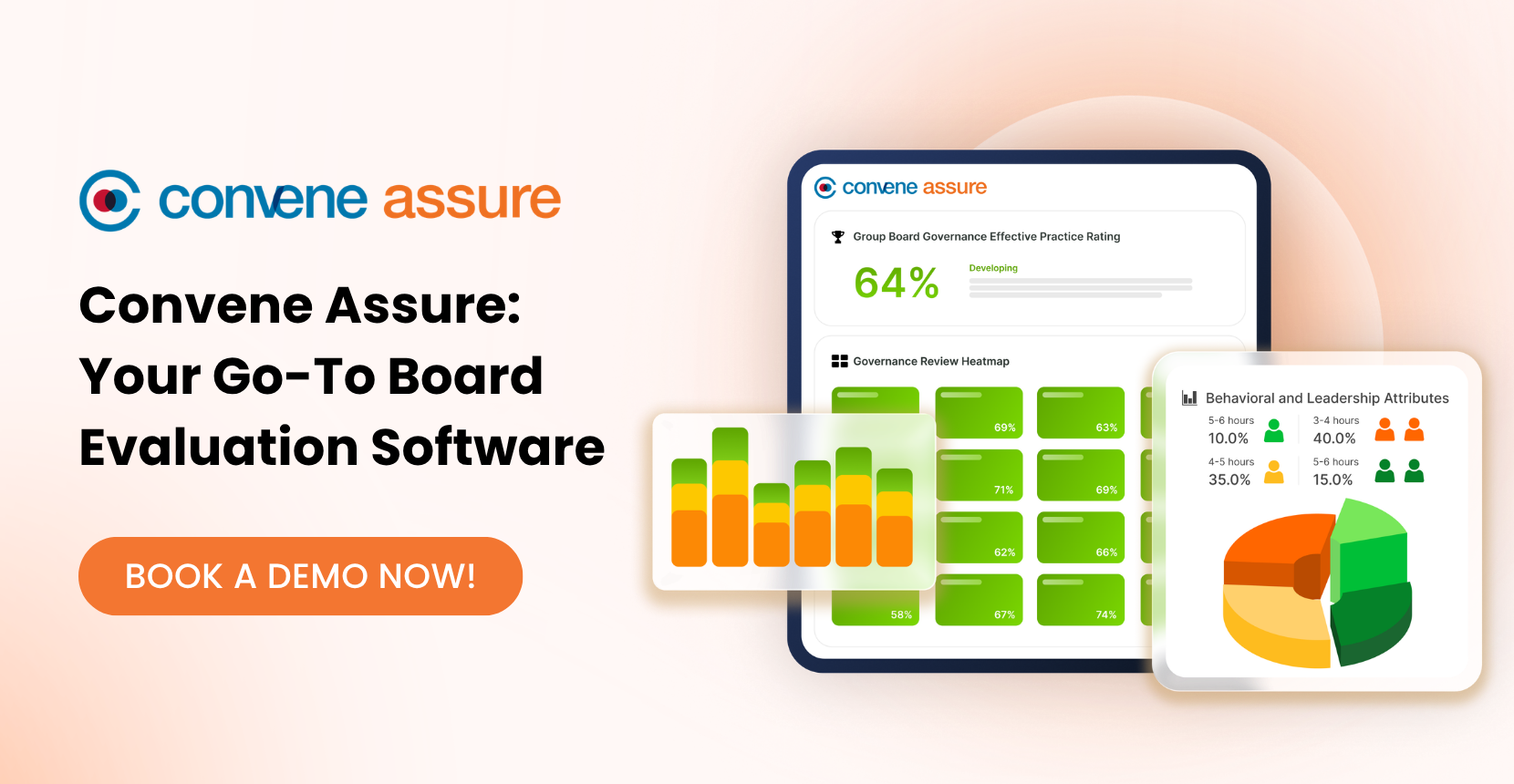
Creating a board performance evaluation report from scratch can be a daunting task, requiring you to synthesize raw feedback into one cohesive narrative. On top of that, you need to ensure that each of your director’s blunt critiques doesn’t accidentally leak — all while trying to map elusive skill and knowledge gaps. This is where board evaluation software comes into play.
Convene Assure, a dedicated board evaluation tool, is designed to streamline and upgrade your entire board assessment process. Purpose-built for modern governance, this all-in-one platform gives you access to secure dashboards to manage simple to complex evaluations, view the reports, and keep up with board effectiveness.
- Customizable Governance-Aligned Surveys: Easily conduct evaluations for your board, committees, and individual directors using Convene Assure’s customizable, regulation-aligned questionnaires. Tailor your board surveys based on your organization’s unique requirements.
- Skills Matrix and Gap Analysis: Gain a clear view of your board’s collective capabilities through a dynamic skills mapping feature. You can now identify your board’s strengths and gaps with actual data-backed insights.
- Automated Report Generation: With Convene Assure’s built-in analytics and visualization features, you can conveniently turn those raw survey responses into clear, actionable reports. Reduce manual effort in your board evaluation process now.
- Secure Data Handling: Keep your board’s confidential evaluation data within a secure environment. Convene Assure’s enterprise-grade AWS centers and guaranteed SOC- and ISO-certified tools ensure all information is protected.
Looking to generate more consistent performance reviews? Talk to our team today and find out why Convene Assure is the perfect board evaluation software for you!



Jielynne is a Content Marketing Writer at Convene. With over six years of professional writing experience, she has worked with several SEO and digital marketing agencies, both local and international. She strives in crafting clear marketing copies and creative content for various platforms of Convene, such as the website and social media. Jielynne displays a decided lack of knowledge about football and calculus, but proudly aces in literary arts and corporate governance.
- Connect:
-

-