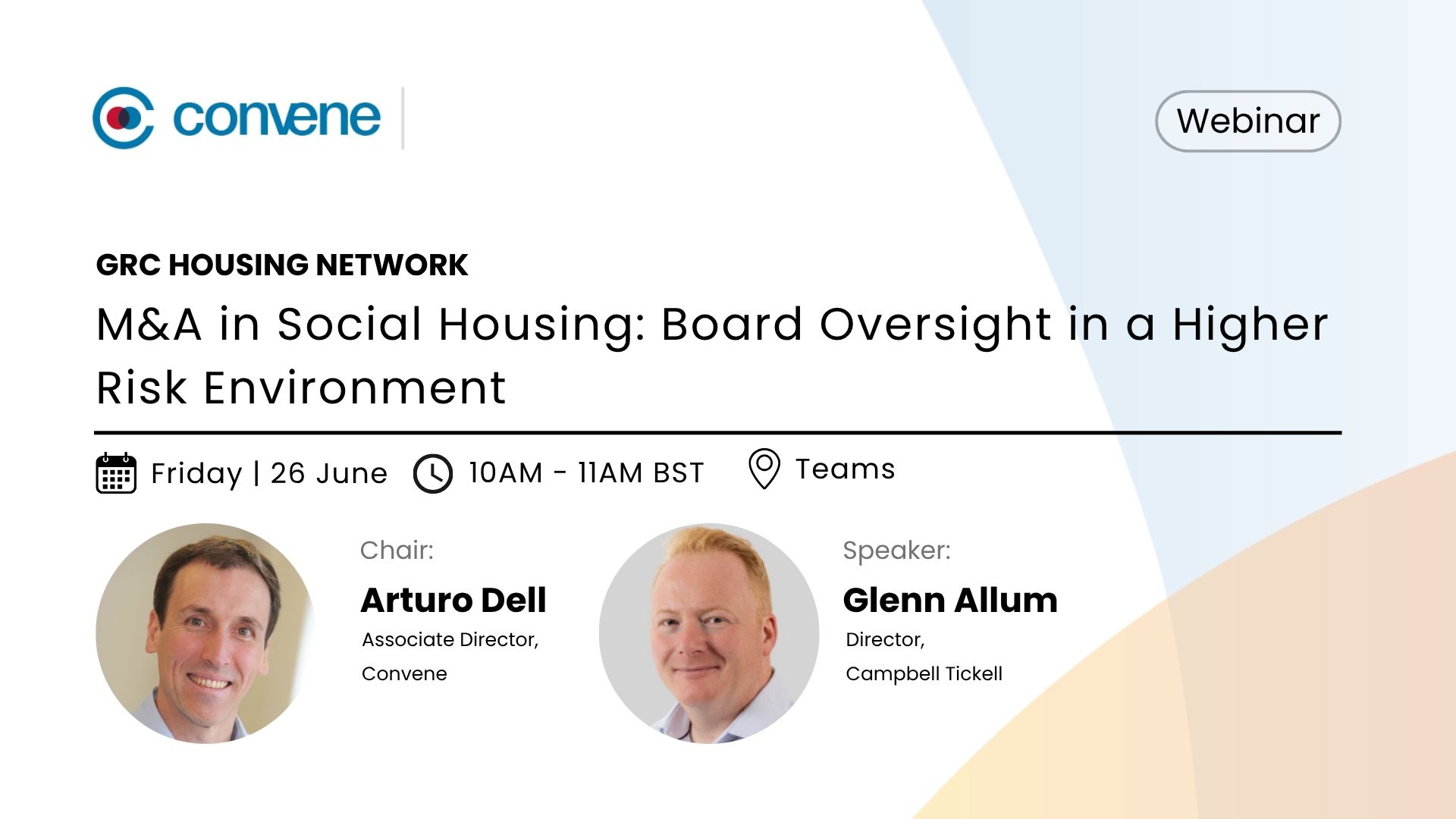


Mergers and acquisitions can be difficult for everyone involved. Figuring out how to combine cultures, build trust, communicate efficiently and align the business plan can create a lot of stress. So, for today’s GRC Webinar, we decided to explore this topic and provide a solution to help housing organisations that may be going through this change.
Firstly, a big thank you to Director Glenn Allum, from Campbell Tickell, for joining and presenting. Also, our GRC Network thrives on open dialogue so thank you to everyone who attended and asked some great questions. We look forward to seeing you at our next webinar!
Glenn Allum: M&A in social housing recap
Campbell Tickell has delivered between 80 and 90 mergers in the last 10 years which provided us with great insight. Read on for our recap of Glenn Allum’s presentation on M&A in Social Housing.
What’s driving M&A in the housing sector?
Allum split the driving factors between ‘push’ and ‘pull’. This is a list of pushing factors that are driving M&A in the housing sector, in no particular order.
Push drivers
- Asset Investment
- Systems and Data Security
- Increasing consumer regulations (Awabb’s Law, Service Charges etc.)
- Financial pressures (costs of materials, inflation, credit)
- High cost of new/replacement debt
- Ability to attract or retain colleagues and/or provide the required breadth of skills
- Impact of international uncertainty
- Encouragement to build more
How do housing organisations respond to these factors?
Allum gave 5 examples of how housing organisations respond to the driving factors of M&A:
- To focus on service
- Improve efficiencies to create or maintain capacity
- Divert capacity (from development to asset or services)
- Sell stock to generate capacity
- Merger
Pull drivers
- Drive efficiency to boost capacity for investment
- Increase resilience and capability to absorb shock
- Increase national coverage, proactively expanding into new regions
- Consolidate in existing geographies where stock holdings are small
- Increase influence (in the UK and potentially in Europe)
- Acquire skills the business is unable to find or secure to deliver objectives
- Increase influence in current areas (such as London) or nationally
- Fix pockets or poor operational performance (a common factor in Groups with stretched geography)
Market trends
Here are 5 market trends, from the last 2-3 years, that Allum shared with the audience:
- Scale is still accepted as a positive strategic ambition
- Consolidation remains a strong feature of the market
- Maintaining credit rating is at a higher priority than V rating but shouldn’t be understated
- There’s been an upward trend of rescue mergers. There’s been many RPs (54) that have been identified as non-compliant. Large Groups can be reluctant to engage while they address their own issues. The RHS are concerned about the capacity of the sector to support these cases.
- Significant regional consolidation in some areas (Northeast and London) Manchester is potentially the next area of consolidation.
Some examples of recent transactions
Rescues
- SYHA
- Tower Hamlets Community
- Shepherds Bush
- Octavia
- One Housing
- Swan
- ARHAG
Acquisitions
- Elim
- South Devon Rural
- Leazes Homes
- South Tyneside
Bilateral
- Settle/Paradigm
- Optivo/Southern
- Aspire/Walsall
- Longhurst/Grand Union
- Sovereign/Network
Future Proofing
- Origin
- Johnny Johnson
- Manchester (2)
New Model
- Bromford – Flagship – LiveWest (BFL)
Q&A
Here are some of today’s summarised Q&A topics which were answered by Allum. If you’d like to see the full, in-depth conversation, please contact the GRC team. Thank you to everyone who participated in the session and moved the conversation forward!
Causes of merger failure
- Relationship breakdown is the most common cause of merger failure
- Insufficient planning, lack of board and executive oversight, and cultural misalignment are the main failure modes
- Two organisations remaining culturally separate long after formal merger is a significant long-term risk, as it means missing the opportunities consolidation was meant to create
Joint board working groups
- Boards should be populated with people skilled in relationship building and with prior merger experience
- Seniority alone is not a sufficient selection criterion
- Trust-building early in the process is critical
Culture
- Organisations often mischaracterise their own culture
- Objective cultural assessments are recommended early in the process
- Structured cultural alignment work should follow once the merger looks likely to proceed
Governance sequence
- Executive-led early conversations come first
- Chairs are brought in once momentum builds
- A joint board working group is then established to oversee business case development
- Shadow board formation follows from there
Whether merger strategy is board-led or exec-led
- Most organisations of scale have a merger strategy in place
- This is partly driven by the NHF merger code, which established a common expectation that merger approaches will be given due consideration
Systems integration
- Systems integration needs to happen within approximately six months to ensure organisations can report and operate effectively
- The bigger long-term risk is cultural separation, not technical integration
Regulatory view of high-performing smaller providers merging with lower-scoring larger ones
- Smaller providers will generally not voluntarily pursue a merger with a partner holding weaker grades than their own
- In rescue scenarios, the regulator’s primary concern is whether the receiving organisation is genuinely stable enough to absorb a troubled provider
Where does Convene Assure fit into M&A?
Now that we’ve explored the driving factors for M&A, the response, market trends, recent examples and the governance perspective, let’s look at how Convene Assure fits into this process.
Fiona Mercer, our governance director, agreed that maintaining relationships through this process is critical and emphasised that objective data is the key enabler.
What does Convene Assure do?
- Convene Assure uses an algorithmic skills matrix rather than simple self-rating, using a structured question sequence to surface capability
- The matrix covers housing sector skills specific to the UK, contemporary skills (focused on future risks), behavioural styles, time availability, leadership aspirations, and learning styles
- Reports can be customised instantly to model different board composition scenarios, for example by toggling which directors are included or excluded
Fiona noted that chairs were grateful for Convene Assure because it gave them objective data to underpin difficult conversations that would be very hard to have.
The Skills Matrix
- Convene Assure uses an algorithmic skills matrix rather than simple self-rating, using a structured question sequence to surface capability
- The matrix covers housing sector skills specific to the UK, contemporary skills (focused on future risks), behavioural styles, time availability, leadership aspirations, and learning styles
- Reports can be customised instantly to model different board composition scenarios
Governance assurance dashboards
- Once the shadow board is established, the platform supports ongoing governance review
- Dashboards cover corporate governance, National Housing Federation governance requirements, and contemporary governance responsibilities
- Integrated action planning allows the shadow board to track progress and report to stakeholders including regulators
- Reports download instantly for board papers and regulatory submissions
One of the biggest decisions a merged board faces is whether to retain the existing chair or go to market for a new one. These tools are designed to support that decision objectively!
If you’d like to explore these capabilities, book a demo with Convene Assure.
Join the GRC Housing Network
Governance, risk and compliance in social housing has never been more complex. From navigating merger activity to keeping pace with consumer regulation, the pressures on boards and GRC professionals are significant and growing.
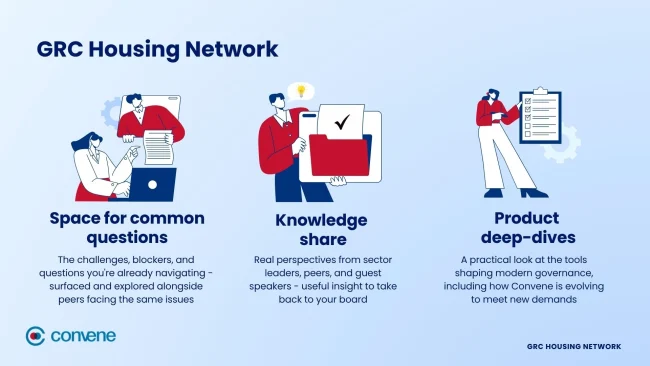
If you work in governance, risk or compliance in the social housing sector, this space is for you. Join the conversation on LinkedIn to help shape the conversation.



- Connect:
-