
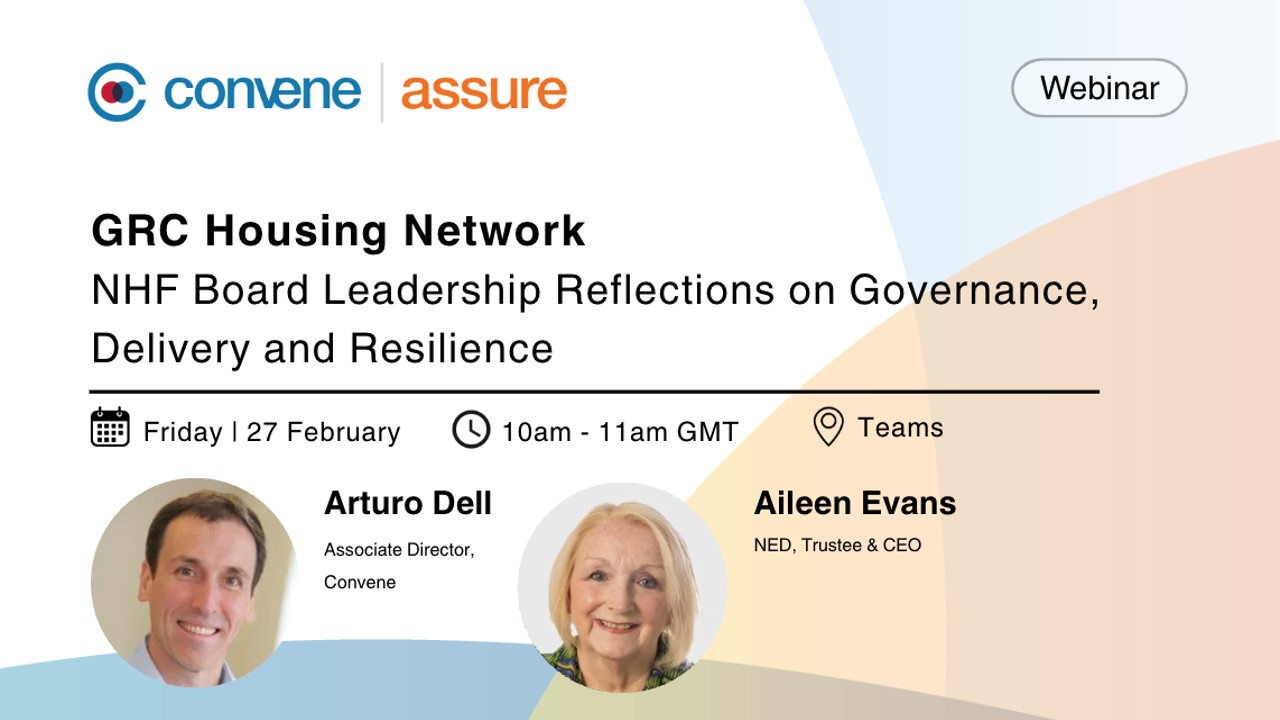


Contextual Overview
Following the NHF Board Leadership Conference, this GRC Housing Network webinar discussion comes at a pivotal moment for housing governance.
Now, boards are operating in an environment of heightened regulatory scrutiny, expanding tenant standards and growing expectations around complaints oversight.
Read on for a breakdown of today’s insightful discussion.
Introducing the Speakers
This session brought together sector insight and governance expertise through three experienced contributors.
Aileen Evans: Our guest speaker has a long background in housing management and previous chief executive experience, Aileen brought first-hand perspective on serving as a member responsible for complaints. Her reflections offered practical, experience-led insight into how boards can use complaints as a driver of learning, assurance and improved customer service.
Currently, Aileen holds governance roles across 3 organisations that utilise Convene to support their board effectiveness and oversight processes.
Aileen’s Current Roles:
- She serves as Chair of Northampton Partnership Homes, providing strategic leadership and board oversight.
- At Curo, she is a Board Member and Chair of the Customer Experience Committee where she plays a key role in strengthening customer focus and complaints governance.
- Lastly, she is Vice Chair of the Governing Board and Chair of the Governance, Ethics and Remuneration Committee at the Chartered Institute of Housing.
Gemma Walford: The discussion was hosted by Gemma Walford who works closely with housing governance professionals and regularly facilitates conversations focused on strengthening governance, risk and compliance practice across the sector.
Arturo Dell: An associate director at Convene and a recognised thought leader on data and governance in housing. Arturo led the conversation, drawing out practical insights on board effectiveness, complaints oversight and the evolving responsibilities facing housing boards.
In conversation with Aileen Evans: Complaints best practice
Assurance is not created through dashboards alone. It is built through informed dialogue.
Complaints as Strategic Intelligence
One of the strongest themes in Aileen’s contribution was that complaints should be seen as a driver of good customer service. With a long background in housing management and executive leadership, she views complaints handling as a key mechanism for building better services not just about obligations.
This reframing matters because if complaints are treated merely as a compliance obligation, the board conversation becomes defensive and reactive. If they are treated as strategic intelligence, they become a powerful source of insight into customer experience and systemic weaknesses.
Aileen described situations where half the complaints team might be absent or where a significant number of Ombudsman cases stem from a single individual. Rather than focusing solely on numbers, she examines the reasons behind them. What are the operational pressures? Are there conversations needed with the Ombudsman? What should the organisation learn from this?
For governance managers, this means presenting complaints information in a way that encourages discussion of root causes and trends, not simply performance metrics.
Key Traits: Curiosity and Tenacity in the Boardroom
When asked what attributes make a good Member Responsible for Complaints (MRC), Aileen highlighted curiosity and tenacity.
Curiosity allows board members to ask probing questions and tenacity ensures those questions are pursued until satisfactory answers are provided.
She illustrated this with a practical example of questioning why operatives were unable to book follow-up repair appointments themselves, drawing on previous experience where that approach had worked effectively. Good governance connects strategic oversight to logistical constraints.
Ultimately, curiosity means ensuring information is transparent, contextual and accessible. Tenacity means tracking actions and ensuring that board questions lead to measurable follow-ups.
The Housing Sector Welcomes Diverse Backgrounds
Aileen stated that effective complaints governance does not depend solely on housing experience. She noted that some of the strongest customer insight practice comes from financial services, where organisations understand tenants. She also referenced lessons from the hotel industry and other service sectors.
Technology as an Enabler of Assurance
Aileen also reflected on the value of board portal technology in supporting governance effectiveness. She spoke about using search functionality to reference Ombudsman spotlight reports and about enabling other board members to engage with complaints information more easily.
Digital tools are not simply administrative conveniences. They strengthen audit trails, improve visibility of actions and support structured challenge. In a sector facing increasing scrutiny, that infrastructure matters.
Using AI with Human Oversight
Aileen also discussed the use of artificial intelligence in complaints handling. She noted that satisfaction levels with AI-assisted responses were higher, largely because the responses were logical and structured.
Crucially, she emphasised that AI should not replace humans. Instead, it should handle the administrative ‘grunt work’ so that people can focus on learning, judgement and resolution.
For board members, this raises important governance considerations. If AI is used in complaints processes, boards will require assurance about oversight, controls and data handling. The MRC role may evolve further as technology becomes more embedded.
Here’s Aileen’s comment on the benefits of combining AI and human oversight:
‘Humans add value, quite quickly, to the bits where there are gaps, to the bits where we need to think about what we’ve learned from this and to the bits where we can think about what that complaint needs by way of appropriate handling so that we can resolve it quickly. Because we all want to resolve it quickly, don’t we? And AI is a tool that can help us do that.’
Culture at the Core
Aileen concluded by praising Curo’s team and their commitment to learning and improving customer service. That final point is perhaps the most important. Governance is not solely about systems and structures. It is about culture.
An effective MRC role depends on operational teams that are open to challenge and committed to improvement. Governance managers sit at the centre of that ecosystem, facilitating information flow, ensuring accountability and fostering constructive relationships between board and executive.
What This Means for Governance Managers
The MRC role requires:
- Clarity of purpose
- Structured engagement with operational teams
- A culture that values learning
Boards must move beyond simply monitoring complaint volumes and focus on understanding themes, root causes and service design implications.
At a time of heightened regulatory expectations, governance managers who strengthen assurance frameworks around complaints and who support curiosity, tenacity and cultural maturity at board level will be enabling their organisations not just to comply, but to improve.
How can Convene support boards with complaints governance and assurance?
Convene Board Portal
Arturo explained how Convene can support better assurance by improving visibility of complaints data, enabling structured board-level discussions and preventing informal decision-making outside secure governance environments.
He then highlighted the growing role of AI in governance processes, including supporting minute generation and improving efficiency in board administration. He emphasised that technology is an enabler for effective, data-driven governance helping boards make better use of limited time while strengthening transparency and accountability.
Adding to this, Gemma acknowledged that housing organisations receive increasingly large and complex board packs, tenant satisfaction measures, regulatory reporting and significant volumes of data. She then demonstrated the ways in which Convene Board Portal can streamline this process.
Convene can help board members:
- Mark up papers with private annotations
- Set personal reminders and actions
- Start structured conversations with fellow board members in advance of meetings
- Track actions and decisions across committees
- Export action logs for governance oversight
To maximise your board’s time, we welcome you to book a demo for Convene Board Portal.
Convene Assure
Gemma also introduced board evaluation functionality, explaining how data-driven assessments can help boards identify skills gaps, succession needs and development priorities.
She demonstrated how heat maps and insights dashboards can provide both individual and collective governance feedback, linking performance against recognised governance standards.
Convene Assure allows for:
- Skills Matrix Analysis
- Succession Support Planning
- Heat maps and Governance Dashboards
- Culture and Behaviours Assessment
- Data-led Assurance Reporting
If you want to ensure that your board is continually improving, book a meeting for Convene Assure today!
Summary
In summary, the discussion reinforced that complaints governance is no longer a peripheral board responsibility. It is a critical part of assurance, culture and regulatory confidence.
Aileen’s insights highlighted the importance of curiosity, tenacity and learning, while Arturo and Gemma demonstrated how structured oversight and digital tools can strengthen board effectiveness.
For housing governance managers, the message is clear. Combining strong culture with the right governance infrastructure enables boards not only to meet regulatory expectations, but to drive meaningful and continuous improvement.
Convene GRC Network
The Convene GRC Network is a place for:
Knowledge exchange: An opportunity to share with other experts and learn from best practice from the sector and elsewhere.
Questions: Ask questions in our trustworthy environment under the Chatham House Rule.
Unique perspectives: A focused space where board members and officers can gather with mutual understanding.
Community: Meet regularly via online webinars and in between meetings through LinkedIn.



- Connect:
-

