
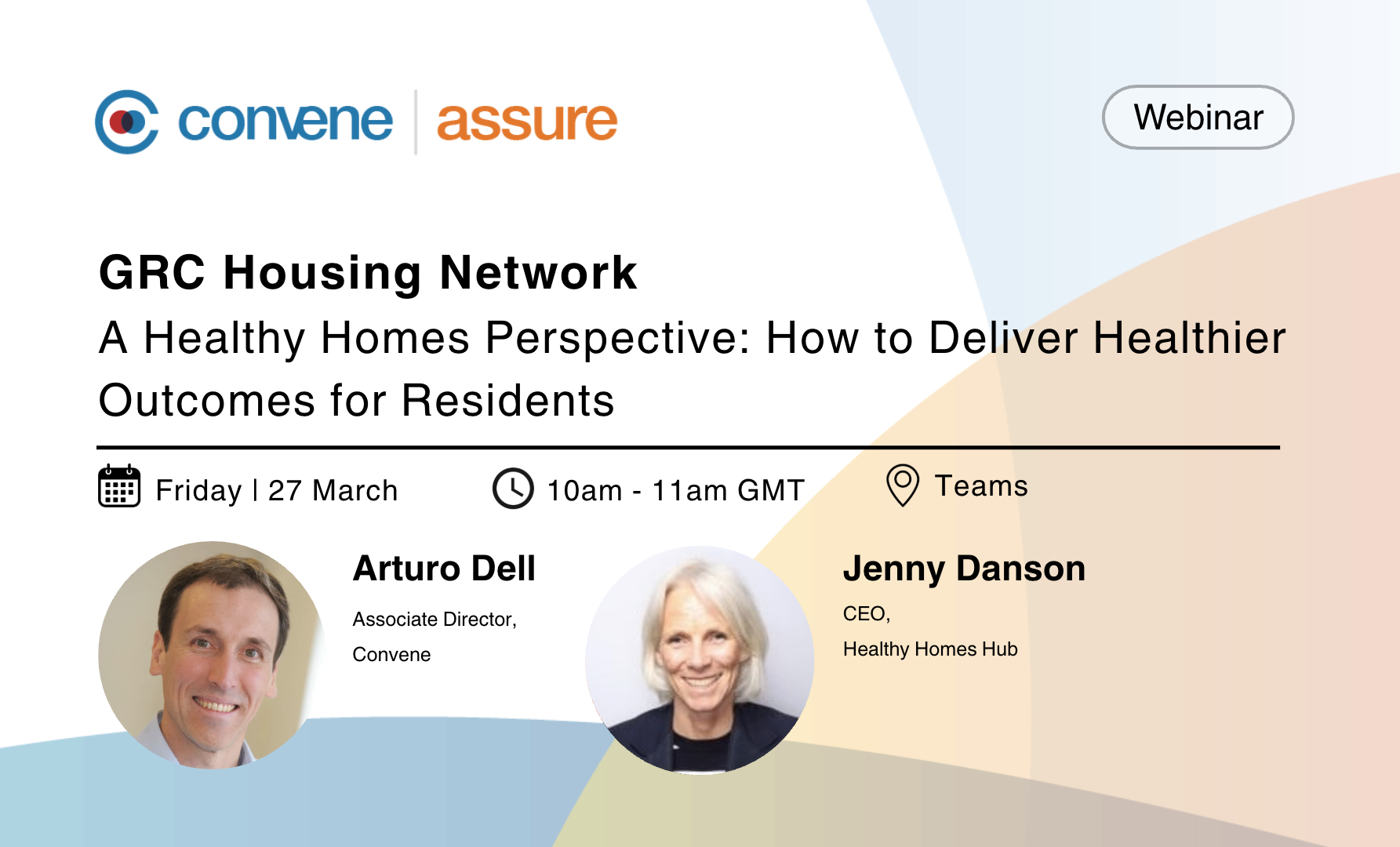


Arturo Dell’s Opening Remarks
This session was hosted by Arturo Dell, Associate Director at Convene and featured Jenny Danson, Chief Executive of the Healthy Homes Hub, who brought extensive board-level experience to the conversation.
Convene’s role in establishing the network was rooted in its experience in the sector, with more than 200 UK housing providers using the board portal. That reach has enabled us to develop a strong understanding of the operational and strategic challenges that housing organisations face, while also reinforcing the importance of data security, trust and governance.
The GRC Housing Network itself has been created by Convene to bring together professionals and experts from across the housing sector. Its purpose was to create a space for sharing tips on best practice, exchanging insights and learning from both sector-specific and external perspectives.
At the centre of the session was a broader and more rounded view of compliance in housing. The discussion introduced the idea of moving beyond traditional compliance frameworks towards a wider perspective on the ‘health of homes,’ encouraging attendees to rethink how housing quality, safety and compliance could be understood.
Read on for a detailed summary of Jenny Danson’s insightful session.
From Compliance to Health: Why Healthy Homes Are the Foundation of Risk Management
A health-led view of housing risk
Jenny explained that healthy homes aren’t ‘nice-to-have’ or an add-on programme. They’re the foundation of effective risk management and delivery. She framed this as a strategic response to what she described as the most complex operating environment in decades, where boards need a lens that connects daily asset decisions to resident outcomes and organisational resilience. Seen through ‘health’, the condition of homes becomes a leading indicator of risk rather than something noticed only when complaints, enforcement or reputational issues escalate.
Sector reach with Healthy Homes Hub
Jenny shared the scale of the Healthy Homes Hub and the breadth of its intended audience. She noted that housing providers, social landlords and local or combined authorities can join for free. Shared learning and shared standards are essential if the sector is to respond at pace without every organisation reinventing solutions on its own.
Why poor housing becomes board-level risk
Jenny linked poor housing quality, especially damp and cold, to significant human and financial impacts. She highlighted the knock-on effects for health costs, productivity, and vulnerable groups and pointed to how widespread the lived experience can be.
For boards, when home conditions drive avoidable harm, they also drive regulatory exposure, reputational issues and increasing cost pressure so they belong firmly on the board risk agenda.
The ‘perfect storm’ operating environment for housing associations
A set of simultaneous pressures hitting housing associations at once includes rising costs, regulatory change, ageing stock and backlog maintenance, decarbonisation demands, cyber risk, data and AI governance, and rising public scrutiny. She underlined that these aren’t future issues, they are daily pressures that reduce financial headroom and constrain investment choices.
The implication is that boards can’t treat these as separate workstreams; they interact and create second-order risks if managed separately.
The compliance trap
A common default response was ‘tick the box, meet the standard, avoid the downgrade.’ She argued that compliance alone doesn’t reduce risk and, in some cases, it simply moves risk around.
In other words, a narrow focus on meeting the minimum can unintentionally push problems downstream, rather than addressing root causes and improving outcomes for residents.
What annual reports are showing
A consistent story Jenny’s seen across the sector is that organisations are being asked to do more and respond faster while budgets tighten. She noted that would result in governance risk rising, leadership attention being consumed by legal and regulatory compliance, damp and mould, and building safety becoming important aspects for boards and executives. Reporting is already signalling where scrutiny is heading and boards should align strategy and assurance accordingly.
Risk is systemic, not technical
Jenny emphasised that many of the sector’s toughest challenges are routinely mislabelled as purely technical issues. She used examples such as damp and mould not being ‘just building defects,’ decarbonisation not being ‘simply a carbon challenge,’ and data or AI risks not being ‘just IT problems.’
The message for boards was that these risks cut across governance, operations, customer experience, finance, and culture so they need joined ownership, evidence and decision-making across functions.
What changes when you view home condition through ‘health’
Jenny explained that when organisations understand home conditions through a health lens, risk becomes clearer and decisions become more joined. She linked this to practical improvements such as improved investment choices, retrofit programmes that were less likely to cause harm and regulatory conversations shifting from defensiveness to evidence.
For boards, the benefit is confidence because decisions can be traced to outcomes and trade-offs can be explained and defended under scrutiny.
What ‘health-led’ risk management means in practice
Jenny recommended turning the health lens into concrete actions. This included embedding health outcomes into investment and asset management strategies, building capability to understand and manage systemic risk and engaging with sector learning and best practice.
She also underlined responding to relevant consultations (including construction products and leasehold reform) and making a deliberate shift from compliance-led to health-led decision-making. The emphasis is on operationalising the approach, so it shows up in priorities, budgets, governance reporting and assurance.
Closing challenge to boards
Jenny concluded with the sentiment that compliance alone will not reduce risk and healthy homes are not optional, they are the foundation of sustainable, resident-focused housing management. She framed this as a strategic choice for the sector and ends with a direct challenge that lands at board level.
Will your organisation lead, or follow?
Q&A Highlights
The following section contains a few paraphrased highlights of the session’s open discussion between Arturo, Jenny and the participants. The conversation touches on everything from health, damp and mould to IT and AI.
1st Question and Response
What got you to start this idea of the Healthy Homes Hub and kind of the great success that you’ve had engaging people in it? –Arturo
Jenny’s Answer: Jenny said she has worked across the housing sector for more than 20 years, including roles in councils, housing associations, contracting, development and manufacturing. She explained that this breadth of experience had given her a clear view of the sector’s recurring problems, many of which had remained unchanged for 10 to 15 years.
One of her main frustrations was seeing the same challenges repeated across different organisations, often lacking innovation. The sector had been going round in loops, with people moving between organisations and taking the same approaches with them.
Jenny said her work around retrofitting homes had made these issues even more urgent, particularly where efforts to do the right thing had still resulted in poor health outcomes for residents. She explained that speaking with health professionals and consultants had reinforced the serious impact poor housing could have on people’s wellbeing.
The sector needed more time, space and shared knowledge to do things differently. She said there was still too little understanding of areas such as building physics, procurement and the health consequences of housing decisions.
The goal was to help leave the sector in a better place over the next five to 10 years. She explained that this meant moving beyond a purely compliance-focused mindset and making health a much more central part of housing discussions.
She explained that when people understood the real consequences of issues such as damp and mould, including the 50% increased likelihood of asthma in children, it became clear that housing decisions were about far more than just managing assets.
2nd Question and Response
How would you build the premise we’re talking about into something like an IT restructure from a board perspective? –Participant
Jenny’s Answer: Jenny explained that every decision, even in back-office functions such as finance or IT, should be tested against one core question. How will this make things better for the resident? She said this mindset should shape discussions across the organisation, whether that means saving money to reinvest in frontline services, streamlining processes or improving safety and wellbeing.
Organisations should be able to clearly explain how their decisions support residents, particularly some of the most vulnerable people in society. She added that if teams cannot answer that question, they should be challenged to rethink their approach and come back with a clearer link to resident benefit.
She also explained that housing organisations can become too internally focused, partly because they do not face the same competitive pressures as customer-facing businesses. As a result, she said there can be too much attention on improving internal processes without enough challenge around whether those changes genuinely improve outcomes for residents.
Arturo’s Response: Arturo said that a stronger focus on health made data much more meaningful, as it brought the Ombudsman’s calls for triangulating and connecting different data sources to life. He explained that this approach helped break down traditional silos between teams, such as assets and customer services, and encouraged a more joined-up way of understanding housing challenges.
3rd Question and Response
How do we streamline the healthy home framework into management systems? Would this affect team restructuring and a huge capital outlay on the checkpoints? –Participant
Jenny’s Response: Jenny explained that it was less about major structural change and more about a shift in mindset. In some cases, teams had simply renamed roles, such as moving from Head of Repairs to Head of Healthy Homes, while others were using the concept more strategically through innovation-focused teams.
A Message to Boards
How can boards be influenced to shift their perspective and help steer the organisation towards a Healthy Homes approach? –Arturo
Jenny’s Response
Jenny explained that many compliance and consumer regulation requirements are simply part of the organisation’s responsibility to keep people safe.
She said a health-focused approach could bring together a wide range of issues, from energy efficiency and decarbonisation to asbestos, Legionella and other compliance matters, under one more meaningful framework. Rather than treating these areas as isolated tick-box exercises, she argued that boards should use them to have broader conversations about residents’ wellbeing.
Boards need to be more curious and look beyond basic compliance metrics. She explained that instead of focusing only on whether a target had been met, boards should also be asking wider questions about issues such as ventilation, air quality and fuel poverty.
Her main message was that the sector needed to shift its lens slightly and put the social back into social housing by making decisions that prioritised safe and healthy homes for tenants. She also warned that this would become increasingly important as housing providers faced more extreme weather, particularly heatwaves, and suggested that many boards had not yet fully engaged with those future risks.
Where does Convene fit into moving beyond compliance measures?
As Jenny explained, teams are often overwhelmed by compliance requirements, reporting demands and reactive pressures, which can lead a focus on ticking boxes rather than addressing root causes.
In this environment, Arturo shared that one of the key challenges is connecting information across teams, bringing together data from assets, customer services and other functions to create a clearer, more holistic view of risk and resident needs.
Without this unified approach, organisations risk operating in fragmented ways, making it harder to deliver meaningful outcomes.
This is where Convene Board Portal can play a critical role in streamlining processes. By centralising board information, reports and data in one secure platform, it enables leadership teams to access consistent, real-time insights across the organisation. This reduces the administrative burden associated with governance and compliance, allowing senior teams to spend less time managing information and more time focusing on strategy and decision-making.
Ultimately, by streamlining governance processes, improving data accessibility and strengthening collaboration, Convene helps organisations move beyond reactive, approaches. It supports a more proactive, insight-driven model of governance. Transform your board today and book a demo!
Where does Convene Assure fit into moving beyond compliance measures?
Convene Assure can support organisations in moving beyond a purely compliance-led approach by embedding a more structured, insight-driven evaluation of governance and board effectiveness. As highlighted in the discussion, boards are under increasing pressure to show evidence of not just compliance, but real outcomes for residents. Convene Assure enables this by providing a clear, consistent framework for board evaluations, helping organisations assess how effectively they are addressing risk, strategy and stakeholder impact.
In addition, Convene Assure supports continuous improvement by enabling benchmarking, tracking progress over time and aligning board performance with evolving regulatory expectations. It provides boards with the evidence they need to strengthen governance, enhance accountability and build confidence among regulators and stakeholders.
Book a demo today to see how Convene Assure can help your board move from compliance to confidence, with smarter evaluations and stronger governance outcomes.
Join Our Future GRC Events
Here are our upcoming events. We hope to see you there!
20 May, Wednesday | 12.30–1.30PM: “Governance in the Age of AI: What Housing Boards Need to Know”
- Join Arturo Dell as he explores the key considerations for housing boards in navigating AI, including governance responsibilities, emerging risks, and strategic opportunities. Register here.
26 June, Friday | 10.00–11.00AM: “M&A in Social Housing: Board Oversight in a Higher-Risk Environment”
- Join Arturo Dell and David Williams, Partner at Campbell Tickell will lead a session on M&A in UK Social Housing. Register here.



- Connect:
-

