

Understanding regulation through AI and potential implications
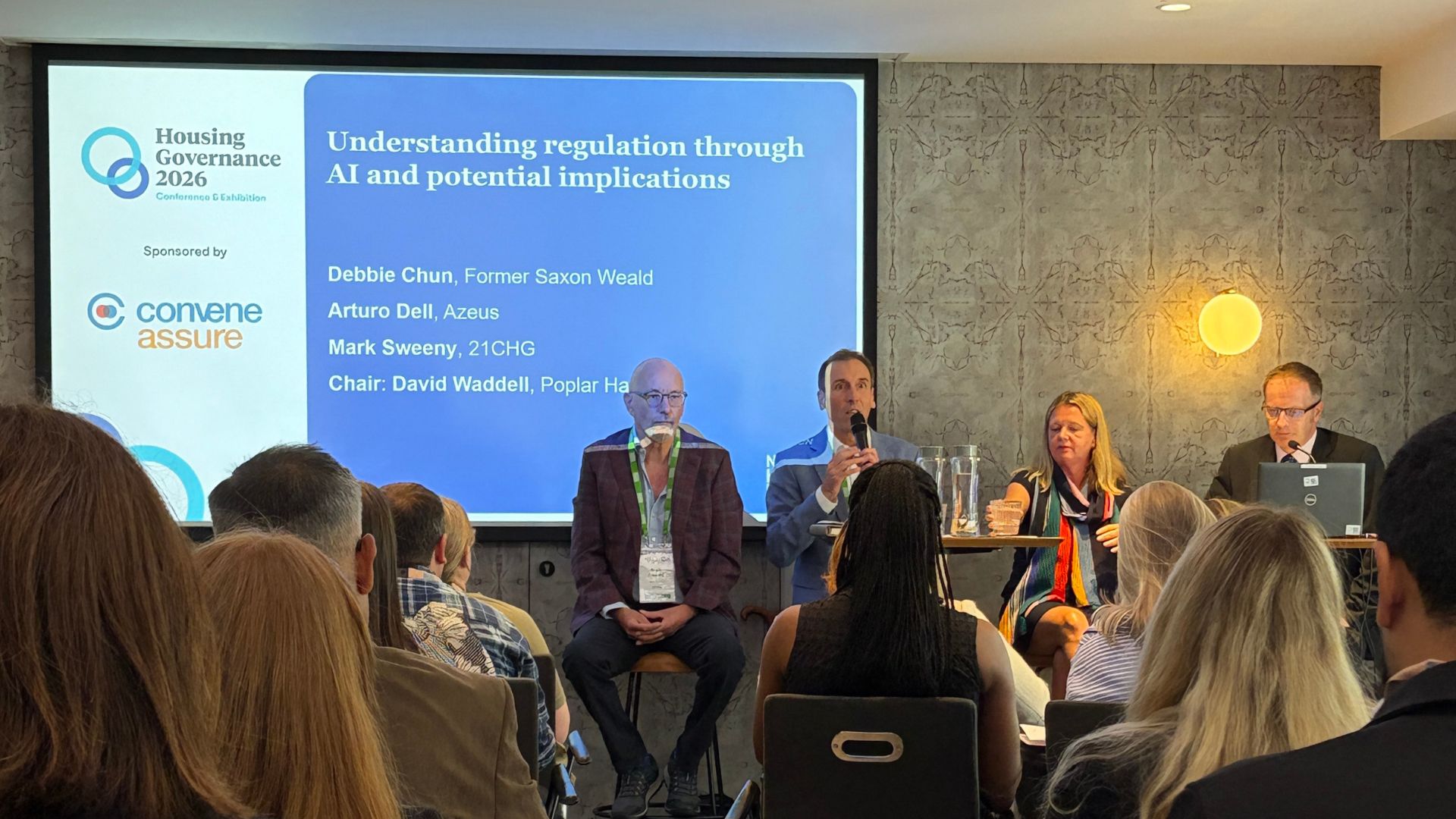
On Thursday 18 June 2026, the National Housing Federation held its Housing Governance Conference, bringing together board members, directors, data protection officers, CEOs and company secretaries that were united by a shared commitment to stronger governance.
Arturo Dell, Associate Director at Azeus Convene, joined a panel session chaired by David Waddell of Poplar Harca, alongside Debbie Chun, Former Saxon Weald, and Mark Sweeney of 21CHG. The discussion moved from the practical realities of AI deployment today to the longer-term questions shaping the future of board governance itself. A rich Q&A reflected how much the audience had to say on the subject.
The state of AI adoption in housing
Arturo Dell opened by describing a sector moving at two distinct speeds. The first is productivity, where organisations are already using AI for notetaking, drafting emails and reviewing documents. He noted that the risk is relatively low because outputs are visible, checkable and easy to act on. The second speed is automation, where AI agents carry out tasks that humans currently perform. That is where the sector is heading.
Dell explained that most organisations are still in the early stages, but the direction of travel is clear, and the conversation is already well underway.
Residents are already using AI
One of the most striking points of the session was Dell’s observation that residents are not waiting for housing associations to catch up. Subject access requests have increased significantly because AI is helping residents produce far better submissions. Tenants will increasingly use AI agents to navigate services, submit complaints and access their data, with or without the organisation being ready for it.
AI is coming whether you are ready or not
Do you remember playing hide-and-seek? The seeker would count and then yell “Ready or not, here I come!”
This was the example that Debbie Chun used to describe the implementation of AI. The question is not whether to adopt it, but how to adopt it safely and responsibly given the pressures the sector faces with increased regulation, compressed financial margins and rising consumer expectations.
Chun stated that transactional back-office tasks in finance, IT and corporate services are the right starting point. These are processes in which a wrong decision will not directly harm a resident.
Chun explained that decisions where an error could directly harm a resident is off limits. Deploying AI simply because the technology is available is the wrong reason and the full cost must be understood. Licensing is not free, and costs will rise as data volumes grow.
Saxon weald in practice
Chun shared an example from Saxon Weald, where Copilot was deployed across 28 customer-facing inboxes. The tool read incoming emails, sorted them, routed them to the right department and applied SLAs automatically. The result was that 96% of responses were handled within 48 hours. This was a measurable productivity benefit from an intentional deployment of AI.
Governing AI versus governing with AI
A question that David Waddell asked was “How do you distinguish between governing AI, which means managing the technology, and governing with AI, where AI becomes part of the governance process itself?”
Mark Sweeney responded that AI means having the strategy, the policy, the mapped use cases and the controls in place. Governing with AI is the more complex and emerging territory.
He explained that if the executive uses AI to write a paper, and the non-executives use AI to read it, there is a risk of what he called a governance loop, where everyone is passing the same questions through the same tools and arriving at the same answers. He noted that this is where governing with AI becomes a strategic question rather than a practical one.
AI is not the decision-maker
On the question of liability and automation, Sweeney shared that AI should not make a board-level decision. The appropriate role for AI in the boardroom is advisory and reflective. It can read the organisation’s strategy, business plan and asset management documents, and then, when a decision needs to be made, to offer a considered view on whether it aligns with what the organisation has already said it wants to do. However, it can’t make executive decisions.
Key themes from the Q&A
The Q&A highlighted a range of practical concerns that reflect exactly where the sector is right now.
Hallucinations and AI summaries
A delegate shared a real experience of AI tools significantly misrepresenting their organisation’s scale when summarising board papers. Dell acknowledged there is no complete solution yet and emphasised the importance of keeping AI tools within a controlled environment, training people to use them safely, and building the right human checks into every process.
Human judgement
A comment submitted from the NHF app shared that a key difference between AI and humans is the ability to ask what feels like a thoughtless question. Dell answered that AI calculates the average of existing knowledge and documentation. Creativity, challenge and the willingness to ask the question no one else is asking are things boards must actively protect.
Bias
Dell explained that predictive analytics, which the sector has been using for three to four years, are often more controllable, more auditable and better understood than the latest generative AI tools. For bias-sensitive applications involving vulnerable or protected resident groups, established predictive techniques with well-understood safeguards may be more appropriate than cutting-edge large language models.
Resident engagement
Sweeney encouraged boards to start from outcomes rather than tools. If a board genuinely wants to hear the unmediated voice of residents, including the sentiment and frustration that gets filtered out in management papers, it can design an AI plan to deliver exactly that.
Creating cases
On Awaab’s Law, Chun offered the example of Saxon Weald deployed AI to scan all incoming emails for damp and mould-related keywords, automatically creating a case with an emergency tag and routing it for human review. This was a well-targeted deployment addressing a live regulatory risk.
Key Takeaways for Housing Governance Professionals
1. AI adoption in housing is a present consideration, and the boards best placed to navigate it are those that start building their foundations now.
2. Good AI governance starts with the basics. That includes a clear policy, defined design principles, impact assessment tools, annual reviews and staff training. From there, it is about identifying the right use cases, protecting human judgment, and keeping decision-making authority with your board.
3. The regulatory landscape changes. The organisations that engage with AI governance seriously today, rather than reacting when requirements formalise, will be considerably better positioned when that moment comes.
Get Involved
If you want to keep the conversation going? Join our GRC Housing Network on LinkedIn, a growing community of housing governance professionals sharing insights, practical guidance and sector updates.
If you are interested in how board assurance can support your AI governance journey, we would love to show you what Convene and Convene Assure can do for your organisation. Book a free demo with our team and see it in action.



- Connect:
-