


There is no shortage of AI hype. But for governance professionals, the question is never really “Is AI impressive?” It is what does it actually do, can it be trusted with sensitive board information, and where does it genuinely help?
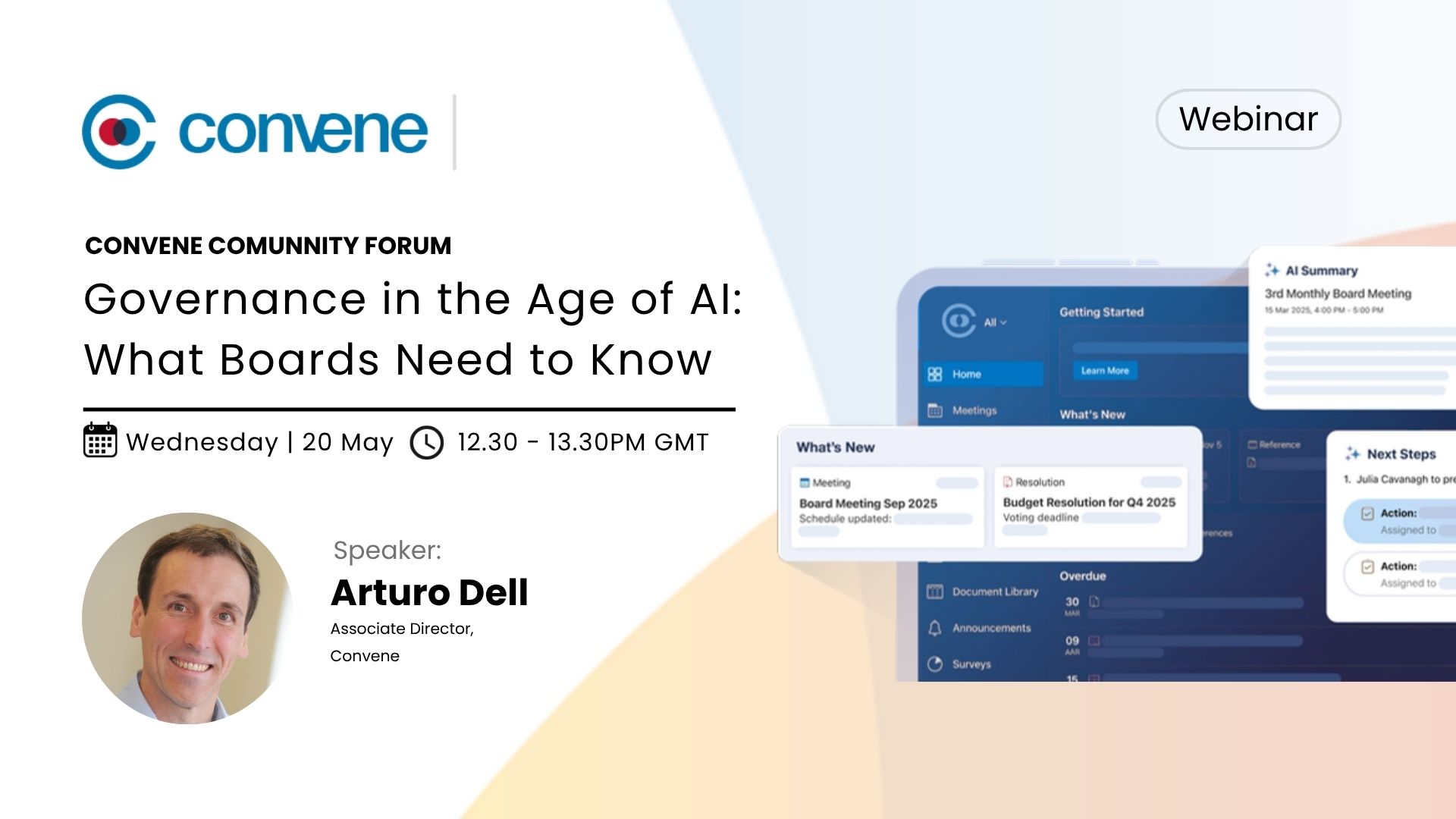
That was the thread running through the Convene Community Forum on 20 May, where Arturo Dell, Convene’s Associate Director and resident expert in data, knowledge and AI, led a session on governance in the age of AI. It combined a grounded look at the current state of the technology with a live demonstration of how AI has been built into the Convene board portal.
What follows is a summary of the key ideas from the session that are useful whether you use Convene today or are simply trying to understand what AI means for how boards work.
Where AI Actually Stands Today
To start, Arturo introduced an example called the AI Dream Team. Three distinct types of AI, each representing a different stage in how the technology has developed. Most organisations are encountering all three already, often without realising it.
The Analyst: Traditional Machine Learning
This is the original form of AI, and it has been quietly running in the background of everyday technology for years. It learns from large amounts of structured data, spots patterns, and makes predictions. Fraud detection, product recommendations, medical imaging tools. A few years ago this was considered cutting-edge. Today it is the baseline, and most people do not think of it as AI at all.
The Creator: Generative AI
This is the one that changed everything. Generative AI does not analyse existing data; it creates new content by learning the probability of what should come next. Text, images, sound, video. ChatGPT, Claude, and Gemini are all versions of the same idea.
The adoption numbers are hard to ignore. Research from Microsoft and LinkedIn, cited in the session, found that over 75% of knowledge workers are already using generative AI tools. For something that did not exist in its current form four years ago, that is a striking figure.
The Doer: Agentic AI
The most recent development. Agentic AI does not wait to be given a question. You give it a goal, and it works out how to get there, executing multi-step tasks without needing to check in at every stage. Agents are given specific capabilities, things like connecting to databases, accessing calendar tools, or reading CRM data, and they string those together autonomously.
Arturo noted that if you give an agent too much access and, as he put it, “before you know it, it’s logged into your bank account and done who knows what with your money.” The power is real. So is the need to keep it tightly controlled.
What the Research Shows
Before getting into the product demo, Arturo walked through findings from two research papers that have become something of a benchmark in this area. One involved contact centre workers, the other involved consultants at Boston Consulting Group. Their findings have held up well and been corroborated by later studies. Three things stood out.
Generative AI is uneven
It is genuinely impressive at some tasks and surprisingly bad at others, and there is no instruction manual. You develop a feel for it only by using it a lot. This remains true even as the models improve.
It helps newer workers more than experienced ones
Productivity gains were significant for people earlier in their careers (30 to 40% in the studies) but minimal for experienced workers. Worth bearing in mind for any organisation trying to work out where the investment will actually make a difference.
People fall asleep at the wheel
This was the finding Arturo spent most time on, and for good reason. People who regularly delegate tasks to AI can actually get worse at those tasks over time, especially when the AI produces something that sounds authoritative but is wrong. For governance professionals who are responsible for accurate records of decisions, this is not an abstract risk.
“Don’t be the one that falls asleep at the wheel with AI. It will help you, but it’s still your responsibility to ensure that what it produces is correct.” –Arturo Dell, Convene
On the broader risk picture, MIT research from August 2025 put data security and privacy at the top of organisations’ AI concerns. The specific worry is employees uploading sensitive documents into public AI tools and that data then becoming exposed. For anyone working with confidential board papers, this is not theoretical. It is already happening in organisations that have not addressed it.
How Convene Has Approached This
Convene AI is built into the board portal itself. The design principle is straightforward. Keep everything within the same secure environment that already protects your governance data. There are no public endpoints, AWS does not use your prompts or AI responses to train its base model, and your data stays entirely yours.
The practical consequence of this is more significant than it might first appear. If a governance platform does not offer secure AI tools, people will find their own solutions. And those solutions will almost certainly be less secure. Convene AI exists partly to close that gap.
There are two main areas where the AI functionality sits.
Minutes IQ
This was the main focus of the demonstration. Minutes IQ is built to reduce the administrative weight of minute taking while keeping the governance professional firmly in the driving seat.
Arturo ran through the full process using a fictional company he had put together with AI assistance for the session. The board meeting covered employment rights legislation and proposed changes to NDA law, the kind of complex, technical material that governance teams regularly have to document with precision.
Before the Meeting
Even before a meeting has taken place, Minutes IQ can generate a draft from agenda documents. If a paper has been uploaded against an agenda item, the AI reads it and produces a preliminary draft. Arturo was measured about how useful this is in practice. For experienced practitioners it may not add much. But for getting to grips with lengthy or technical documents quickly, having a structured summary already sitting in the minutes template is a reasonable head start.
After the Meeting
This is where it becomes genuinely useful. Once a transcript is available (uploaded manually or pulled automatically from a Teams or Zoom integration), the process runs as follows.
- The AI maps the transcript to the agenda, working out which parts of the discussion correspond to which items. Arturo was clear that this mapping should always be checked. If it goes wrong, everything that follows is affected.
- A summary is generated from the transcript. This includes structured insights across a range of categories such as decisions, risks, timeline, key people and sentiments. Administrators can choose which categories to include.
- Actions flagged in the discussion are surfaced automatically. They can be converted into tracked action items within Convene in a single click, with named owners and due dates.
- Draft minutes are generated for each agenda item, drawing on both the uploaded document and the transcript. Teams can then ask the AI to make sections more concise, more professional, or rewrite them entirely before the final version is exported.
Customisation
Administrators can configure Minutes IQ to draw on additional sources when generating minutes. The meeting organiser’s private notes, sticky notes added during the meeting, and previous minutes can all be fed in. Giving the AI examples of well-written minutes from past meetings allows it to learn how the organisation writes over time.
It is also possible to provide a writing style guide covering tone, structure and wording. For organisations with specific conventions around minute taking, whether set by regulation, board preference or internal house style, this gives meaningful control over the output.
AI Companion
Arturo finished with a brief look at AI Companion, with a fuller session on this feature planned for a future forum.
Where Minutes IQ is primarily for governance officers and administrators, AI Companion is designed for directors, CEOs and executives engaging with meeting materials. From within the Convene interface, they can ask questions about documents, request summaries of specific papers, and work through the content of agenda items conversationally.
In the demonstration, Arturo showed a board member asking the AI to summarise a complex NDA document and then identify the key risks in the proposed legislation. The AI only draws on documents already in Convene, not anything from the public internet. That matters because the responses are grounded in the actual papers in front of the board, rather than whatever a general model happens to know.
Arturo was careful about how he framed this. The point is not to let board members skip their reading. It is to take the time currently spent trawling through lengthy documents and redirect it towards more useful preparation. The risk worth watching for, given what the research shows, is board members becoming passive consumers of AI summaries rather than actively engaged governors.
“The last thing we would want is that these tools mean board members are not doing their jobs because they are completely reliant on AI. What this is supposed to do is free the time they would spend trawling through long documents so they can have quality discussions.” –Arturo Dell, Convene
Questions from the Session
Can AI-generated minute drafts be deleted or edited?
Yes. Each agenda item has an editing interface where content can be modified, reformatted or removed before the minutes are finalised and exported.
How does it work in hybrid meetings without a Teams transcript?
Arturo acknowledged this as an active area of development. For now, the tool works best when a transcript is available. For meetings that are not recorded, Convene is exploring how manually captured notes might be combined with AI document analysis. In the meantime, he pointed to third-party tools that can identify speakers by voice in non-Teams environments.
Is Convene AI a chargeable add-on?
Yes. The team offered free trials for anyone who wants to explore it before making a decision.
What Comes Next
The next Convene Community Forum will shift focus slightly. Rather than a product demo, it will be a more open conversation about how AI is reshaping the governance role in practice, including its implications for risk and oversight. Attendees have also asked for a dedicated session on AI Companion, which the team is looking to schedule separately.
If you want to trial Convene AI, talk through whether it is the right fit for your organisation, or just follow up on anything from this session, get in touch with the team!



- Connect:
-

