



Boards in New Zealand have been under increasing pressure not only to modernise their operations but also to ensure they make accurate, smart decisions.
According to the Institute of Directors’ 2025 survey, “For New Zealand boards, digital oversight is clearly accelerating, but maturity is uneven.” This means boards are expected not only to focus on technical but also cultural improvement, for instance, developing literacy and confidence without losing agility. But besides capability and culture, boards also recognise technology as part of their journey. The survey also found that 60% of boards reported they’re working with management to determine how technology can enhance productivity.
Governance technologies, particularly board portals, have re-entered the mainstream, accelerating innovation for organisations. In this guide, we’ll dive deep into the impact of board portals on New Zealand organisations and how directors can opt to adopt the portal.
What is a board portal?
A board portal is a digital governance platform utilised by directors, executives, and company secretaries to help them manage board activities in a secure, centralised environment. To put it simply, it replaces traditional processes that rely on email and printed board packs with a system where all workflows and materials are managed end-to-end.
Modern board portals usually come with enterprise-grade security features like encryption, multi-factor authentication, and role-based access controls to protect highly sensitive information. In general, a board portal software is used to:
- Safely distribute and update meeting packs
- Keep governance documents in a version-controlled repository
- Run meeting workflows, like scheduling, minutes, resolutions, and approvals
- Keep a secure audit trail of board actions and decision history
- Enable board members to review, annotate, and collaborate digitally
Why Board Portals are Growing in New Zealand
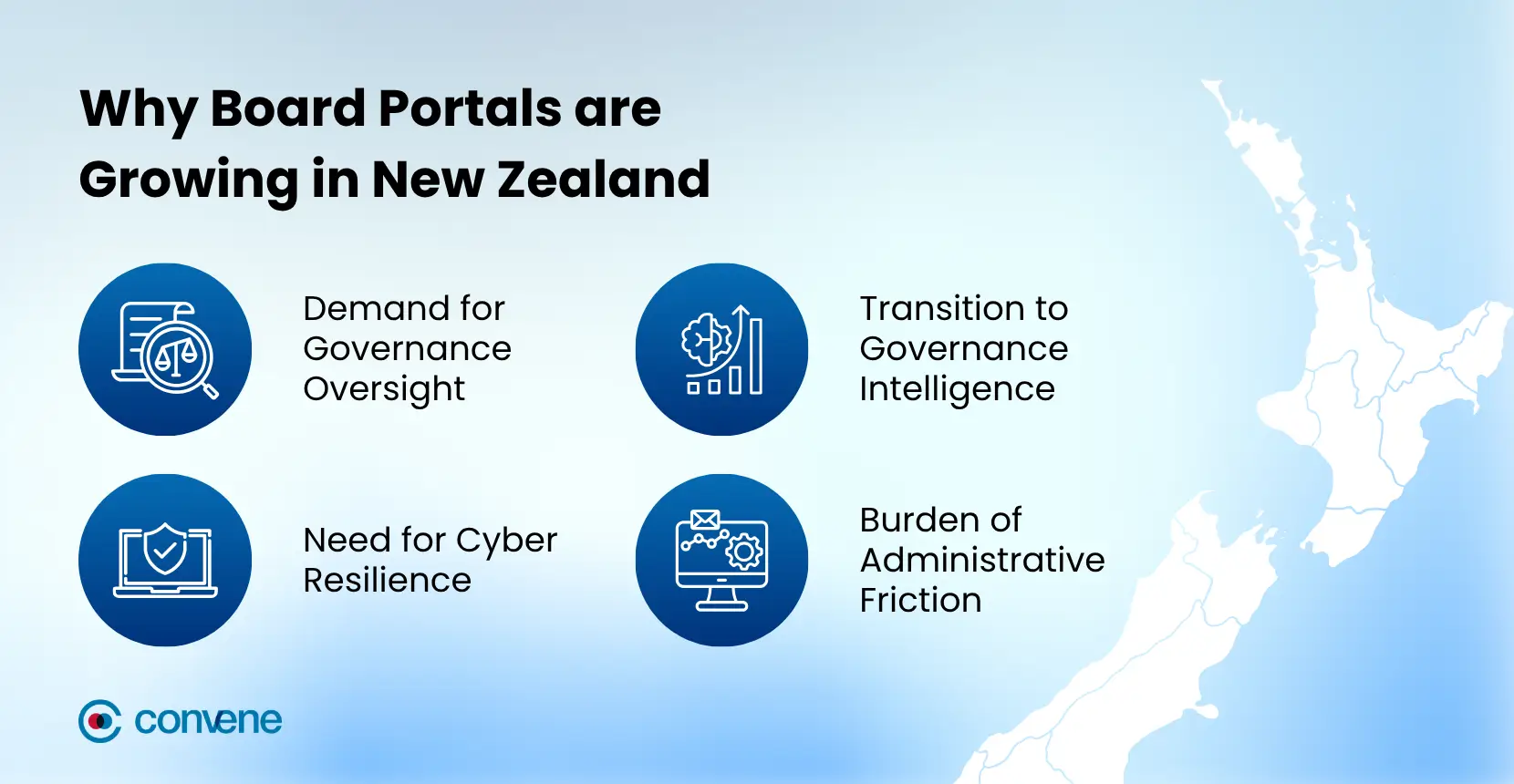
The adoption of board portal software is not just for digital convenience but more of a governance shift for organisations. Below are the top reasons why board portals are rapidly adopted in New Zealand boardrooms.
- Demand for Governance Oversight: Modern organisations always aim for access to better documentation and records, decision traceability, and evidence-based governance. Board portals meet these demands through version-controlled files, compliance decision records, and strict archival systems.
- Need for Cyber Resilience: Cybersecurity, regardless of the industry, is one of today’s most material governance risks. The adoption of board governance software can fortify cyber resilience for organisations facing cybersecurity issues (scams and fraud, phishing, malware). Such platforms offer encrypted document sharing, multi-factor authentication, and secure communication channels.
- Transition to Governance Intelligence: Data-driven decision-making has been more important than ever. This move is rooted in a broader governance trend: increasing engagement with digital reporting, analytics, and AI tools as part of board oversight responsibilities. Modern portals provide access to performance reporting, interactive dashboards, and accurate decision logs, promoting continuous governance intelligence.
- Burden of Administrative Friction: Administrative efficiency remains a consistent governance burden for many New Zealand boardrooms. This is particularly useful for those who still depend on email-based board packs and manual approval cycles. In the recent Tuanz’s 2026 Digital Priorities Report, CIOs and CTOs in New Zealand expect transformation to be challenging, especially modernising core platforms and data foundations.
Find out the essential criteria that every Australian organisation should
consider before choosing a board portal. Get our free buyer’s guide below.
Benefits and Must-Have Board Portal Features in 2026
As governance requirements become more complex, organisations must find smarter ways to manage board activities securely and efficiently. This is what board portals are designed to address. Here are the major benefits and must-have features of board governance software:
1. Secure, Centralised Hub and Mobile Access
Modern portals provide directors and executives with a centralised location for board documents, meeting materials, policies, and resolutions. This way, all confidential information is stored in a secure system where only authorised users can have access from any device.
This is particularly useful for New Zealand organisations with remote trustees or hybrid board setups. Hence, allowing directors to check meeting materials while working remotely or attending off-site meetings. Most enterprise-grade board portal software also offers:
- Role-based access permissions
- Multi-factor authentication (MFA)
- End-to-end encryption
- Offline document access
- Real-time version control
- Audit-ready activity tracking
2. Paperless and Quicker Meeting Preparation
Tedious meeting preparation is a thing of the past. Board secretaries shouldn’t be spending too much time drafting and sending out board packs, compiling reports, and coordinating updates. A reliable board portal can automate most of such tasks, resulting in better agenda creation, shorter preparation cycles, faster post-meeting approvals, and fewer administrative costs. Most board governance software offers meeting preparation tools, such as:
- Annotation and note-taking features
- Live meeting minutes taker
- Searchable meeting archives
- Agenda Builder
- Integrated voting and approvals
- Real-time collaboration features
For New Zealand boards in highly regulated sectors like finance and healthcare, a portal with such features can improve governance responsiveness while also reducing procedural bottlenecks.
3. Stricter Risk and Data Management
Governance documents typically contain highly confidential information (e.g., legal matters, employee data, and financial reports) that require proper management. That said, having outdated file versions, lost paperwork, and even misaddressed emails can increase risk exposure. Modern board portals for New Zealand boards can mitigate such risks through security controls, including:
- Data encryption in transit and at rest
- Granular user permission settings
- Remote wipe capabilities
- Secure document watermarking
- Comprehensive audit trails
- Automatic access revocation for departing users
Having a secure governance structure can help New Zealand organisations ensure stronger resilience, secure backups, and better disaster recovery during cyber incidents or operational disruptions.
4. Stronger Governance and Decision-Making
Organisations looking to strengthen governance while improving their decision-making processes can significantly benefit from a board portal. Such platforms provide a centralised environment for greater visibility of board activities and a trusted record of key decisions and approvals. Modern board portals essentially come with features that support governance objectives, such as:
- Detailed audit trails and activity logs
- Electronic voting and resolution tracking
- Digital signature or approval workflows
- Task assignment and progress monitoring
- Automated meeting attendance records
- Action item tracking and deadline reminders
With such features, New Zealand organisations get a complete record of their board activities. At the same time, this reduces ambiguity around board responsibilities and supports stronger governance oversight.
How to Choose the Right Board Portal for New Zealand Companies
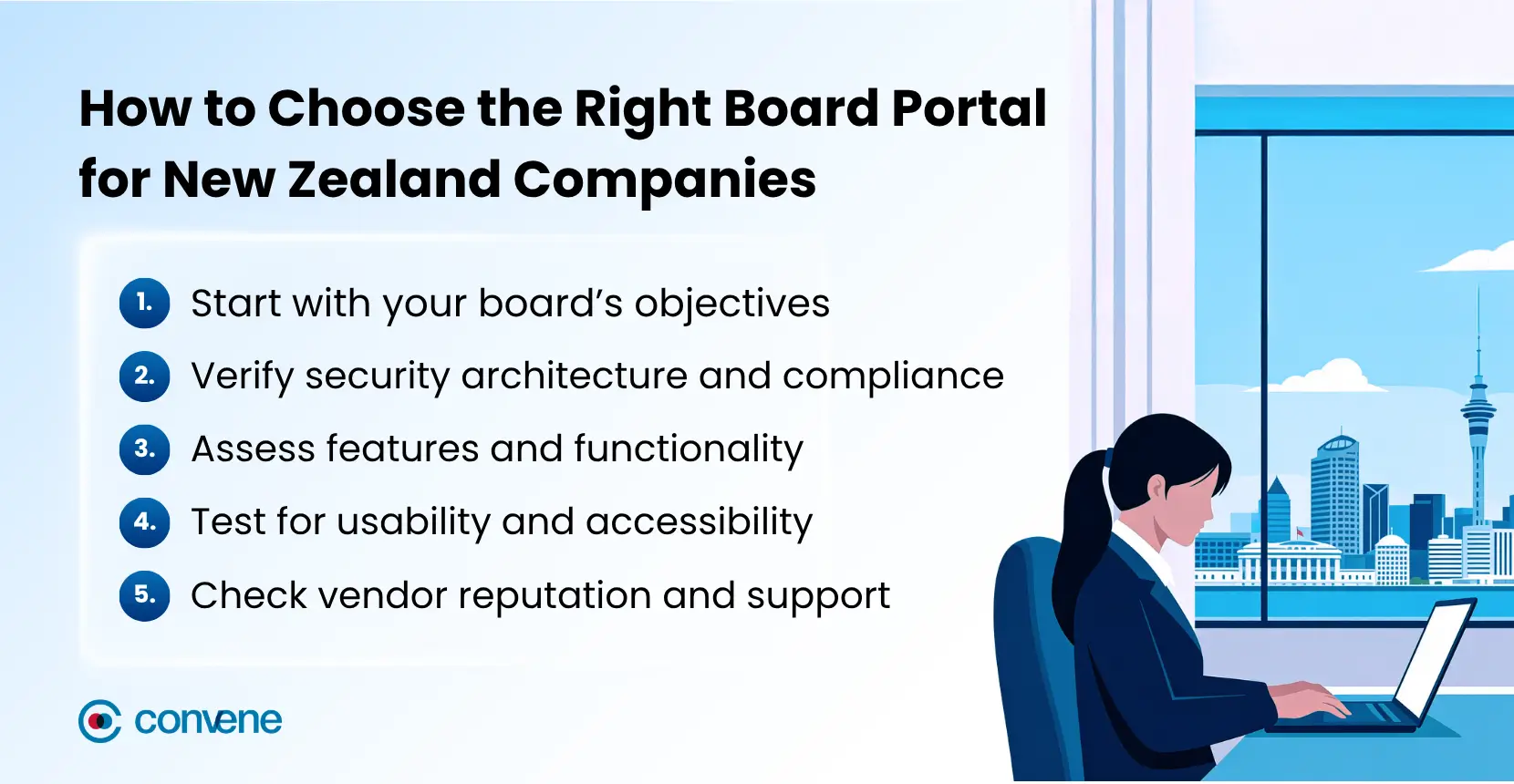
Selecting the right board portal is a strategic move that can affect your organisation’s governance effectiveness, information security, and board performance. Are you looking for the one that actually fits your organisation best? Here are some tips to help you get started.
1. Start with your board’s objectives
Before comparing vendors, organisations should clearly define their expectations for a board portal. Different boards have different requirements depending on their size, governance structure, industry, and operational complexity.
Key questions you can consider are:
- Is the main goal to streamline board meeting preparation and distribution?
- Does the board need secure collaboration among directors and committees dispersed globally?
- Are there governance, compliance, or audit expectations that the portal should support?
- Will the portal be used by more than one entity, for example, subsidiaries, or separate committees?
Having clear objectives helps simplify the selection process and makes sure it matches up with your board’s priorities. Keep in mind that a board portal that addresses your current problems while supporting future growth is typically the best option.
2. Verify security architecture and compliance
Board portals hold some of an organisation’s most confidential information, such as strategic plans, financial reports, legal paperwork, and even private board discussions. For that reason, security should be one of your most critical evaluation criteria. Ideally, you’d want a board portal that can offer:
- End-to-end data encryption both in transit and at rest
- Multi-factor authentication (MFA) and identity management controls
- Role-based access permissions and document-level security
- Secure data hosting and disaster recovery capabilities
- Audit trails that record user activity and document access
- Compliance with recognised security standards such as ISO 27001, SOC 2, or equivalent frameworks
For New Zealand organisations, don’t forget to confirm whether the vendor handles privacy obligations correctly — for instance, by having data management policies that comply with the Privacy Act 2020. On top of that, security controls must also be independently audited and supported by transparent documentation.
3. Assess features and functionality
One of the most extensive aspects to check is the platform’s features and functionality. The ideal board portal software doesn’t just streamline board administration but also facilitates informed decision-making without complicating it. A few categories to prioritise when assessing features are:
Virtual Meeting Tools
- Agenda creation and management
- Real-time access to meeting materials
- Integrated video conferencing
- Director annotations and note-taking
- Action item and task tracking
- Live minute-taker
- Attendance tracking
Document Management
- Secure document storage and sharing
- Version control and document history
- Advanced search functionality
- Role-based access permissions
- Audit trails for document access and activity
Voting and Approvals
- Electronic voting and resolutions
- Digital signatures and sign-off workflows
- Resolution tracking and recording
- Automated vote collection and tabulation
- Secure recording of board decisions
- Compliance and audit reporting for approvals
AI Capabilities
- AI-powered meeting summaries generation
- Automated extraction and suggestion of action items
- AI-assisted creation of tasks and notifications
- Access to past decisions and records through AI-assisted retrieval
- In-app AI companion or assistant for queries.
Make sure to choose a portal based on your organisation’s governance requirements, operational workflows, and long-term objectives.
4. Test for usability and accessibility
A feature-rich platform will likely fail to deliver value to your board if it’s difficult to use. Regardless of the members’ digital literacy, the board portal should be easy to learn and adopt. After all, user experience typically influences adoption rates.
Talk to the vendor and arrange demos and trial periods, allowing directors and administrators to test the board portal. A few aspects to take note of are:
- Ease of navigation and intuitive interface design
- Accessibility across desktop, tablet, and mobile devices
- Offline access to board materials
- Fast document loading and search functionality
- Simple annotation and collaboration tools
- Compliance with accessibility standards where applicable
To ensure everything runs smoothly, make sure to also get feedback from all directors before making a final decision.
5. Check vendor reputation and support
A board portal software provider isn’t just a simple software vendor but a long-term governance technology partner for your organisation. By reviewing the vendor’s track record, you can avoid implementation issues and service disruptions later on. Some factors you can check are:
- Experience serving boards and governance professionals
- Customer references and independent reviews
- Financial stability and market presence
- Product development roadmap and innovation strategy
- Availability of local or regional support services
- Onboarding, training, and change management assistance
- Service-level agreements (SLAs) and support response times
In most cases, you’d also want a provider that commits to ongoing security updates, regulatory compliance, and customer success.
How Convene Board Portal Checks Every Box for New Zealand Boards
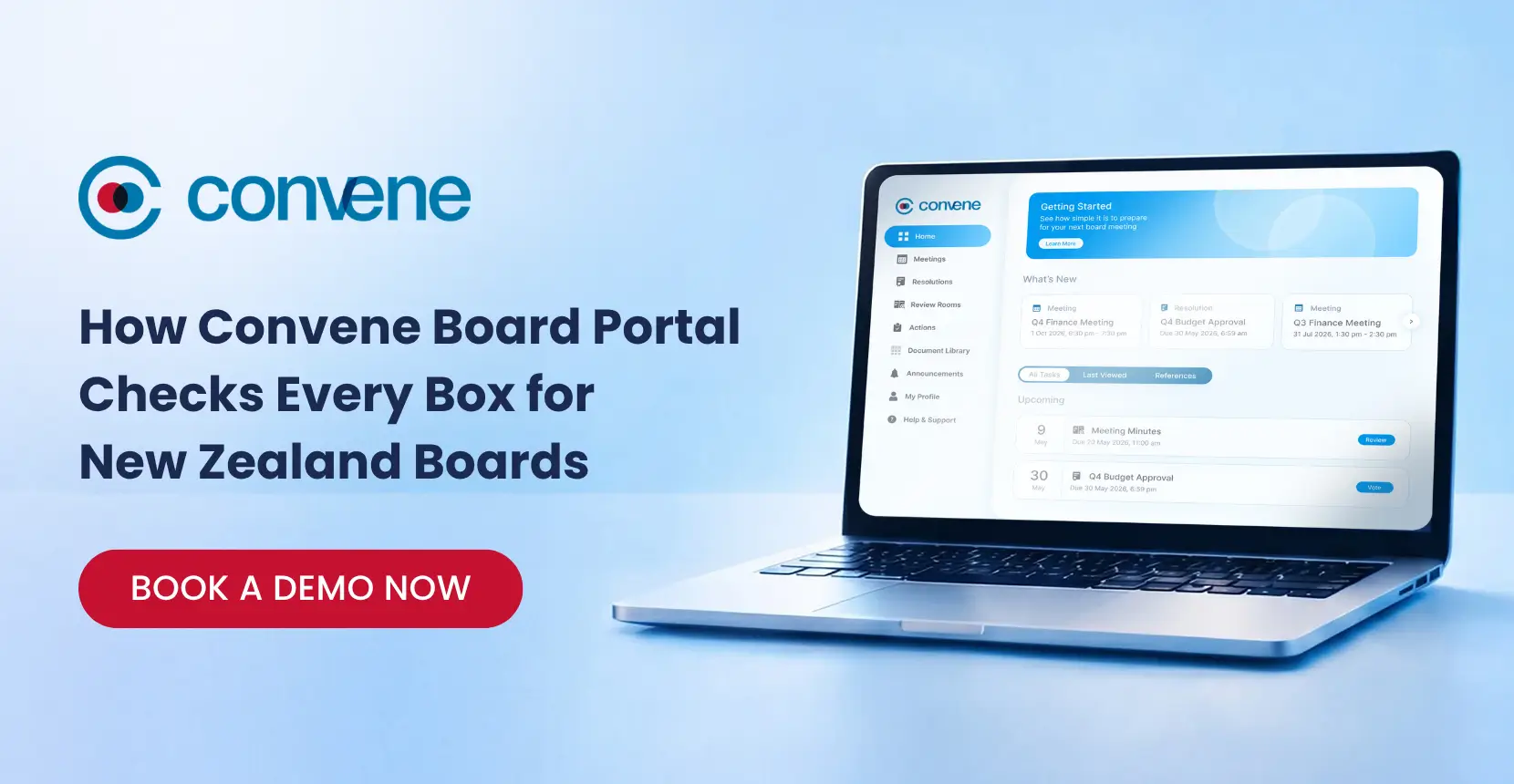
Boards in New Zealand are finding it hard to keep up with increasing governance demands. Many struggle with overseeing risks, monitoring performance, and making fast yet smart decisions. For boards looking to solve such issues, a board portal is the perfect governance tool to invest in.
Designed for future-forward boards, Convene Board Portal aims to support New Zealand organisations transition their governance into a strategic advantage. Trusted by listed companies, NFPs, and governments worldwide, its features help you spend less time on administration and more time on high-value decision-making.
With Convene, New Zealand boards can:
- Run Board Meetings Without the Chaos: Create proper agendas, distribute board packs, capture minutes or take notes, and run meeting workflows from a single platform — all without the hassle.
- Lock Down Sensitive Board Information: Keep your confidential documents safe with Convene’s enterprise-grade security features, including encryption, role-based permissions, multi-factor authentication, and audit trails.
- Make Collaboration Effortless, Anytime, Anywhere: Give directors secure access to meeting materials across different devices, complete with annotations, notes, and real-time updates. Your board can now make decisions anytime, anywhere.
- Turn Approvals Into Instant Action: Streamline resolutions, voting, and approval workflows with Convene, while maintaining an auditable record of board actions and activities.
- Leverage AI for Smarter Governance: Enhance board efficiency with Convene AI’s AI-powered assistance to summarise your board meetings and generate accurate, automated minutes.
Ready to upgrade your governance performance? Request a demo today and learn how Convene Board Portal can help.



Jielynne is a Content Marketing Writer at Convene. With over six years of professional writing experience, she has worked with several SEO and digital marketing agencies, both local and international. She strives in crafting clear marketing copies and creative content for various platforms of Convene, such as the website and social media. Jielynne displays a decided lack of knowledge about football and calculus, but proudly aces in literary arts and corporate governance.
- Connect:
-

-


