


- The Protection of Personal Information Act (POPIA) was fully enforced in 2021 to regulate how entities manage and use personal information in South Africa. It applies to all private and public entities that handle local personal information, whether operating locally or abroad.
- There are eight lawful conditions that responsible parties must meet to be eligible to process personal information. These conditions are Accountability, Processing Limitation, Purpose Specification, Further Processing Limitation, Information Quality, Openness, Security Safeguards, and Data Subject Participation.
- Non-compliance with POPIA can result in administrative fines of up to ZAR 10 million, criminal imprisonment of up to 10 years, and civil claims by data subjects.
- Organisations can leverage a digital governance platform to enhance POPIA compliance by centralising data inventory, automating data protection, and empowering Information Officers with tools for more strategic oversight.
- Convene Board Portal is a board portal solution designed to help organisations strengthen POPIA compliance. It is designed with security safeguards, including document encryption, role-based access controls, document versioning, and AI-driven compliance intelligence.
The Protection of Personal Information Act (POPIA) is South Africa’s primary data privacy law that regulates how legal entities collect, store, and share personal information. The Information Regulator began enforcing it in 2021 to protect individuals and businesses from data privacy violations, identity theft, and misuse of information.
The European Union’s General Data Protection Regulation (GDPR) and POPIA often draw comparisons because both establish legal standards for data processing and consent management. While POPIA closely models GDPR, its application is strictly limited to South Africa.
This article breaks down what is POPIA Act South Africa. Understand its implications for businesses, key compliance requirements, differences from GDPR, and best practices to strengthen compliance.
What is POPIA Act?
The Protection of Personal Information Act (POPIA) is the national consumer data privacy law of South Africa. It is a legal framework that governs how data processors and controllers manage the entire lifecycle of personal data.
Signed into law in 2013, POPIA became fully enforceable in 2021 after the enactment of additional provisions, including the Promotion of Access to Information Act (PAIA). Along with POPIA’s enactment is the establishment of the Information Regulator, an independent statutory body responsible for overseeing the law’s implementation in South Africa.
Related Reading: What is King V of Corporate Governance: An Essential Guide for South African Boards
Who must comply with POPIA?
Private and public entities handling or processing any type of personal information must comply with POPIA. This includes businesses, government agencies, nonprofits, and foreign entities, both operating within South Africa and processing local personal information from abroad.
Who are the key parties involved in POPIA?
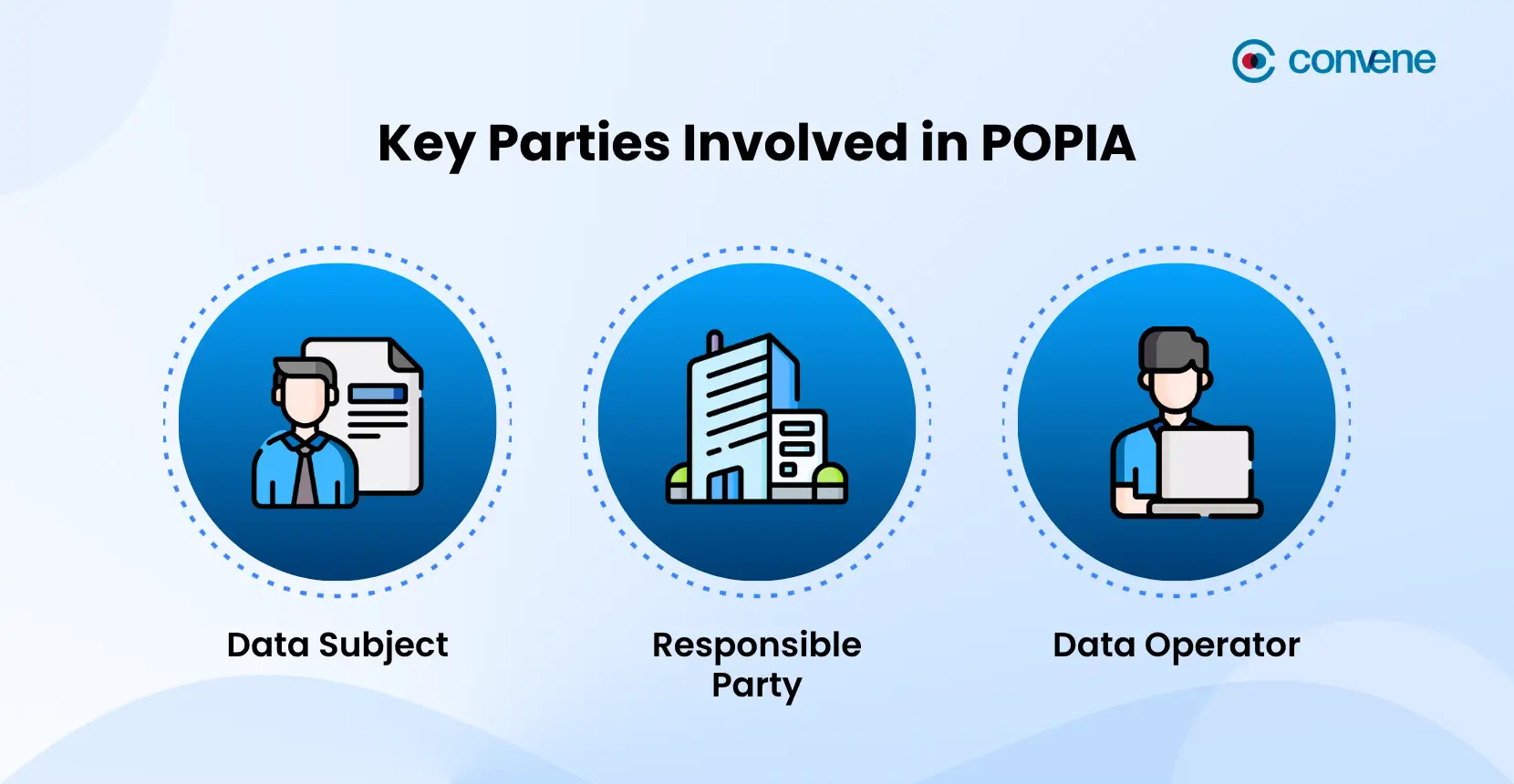
The POPIA Act South Africa identifies three main parties involved in the data handling lifecycle: data subject, responsible party, and data operator.
- Data Subject: This refers to an individual or a legal entity that owns personal information. Unlike the GDPR, which protects natural persons, the POPIA Act protects both living and juristic persons.
- Responsible Party: Also known as the controller, it is an individual or a business that determines why and how the data will be processed. These can include nonprofit organisations, government agencies, or individuals.
- Data Operator: Also called processors in other jurisdictions, it is an entity, such as an IT vendor, assigned to process personal information on behalf of the responsible party.
The Eight Conditions for Lawful Processing of Personal Information Under POPIA
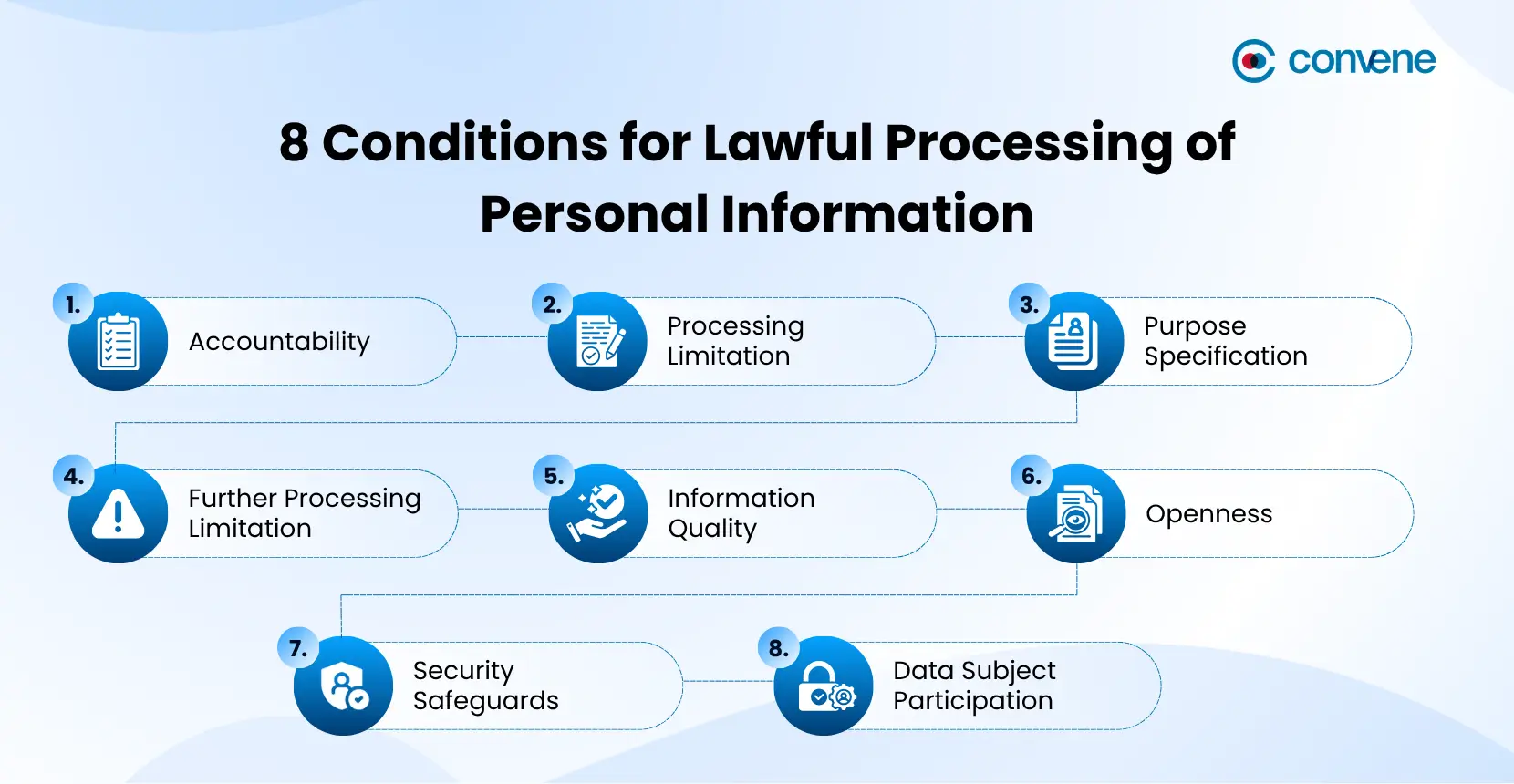
POPIA outlines eight conditions for lawful processing of personal information that every responsible party must comply with.
1. Accountability
The responsible party should be accountable for ensuring compliance with all the conditions. This entails overseeing the management of personal information and determining how and why data is processed.
2. Processing Limitation
Data subjects must provide their full consent to the responsible party for the collection and processing of their personal information.
Any collection, processing, or use of information outside the intended scope should be acknowledged as a limitation and requires additional consent before further processing.
3. Purpose Specification
Personal information must be collected and stored for specific, explicitly defined, and legitimate reasons. The consent should explain the retention period or how the responsible party intends to dispose of the data after use.
4. Further Processing Limitation
The responsible party must not reuse personal information unless the process aligns with the original purpose. If the data will be used for a different purpose, the business must obtain additional consent.
5. Information Quality
It is the responsibility of the business to ensure that the collected personal information is complete, accurate, and not misleading. To avoid inaccuracy, responsible parties should validate information as they capture it.
6. Openness
The data subject must be aware of the reasons and methods of why and how the data is processed. As a data controller, the responsible party is mandated to be transparent with data subjects about the collection and use of information.
7. Security Safeguards
Businesses are required to establish procedures to identify foreseeable internal and external data security risks to personal information. POPIA mandates that they have systems in place to prevent personal data from unauthorised access.
8. Data Subject Participation
POPIA grants data subjects the right to access, correct, delete, or object to the processing of their personal information. The responsible party must provide mechanisms that allow data subjects to exercise these rights.
POPIA Non-Compliance Violations and Penalties
Entities that fail to comply with POPIA are subject to administrative fees, criminal penalties, and civil claims.
Here are the key violations and POPIA fines outlined in Chapter 11.
| Violation | Description |
|---|---|
| Section 100: Obstruction of Regulator | Preventing the Regulator from enforcing policies or conducting investigations |
| Section 101: Breach of confidentiality | Unlawful disclosure of personal information |
| Section 102: Obstruction of execution of warrant | Intentionally preventing lawful search or seizure processes |
| Section 103: Failure to comply with enforcement or information notices | Failure to comply with enforcement notice |
| Section 104: Offences by witnesses | Providing false or misleading information during an investigation or failing to submit required evidence |
| Section 105: Unlawful acts by responsible party in connection with account number | Illegal collection and processing of personal information by a responsible party |
| Section 106: Unlawful acts by third parties in connection with account number | Unlawful acquisition and use of account numbers by external parties |
Violations can include fines of up to ZAR 10 million and imprisonment of up to 10 years, depending on the severity.
| Penalty Type | Possible Consequences |
|---|---|
| Administrative Fines | Fines up to ZAR 10 million, depending on the nature of personal information involved. |
| Criminal Penalties | Imprisonment of up to 12 months for minor offences (for sections 59, 101, 102, 103(2) or 104(1)) Imprisonment of up to 10 years for serious offences (for sections 100, 103(1), 104(2), 105(1), 106(1), (3) or (4)) |
| Civil Claims | Data subjects may institute civil proceedings for damages against responsible parties. |
How does POPIA regulate special personal information?
Special personal information pertains to a category of personal data that is highly sensitive or confidential. POPIA imposes stricter processing conditions for this type of information to prevent misuse, discrimination, and privacy violations.
Generally, POPIA prohibits the processing of such information unless the data subject has provided consent, the processing is required by law, or the information has been deliberately made public by the data subject.
What is considered Special Personal Information under POPIA?
- Religious or philosophical beliefs
- Race or ethnic origin
- Trade union membership
- Political perspectives
- Medical information
- Biometrics (e.g., fingerprints and facial recognition)
- Sexual orientation
- Criminal records
- Children’s personal information
POPIA Compliance Checklist: Step-by-Step Action Plan for Organisations
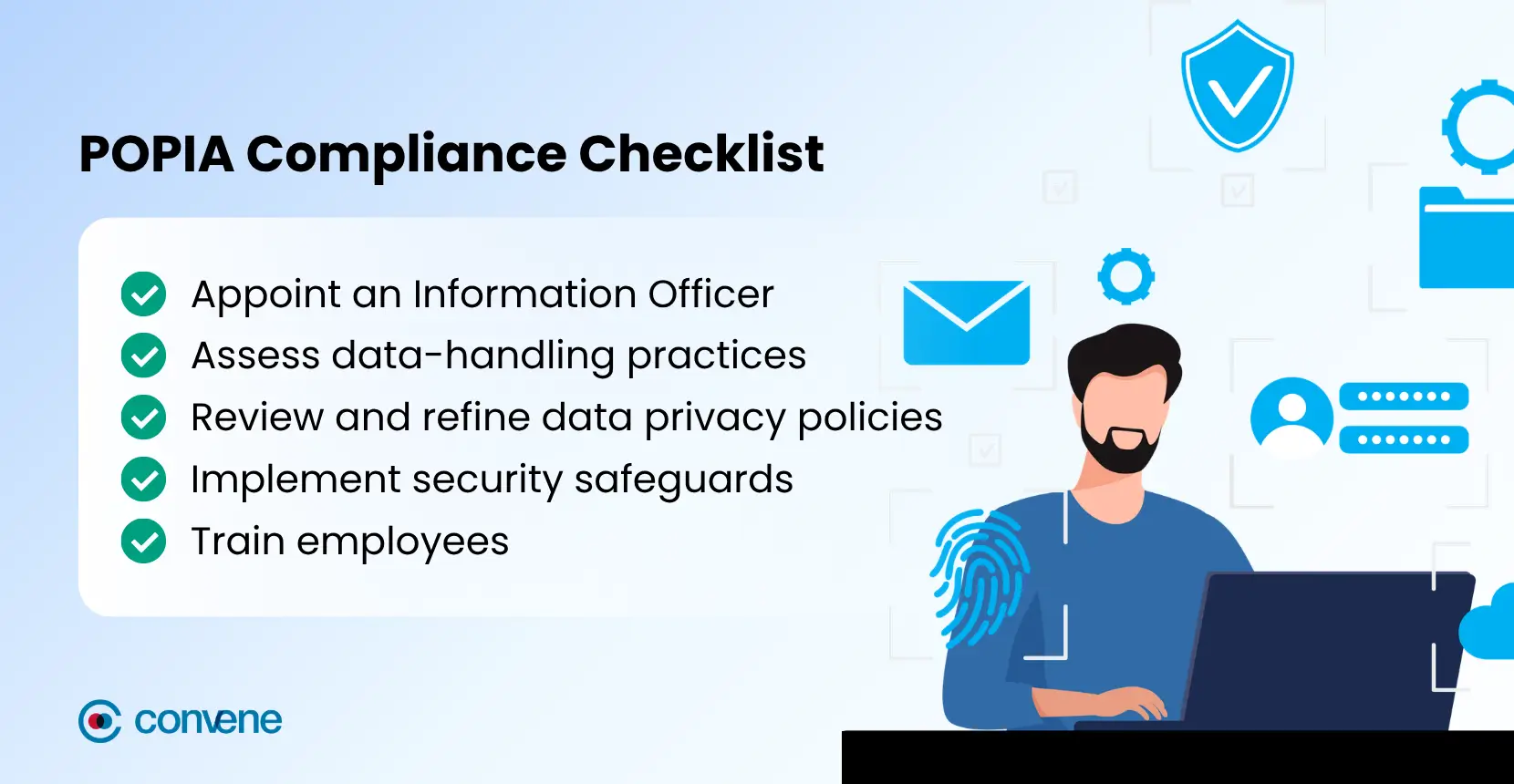
Compliance with POPIA involves several steps, including appointing an Information Officer, assessing data handling practices, reviewing data privacy policies, implementing security safeguards, and training employees.
1. Appoint an Information Officer
Designate an Information Officer (IO) who will lead and oversee the POPIA compliance of the organisation. They should be responsible for operationalising procedures, conducting awareness training, and coordinating with regulators. One or more employees can also be appointed as Deputy Information Officers to support the IO in managing compliance.
2. Assess data-handling practices
Conduct a comprehensive data mapping across the operation, which should capture the type of data, source, and usage. The result could be the baseline of risk assessment that will help identify emerging issues and gaps in current data handling practices.
3. Review and refine data privacy policies
Audit existing privacy policies in the bylaws and align them with POPIA’s requirements. Key areas to prioritise include cross-border transfers, cookies and tracking, data breach protocols, marketing consent, and compliance processes.
4. Implement security safeguards
Establish robust security measures to avoid data leaks and breaches. Technical measures should include document encryption, role-based access controls, and intrusion detection systems. For stronger physical security, organisations should secure the premises of data hosting rooms and maintain visitor logs.
Digital tools like board portal software are designed with advanced security safeguards that notify them of breaches and suspicious activities in real-time. This enables the board of directors to respond quickly and minimise the risk of exposing personal information.
5. Train employees
Enhance the security awareness and training of employees so they can align their daily decisions with POPIA requirements. Every employee should understand not only the policies, but also the reasoning behind them. Organise discussions on critical topics, such as handling data subject requests, consequences of non-compliance, and classification of personal information.
What are the differences between POPIA and GDPR?
GDPR and POPIA share many core data protection principles. However, their differences mainly lie in their scope, geographic application, and regulatory requirements.
| Scope | GDPR | POPIA |
|---|---|---|
| Scope | Article 4 states that the law is applicable only to ‘identified or identifiable natural persons’. | Section 1 clarifies that the law is applicable to either a natural person or a juristic person.
|
| Territory | GDPR covers organisations operating within EU member states, as well as organisations outside that offer services to EU citizens. | POPIA applies to organisations that process personal data in South Africa. It also applies to organisations abroad processing local personal information. |
| Controllers/Processor | GDPR requires all data controllers, including foreign organisations, to assign local representatives. | POPIA does not require foreign organisations to appoint a local representative. |
| Right to Data Portability | Data subjects have the right to receive their personal information in a structured and machine-readable format. | Data subjects do not have the right to data portability. |
| Officer-in-Charge | Data Protection Officer (DPO) | Information Officer (IO) |
How a Digital Governance Platform Supports POPIA Compliance
A digital governance platform is a tool that helps organisations efficiently manage, protect, and control their data in a way that is structured and compliant.
In South Africa, digitalising governance practices is critical for scaling compliance and meeting the evolving regulatory landscape, particularly after the enforcement of POPIA.
Here’s how a digital governance platform supports POPIA compliance:
1. Centralised Data Inventory and Visibility
A governance platform makes it easier to map and locate specific information. It functions as a digital repository for information, helping organisations streamline data collection across many sources. As a result, employees make decisions faster and practise stronger data hygiene.
The platform is built with role-based access control features that tailor information access for every user. This ensures that users can only view documents they are authorised to access, strengthening compliance with internal privacy policies.
2. Automated Data Protection
Compliance with data protection standards such as GDPR and POPIA becomes uncomplicated with a governance platform. Its security safeguards simplify key processes, such as consent management, access monitoring, data retention, and incident reporting.
Additionally, it provides comprehensive audit trails for all activities, relieving organisations of manual reviews and ensuring that every process remains secure and transparent.
3. Empowers Information Officer
An Information Officer can leverage a board portal for more proactive oversight. Instead of focusing only on data management and compliance, the officer can also prioritise security training to strengthen long-term compliance.
At the same time, using a governance platform like a board portal also allows them to shift from managing routine administrative tasks to more concrete and strategic initiatives.
Frequently Asked Questions About Protection of Personal Information Act (POPIA)
Can organisations conduct cross-border data transfers under POPIA?
Yes. Organisations can conduct cross-border data transfers, but only if the foreign recipient is governed by an equivalent policy or law that provides the same level of data protection as POPIA.
What role does cybersecurity play in POPIA compliance?
Cybersecurity is pivotal to POPIA compliance. Under lawful condition seven, responsible parties must secure the integrity and confidentiality of personal information by implementing technical and organisational security measures.
This includes establishing strong cybersecurity practices, such as access management, encryption, and network security, to protect personal information against both internal and external threats.
Strengthen Data Governance for POPIA Compliance with Convene Board Portal
POPIA compliance is an ongoing requirement in South Africa that organisations must meet through continuous oversight, clear accountability, and the right tools. To prevent personal information from falling through the cracks, South African organisations need a governance platform that can enhance both visibility and controls.
Convene Board Portal is a leading board management solution that helps boards move from reactive compliance to a proactive governance culture.
It is a secure digital workspace where directors, executives, and Information Officers can collaborate with confidence because every interaction and document is traceable and encrypted.
Built with a suite of robust collaboration and security features, Convene Board Portal enhances board governance and POPIA compliance by:
- Safeguarding the confidentiality of sensitive or personal information while documents are at rest and in transit with AES-256 document encryption
- Ensuring information is accessible and protected from unauthorised users through role-based access controls
- Preventing document misuse with real-time document versioning and customisable watermarks
- Enhancing compliance intelligence with AI-driven features that retrieve key insights from meeting materials and summarise complex legal discussions
- Centralising oversight and compliance in one hub, it enables the board of directors to manage all governance activities from one place
Embrace digital transformation across the board for stronger and smarter POPIA compliance.



Jean is a Content Marketing Specialist at Convene, with over four years of experience driving brand authority and influence growth through effective B2B content strategies. Eager to deliver impactful results, Jean is a data-driven marketer who combines creativity with analytics. In her downtime, Jean relaxes by watching documentaries and mystery thrillers.
- Connect:
-

-