



As any entrepreneur knows, businesses and partnerships are built on trust. The collaboration and negotiation, however, highly depend on the parties’ confidence that shared information will be handled responsibly and privately on top of it all. That said, words alone aren’t enough. Trust must be formalized and documented through contracts and agreements.
Confidentiality agreements are utilized by businesses to create legally enforceable boundaries when it comes to the ownership, permissible use, and disclosure limitations of information shared between parties. The importance of such contracts is reinforced by a surge in trade-secret disputes, with over 1,500 federal cases filed in 2025, showing how disputes over confidential information are increasingly shaping the corporate legal landscape.
In this guide, we’ll deep dive into the meaning of non disclosure and confidentiality agreement, types and elements to consider when creating a confidentiality agreement, and more.
What is a confidentiality agreement?
A confidentiality agreement, also known as a non-disclosure agreement (NDA), is a legally binding contract used to protect the privacy of certain information. In general, it outlines how the information may be used, what the duties of the involved parties are, and specific consequences for breach of contract.
Parties involved in such agreements can either be unilateral (only one party keeps it confidential) or bilateral (both are bound to secrecy). These agreements are common in partnerships, mergers, and other business deals.
Compared to sales contracts or service agreements, a confidential agreement document is specifically created to protect data privacy and trade secrets. Despite some jurisdictions recognizing oral agreements, having a written contract is still the best practice to guarantee enforceability, legality, and traceability to prevent disputes.
Why is a confidentiality agreement important?
Protecting confidential information is crucial for almost all types of business. A confidentiality agreement statement is important as it creates a legal framework to safeguard trade secrets, proprietary data, and other business knowledge from unauthorized misuse or disclosure.
At the same time, this gives businesses peace of mind when collaborating with investors, third-party vendors, or employees without the risk of exposing anything to competitors. Moreover, confidentiality agreements can serve as documented evidence to support litigation or injunctive relief in case of misappropriation.

What are the key elements of a confidentiality agreement?
A well-drafted confidentiality agreement is an effective tool for maintaining the organization’s intellectual property or trade secrets. Below are the essential elements a basic confidentiality agreement must have:
- Identification of Parties: Parties involved in the transaction and their roles. Information such as full names, addresses, jurisdiction, and corporate identity must be included.
- Definition of Confidential Information: A clause specifying what is considered confidential (e.g., financial data, customer lists, operational plans).
- Obligations and Standard of Care: Responsibilities of the parties (usually the Receiving) in terms of maintaining secrecy, using information, and authorising access.
- Duration and Survival of Obligations: Duration for confidentiality of the protected information, ranging from one to five years, depending on the nature of the information.
- Permitted Disclosures: Provisions that permit disclosure under specific circumstances, like when it’s required by law or with written consent from the disclosing party.
- Exclusions: Specific information that is not considered confidential, such as publicly available or independently developed data.
- Governing Law: Relevant laws that are applicable to your contract, particularly in case of disputes.
Three Types of Confidentiality Agreements (with Examples)
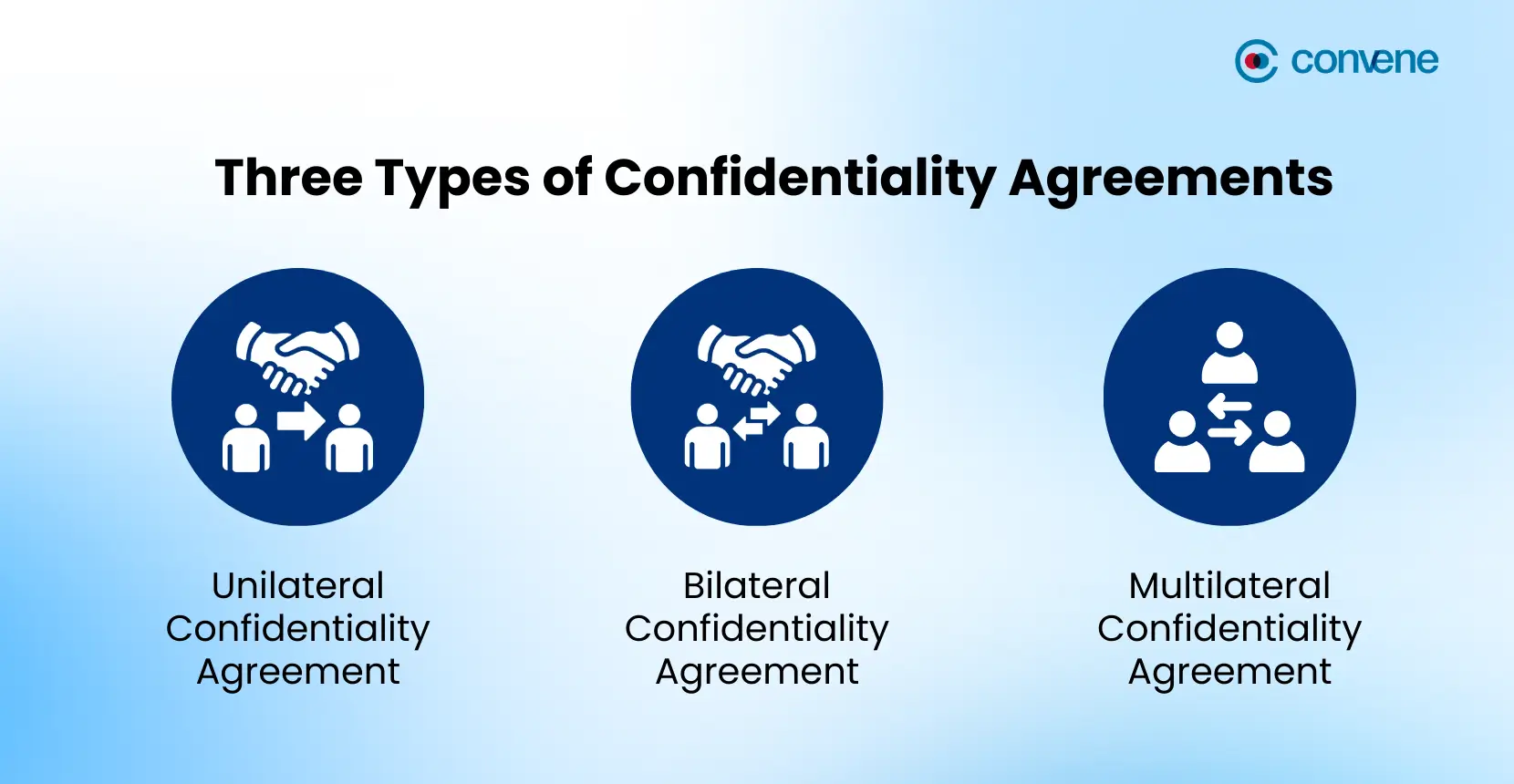
Confidentiality agreements are commonly utilized in labor relations, innovation projects, and other business contracts. Therefore, the type of confidentiality agreement you choose will depend on the contract’s purpose and the number of involved parties.
1. Unilateral Confidentiality Agreement
Also referred to as one-way contracts, unilateral confidentiality agreements only require one of the parties to disclose the sensitive information. In other words, the Disclosing Party will share the confidential information with the Receiving Party, who is legally bound to maintain confidentiality. Considered as the most common type used by companies, here are some unilateral confidentiality agreement examples:
- Employer-Employee NDAs (trade secrets, operation plans, supply sources, business plans, merchandising systems)
- Company-Contractor NDAs (contractor agreements include limitations on using or sharing information)
- Inventor-Evaluator NDAs (business operations, customer information, intellectual property, service information)
- Seller-Buyer NDAs (production processes from creation to manufacturing, proprietary rights, technology, or machines used for production)
2. Bilateral Confidentiality Agreement
Bilateral confidentiality agreements, also known as two-way or mutual contracts, require both parties to share confidential information. This also means both parties act as the Disclosing and Receiving parties, and they can limit one another on how to use or share the information.
This type of agreement is typically utilized in joint ventures and partnerships, mergers and acquisitions, investment discussions, and co-marketing collaborations or initiatives. In short, bilateral agreements are best suited for circumstances wherein a great volume of private information must be exchanged or shared.
For instance, two tech firms looking into a joint product development partnership typically require the exchange of proprietary source code, product roadmaps, financial projections, and customer insights. Therefore, a bilateral contract is necessary to guarantee mutual protection or accountability.
3. Multilateral Confidentiality Agreement
If the situation requires more than two parties, it is called a multilateral confidentiality agreement. In this type, at least one party may disclose the information, but all parties are obligated to maintain confidentiality. Multilateral contracts are often utilized to prevent having multiple unilateral or bilateral agreements between two parties.
This type of agreement is commonly used in negotiation-heavy deals, such as consortium and joint ventures, supply chain management, project evaluation, and research and development.
A multilateral agreement can be complex to negotiate due to the number of parties involved. For that reason, it is important to carefully draft it to be enforceable across all parties.
Confidentiality Agreement Template
If you’re looking for a simple confidentiality agreement template, here’s one that you can use.

How to Write a Confidentiality Agreement: Best Practices
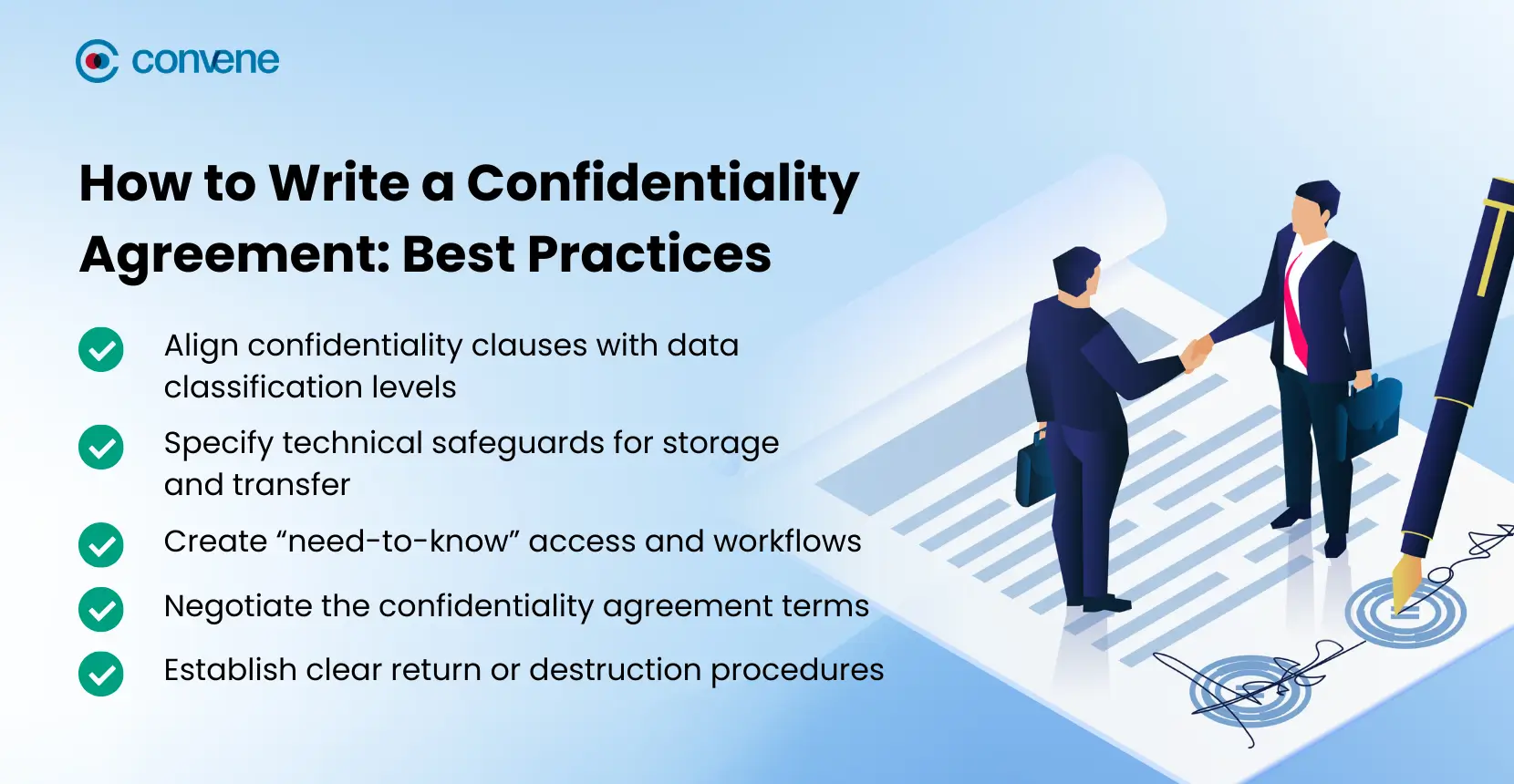
Managing confidentiality agreements is not as easy as drafting a simple business document. It requires integration of legal drafting, information security controls, and contract governance. But how can you effectively manage your organization’s confidentiality agreements?
1. Align confidentiality clauses with data classification levels
The first best practice to follow is aligning confidentiality agreement clauses with your company’s data classification framework (e.g., internal, public, confidential, highly confidential). Ideally, it is vital to include a comprehensive disclosure clause and a restrictive disclosure clause.
- Comprehensive Disclosure Clause: Covers all non-public information disclosed in any form. These clauses may be written, oral, or electronic, and are typically used in strategic partnerships, M&A, and research and development.
- Restricted Disclosure Clause: Covers only specifically defined or marked information. Such clauses are limited to written or marked “confidential” information, and are often utilized in vendor agreements or limited technical exchanges.
The international standards ISO/IEC 27001 and ISO/IEC 27002 establish guidelines for information classification, which enables organizations to protect their data according to its value and sensitivity. This is critical to establish limits for disclosing data, create procedures for handling data, and determine how long data should be kept.
2. Specify technical safeguards for storage and transfer
One thing that a business confidentiality agreement should not exhibit is ambiguity. Therefore, it is imperative that it explicitly reference your organization’s technical safeguards for storage and transfer.
Frameworks like the CIS Critical Security Controls suggest encryption at rest, secure key management, endpoint protection, and network segmentation for sensitive information. In addition, it is ideal for your organization to include provisions that work on zero-trust architectures or incorporate restrictions on personal device storage.
3. Create “need-to-know” access and workflows
A confidentiality agreement must only be accessible to authorized parties. This is why core safety measures such as role-based access control (RBAC), multi-factor authentication (MFA), and session monitoring must be implemented.
By embedding such controls into your NDA workflows (e.g., approval checkpoints, time-bound access), you can reduce insider threat exposure and create a defensible governance trail.
4. Negotiate the confidentiality agreement terms
Another best practice to consider is negotiating the terms of the agreement with the concerned stakeholders. Ideally, you must prioritize coordination with the legal, security, and operational teams. Keep in mind that all negotiations must be by the book and accurate, regardless of whether it’s for bilateral or unilateral contracts. The goal is to ensure everyone is on the same page.
As for the agreement terms, note that these documents are typically temporary or created with a pre-established duration (e.g., 2 to 5 years after signing). Obligations in the confidentiality agreement are no longer valid once the contract expires. In other words, involved parties are sometimes (depending on the agreement) authorized to disclose information written in the contract.
5. Establish clear return or destruction procedures
Last but not least, a general confidentiality agreement must include a provision detailing how information would be handled at the contract’s expiration or termination. It is best practice to specifically outline whether the sensitive information should be destroyed or returned to the disclosing party.
Depending on the agreement, a request for destruction is typically confirmed in writing or must be certified by an authorized party. But for legally retained information, the duration of obligations usually varies, which must be outlined in the agreement.
What are the consequences of breaching a confidentiality agreement?
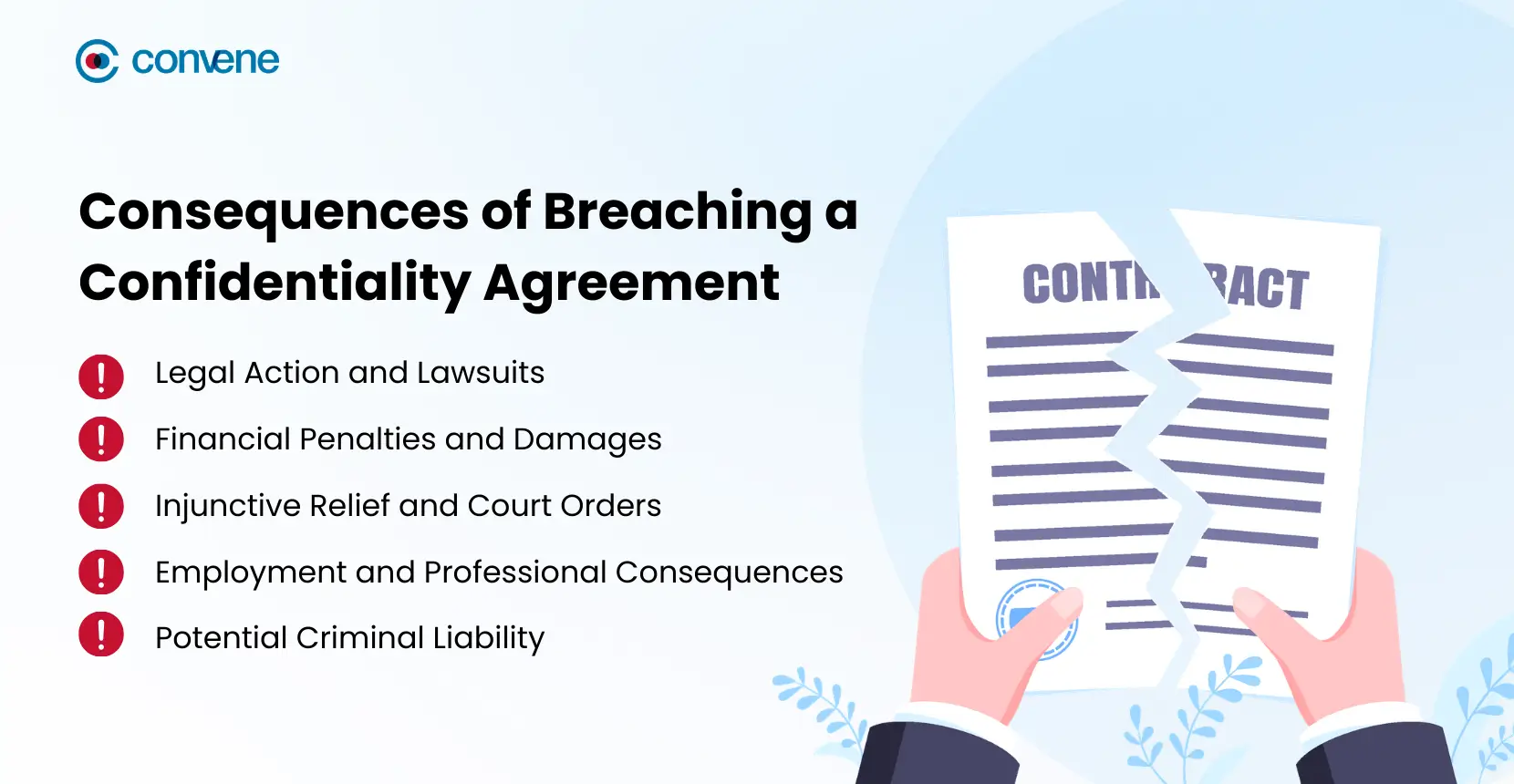
As confidentiality agreements are legally binding documents, any violation is usually treated as a breach of contract. Regardless of whether it’s accidental or intentional, here are the most common consequences your businesses can face:
1. Legal Action and Lawsuits
Risk of litigation is the most common and immediate consequence when breaching a confidentiality agreement. The injured party has the right to file a lawsuit alleging breach of contract. However, they must provide proof that a valid agreement was created, that a breach occurred, and the damages caused by the violation.
Depending on the case, the court may enforce the agreement through civil proceedings and find out on how to compensate the harmed party. Some grounds for lawsuits may include copyright infringement, patent infringement, misappropriation of trade secrets, and breach of fiduciary duty.
2. Financial Penalties and Damages
Breaches in confidentiality agreements can also result in monetary liability. Depending on the violation’s severity and intent, the court may order different forms of damages, such as:
- Compensatory damages to cover any financial losses or lost business opportunities.
- Punitive damages for cases that involve intentional or malicious misconduct.
- Liquidated damages if the agreement specifies a predetermined penalty amount.
- Legal fees and litigation costs of both parties that the losing side is typically required to pay.
3. Injunctive Relief and Court Orders
Filing for financial damages often takes time, especially if a big amount of money must be collected. In cases where violations cause irreparable harm that money can’t fix, injunctive relief is the best option. This is pursued to prevent further disclosure or information misuse while the court case is ongoing. Once granted, a court-issued injunction must be followed. Violation can lead to contempt of court and additional penalties.
4. Employment and Professional Consequences
For employees and contractors, breaching confidentiality obligations also constitutes grounds for termination “for cause”. For one, organizations can dismiss employees due to loss of trust and potential exposure to liability. This can lead to professional reputational damage, which can make future employment difficult — particularly in industries relying heavily on discretion or information security. As for regulated professionals like law or healthcare, breaches can trigger disciplinary action, suspension, or even revocation of licences.
5. Potential Criminal Liability
While NDA breaches are usually civil matters, severe cases like trade secret theft or data privacy violations may cross into criminal territory. In these situations, possible penalties may include fines, imprisonment, and other statutory sanctions. This may depend on the jurisdiction and applicable laws relevant to the agreement terms and involved parties.
Frequently Asked Questions About Confidentiality Agreements
Who is typically required to sign a confidentiality agreement?
Confidentiality agreements are typically signed by employees, contractors, consultants, vendors, partners, and investors. In short, everyone who has the authority or need to access the information. In some cases, board directors will sign NDAs to protect board deliberations and future initiatives shared during their meetings.
Can a confidentiality agreement cover oral information?
Yes. Many confidentiality agreements explicitly state that obligations apply to written, electronic, and oral disclosures. However, some contracts still require these oral disclosures to be verified or certified in writing, within a specified timeframe, to avoid disputes over classification.
Can confidential information ever be disclosed legally?
Disclosure may be permitted under certain exceptions like court orders, legal obligations, regulatory reporting, whistleblower protections, or written consent from the disclosing party. Many confidentiality agreements formally include “permitted disclosure” clauses to address such scenarios.
Do confidentiality agreements apply after employment ends?
In some cases, yes. Confidentiality obligations may survive termination of employment or contractual relationships. This often applies to trade secrets, proprietary technologies, and customer data, which may remain protected indefinitely or for a specific survival period.
Guaranteed Confidentiality for Boardroom Confidence with Convene Board Portal

Today, even a single data leak can ruin the reputation of any business, and “good enough” security measures should not be an option. At Convene, we understand that confidentiality is the bedrock of effective governance — so we give you tools to protect your most sensitive data!
Convene Board Portal, a leading board management software, gives organizations absolute control over who sees what, and when. Our platform offers a seamless, secure ecosystem for your most sensitive discussions and gives you peace of mind that the right eyes see the right documents, and nothing else. With Convene, you can:
- Lock Down Every Board Document: Keep your board packs secure with Convene’s Document Library and security features like copy restrictions and watermarking. Protect your strategy decks and financial reports from leaks and ensure authorized access. Plus, easily monitor all document activities with our audit trail feature and see who views, downloads, or edits your files.
- Secure Data Beyond the Boardroom: Convene’s multi-level encryption and on-the-fly decryption model safeguards your files from storage to approval. Features like data wipe and automatic purge are also available to prevent exposure risks.
- Maintain Enterprise Security at Scale: Powered by AWS, Convene’s enterprise-grade cloud hosting guarantees advanced threat detection and monitoring to keep your data protected at all times.
Want less risk but more control over your data? Request a demo to know how Convene can make that happen.



Jielynne is a Content Marketing Writer at Convene. With over six years of professional writing experience, she has worked with several SEO and digital marketing agencies, both local and international. She strives in crafting clear marketing copies and creative content for various platforms of Convene, such as the website and social media. Jielynne displays a decided lack of knowledge about football and calculus, but proudly aces in literary arts and corporate governance.
- Connect:
-

-