



Key Takeaways:
- Bylaws govern a corporation’s internal operations, outlining procedures for board meetings, voting rights, roles of directors, and other management responsibilities.
- Articles of incorporation are legal documents filed with the state to formally establish a corporation and define foundational details like the company name, structure, and registered agent.
- While articles of incorporation create the corporation as a legal entity, bylaws provide the internal rules that guide daily governance and decision-making.
- Bylaws are primarily internal documents used by directors, officers, and members, whereas articles of incorporation are public filings required for legal recognition.
- Together, bylaws and articles of incorporation establish both the legal foundation and governance framework needed for effective corporate management and compliance.
Incorporating a business doesn’t only involve capital. As Forbes outlines, achieving business objectives has six stages: planning, securing funding, registering, launching, establishing and creating value. Throughout this journey, businesses will need to rely on strong governance structures to enhance clarity and stakeholder engagement. This is where bylaws and articles of incorporation come in.
Together, these statutory requirements legitimize a company’s existence and provide the framework for decision-making and operations.
Learn in this article the key distinction between bylaws and articles of incorporation. Understand how they help companies operate with clarity, protect stakeholders, and prepare for sustainable growth.
At the end, discover the power of the Convene board portal in streamlining document governance, ensuring all key stakeholders can access, track, and collaborate on these critical documents securely and efficiently.
What are bylaws?
Bylaws are a set of procedural rules and regulations for internal management and operations. After a company is formed, it drafts bylaws to define key governance processes such as shareholder and board meeting formalities, voting rights, board composition, and the appointment of committees.
Unlike articles of incorporation, bylaws are intended for internal stakeholders. They are treated as the agreement between founders, leaders, staff, and members that legally binds their actions and decisions. While they aren’t public documents, bylaws are a critical resource for resolving internal disputes and clarifying internal procedures.
Are bylaws required in every U.S. state?
Bylaws are vital to maintaining corporate compliance. In the United States, 31 states require companies to form bylaws, whereas the following don’t impose such a mandate.
- Alaska
- California
- Colorado
- Kansas
- Louisiana
- Michigan
- Minnesota
- Missouri
- Nevada
- North Dakota
- Ohio
- Pennsylvania
- Rhode Island
- Utah
- Wisconsin
Although bylaws aren’t legally required in these states, some companies create them at their own discretion to help structure and govern their daily activities.
Why are bylaws important in corporate governance?
Companies use bylaws to clarify relationships and assign roles among shareholders, directors, and department heads. They establish the flow of decision-making, ensuring everyone understands what is expected from them. Beyond roles, bylaws also strengthen transparency and accountability, which help internal teams avoid or resolve conflicts.
What are the key components of bylaws?
There are variations on how bylaws are structured, depending on the unique considerations and processes of each company. However, there are general provisions that should always be included, such as:
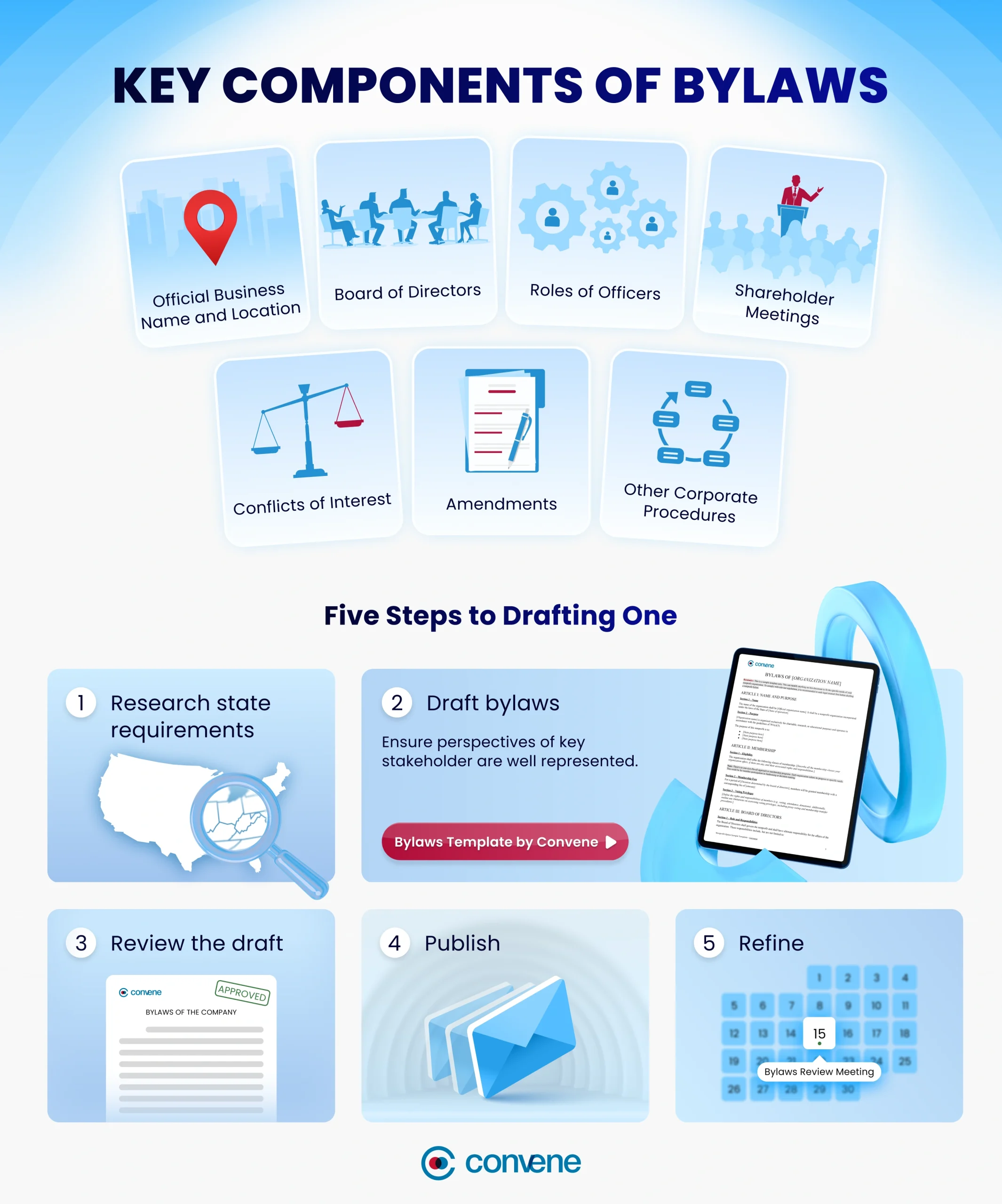
- Official Business Name and Location: Introduce the company’s legal identity by indicating the official business name and address. These serve as the primary reference for regulators in case of notices or official communications.
- Board of Directors: This provision describes the authority and responsibilities of the board. It explains term limits, board meeting protocols, member qualifications, board structure, voting rights, and quorum.
- Roles of Officers: Bylaws also define the roles and responsibilities of other officers, including C-suite executives. This provision guides how companies should appoint, evaluate, and, if necessary, remove them from their positions.
- Shareholder Meetings: The bylaws outline the formalities of both annual and special shareholder assemblies. Additionally, this section details how boards should spearhead voting, with an emphasis on rights, weight allocations, and proxy participation.
- Conflicts of Interest: Bylaws hold board members and officers accountable to their fiduciary duties to ensure they act in the company’s best interest. In the event of conflicts, this provision lists procedures for resolution, including the investigation process and disciplinary actions.
- Amendments: This specifies the proper channels and processes by which the board should alter bylaws. This includes voting thresholds, approval hierarchy, and implementation plan.
- Other Corporate Procedures: The document also clarifies other key governance practices, such as document management, dissolution, law compliance, committee formation, membership, and strategic planning.
Five Steps to Drafting Effective Corporate Bylaws for Your Company
1. Research state requirements and best practices
A lot of technical details go into bylaws, so it’s crucial to research first before drafting. Review state laws to identify required provisions and consult with legal professionals for best practices. Since states influence formats of bylaws, researching before anything else ensures the outcome is both relevant and compliant.
2. Draft bylaws
After listing the outline, begin drafting the bylaws. Who should draft the bylaws? In most instances, founding members lead this process after incorporation. However, for larger companies, they typically employ the help of a dedicated committee to coordinate inputs from founders, board members, C-suite executives, staff, and legal consultants. When drafting, remember that considering the perspectives of key stakeholders ensures they are well represented in the document.
To help you get started, here’s an example bylaw template you can use as a reference.
3. Review the draft
Have your qualified legal consultants review the accuracy and fairness of the bylaws. This ensures that every required provision is included and that they adhere to state laws. After the legal review, involve the board of directors for final approval.
4. Publish
Once ready, distribute the document to the board members, executives, department heads, employees, and stockholders. Board portals make this process faster for busy boards. These platforms offer a secure, centralized hub where stakeholders can draft, review, and distribute bylaws, keeping every leader in the loop.
Additionally, posting the bylaws on your website would help boost transparency, especially for organizations involved in fundraising and donations, such as nonprofits.
5. Refine
Just as companies evolve, bylaws also need review and updates. To ensure provisions still reflect the company’s current state, schedule periodic board meetings to review operations, governance structure, and compliance obligations. Similar to drafting, the founding members, board, or committee can spearhead the amendment process, with the final approval of key stakeholders.

What is articles of incorporation?
The articles of incorporation (AoI) definition refers to documents submitted to the Secretary of State to legally form a company and gain corporate status. They are equivalent to a constitution, stating foundational information, such as the official business name, corporate structure, registered agent, and authorized shares. Depending on the state, these documents are sometimes referred to as a certificate of formation, certificate of incorporation, or corporate charter.
How do companies benefit from articles of incorporation?
The AoI serves several external purposes. They formally establish a corporation as a separate legal entity from its owners. This makes them eligible for limited liability protection and tax advantages. Moreover, once acknowledged by the state, the AoI grants the corporation the legal capacity to own property, enter into contracts, and conduct business under its registered name.
What information should be included in articles of incorporation?
All states in the US require AoI. Here are the sections to typically include to ensure a correct and complete submission.
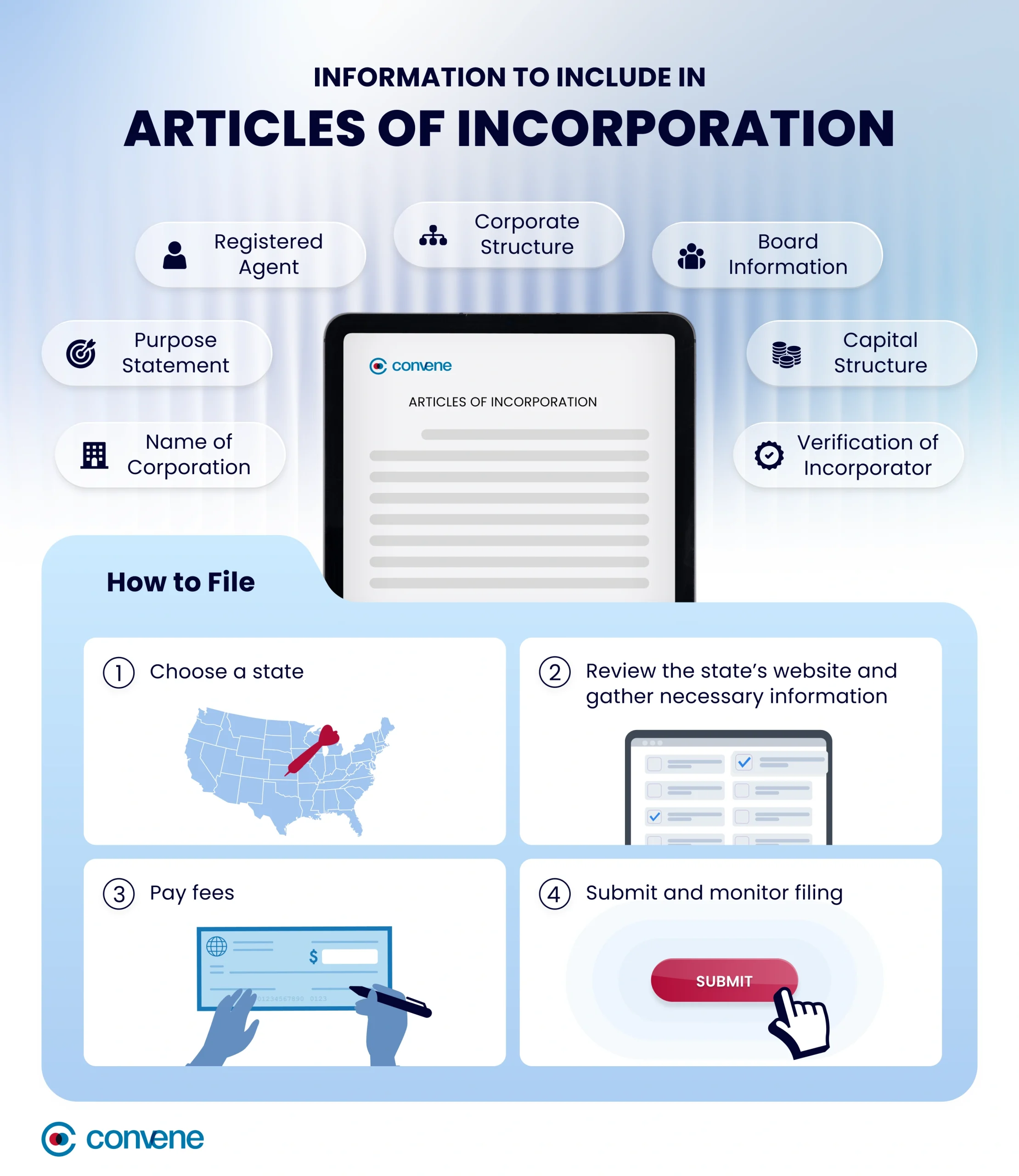
- Name of Corporation: Begin with the company’s official name, which must comply with the state’s naming guidelines. Governments usually mandate the avoidance of words that are misleading or those that imply indecent services or association with religion or politics.
- Purpose Statement: Declare the business activities that the company intends to do. The format and length of the statement vary. Some states accept broad descriptions, while others want details in a list format.
- Name and Address of the Registered Agent: Establish your legal contact by indicating your registered agent’s name and address. This is important for state governments to know where and whom to coordinate with for memos and legal matters.
- Corporate Structure: Clarify the legal form of your company, whether corporate, nonprofit, non-stock, LLC, or PLC. This would dictate the terms for tax obligations, liability, and reporting requirements.
- Board Information: List the founding board members for transparency, including their full names and complete addresses.
- Capital Structure: For companies intending to issue stock, specify the total number of authorized shares each member could have and the class of stock (e.g., common or preferred) they may acquire.
- Verification of Incorporator: Seal and authorize the document by verifying it with the incorporator’s full name, address, and signature.
How to File Articles of Incorporation: Step-by-Step Guide
1. Choose a state
Decide which country or state you want to incorporate the company in, while considering long-term factors such as ease of doing business, tax benefits, and corporate regulations. For instance, if you decide to incorporate in the U.S., each state would impose varying AoI guidelines, some stricter than others. Among its states, Delaware and Nevada are top choices for new companies for their business-friendly regulations.
2. Review the state’s website and gather necessary information
Review the website of the Secretary of State or equivalent office to confirm document requirements. The format may change from time to time, so it’s best practice to review first to always get the updated version.
Once you’ve reviewed, gather all pertinent details and proceed with drafting. Typically, a standardized format is provided by the state that you can download and fill out. In some cases, companies submit customized documents to reflect unique provisions on capital structure or ownership. Even so, the AoI must still comply with the state’s standard rules.
3. Pay fees
Pay the required fee before submitting the AoI document. If the company operates in multiple states, it must also incorporate in each one and fulfill tax obligations. States set different amounts, but fees range from 50 to 275 USD. The states with the lowest fees of 50 USD are Arizona, Arkansas, Colorado, Hawaii, Iowa, Michigan, and New Mexico. On the other hand, the state with the highest fee is Massachusetts, which charges 275 USD.
4. Submit and monitor filing
Submit the AoI documents either via website, mail, or in person. Check with the state what process they prefer, since some are promoting paperless transactions already. If done online, websites usually provide instant confirmation, but it would take one to three weeks if done by paper.
Start drafting the document using this articles of incorporation example from Unilever as a guide.
Bylaws vs. Articles of Incorporation: Key Differences Every Business Should Know
Are bylaws the same as articles of incorporation? The previous sections have clearly established the importance of both bylaws and articles of incorporation in compliance and governance.
Within the context of a house analogy, bylaws function as the house rules, while the AoI acts as the house contract that legitimizes the transaction. Therefore, one can’t simply replace the other because they have different purposes and implications.
To sum up everything we’ve explained so far, here’s a detailed side-by-side comparison of the differences between bylaws and articles of incorporation.
| Aspect | Bylaws | Articles of Incorporation |
|---|---|---|
| Purpose | Structure internal governance and operations | Legally create a corporation recognized by a government body |
| Audience | Internal stakeholders (e.g., board members, senior executives, department heads, members, and employees) | External stakeholders (e.g., state, federal, or national government) |
| Filing Requirement | Not filed with the government | Filed with the Secretary of State or equivalent office |
| Legal Implication | Legally binds stakeholders to ensure compliance and accountability | Provides legal liability protection, allowing a company to hold properties and enter into contracts independently of the owners |
| Amendments | Amended by the board or members’ approval | Amended by revising the AoI filing upon the state’s approval |
| Content | Includes internal rules and procedures | Includes foundational corporate information |
| Visibility | Accessible mainly to internal stakeholders | Accessible to the public |
| Timing | Adopted after incorporation, typically drafted at the first general assembly | Filed at the time of incorporation to form a legal entity |
| Creator | Founders, the board of directors, or legal professionals | Founders or registered agents |
| Sample Drafts | Bylaws Template | Unilever’s Articles of Incorporation |
Conflicts Between Articles of Incorporation and Bylaws: How to Prevent
Conflicts between bylaws and AoI happen quite often. There could be an inconsistency in guidelines for board composition or overlapping content about capital structure. These instances confuse decision-makers, which can cause internal power struggles and legal disputes later on.
In such cases, can bylaws override the AoI? No, bylaws can’t contradict any provision in the AoI. The AoI is government-approved, meaning it must be the primary and superior governing document of a company.
To avoid these issues, here are the best practices you can apply when drafting bylaws and AoI.
Align bylaws with statutory requirements
Research on relevant statutory requirements and corporate laws prior and incorporate them in the documents to avoid unenforceable and conflicting provisions.
Employ legal counsel and key stakeholders early
Seek guidance from a legal counsel and involve key stakeholders from the get-go to establish a mutual understanding of provisions. Board members, executives, and managers can use their governance expertise during the writing process, whereas the legal counsel will help resolve potential conflicts before finalizing the documents.
Maintain version control and clear documentation
Record all amendments of both documents, including approval dates and the rationale behind every proposed change. This makes tracking more efficient in the long run and enhances overall transparency, therefore reducing misinterpretations.
To streamline documentation and maintain security over pertinent details, companies can explore advanced software for board governance. Board portal software comes with a document repository that is reliable for safeguarding sensitive organizational information and ensuring every file version is recorded.
Frequently Asked Questions on Bylaws and Articles of Incorporation
Do I need both bylaws and articles of incorporation to start a company?
Generally, both documents are essential for starting a company. They have different functions, but they complement each other in empowering the board of directors to govern with structure and integrity. In the U.S., even if some states don’t require bylaws, companies still create them to structure operations and decision-making.
How do bylaws differ from the constitution?
Bylaws and constitutions are similar in that they provide a governance structure. However, they operate at different levels. A constitution declares high-level principles that serve as the basis of all policies and projects.
On the other hand, bylaws are more focused on daily decision-making, laying out procedures for board meetings, roles and responsibilities, and committee creation. In terms of flexibility, constitutions are more difficult to amend, which typically requires a special member resolution or a higher voting threshold.
What is the difference between articles of association and articles of incorporation?
Articles of incorporation act as the company’s birth certificate. They are used to establish legal existence and secure permission to conduct business activities. On the other hand, articles of association set out the company’s internal rules. They function like a rulebook similar to bylaws.
Strengthening Governance From The Ground Up with Convene

Clarity and accountability are pillars of effective governance. For companies, this means grounding foundations such as bylaws and articles of incorporation in compliant and coherent legal and operational frameworks to avoid ambiguity and disputes.
Convene board portal provides the security and structure every company needs to draft, approve, and amend its governance foundation. The digital platform centralizes collaboration and decision-making workflows, enabling boards to make resolutions in one place—efficiently, securely, and with full accountability.
Built on Amazon Web Services (AWS), Convene Board Portal delivers enterprise-grade security, digital audit trails, and encrypted document repositories to help leadership uphold strong governance from day one with confidence.
Empower your board with a compliant, secure, and intuitive board governance platform. Book a Convene demo today!



Jean is a Content Marketing Specialist at Convene, with over four years of experience driving brand authority and influence growth through effective B2B content strategies. Eager to deliver impactful results, Jean is a data-driven marketer who combines creativity with analytics. In her downtime, Jean relaxes by watching documentaries and mystery thrillers.
- Connect:
-

-