



Key Takeaways
- Data residency is a strategy where organizations store and process digital assets within specific geographic locations.
- Over the years, data residency has become a strategic imperative for organizations to reinforce data governance amid globalization and evolving regulatory landscapes.
- Data residency frameworks vary per country, which makes it crucial for organizations to understand their implications to maintain compliance.
- Data residency, data localization, and data sovereignty are related concepts but serve different purposes. Data localization mandates that data be stored within specific geographic locations, while data sovereignty refers to the laws and regulations of the jurisdiction in which the data resides.
- An effective data residency strategy combines centralized data management, data flow visibility, modern IT infrastructure, automation, and strong board governance practices to support long-term security and business resilience.
Data residency is becoming a strategic imperative for organizations seeking to reinforce data governance amid globalization and evolving regulatory landscapes.
Recent research by Mordor Intelligence reflects this shift. It identified that stricter data-localization laws and expansion of sovereign cloud offerings are the primary drivers of the global data residency and compliance market. This underscores the growing demand for data residency across industries, not only in highly regulated sectors such as finance, healthcare, defense, and government.
This guide explains what is data residency, why it matters, the key compliance data residency requirements, and best practices for developing a robust data residency strategy.
What is data residency?
Data residency is an IT and operational strategy in which organizations store and process digital assets within specific geographic locations. This automatically makes organizations accountable to the jurisdictions where their data resides, heightening the importance of compliance management in data residency.
Generally, organizations can establish data hosting facilities within or outside their country of operation, as long as local legislation and governance requirements are met. However, in highly regulated sectors, governments often prohibit foreign data hosting centers.
For example, Australia requires government agencies to strictly host their data with providers that meet the Hosting Certification Framework (HCF). Similarly, while the EU’s GDPR does not generally mandate local data hosting, it only permits cross-border data to countries with equivalent levels of data protection.
Related Reading: Cloud Hosting Versus On-Premise Hosting: What’s The Difference?
Why should data residency matter to your business?
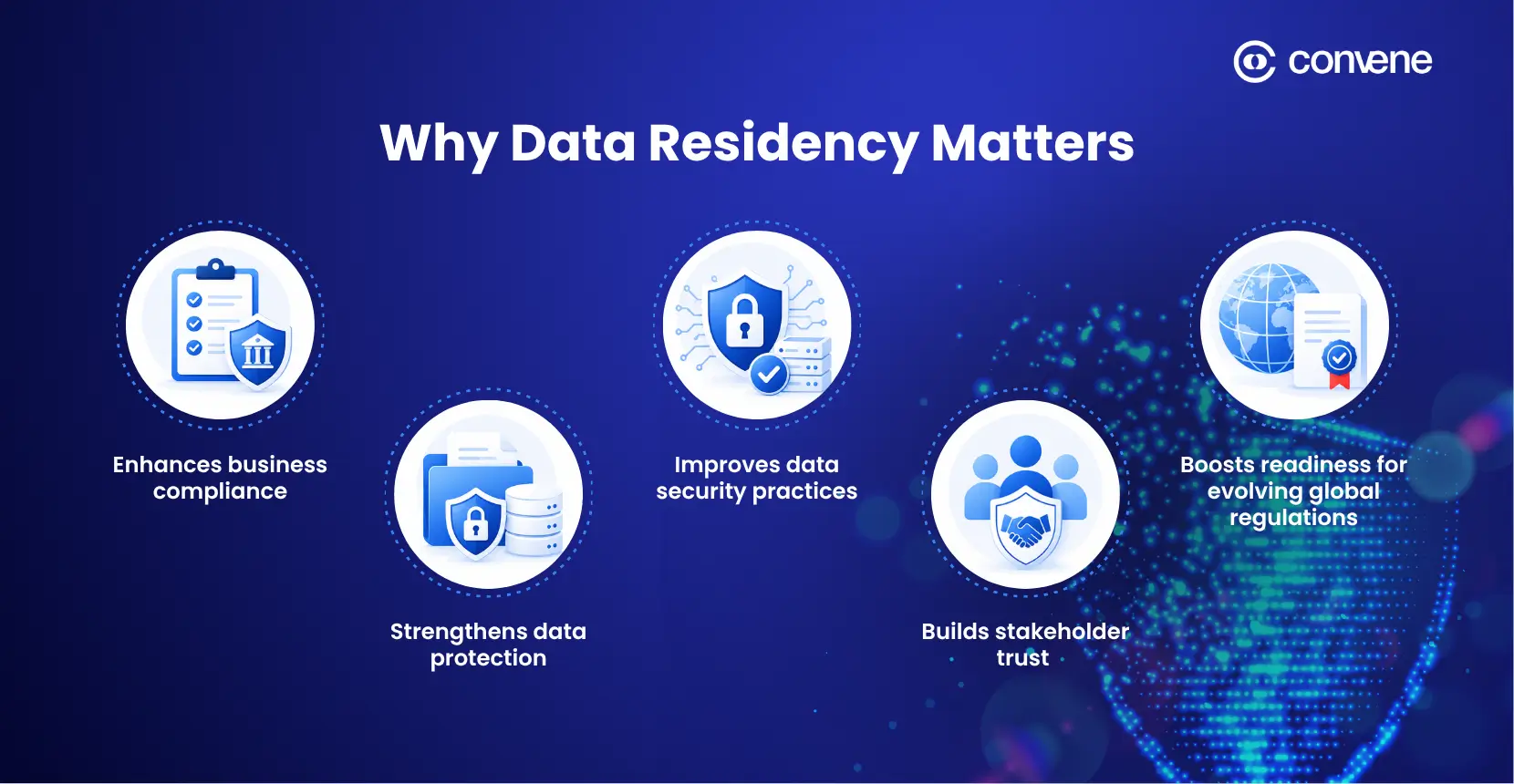
Data residency plays a critical role in enhancing business competitiveness. It strengthens risk management, fosters stakeholder engagement, and improves overall cyber posture.
1. Enhance business compliance
A comprehensive data residency strategy should account for critical aspects, including cross-border data transfer, data retention, and data sovereignty. By establishing clear internal controls and governance practices, organizations can enhance data hygiene.
In effect, data residency reduces the risk of legal penalties, regulatory investigations, and reputational damage. At the same time, it simplifies internal audit processes and demonstrates responsible data governance.
2. Strengthen data protection
Data residency helps protect sensitive data from unauthorized access by foreign governments because of local data residency laws. This is especially important for organizations using third-party cloud service providers.
For example, the U.S. CLOUD Act allows U.S. law enforcement agencies to compel U.S.-based cloud providers (e.g., Google, Microsoft, and Amazon Web Services) to hand over data they control, even when the data is outside the country. This reinforces the importance of implementing data residency strategies that support compliance with data governance regulations, such as the GDPR.
3. Improve data security practices
Data residency also strengthens technical security posture. A defined geographic location provides a smaller footprint, allowing organizations to apply consistent encryption standards, access controls, and monitoring. As a result, it is easier to maintain visibility and enforce uniform security practices.
4. Build stakeholder trust
Clients and investors always need assurance that their data is handled responsibly. A clear data residency strategy signals commitment to data protection and regulatory obligations. This transparency strengthens trust, which is crucial for long-term business success.
5. Boost readiness for evolving global regulations
More countries have introduced or tightened their data privacy and data sovereignty laws in recent years. This increases pressure on organizations to adopt new data protection practices. A mature data strategy allows an organization to comply with evolving data residency laws, providing a competitive advantage in navigating increasingly rigid regulatory landscapes.

Understanding Data Residency Across the U.S. and Other Countries
Most countries do not have explicit laws for data residency, only a series of data privacy laws that organizations use as the foundation for their data residency frameworks.
Here are notable data privacy laws in the U.S., its states, and other governments, including the European Union, the United Kingdom, Canada, and Japan.
Federal Laws Shaping Data Residency in the U.S.
These federal laws do not mandate data residency but have a pivotal influence on how organizations manage and secure data. They help establish risk management systems and data infrastructures needed to build robust data residency strategies.
| HIPAA (Health Insurance Portability and Accountability Act) | This requires healthcare providers, insurers, and contractors to protect sensitive information from unauthorized access. HIPAA doesn’t require data to be stored in specific geographic locations. However, it establishes administrative and technical safeguards that organizations must implement, regardless of hosting locations. |
| GLBA (Gramm-Leach-Bliley Act) | Also known as the Financial Services Modernization Act of 1999, it requires institutions to explain their information-sharing practices to customers to ensure compliance with the Financial Privacy Rule and Safeguards Rule. |
| FISMA (Federal Information Security Management Act) | This requires federal agencies, contractors, and service providers to develop, document, and implement organization-wide information security programs, including risk assessments. |
| CLOUD Act and Cross-Border Data Access | This allows U.S. law enforcement authorities to require U.S.-based service providers to disclose customer data, even if that data is stored on servers located outside the United States. For U.S.-based cloud service users, this can potentially conflict with non-U.S. privacy standards like the GDPR. |
U.S. State-Specific Regulations
| CCPA (California Consumer Privacy Act) | The CCPA provides consumers with greater control over their personal information. Companies should inform customers about what data they will collect and honor data deletion requests. |
| New York SHIELD Act | This imposes stricter breach notification requirements on businesses that handle information from New York residents, whether they operate within or outside the state. |
| Massachusetts Data Security Law | Organizations that handle personal information of Massachusetts residents should implement and maintain Written Information Security Program (WISP). |
Data Privacy Laws in Other Countries
| European Union | GDPR (General Data Protection Regulation) | A comprehensive data privacy law from the EU that governs how organizations collect, process, and protect the personal data of its residents. It harmonizes privacy rules across member states, granting individuals data privacy rights over their personal information. |
| United Kingdom | DPA (Data Protection Act) | This is the UK’s domestic data privacy law that is implemented alongside the GDPR. It introduces new areas for governance, including a new regime for how police and criminal justice bodies should handle data and dedicated provisions for how intelligence services process personal data. |
| Canada | PIPEDA (Personal Information Protection and Electronic Documents Act) | Enacted to govern the collection, use, and disclosure of personal information in Canada. Similar to GDPR, individuals are granted the right to access personal information collected by organizations. |
| Japan | APPI (Act on the Protection of Personal Information) | The APPI is a comprehensive law that requires organizations to obtain consent before collecting, using, or sharing information. It imposes stricter consent requirements for special categories of sensitive information, such as race, religion, and medical data. |
What are the differences between data residency, data localization, and data sovereignty?
Data residency, data localization, and data sovereignty share similarities but their differences mainly lie in their scope and legal implications. Data residency is about where the data is stored, localization refers to the mandate that requires data to stay in specific locations, and sovereignty pertains to laws that govern data hosting facilities.
Below is a brief comparison of data residency vs data localization and data residency vs data sovereignty.
| Data Residency | Data Localization | Data Sovereignty | |
| Definition | The specific geographic location where an organization can store and process digital assets, databases, and system records. | A mandate that requires organizations to collect, process, and store data within a country’s physical border. | This is a concept that data is subject to the laws and regulations of the jurisdiction in which they reside. Regardless of where a company is headquartered, its data must be governed by local privacy, security, and compliance policies. |
| Key Drivers | Business contracts, procurement modalities, internal governance policies, or broader regulatory requirements | National security and economic development | Risk management, legal accountability, and consumer rights protection |
| Cross-Border Transfer | Data can be moved when business operations demand it. | Data is strictly not transferable to other borders. | Data may be transferred to another location provided that the exchange follows foreign jurisdictions. |
What are the industries that need data residency?
Data residency applies across industries, but finance, healthcare, government, technology, and telecommunications face stricter requirements because of their rigid regulatory environments.
1. Finance/Banking
Financial institutions regularly handle sensitive customer data, including payment details, credit scores, loan applications, and transaction histories. This requires strong data governance frameworks that define proper data use and protection across all levels of business operations.
For example, the Australian Prudential Regulation Authority (APRA) sets the Prudential Standard CPS 234 (Information Security), which requires robust security controls over data, regardless of location. Under this, institutions are legally responsible for ensuring that third-party service providers implement equivalent security measures.
2. Healthcare
Another tightly regulated sector is healthcare. Countries like China implement stringent protocols for cross-border transfer of healthcare data. Under its Cybersecurity Law and Personal Information Protection Law (PIPL), medical and health records are classified as sensitive personal information, which requires Critical Information Infrastructure Operators (CIIOs) to store them on servers within mainland China.
3. Government and Public Sector
Governments are proactive in safeguarding national information, including defense strategies, economic development, law enforcement, and internal communications. In the U.S., legal mandates for data localization are supported by isolated cloud infrastructures. Technologies such as Microsoft Azure Government protect all data from federal, state, and local agencies.
4. Technology and SaaS
Technology and SaaS companies leverage data residency strategies for legal compliance, commercial advantage, and stakeholder trust.
First, hosting data locally helps meet requirements of clients operating within countries that have strict cross-border data transfer policies and data localization. Second, it assures large enterprises or governments that information remains under domestic control. Third, this reduces network latency, improving performance and reliability that boosts stakeholder trust.
5. Telecommunications
Telecommunication companies establish data residency to comply with local data privacy laws, maintain fast network latency, and improve operational efficiency. By keeping core network routing and databases locally, providers can avoid connectivity disruptions and ensure high-speed connectivity.
What are the common challenges to data residency?
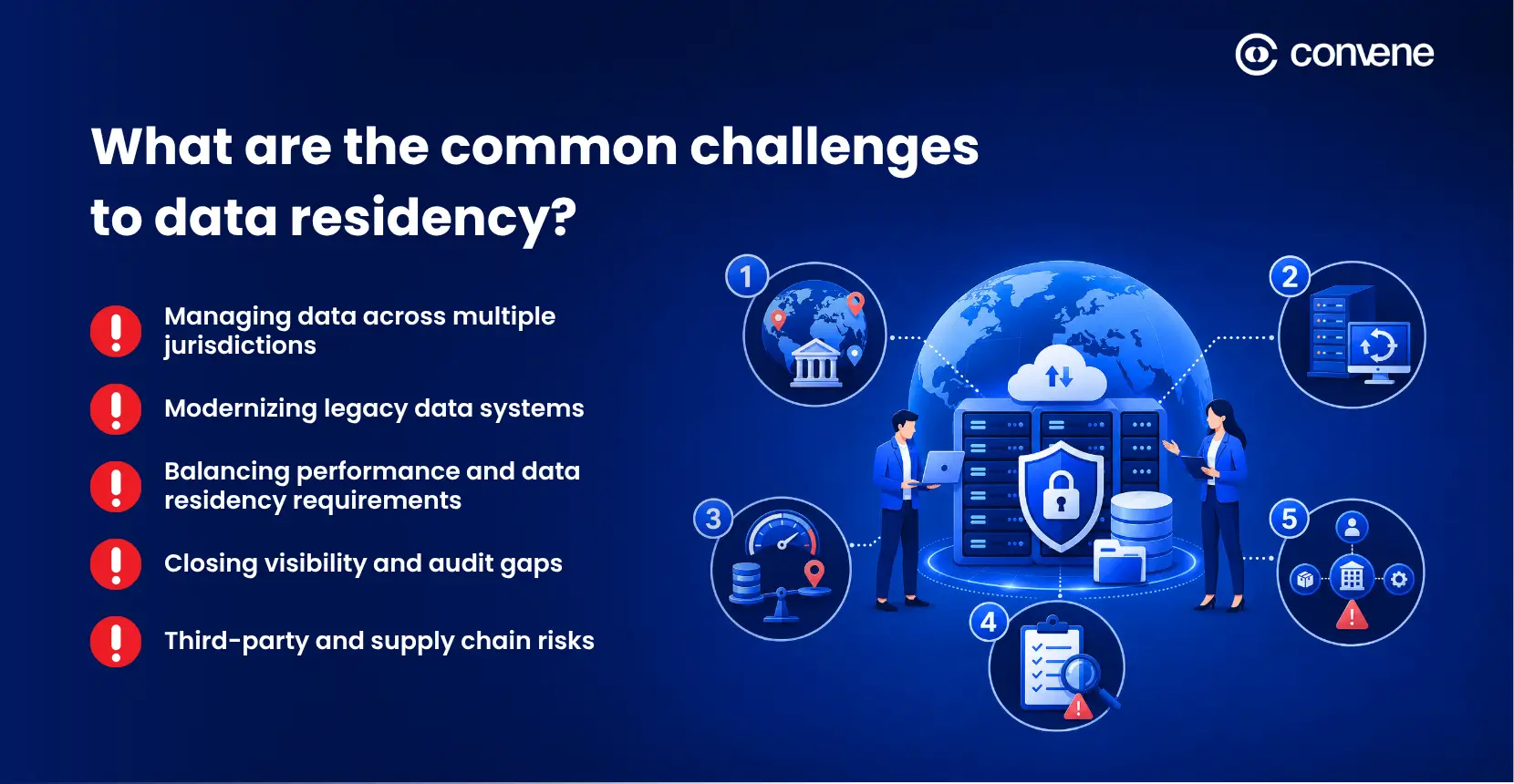
Organizations must consider technical, operational, and governance aspects to effectively avoid the common challenges to data residency. These risks are particularly heightened in hybrid and multi-cloud environments that must comply with multiple jurisdictions, and data flows through third-party providers.
1. Managing data across multiple jurisdictions
One of the initial challenges is navigating the patchwork of overlapping data protection laws. For example, GDPR and the CLOUD Act have different principles regarding cross-border transfers. The former prevents non-EU entities from accessing personal data, while the latter permits companies to hand over data even if operating outside the U.S.
2. Modernizing legacy data systems
Legacy systems often lack region pinning, granular tenancy, and regional key segregation capabilities — all of which are crucial for managing data flows. For cloud users, this significantly increases the probability of misconfigurations and of unauthorized cross-border data transfers. Without the support of more robust systems, this can disrupt adherence to local data privacy and localization requirements.
3. Balancing performance and data residency requirements
Confining data within a specific region can help lower latency for specific users; however, this may also deter performance if an organization operates at a global scale. This gap grows as user bases expand across multiple locations, forcing organizations to choose between strict adherence to residency requirements and architectural flexibility.
4. Closing visibility and audit gaps
Inconsistent efforts by the compliance committee limit the organization’s visibility into data flow and the evolving regulatory landscape. One error or overlooked configuration can lead to policy violations and irreversible data transfers.
5. Third-party and supply chain risks
Organizations that use cloud hosting rely on third-party providers, which may also rely on subcontractors to process and transmit data. These external networks make it more challenging to exercise full oversight, particularly when third-party providers have different security and compliance practices.
5 Best Practices To Establish a Data Residency Framework
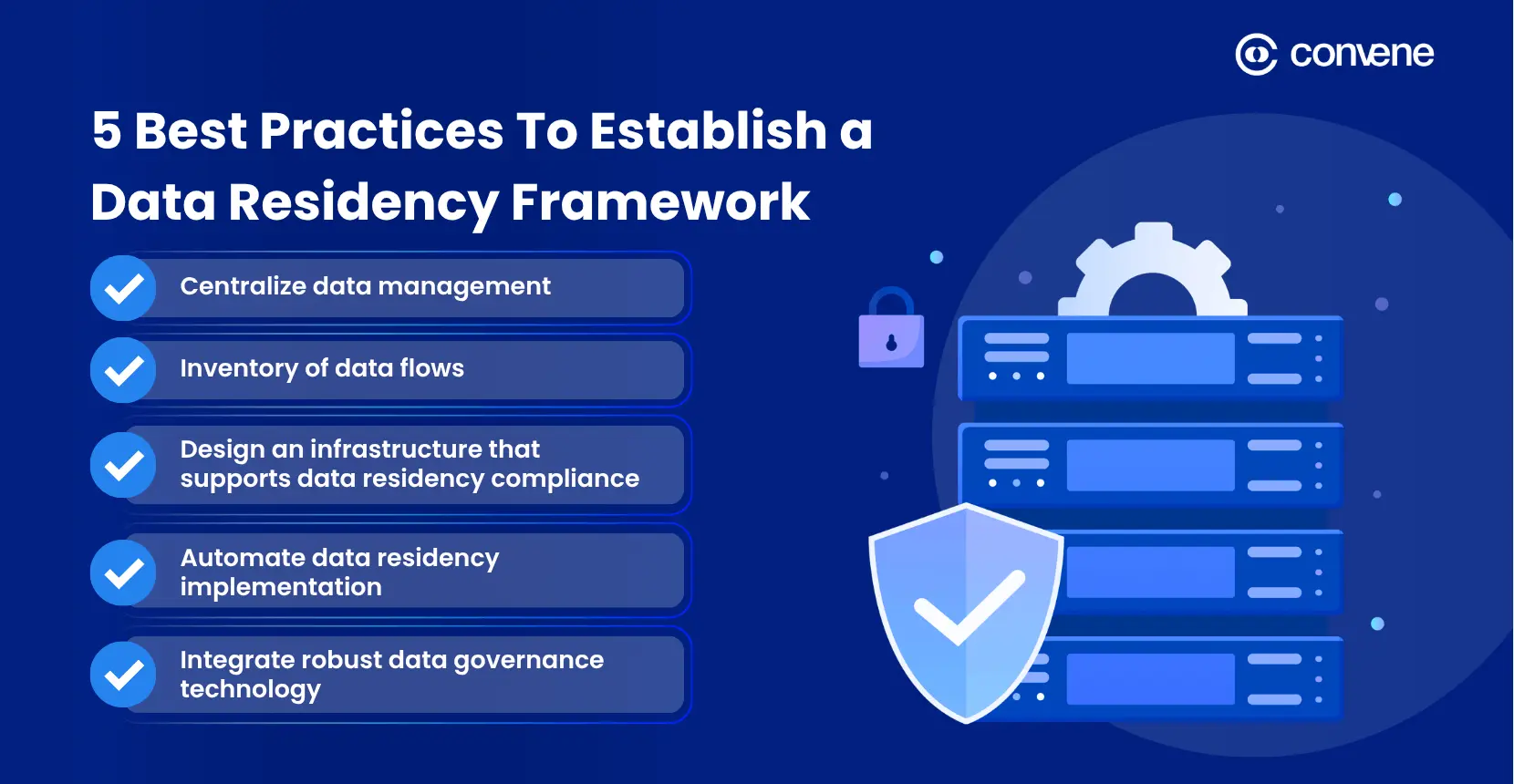
Data residency compliance hinges on robust oversight, knowing where exactly the data is and how it flows throughout the business. To achieve that, organizations must establish a well-defined data residency framework to reduce security and compliance risks.
Here are five best practices to establish an effective data residency framework.
1. Centralize data management
Centralize oversight so the organization has a single source of truth. This entails consolidating log records, automating data discovery, and continuously monitoring data activities into one workflow. Together, these ensure real-time visibility into data movement and changes in data storage locations, enabling faster risk detection and response.
2. Inventory of data flows
Review relevant legislation with IT, compliance, and legal teams and meticulously map the data flow to ensure every point is recorded and compliant. In addition, implement data localization where necessary and use encryption both in transit and at rest to avoid unnecessary data breaches or exposures.
3. Design an infrastructure that supports data residency compliance
Establish internal policies that embed data residency and regulatory compliance at every stage of operations. Collaborate with decision-makers to define standards for data classification, access control, retention, and cross-border transfers.
It is also crucial to modernize legacy systems to eliminate outdated platforms and high-risk processes. This helps build a scalable data residency strategy that balances performance and data protection requirements.
4. Automate data residency implementation
Manual management of data residency is not scalable. For organizations operating in multiple jurisdictions, it is a practical investment to explore automation to ensure policies are consistently enforced across many stages of data movement.
Automating oversight helps prevent accidental transfers of sensitive information to prohibited regions, thereby avoiding costly penalties and reputational damage.
5. Integrate robust data governance technology
Support the board of directors with modern tools to improve oversight and handling of board information related to data residency.
Board portals like Convene Board Portal are governance platforms built with advanced security safeguards that allow boards to conduct meetings, collaborate, and store sensitive information within a single environment.
West Bar Virginia demonstrates this in practice by centralizing document governance within the Convene Board Portal. It leverages the platform’s enterprise-grade security measures, such as comprehensive audit trails, document encryption, granular access controls, and centralized document sharing to safeguard sensitive materials and protect documents from unauthorized access.
Frequently Asked Questions on Data Residency
How can small businesses implement data residency?
Small businesses can start with data residency by exploring cloud hosting options. Unlike corporations with established IT infrastructure, smaller businesses deal with leaner operations and resources. Rather than building a physical data hosting facility, it will be more practical to choose cloud and SaaS vendors that already offer regional hosting choices.
What is the impact of cloud computing on data residency?
Cloud computing and data residency have different principles regarding data management. Cloud computing replicates and routes across multiple geographic locations for speed, while data residency stores and processes within specific locations.
Given this difference, choosing a cloud service with cloud computing for data residency can lead to non-compliance. For greater traceability, it is crucial to select a cloud service provider with regional facilities.
Future-Proof Data Residency Strategy with Convene Board Portal

Data protection has become a strategic imperative for businesses due to the rapid sophistication of cyber and security risks. At the board level, this forces directors to adopt secure governance platforms that scale with the business and adapt to changing regulations.
Introducing Convene Board Portal, an intelligent board management portal designed to help boards work smarter. It streamlines board governance through AI-assisted workflows while maintaining the highest level of security.
Powered by Amazon Web Services (AWS), the platform delivers a scalable and secure foundation for data residency strategy. It allows organizations to choose where their board data is stored, offering flexibility to align their data residency frameworks with both business priorities and regulatory requirements.
Together, these advanced capabilities give boards confidence in managing sensitive information securely, enabling them to meet evolving regulatory requirements and governance expectations more effectively.
Book a demo with Convene Board Portal today to discover how it futureproofs data and board governance.



Jean is a Content Marketing Specialist at Convene, with over four years of experience driving brand authority and influence growth through effective B2B content strategies. Eager to deliver impactful results, Jean is a data-driven marketer who combines creativity with analytics. In her downtime, Jean relaxes by watching documentaries and mystery thrillers.
- Connect:
-

-