


Key Takeaways:
- A board evaluation tool is a platform that helps organizations assess performance across key areas such as governance, strategy, and board dynamics by using surveys and feedback frameworks to evaluate board effectiveness.
- Modern board evaluation tools address common challenges like limited feedback, fragmented processes, and weak follow-through
- The most essential features to look for in a board evaluation tool are governance review frameworks, skills matrix analysis, analytics, action planning, security, scalability, and AI capabilities
- The most common types of board evaluation tools are surveys and questionnaires, structured interviews, and peer or 360-degree reviews
From an ever-changing corporate landscape, what separates high-achieving boards from those struggling to catch up? In many cases, it comes down to how willing a board actually is to look inward. The boards that perform best are those that regularly assess how they operate and understand where they can improve.
Because board evaluations are often slowed by scattered data sources, manual follow-ups, and time-consuming review processes, many organizations are turning to leading effectiveness tools for executive boards, such as board evaluation tools, to simplify the work and make insights easier to act on. Knowing the key features to look for in a board evaluation tool can help you choose the best solution for your board.
What is a board evaluation tool?
Board evaluation software or tools are structured systems, almost always digital, that help organizations evaluate how their boards are performing in key areas such as governance, strategy, and board dynamics. They support different types of evaluations, including self-assessments, peer reviews, committee evaluations, and full board reviews, helping organizations gather balanced feedback from multiple perspectives.
Such tools are now the norm for conducting monthly or annual board reviews, as they provide a reliable, measurable way to evaluate board effectiveness through the following key areas:
- Board composition and skills
- Strategic alignment
- Meeting effectiveness
- Decision-making quality
- Director engagement and contributions
Why do organizations need one?
If you know where you currently stand, you would know where to walk from there. But when that clarity is missing, direction becomes blurred, and momentum slows. Meetings will feel unproductive, roles and responsibilities will become unclear, and important board issues will remain unresolved.
Board evaluation tools address these issues by standardizing how board performance is measured and reviewed. They help boards identify gaps not only in individual performance, but also in collective capabilities. In addition, they also help match their skills with the areas where they are most needed.
Common Pain Points in Traditional Board Evaluations
Before looking at features, it helps to know what problems board evaluation tools aim to fix. Below are some of these pain points:
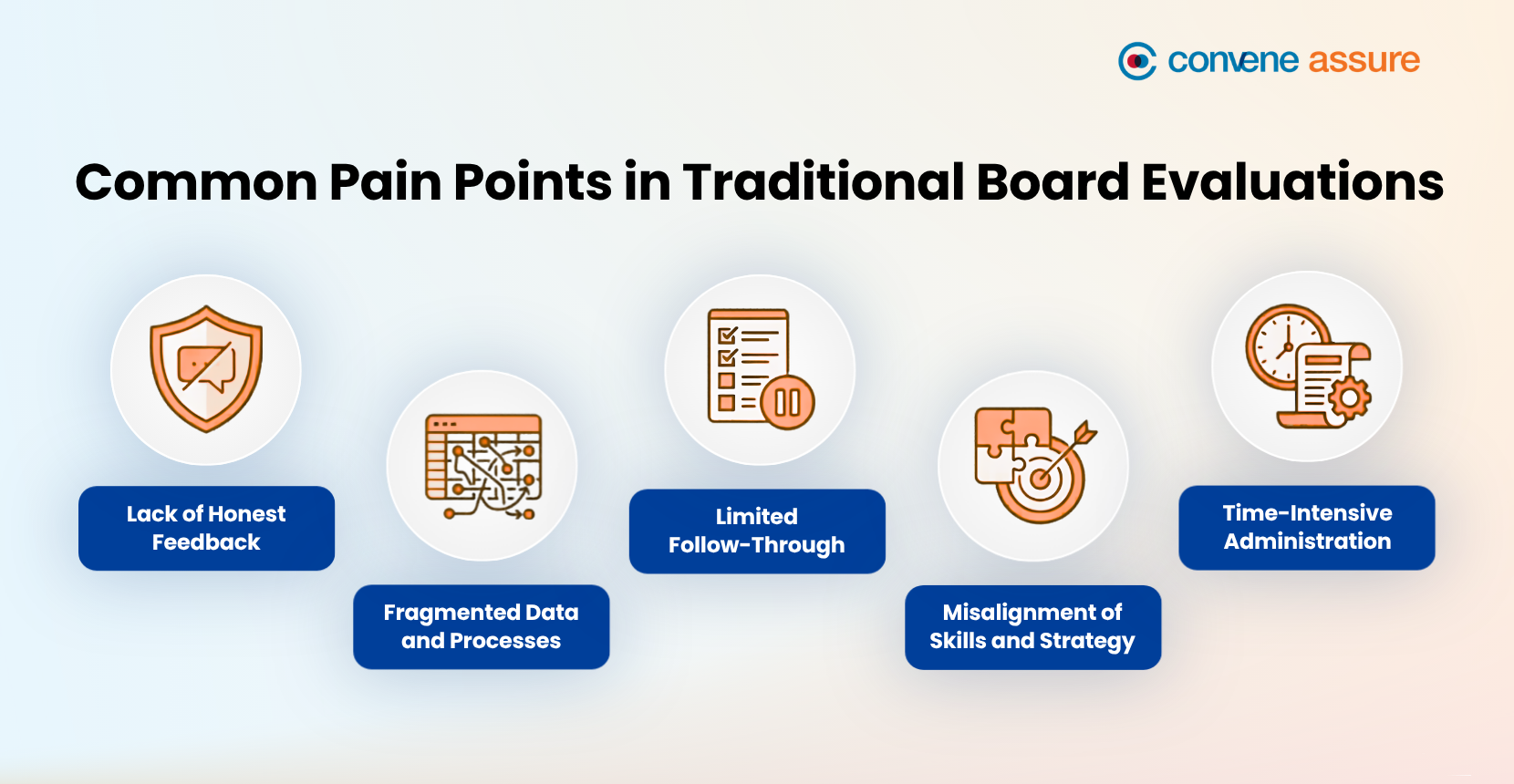
Lack of Honest Feedback
A major problem with traditional evaluations is getting honest feedback from the members. If responses are not anonymous, directors may hold back, especially when asked to rate their leaders and their peers. This usually leads to comments that are either overly positive or overly vague. For example, responses may simply state that things are ‘working well’ without pointing out what could be done better.
Fragmented Data and Processes
Many boards still use spreadsheets, emails, and separate documents to run evaluations, which slows things down at every step of the process. Not only that, but manually compiling responses can also lead to inconsistent data formats, increased risk of errors, and difficulty tracking historical performance.
Limited Follow-Through
Some boards focus on ‘getting it done’ rather than on driving improvement, treating board evaluations as a simple checklist exercise. What happens is that after boards complete their annual evaluations, they do not follow up on the findings, or they do not know how. This lack of follow-through can lead to repeated issues across evaluation cycles and missed opportunities for governance improvement.
Misalignment of Skills and Strategy
Without clear visibility into their collective strengths, directors may struggle to apply their expertise where it matters most.
Evaluations often reveal skill gaps, particularly in areas such as industry-specific knowledge, digital or technological expertise, risk management capabilities, and ESG oversight.
Time-Intensive Administration
Old-school evaluation processes take a lot of time and effort. Administrators often have to manage their time:
- Creating and distributing surveys
- Following up on responses
- Compiling and analyzing data
- Preparing reports for board discussions
This process can drag on for weeks or even months, especially for bigger boards or those with several committees. Board members may also find the process a hassle, which can mean fewer responses or rushed answers.
What are the key features to look for in a board evaluation tool?
The best board evaluation software combines structure, insight, and action. When choosing the right solution, look for tools that connect every step of the process, from collecting feedback to driving improvements, so you can build a capable board while meeting corporate and regulatory standards.
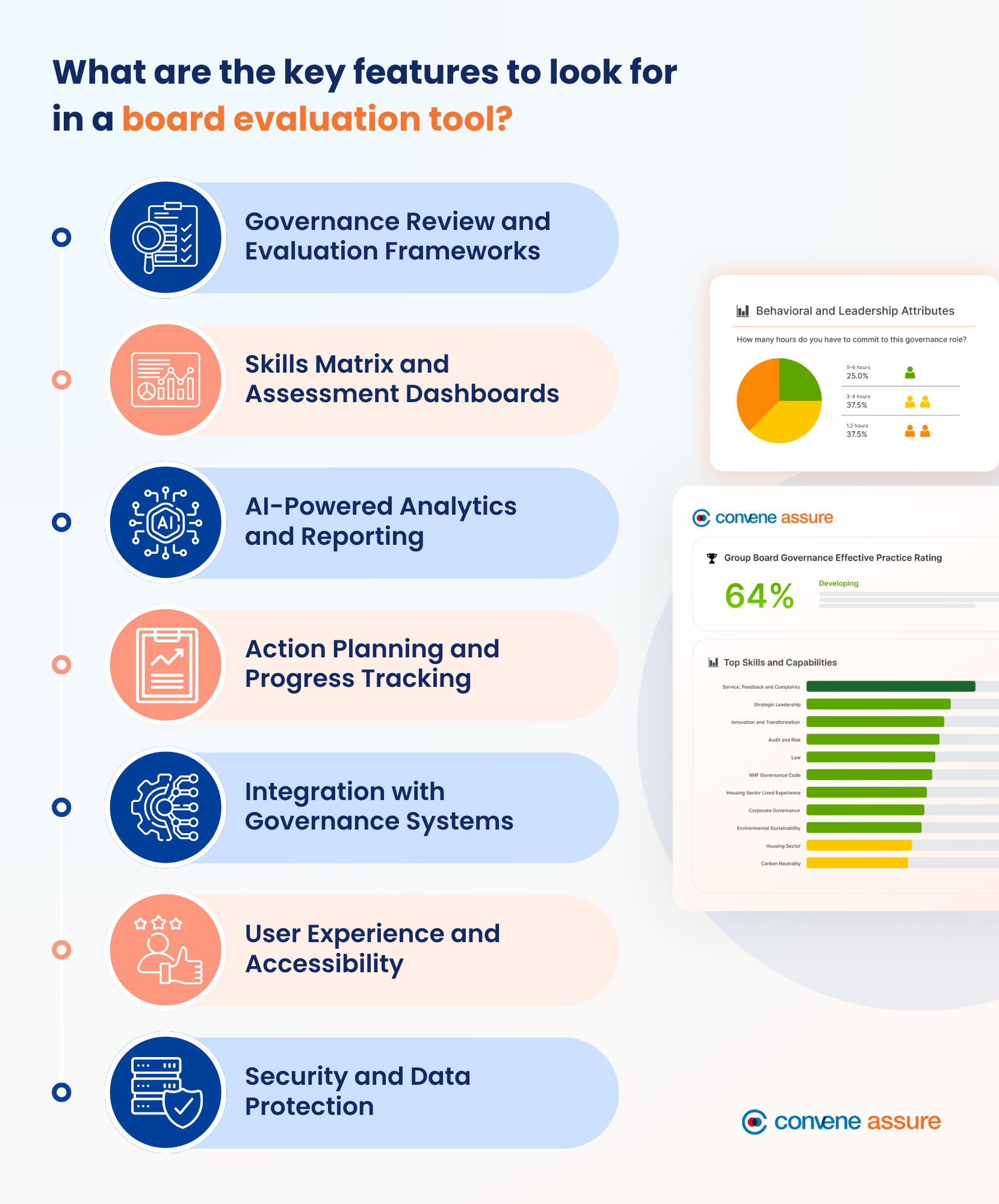
Governance Review and Evaluation Frameworks
The best review tools for board committee effectiveness start with a clear review framework. It usually covers the complete evaluation cycle, not just compliance. This gives boards a consistent way to assess performance and capacity across different areas.
At the individual level, governance review assesses a member’s strengths and vulnerabilities, as well as their understanding of relevant regulations, including those of the Securities and Exchange Commission (SEC) and the National Housing Federation (NHF) Code of Governance in the UK. At the board level, it aggregates the group’s cumulative results to assess overall board performance.
Board evaluation tools make this easier by offering pre-built or customizable questionnaires, self-assessments, peer reviews, and 360-degree board evaluations that boards can use as-is or tailor to their specific needs. This way, evaluations stay relevant and consistent, no matter the board’s structure or industry. With clearer insights from the results, boards can make targeted and informed decisions that directly address identified gaps and priorities.
Skills Matrix and Assessment Dashboards
One key feature of modern board evaluation software is the ability to aggregate assessment scores and translate them into dynamic skills matrices. A skill matrix shows whether the board’s capabilities align with the organization’s strategy. Instead of relying on manual spreadsheets or subjective judgment, these tools convert evaluation data into clear visual maps of directors’ experience, expertise, and development areas.
This gives organizations an objective view of where the board is strong, where gaps exist, and which capabilities may be needed as priorities evolve. With everything centralized and measurable, boards can make evidence-based decisions about composition, committee structure, and future readiness.
In addition, this feature helps with board renewal. During transitions to a new business strategy or leadership team, it highlights the capabilities needed to support the change. By linking performance data to skills, boards can proactively plan for succession, director development, and recruitment, rather than relying on ad hoc or short-term fixes.
AI-Powered Analytics and Reporting
Gathering feedback is just the start. The real value comes from turning that feedback into clear, practical steps. Modern tools use AI-powered analytics and dashboards to give a full view of board performance. Boards can see real-time trends, track KPIs, and compare results over time — without manual number crunching.
To support this, many tools also provide built-in recommendations and governance resources. Instead of leaving boards to interpret results on their own, these features offer practical guidance on what to improve and how to approach it. This may include best practices, targeted suggestions, or structured frameworks that guide next steps.
By connecting insights to clear next steps, these tools help boards turn knowledge into action.
Action Planning and Progress Tracking
The gathered feedback should then be fed into the action plans. This is how boards can know what steps to take after the evaluations.
Without a clear follow-up plan, evaluations can end up as just another compliance task. Modern board evaluation tools help prevent this by enabling boards to prioritize findings, assign responsibilities, set timelines, and monitor progress in one central system. Features such as task tracking, status updates, reminders, and progress dashboards make it easier to manage improvement initiatives and keep momentum between review cycles. This builds accountability and makes sure issues get fixed.
Integration with Governance Systems
More board evaluation tools now integrate with broader governance platforms, creating a single place for all board management. This lets organizations link evaluation data with meeting materials, records, and workflows. With everything in one place, boards can quickly review past data and track year-to-year progress.
Integration also saves time by cutting out duplicate work. When these tools are connected with governance software such as board portals, evaluations can be managed alongside agendas, minutes, and board materials in a single environment. For administrators, this means they can handle evaluations within the same systems they already use for governance tasks, while directors get a smoother, more organized experience.
User Experience and Accessibility
A board evaluation tool only works if it is easy to use. If the platform is too complex or slow, fewer people will take part. Modern tools focus on user experience, with simple interfaces, mobile access, and streamlined workflows. Directors can finish evaluations quickly, even if they are busy, and administrators can run the process with less effort. Many platforms also integrate with secure communication and collaboration tools that support hybrid participation. This is essential when dealing with a geographically dispersed board, as it allows board members to engage seamlessly, whether they are in-person or remote.
A user-friendly design also means more people will use the tool and give better feedback. When the process is simple, boards are more likely to participate and gain useful insights for stronger governance.
Security and Data Protection
Board evaluations often involve sensitive discussions, performance data, and confidential board information. Because of this, security is a critical feature of any evaluation tool.
Modern platforms are designed with strong data protection measures, such as enterprise-grade encryption, secure access controls, and role-based permissions. These safeguards ensure that only authorized users can access evaluation data while maintaining the confidentiality of responses.
Beyond protecting information, security also means adhering to recognized standards and compliance requirements, such as SOC 2 and ISO 27001. Many board evaluation tools are built to align with established data security frameworks and governance standards, helping organizations meet regulatory expectations and maintain proper oversight. This is especially important when evaluation records may need to support audits or demonstrate accountability.
Frequently Asked Questions
What are the types of board evaluation tools?
The most common types include surveys and questionnaires, structured interviews, and peer or 360-degree reviews. Some organizations also use hybrid approaches that combine multiple methods to capture both quantitative and qualitative insights.
How often should the board conduct an effectiveness review?
The frequency of board effectiveness reviews depends on the organization’s needs, but they are generally conducted monthly or annually to ensure the board can regularly reassess its performance with a fresh perspective and identify areas for improvement.
What are the leading effectiveness tools for executive boards?
For boards to function effectively, they need the right tools to support collaboration, evaluation, and decision-making. These include board portals for secure collaboration, performance assessment tools for evaluating effectiveness, skills mapping tools to align board composition with strategy, and AI-driven reporting tools that surface insights from evaluation data. Together, these tools help boards move from manual assessments to more structured, data-informed governance processes.
Strengthen Board Evaluations and Governance with Convene Assure
By fixing common problems in the board evaluation process, like poor feedback, scattered processes, and weak follow-up, modern board solutions help boards work better and make smarter decisions.
Most importantly, these leading effectiveness tools for executive boards make sure evaluations lead to real change, building stronger governance and better long-term results. This is especially relevant in today’s environment, where boards are expected to meet growing governance, risk, and compliance (GRC) demands.
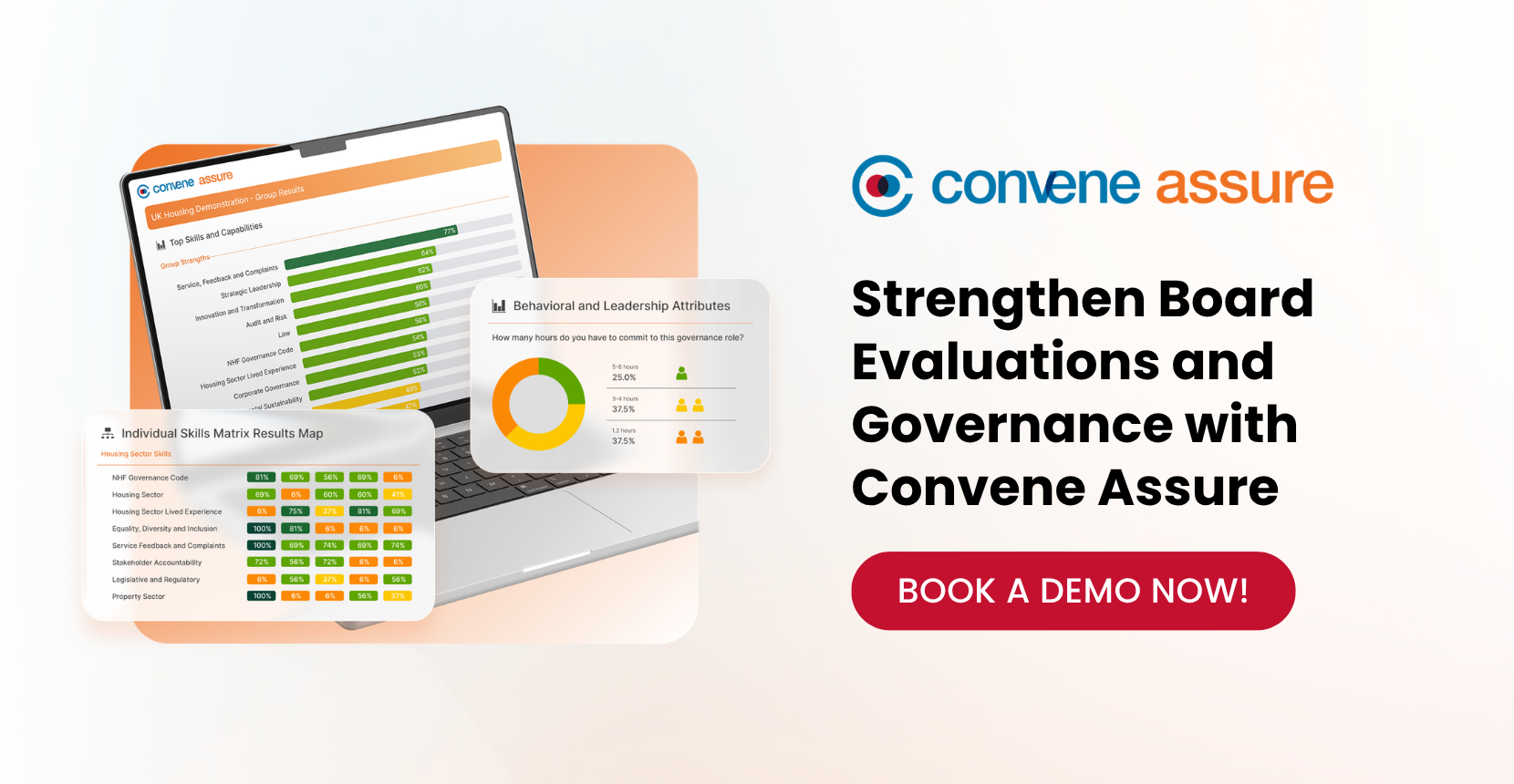
So, what are the best tools for conducting annual board reviews? For boards looking to elevate their evaluation process, Convene Assure offers a comprehensive solution that is both multi-layered and evidence-based to address these exact challenges. These are the features it offers:
- Governance Review for 360° board assessments
- Skills Matrix to align expertise with strategy
- Board Renewal tools for succession planning
- Recommendations & Resources for actionable guidance
- Action Plans generated directly from evaluation results, to track and implement improvements
- Annual Benchmarking to see growth from year to year
All this board information is stored within local AWS enterprise-grade data centers, so boards can operate with confidence, knowing their data is protected and aligned with enterprise security standards.
Rest assured that your board is set up for stronger, more effective governance. Book a demo with Convene Assure today to see how your board can benefit from a smarter, more structured evaluation process.



Jess is a Content Marketing Writer at Convene who commits herself to creating relevant, easy-to-digest, and SEO-friendly content. Before writing articles on governance and board management, she worked as a creative copywriter for a paint company, where she developed a keen eye for detail and a passion for making complex information accessible and enjoyable for readers. In her free time, she’s absorbed in the most random things. Her recent obsession is watching gardening videos for hours and dreaming of someday having her own kitchen garden.
- Connect:
-