



Home health care has become a key component of how the Australian government manages its rapidly ageing population.
As of 2025, 18% of the population is aged 65 and over and eligible for aged care services. This population ageing was forecast as early as 2005 by the Productivity Commission, which projected that one in four Australians or around 7 million would be in this age group by 2050. This underscored the need for the government to prioritise long-term planning for aged care services.
In response, Australia introduced policy reforms like the Aged Care Act 2024 to ensure fair access to aged care services. This has placed great pressure on providers to develop sustainable care models that will encourage elders to remain in their homes for longer.
This article examines the challenges and opportunities arising from Australia’s ageing population, particularly how it’s reshaping the market landscape for home aged care Australia providers. It also highlights the importance of a board portal for health care in supporting providers as they navigate changing governance and compliance expectations.
What is in-home aged care?
In-home aged care or home health care services are ideal for older people who prefer to receive assistance with their health or daily tasks close to family or friends, rather than moving to residential aged care facilities. This option offers more control and freedom over their daily routines compared to traditional aged care.
With in-home aged care, the level of care is customisable to each person’s health requirements and lifestyle preferences. Some may only need help with personal care and medication management, while there will be others who’ll avail support with mobility and companionship.
The State of In-Home Aged Care in Australia
The Aged Care Quality and Safety Commission (ACQSC) is the primary governing body for aged care providers in Australia, ensuring the safety and quality of life of the older population.
In 2025, the agency updated the Aged Care Quality Standards for both in-home and residential care to respond to the growing demand for aged care services. The revised framework introduced seven quality standards, namely the individual, the organisation, the care and services, the environment, clinical care, food and nutrition, and the residential community.
Broader trends reinforce this shift in national priorities. According to the Australia Institute of Health and Welfare, 37% of the 275,500 aged care admissions were for home care in 2023 to 2024. This highlights Australia’s growing preference for in-home aged care.
Why is the demand for senior home health care services rising in Australia?
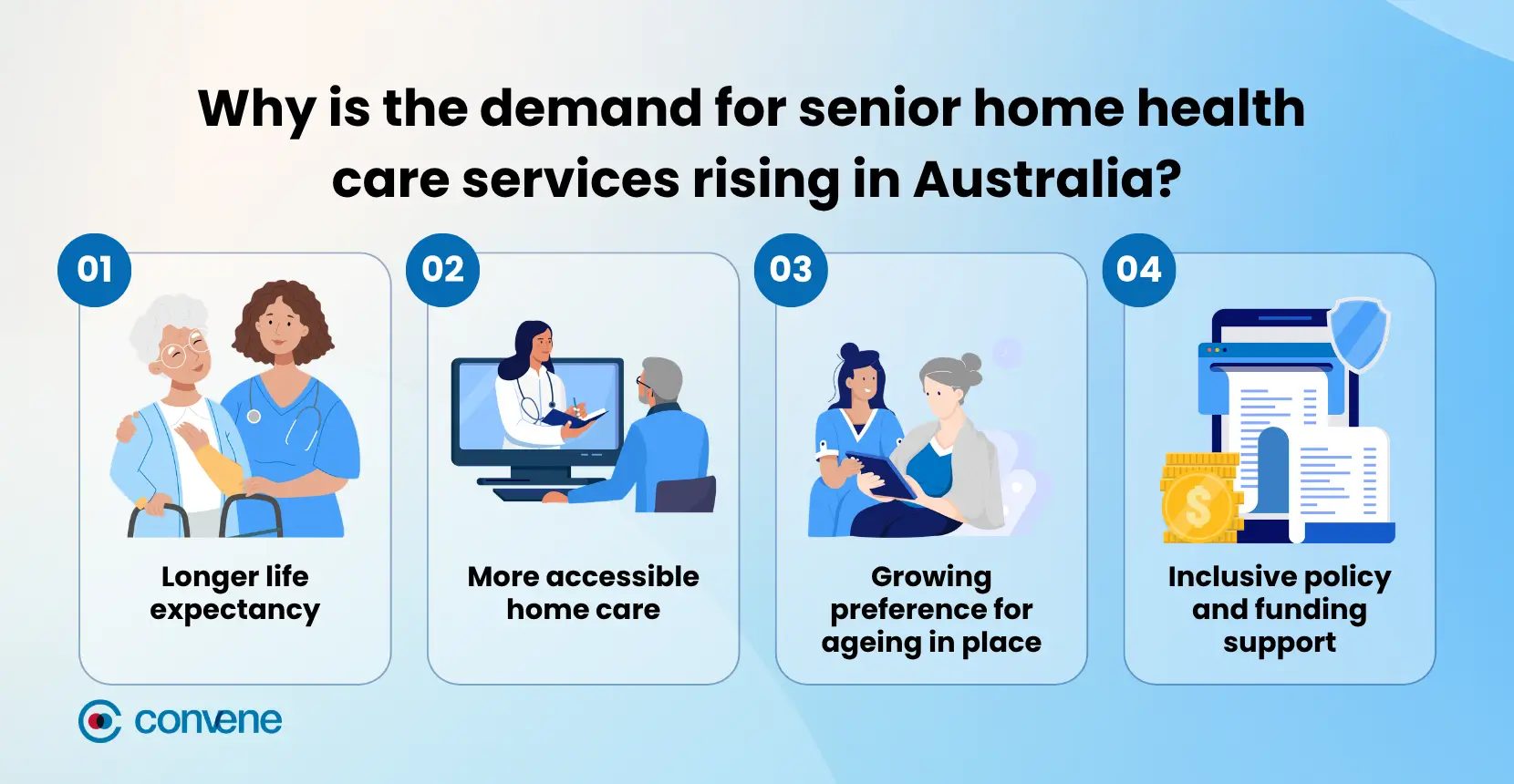
The rising demand for home aged care Australia is driven by the following factors:
1. Longer life expectancy
As the population ages steadily, life expectancy also increases. This means that more older people will be living with chronic diseases, such as diabetes, arthritis, heart disease, and dementia. These long-term conditions, as long as they are not severe, are typically manageable with regular monitoring and medication support, which many prefer to just do at home.
2. More accessible home care
Technology has simplified the process of arranging medical help and doctor appointments. Innovations such as remote monitoring enable providers to monitor vitals and assess overall health status without requiring hospital or clinic visits. These options are ideal for residents of rural areas, especially for routine checkups and rehabilitation.
3. Growing preference for ageing in place
A survey by CareSide revealed that among respondents aged 40 to 64 years, 66% prefer senior home health care services compared to 34% who prefer residential facilities. This is because many older Australians value privacy and prefer ageing in place Australia. Home health care services meet these preferences by allowing them to be close to family and friends while receiving the necessary assistance.
4. Inclusive policy and funding support
For ACQSC, shifting towards in-home care is a practical solution as more older people enter the 65 and over age group. Since 2024, it has been accelerating reforms in aged care by replacing the Home Care Packages and Short-Term Restorative Care Programmes with a single scheme called the Support at Home Programme.
It consolidates the funding pathways with three funding options: assistive technology and home modifications, restorative care, and end-of-life care. The reform signals to home aged care Australia providers that the government is serious about investing in community-based care by creating more funding opportunities.

Key Challenges Facing In-Home Aged Care Providers in Australia
The rising demand surfaces inherent challenges that providers must anticipate and prepare for in advance to ensure continuous service for older people.
Among the most pressing challenges they face are:
1. Workforce Shortages
According to KPMG’s recent study, the number of aged care service providers in Australia is continuing to decline. In 2024, home aged care decreased by 0.7%, while residential 3.0%.
It’s expected that the number of older people aged 65 and over will increase by 1.5 million by 2050. This will make aged & disability care the highest growing occupation in the country in the next few decades.
The government is anticipating its impact and is targeting an additional 400,000 workers, which they aim to obtain through increasing wages and encouraging migrant workers. For providers, having strong foresight will help them prepare for heavier workloads as the workforce shrinks.
2. Modernising Care
Many aged care providers forgo adopting technology due to ethical issues and infrastructure limitations. With the amount of sensitive medical information that needs to go back and forth between workers, patients, and families, a structured approach is important to enforce strong data privacy and compliance.
In addition, not all aged care providers in Australia have equal access to technology. They have varying levels of digital literacy, causing them to hesitate and delay adoption. This results in them continuously relying on manual processes and fragmented communication channels.
3. Financial Pressures
The State of the Sector survey by the Aged and Community Care Providers Association (ACCA) revealed that 97% of care providers were concerned about the increasing costs in the sector. Moreover, 20% of smaller providers weren’t confident to offer aged care services due to financial restraints.
Providers recognise the importance of the ongoing aged care reform. However, they prefer that authorities implement it at a more manageable pace to avoid further strain on their finances.
4. Evolving Regulatory Compliance
With the implementation of the Support at Home Program, the government has become stricter in ensuring providers are eligible for operations and funding.
To maintain good standing and legal status, providers must submit regular reports for:
- Records of incidents, vaccinations, staffing, and care notes.
- Quarterly financial reports that detail direct care labour costs.
- Aged Care Financial Reports that cover annual income from services provided, expenses, and other items, such as assets, liabilities, and equity.
- Provider Operations Collection Form to disclose information about executive position details, governing body membership, diversity information, and common feedback received by each service.
These regulatory changes encourage providers to be diligent in their record-keeping and disclosures. To streamline compliance, solutions like board portal for health care are beneficial for improving transparency among board members. It’s widely used for storing documents, helping maintain consistent documentation for audits, reporting, and mandatory reviews.
5. Data-Driven Quality Assurance
As technology continues to reshape home aged care Australia services, more providers are becoming data-driven when tracking service outcomes, client feedback, and risks. The pressure to maintain high service levels requires them to establish systems that streamline internal audits, training updates, and periodic reporting.
By prioritising transparency and accountability, it will be easier to create service development programs grounded in evidence.
How Board Portal for Health Care Helps Providers Navigate Challenges
With all the challenges facing home health care providers today, boards need the right tools to make informed decisions and ensure high-quality care delivery across locations.
Board portals for health care serve as all-in-one hubs for governance, collaboration, and compliance. By consolidating critical board functions, they help boards gain confidence in their oversight, risk management, and policy implementation.
Here’s how in-home aged care providers can benefit from using a board portal:
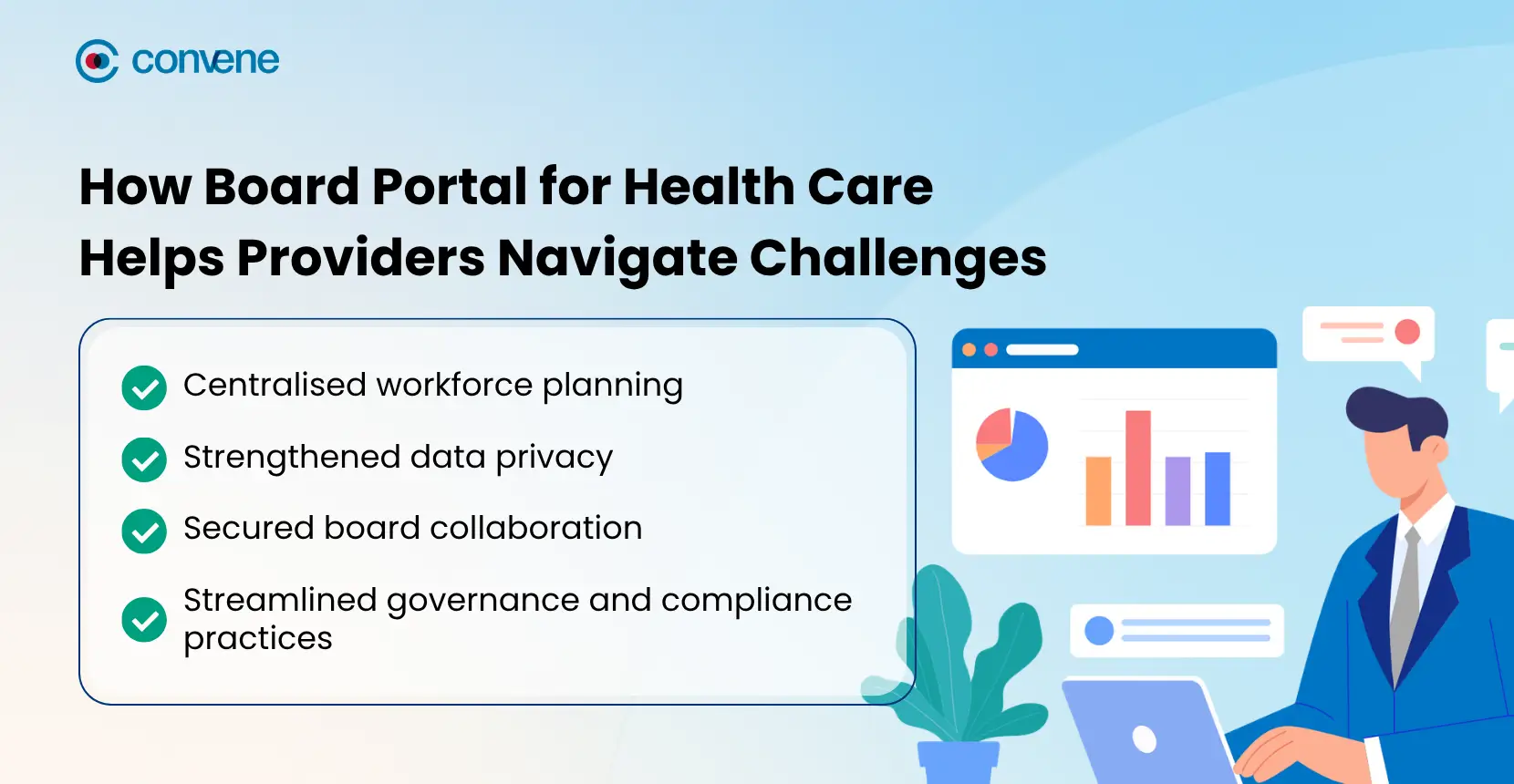
1. Centralised workforce planning
Data is crucial for effective workforce planning. Reports on staffing levels, turnovers, patient demand forecasts, and labour cost estimations must be equally accessible to board members to enable timely alignment and proactive management of resource gaps.
The human resources team can utilise a board portal for health care to store workforce planning materials. Given the nature of in-home aged care work, the platform helps centralise data and supports secure remote access, allowing staff and boards to review related reports promptly, regardless of location.
Board portals also include a version control feature that ensures everyone always sees the latest document versions and even allows users to compare previous versions.
2. Strengthened data privacy
Board portals for health care are designed with enterprise-grade security features, such as document encryption, granular access controls, and audit trails, to reduce the risk of data breaches.
By transitioning into digital document management, organisations can better safeguard sensitive reports. This reduces exposure to data breaches and improves compliance with relevant regulations, including the Privacy Act and the Australian Privacy Principles.
3. Secured board collaboration
As the aged care market continues to evolve, communication between boards and committees is a critical factor for success. Board portal for health care are intuitive communication tools that replace fragmented communication channels, such as email threads or unsecured file drives.
Within these digital environments, board members can perform their core activities, including preparing for meetings, benchmarking, reviewing board papers, and even annotating documents. This ensures no essential information falls through the cracks, enabling more productive collaboration among board members.
4. Streamlined governance and compliance practices
Coordination is more complex for in-home aged care providers since they oversee operations across multiple locations. By digitising meeting management, boards can conveniently streamline their governance workflows, all while maintaining full visibility over activities.
Structuring meetings is not time-consuming with a board portal for health care. Boards can easily schedule meetings, distribute board packs, and track agenda items without having to change apps. After meetings, there’s an automated meeting summary with recommendations, helping board members align and move forward with plans.
The Future of In-Home Aged Care in Australia
The aged care landscape in Australia has been actively integrating technologies, such as board portals, smart devices, robotics, and mobile health apps, into its operations.
Learn how these innovations are reshaping the quality of care for older people in Australia.
Personalised Care
The global healthcare sector is shifting from a one-size-fits-all approach to a more personalised and patient-centred care.
Healthcare innovations like smart homes, wearable devices, and remote monitoring have advanced analytics and AI capabilities that provide comprehensive health data. This enables the development of customised support tailored to the unique needs and preferences of individuals.
Robotics Care System
Still in its early stages, more healthcare organisations are exploring robotics to ease workforce strain. Robotic care systems offer additional support to older people, particularly with their daily routines, including mobility assistance, medication management, and cognitive stimulation.
Digital Healthcare and Telecare
Digital health services like telehealth, mobile apps, or virtual consultations allow older people to connect with health professionals faster. In the future, more people will prefer remote services to physical clinics, improving accessibility and inclusivity of aged care services.
Board Portal Technology in Aged Care
For board-level communication, board portal software is also transforming the way aged care providers manage governance. Board members no longer have to worry about missing approvals or being late for meetings because board portals are accessible via mobile, web, and tablet — ensuring every critical information reaches them on time.
Frequently Asked Questions on In-Home Aged Care
Does a board portal help comply with the Aged Care Quality Standards?
Yes. Healthcare boards can leverage a board portal to streamline governance activities and strengthen compliance with the Aged Care Quality Standards. It supports evidence-based compliance by centralising documentation, maintaining clear audit trails, and enabling real-time access to reports.
What are the key features to look for in a board portal for aged care providers?
Healthcare boards must seek a board portal solution that has robust security features. Select a provider with role-based access controls, encryption, and multi-factor authentication. Equally important are centralised document management, automated meeting workflows, and clear audit trails for board paper approvals.
In addition, AI-powered capabilities are becoming a valuable addition to board portals. Features such as meeting summaries and intelligent assistants help retrieve files and generate insights instantly.
Streamline Governance and Support Holistic Aged Care with Convene Board Portal
The ageing population of Australia has become an inevitable force pushing home aged care providers to modernise processes and expand services.
Convene Board Portal supports organisations in their transition to more efficient, secure, and digital-first governance. It centralises board information and activities in a single hub, enabling seamless collaboration among leaders.
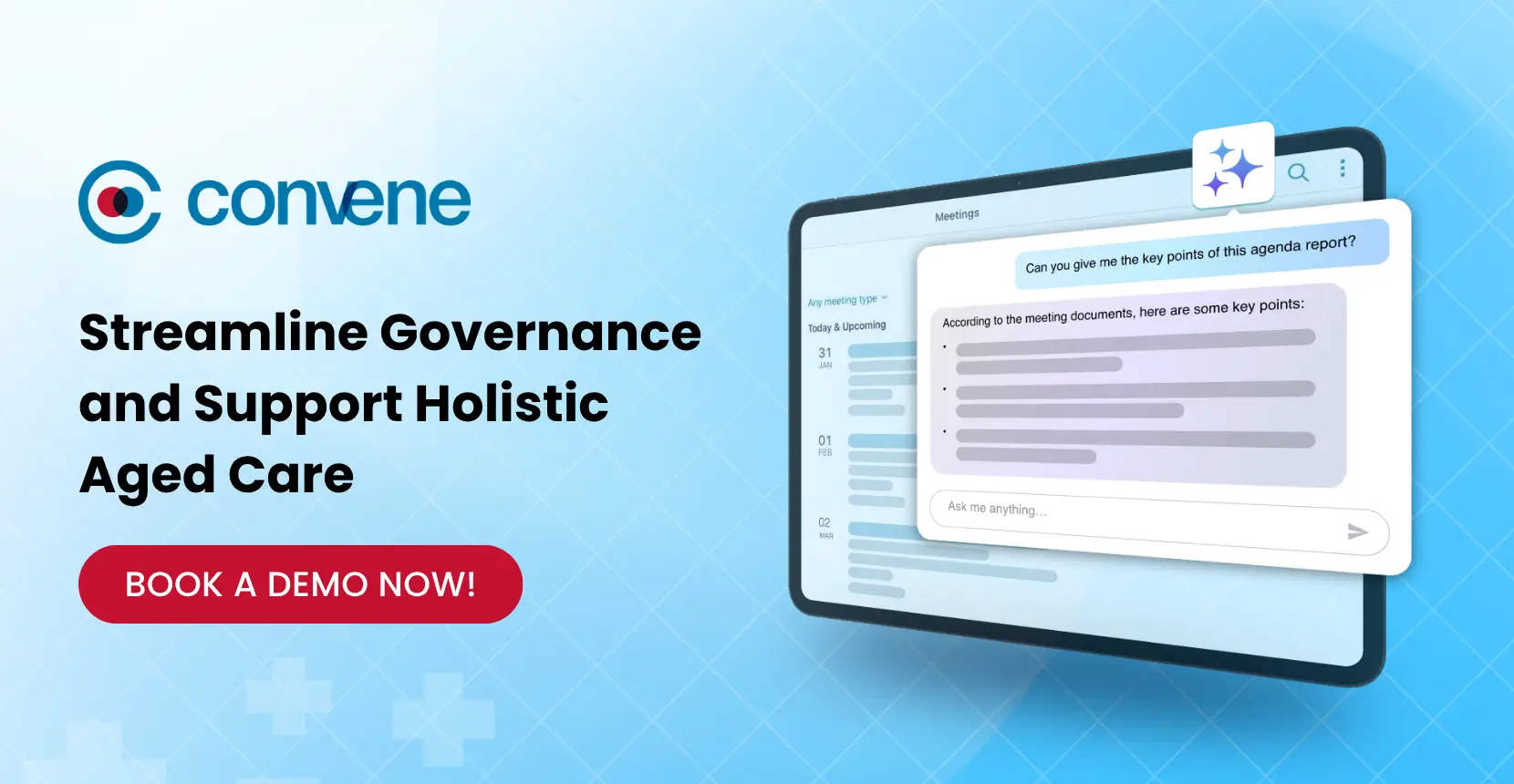
Enhanced with Convene AI, it also enables instant file retrieval and generation of executive-ready meeting summaries, supporting faster and more informed decision-making. Convene Board Portal is also backed by robust data hosting infrastructure and IRAP-aligned processes, ensuring that data management meets regulatory requirements.
Reach out to our team for an app walkthrough! Achieve secure, efficient, and high-quality in-home aged care with Convene Board Portal.



Jean is a Content Marketing Specialist at Convene, with over four years of experience driving brand authority and influence growth through effective B2B content strategies. Eager to deliver impactful results, Jean is a data-driven marketer who combines creativity with analytics. In her downtime, Jean relaxes by watching documentaries and mystery thrillers.
- Connect:
-

-