



Board portals have become one of the most widely used tools for Australian organisations looking to overhaul their board operations. Besides that, many of these organisations need support to navigate increasing regulatory demands and cybersecurity risks—both of which board portals are designed to address.
But this board technology is no longer limited to meeting management or document sharing. Modern platforms today incorporate AI-powered capabilities to analyse board materials and generate more critical insights. In the 2025 AI Deployment and Governance Survey Report by the Governance Institute of Australia, 9 out of 10 organisations reported they are using AI, yet nearly half said they still lack training and knowledge in AI, affecting successful rollout.
In this guide, we’ll explore why boards should be AI-ready and invest in an AI-powered board portal, plus a checklist to help you get started.
What does AI readiness mean for boards?
AI readiness means a board is equipped to oversee AI opportunities and risks while using it responsibly. An AI-ready board possesses these key characteristics:
- Strategic Alignment and Leadership: AI initiatives are likely to succeed only when they align with clear business goals. So instead of pursuing AI for its novelty, directors must evaluate how proposed AI use cases can contribute to the organisation’s long-term value and competitive advantage. Set clear accountability for AI oversight at both the board and executive levels to ensure alignment between strategy and implementation.
- Board Skills and AI Expertise: Effective oversight requires a baseline understanding of AI’s capabilities, limitations, risks, and regulatory implications. Directors must have sufficient knowledge to evaluate AI-related risks and make informed decisions when necessary. Having education programmes or external advisers can also be beneficial.
- Data Readiness and Information Quality: It’s the board’s responsibility to ensure the organisation has reliable and well-governed data before scaling AI initiatives. This means evaluating data quality, ownership, accessibility, and security across the enterprise. When data management is weak, it tends to end with misleading outputs and biased results.
- Governance, Risk, and Compliance: Establishing governance frameworks covering how AI systems are developed, deployed, and monitored is one task boards shouldn’t skip. Doing so addresses risks like algorithmic bias, data privacy violations, lack of transparency, and non-compliance. Ensure ethical AI use with clear policies and risk controls.
- Technology and Operational Readiness: Having the right technological infrastructure and operational workflows is key to successful AI deployment. Boards should assess if their current systems can support the deployment, as well as any change management processes.
How to Check Your Board’s AI Readiness
Prior to adopting AI tools, it’s critical for boards to first evaluate if they are actually “ready” to implement AI. Here are some steps to get you started.
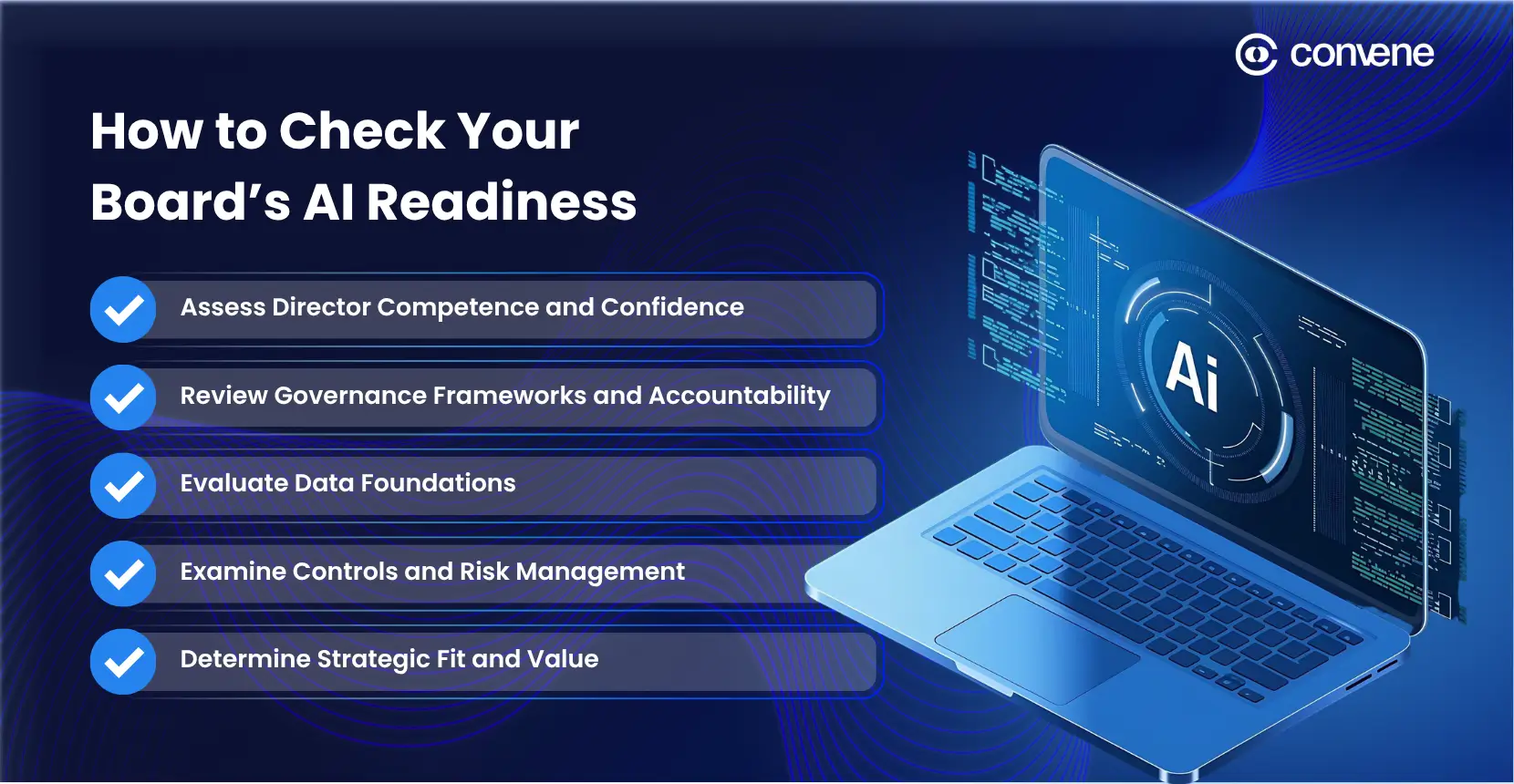
- Assess Director Competence and Confidence: Start by assessing the directors’ competence and confidence to make decisions involving AI. Do they understand core AI concepts, model limitations, ethical considerations, and relevant regulations? Check for skills gaps and if training would be necessary.
- Review Governance Frameworks and Accountability: Next, determine if the board has existing governance over AI, from oversight responsibilities and escalation paths to reporting structures. In addition, AI risks and opportunities should be integrated into governance frameworks and board agendas.
- Evaluate Data Foundations: High-quality and well-managed data is vital to support the responsible use of AI. This involves data accuracy, lineage, privacy controls, access management, and compliance with Australian laws like the Privacy Act 1988 or APPs.
- Examine Controls and Risk Management: Then, understand how AI-related risks are identified, measured, and mitigated. Look into model validation and monitoring, bias and fairness controls, third-party AI vendor management, human oversight, and cybersecurity measures.
- Determine Strategic Fit and Value: Lastly, prioritise all AI initiatives based on clear objectives and measurable outcomes. The organisation must be able to scale AI responsibility, such as through change management and workforce capability. The board must also be confident that AI will lead to improved performance.
Why Organisations Need an AI-Powered Board Portal in 2026
Australian boards continuously operate in a landscape where speed, complexity, and risk require more than document management. AI-powered board portals are becoming a critical tool for better automation and smarter workflows that traditional platforms cannot support. Here are the reasons why organisations and boards need AI-powered portals:
Governance Expectations Continue to Rise
According to the Australian Institute of Company Directors (AICD), directors reported cyber security, artificial intelligence, and regulatory compliance among the more critical governance issues that influenced their agendas in 2025. Hence, directors are expected to implement stronger oversight.
Modern board portals help address such issues by centralising board materials, meeting agendas, and other governance documents in one secure platform. This allows Australian boards to stay informed, prepare more efficiently for meetings, and maintain oversight more easily.
Hybrid Boardrooms are Now the Norm
Australian boards transitioning to hybrid setups are no longer temporary, as more are operating across multiple locations. But with directors working on several commitments (often remotely), traditional paper-based processes and fragmented communication typically create inefficiencies.
Hybrid governance is one aspect where board portals excel. Advanced platforms can provide secure access to board packs, meeting minutes, resolutions, and other confidential documents from any device. At the same time, features like real-time updates, annotations, and voting tools are also available to keep directors engaged regardless of their location.
Cybersecurity Risks are Increasing
Even in 2026, cybersecurity remains a top pressing concern for Australian organisations. For instance, board documents often contain highly confidential information (e.g., financial, legal), which are instant targets for cybercriminals. In their Annual Cyber Report 2024-25, the Australian Signals Directorate received over 43,500 calls to the Australian Cyber Security Hotline, a 16% increase from the previous year, and responded to over 1,200 cybersecurity incidents.
Such figures highlight why relying on unsecured file-sharing platforms is not the best approach for boards. Trusted board management software Australia is equipped with enterprise-grade security features, including encryption, multi-factor authentication, role-based permissions, secure document sharing, and audit logs. These help Australian boards protect confidential data while still meeting their compliance or governance requirements.
AI is Reshaping Board Operations
Artificial intelligence is rapidly turning into a boardroom issue—often affecting operational oversight and risk management. For such reason, directors are expected to be fully aware of the opportunities or risks of AI adoption. In a recent report, 33% of Australian executives revealed they prioritise data-informed decision-making to reflect AI’s growing influence, while 49% are actively redesigning workflows with AI.
Modern AI board portals can now support these capabilities through AI-powered features, from automated meeting minutes to document summarisation. These platforms help directors process more information more efficiently while still upholding oversight. However, boards must ensure that any AI-enabled tools they use are aligned with their organisation’s policies.
Checklist in Evaluating AI-Powered Board Portals for Australian Organisations
In 2026, board portals serve as a governance infrastructure that supports rapid decision-making, efficient workflows, and secure collaboration—not just meeting management tools. But with rising cyber threats, regulatory demands, and rapid tech change, AI capabilities are now a key requirement—not just an optional feature. Here’s a checklist to help you find an AI-powered board portal:
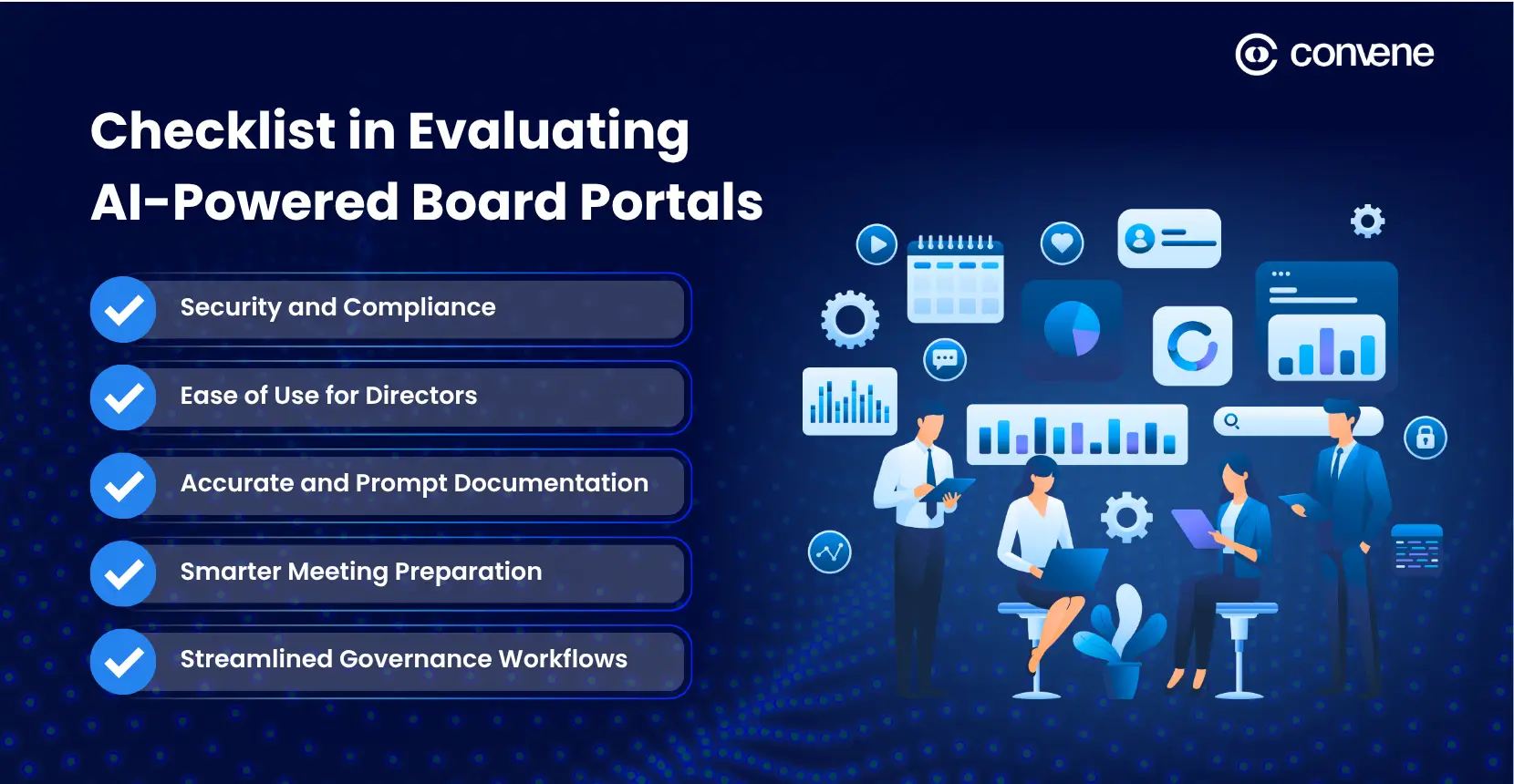
Security and Compliance
Board materials have confidential information such as financial reports and legal records. Therefore, security must take precedence when selecting a board portal.
- End-to-end encryption for data at rest and in transit
- Single sign-on (SSO) and multi-factor authentication (MFA)
- Offline access for remote requirements
- Certifications such as ISO 27001, SOC 2, or equivalent standards
- Secure hosting on a trusting cloud infrastructure (e.g. AWS or other enterprise-grade providers) to minimise third-party access risks
- Alignment with Australian security or government standards, such as IRAP compliance
Ease of Use for Directors
A secure board portal Australia may fail if the intended users have difficulty using it. The ability to adopt plays a key role in whether the platform will be successful in meeting the organisation’s needs.
- User-friendly interface across desktop, mobile device, tablet
- Private and shared annotations and note-taking capabilities
- Customisable dashboards and meeting views
- Advanced search across documents, minutes, agendas, and policy documents
- Offline access to board materials
- Minimal implementation training for users
- AI companion for summarisation and task assistance
- Agentic AI for insight retrieval and workflow efficiency
Accurate and Prompt Documentation
Board portals play a critical role in maintaining accurate, version-controlled documentation as a single source of truth for directors.
- Secure document management and file sharing
- Automatic version control and history tracking
- Smart document classification and tagging
- Advanced search across documents, minutes, and agendas
- Granular document watermarking and download controls
Smarter Meeting Preparation
A board portal that can reduce the administrative burden of meeting preparation is what an organisation needs.
- Easy agenda creation and board pack compilation
- AI-powered meeting and board pack summarisation
- AI-assisted meeting drafting and transcription
- Automated agenda and action item creation
- Intelligent document search
- AI-powered knowledge retrieval from historical records
Streamlined Governance Workflows
An ideal board portal should not only support document sharing but also governance processes, from voting and approvals to decisions.
- Integrated voting and approval workflows
- Role-based approvals and permission controls
- Audit trail and activity logging
- Automated recording of decisions and resolutions
- Governance insights and trend analysis
- Administrative controls for AI usage and permissions

Frequently Asked Questions About AI-Ready Board Portals
How are boards using AI?
Boards primarily use AI to improve governance efficiency and strengthen oversight, rather than make decisions autonomously. In most cases, boards also use AI to summarise board papers and reports, extract key insights, and speed up meeting preparation.
Outside of meetings, boards often use AI to analyse governance trends, enhance scenario planning, and navigate risks such as cybersecurity or regulatory change more effectively. Still, boards typically apply strict controls around AI use to ensure outputs and sensitive data are handled within secure environments.
Can AI board portals integrate with existing enterprise systems?
Many modern board portals integrate with tools like document management systems, identity providers (SSO), and collaboration platforms to ensure streamlined workflows and processes.
What are the top AI board portal options?
There are several established board portal providers, each offering different levels of AI capability, including Diligent Boards, Nasdaq Boardvantage, and Convene Board Portal. The best option depends on your organisation’s needs for security, usability, integration, and budget.
Convene: The AI-Ready Board Portal You Need
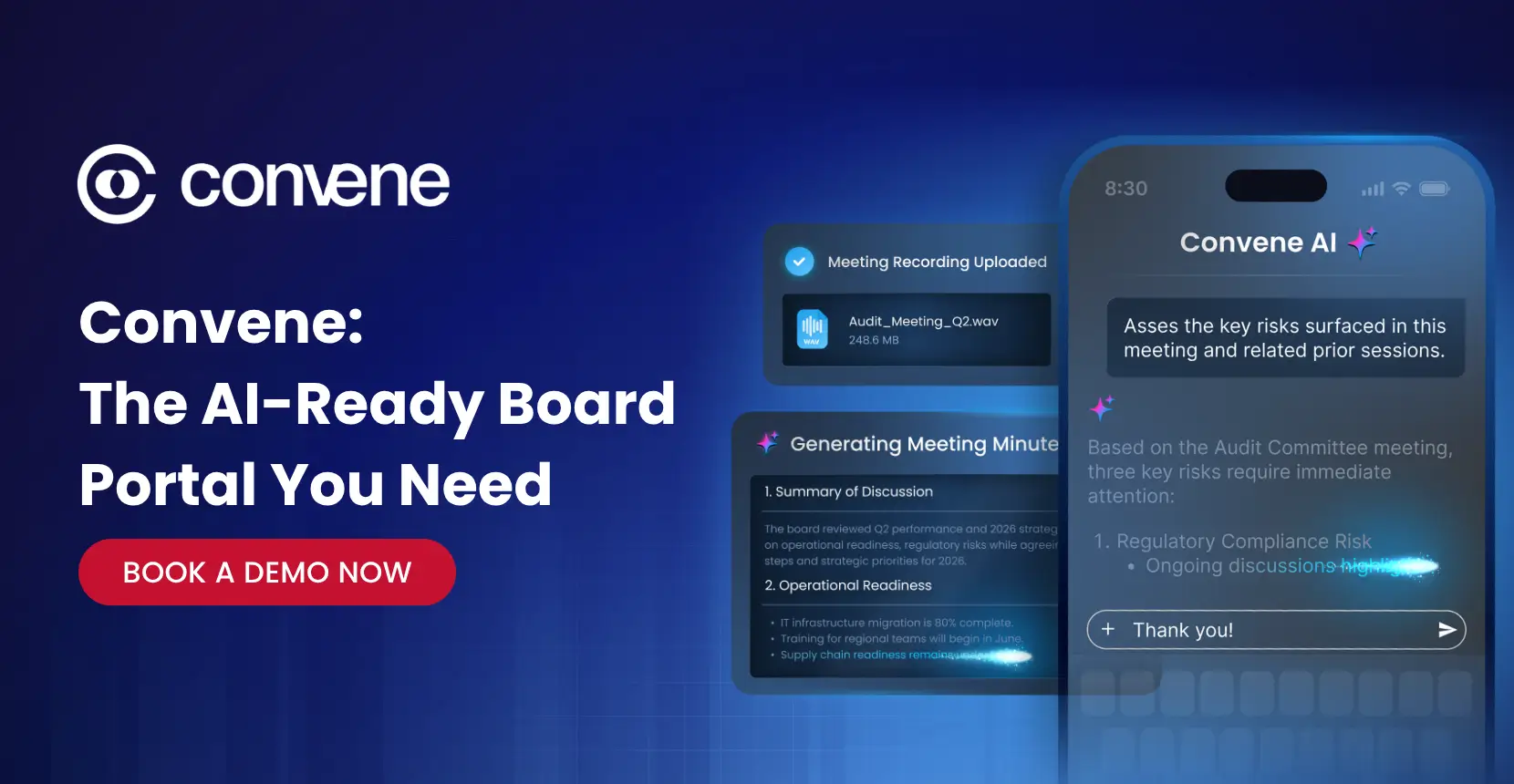
For many Australian organisations, becoming AI-ready proves easier said than done. But the challenge doesn’t just come from adopting AI; it’s embedding it responsibly into governance processes — all while ensuring security and board effectiveness aren’t compromised. This is where deploying an AI-ready board portal like Convene would be a smart move.
Convene Board Portal is a leading board management platform built for organisations that want to move beyond fragmented workflows towards a more connected and intelligent governance environment. Within Convene, intelligence is not an add-on but embedded directly into the platform through Convene AI.
Convene AI, a next-generation intelligence feature, is designed to address modern governance requirements. Powered by AWS Bedrock, Convene AI uses enterprise-grade security with AI-powered tools to streamline meeting administration and improve board workflows.
Tired of relying on standalone AI tools? Convene AI brings intelligence assistance and features all in one platform. Its key capabilities include:
- AI Companion: Generate document summaries, retrieve insights from board materials, access past decisions, and send notifications through our platform’s conversational AI assistant.
- Automated Minutes: Instantly have meeting minutes, transcripts, and key decisions on record with Convene AI. You can also review and edit them before finalisation.
- AI-Powered Action Management: Automatically identify action items from meetings and suggest next steps to help your board turn those discussions into accountable actions without the hassle.
Ready to future-proof your board? Request a free demo and learn why Convene AI is the only AI-ready tool you need!



Jielynne is a Content Marketing Writer at Convene. With over six years of professional writing experience, she has worked with several SEO and digital marketing agencies, both local and international. She strives in crafting clear marketing copies and creative content for various platforms of Convene, such as the website and social media. Jielynne displays a decided lack of knowledge about football and calculus, but proudly aces in literary arts and corporate governance.
- Connect:
-

-