


Corporate governance in Egypt has undergone a rapid yet intentional transformation in the past few years. In order to build a resilient and reputable enterprise, frameworks are consistently reviewed and updated to address three important priorities: attracting investors, advancing sustainability and succession, and mitigating risks. One specific turning point is the introduction of corporate governance codes by the Egyptian Institute of Directors (EIoD) under the Financial Regulatory Authority (FRA). These codes align local practices with international and regional standards, raising the bar for transparency, accountability, and board effectiveness.
Recent updates to listing rules and governance guidance, under FRA Resolution No. 26 of 2026, have also put greater focus on board independence and disclosure. For EGX-listed boards, this means compliance now goes beyond having the right policies or making disclosures. Regulators now expect organisations to show not only what decisions were made but also how those decisions came about, using records like board resolutions and audit trails. Through the new regulation updates, boards must present clear, verifiable, and well-documented evidence of their decision-making process.
As a result, digital evidence has become central to effective governance in Egypt.
What is the Financial Regulatory Authority?
Established under Law No. 10 of 2009, the Financial Regulatory Authority is Egypt’s unified regulator overseeing non-banking financial markets and instruments, including capital markets, insurance, leasing, factoring, and fintech activities. It replaced key regulatory bodies, including the Egyptian Insurance Supervisory Authority (EISA), the Capital Market Authority (CMA), and the Mortgage Finance Authority (MFA), consolidating their functions under a single authority. The FRA operates with legal independence across financial, administrative, and technical areas, with the objective of:
- To develop and maintain stability of non-banking financial markets
- To protect stakeholder rights
- To issue new systems and rules to ensure the efficiency and transparency of these markets
It also works in coordination with the General Authority for Investment and Free Zones (GAFI) to help promote investment, facilitate business establishment, and regulate free zones in Egypt.
What Boards Can Expect Under the FRA Corporate Governance Code 2026
The FRA Corporate Governance Code 2026 marks a move toward more structured and evidence-based governance in Egypt. Recent FRA resolutions from 2025 and 2026 set out detailed requirements for board composition, decision documentation, and compliance. In general, these regulations use a ‘comply or explain’ approach, encouraging organisations to follow established principles but allowing flexibility when deviations are clearly justified.
A major development is the introduction of binding governance rules under FRA Decree No. 200 of 2025, which sets out comprehensive requirements for board structure, internal policies, and oversight.
FRA Resolution No. 26 of 2026 builds on this by adding new measures to improve governance, transparency, and market efficiency, giving companies three months to comply. Companies must now formalise governance frameworks for risk management, internal audit, and ethical standards, and keep clear documentation to support these processes.
At the same time, FRA Resolution No. 26 of 2026 raises governance expectations for listed companies by requiring cumulative voting for board elections, mandatory board performance evaluations, and the use of electronic systems to improve transparency and verify compliance.
Why Digital Evidence Matters for FRA Governance and Compliance
In practice, digital evidence covers electronically stored records, such as meeting minutes, board resolutions, audit logs, compliance reports, and internal communications. These records create a clear, chronological view of governance activities, making it easier for regulators, auditors, and stakeholders to assess compliance.
Digital evidence is also critical for audit readiness as regulators now expect organisations to provide documentation quickly and accurately. When records are fragmented or kept manually, delays and inconsistencies can occur. Digital systems, like board portals, help boards retrieve complete records efficiently, lowering the risk of non-compliance.
Egypt’s focus on financial inclusion and digital transformation makes strong documentation systems even more important. Egypt Vision 2030 highlights digitalisation as a key driver of growth, transparency, and efficiency. This strategy calls for technology adoption across public and private sectors, including financial services and corporate governance.
Cost of Non-Compliance with FRA Governance Requirements
In evidence-based governance, failing to adhere to regulatory standards can expose organisations to a range of regulatory, operational, and reputational consequences.
From a regulatory perspective, non-compliance may lead to increased scrutiny from the FRA, particularly during audits or disclosures. Incomplete or inconsistent governance records can raise concerns about whether board decisions were made in line with required procedures, potentially resulting in penalties. In more serious cases, failure to comply with regulatory requirements can affect a company’s ability to operate. In 2025, the FRA revoked the licenses of 258 microfinance NGOs after they failed to rectify their status and meet the requirements despite being given ample time to do so.
Operationally, inadequate governance documentation can create inefficiencies and delays. When records such as board minutes or audit trails are fragmented or difficult to retrieve, organisations may struggle to respond promptly to regulatory requests or internal reviews. This can disrupt reporting timelines and complicate audit processes.
There are also reputational considerations with non-compliance. For companies listed on the Egyptian Exchange, governance transparency plays a key role in maintaining investor confidence. This suggests that weak or poorly documented governance practices may signal a lack of oversight or internal control, potentially affecting stakeholder trust and market perception.
How EGX Boards Can Capture and Maintain Digital Evidence
To meet FRA governance expectations, boards need reliable ways to capture, organise, and maintain digital records. As such, the following are key practices boards should put in place:
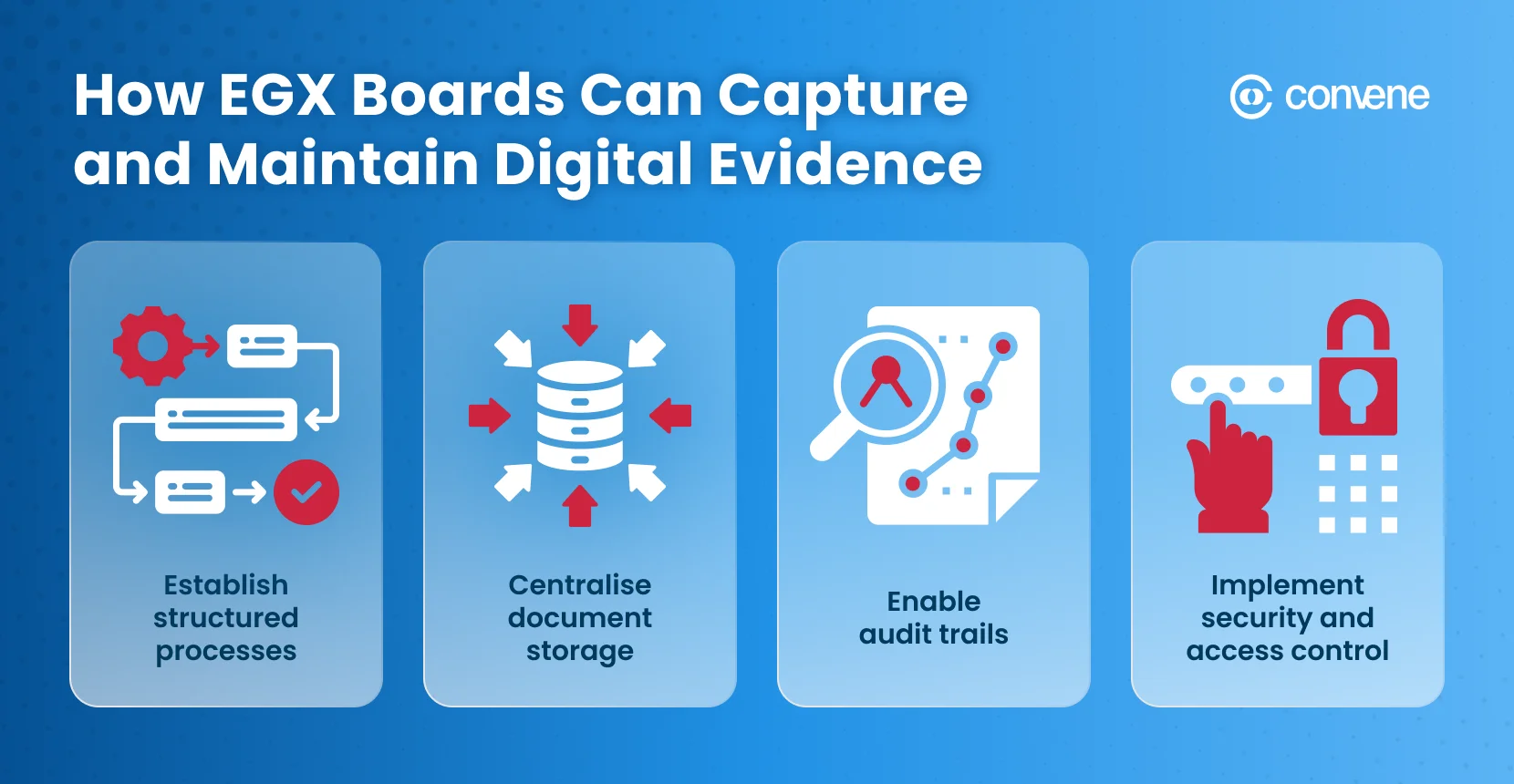
1. Establish structured processes
Boards should set clear procedures for generating and managing digital records. This includes defining how and when to create and approve board and committee reports, as well as annual governance disclosures. Using standardised digital templates for minutes helps ensure meetings are documented consistently. These structured processes support annual governance reports and public disclosures required by the FRA.
2. Centralise document storage
Another practice that can help boards manage digital records is establishing a centralised digital repository, such as a secure board portal or governance management system. Storing documents in one place avoids scattered files across emails or personal drives and ensures secure access to board files through permission-based controls. Centralisation also supports version control, which makes it easier to find the latest approved minutes, committee charters, or regulatory filings. This approach meets FRA expectations for making governance information easily accessible to shareholders and regulators.
3. Enable audit trails
A strong digital evidence system should automatically log an audit trail of all actions on governance documents, including uploads, edits, approvals, and access. For example, when meeting minutes are finalised and stored, the system should record who did what and when. The same goes for approving documents. These audit trails provide a transparent history, which is essential for FRA compliance, especially during audits, regulatory reviews, or disputes, as they show both the outcome and the decision-making process.
4. Implement security and access control
Given the sensitivity of governance records, boards must implement robust security measures like role-based access control and encryption. Role-based permissions make sure only authorised users, such as important board members, company secretaries, or compliance officers, can view or change certain documents. Encryption protects data both when stored and when sent. These safeguards support confidentiality and information security, and help protect the integrity of records used for regulatory reporting or stakeholder communications.
What EGX Boards Must Do to Meet FRA Governance Expectations
Meeting FRA requirements calls for a proactive, structured approach to governance. Boards should regularly review and update internal policies to reflect changes in FRA guidelines and EGX listing rules. Other important considerations include:
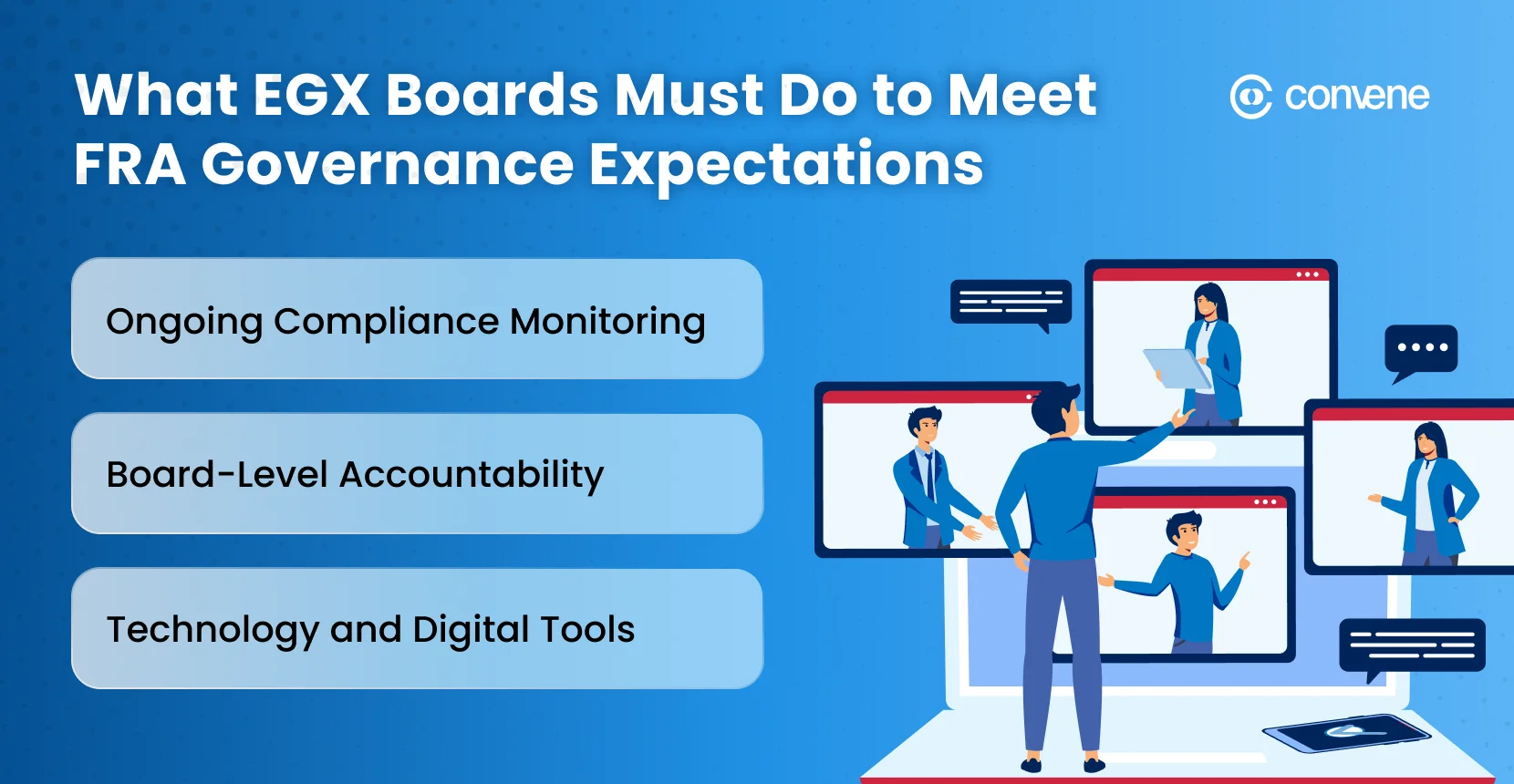
Ongoing Compliance Monitoring
To meet FRA governance expectations, boards need to make compliance part of their daily practices. This means regularly reviewing governance policies, documentation standards, and reporting procedures to ensure they match the latest FRA requirements.
For example, with the new rules requiring companies to prepare comprehensive internal governance regulations and to keep detailed electronic records of board and committee activities, regular internal audits can help simplify the preparation process. Compliance reviews help spot gaps in documentation or processes before they become problems during regulatory inspections.
Board-Level Accountability
Directors need to take an active role in overseeing compliance, rather than simply delegating it. This usually involves making sure decisions are properly documented, deliberations are transparent, and governance processes are applied consistently.
Recent FRA frameworks require boards to set up specialised committees, such as audit, risk, and nominations, and appoint a governance officer to monitor implementation. Building a culture where documentation and governance are seen as strategic responsibilities, not simply administrative tasks, helps align board oversight with regulatory expectations.
Technology and Digital Tools
As governance requirements become more detailed and documentation-heavy, manual record-keeping is no longer enough. Boards should use digital tools like secure board portals, document management systems, and electronic meeting platforms that offer reliable storage, version control, and audit trails.
FRA rules allow and encourage the use of electronic systems for meeting documentation, including audio and video recordings of board and general assembly sessions, as long as they meet security and integrity standards. These tools streamline governance processes and improve the accuracy and accessibility of evidence needed for regulatory reporting and audits.
Frequently Asked Questions
What is the financial regulatory authority in Egypt?
The Financial Regulatory Authority is the regulatory body responsible for supervising non-banking financial markets in Egypt. It ensures transparency, protects investors, and enforces governance standards for listed companies.
What is the penalty for non-compliance with FRA governance rules in Egypt?
Penalties may include fines, regulatory warnings, restrictions, or increased supervision. In serious cases, non-compliance can lead to licence suspension or revocation, as well as impacts on listing status with the Egyptian Exchange.
What records should EGX boards maintain for compliance?
Boards should maintain comprehensive records of meetings, resolutions, audit trails, financial disclosures, and compliance reports. These records must be accurate, secure, and easily accessible to meet regulatory expectations.
How does a board portal support FRA compliance?
Board portals like Convene centralise governance documents, enable secure access, and maintain audit trails of board activities. This helps organisations organise records more effectively and provide verifiable evidence of decisions in line with FRA requirements.
Streamlining Digital Evidence Management with Convene Board Portal
As regulatory demands from the FRA and GAFI increase, boards listed on the EGX need to shift from old governance methods to more organised, evidence-based practices — and they need to do it quickly.
Organisations that invest in strong documentation systems are better prepared to manage risk, build stakeholder trust, and adapt to regulatory changes.
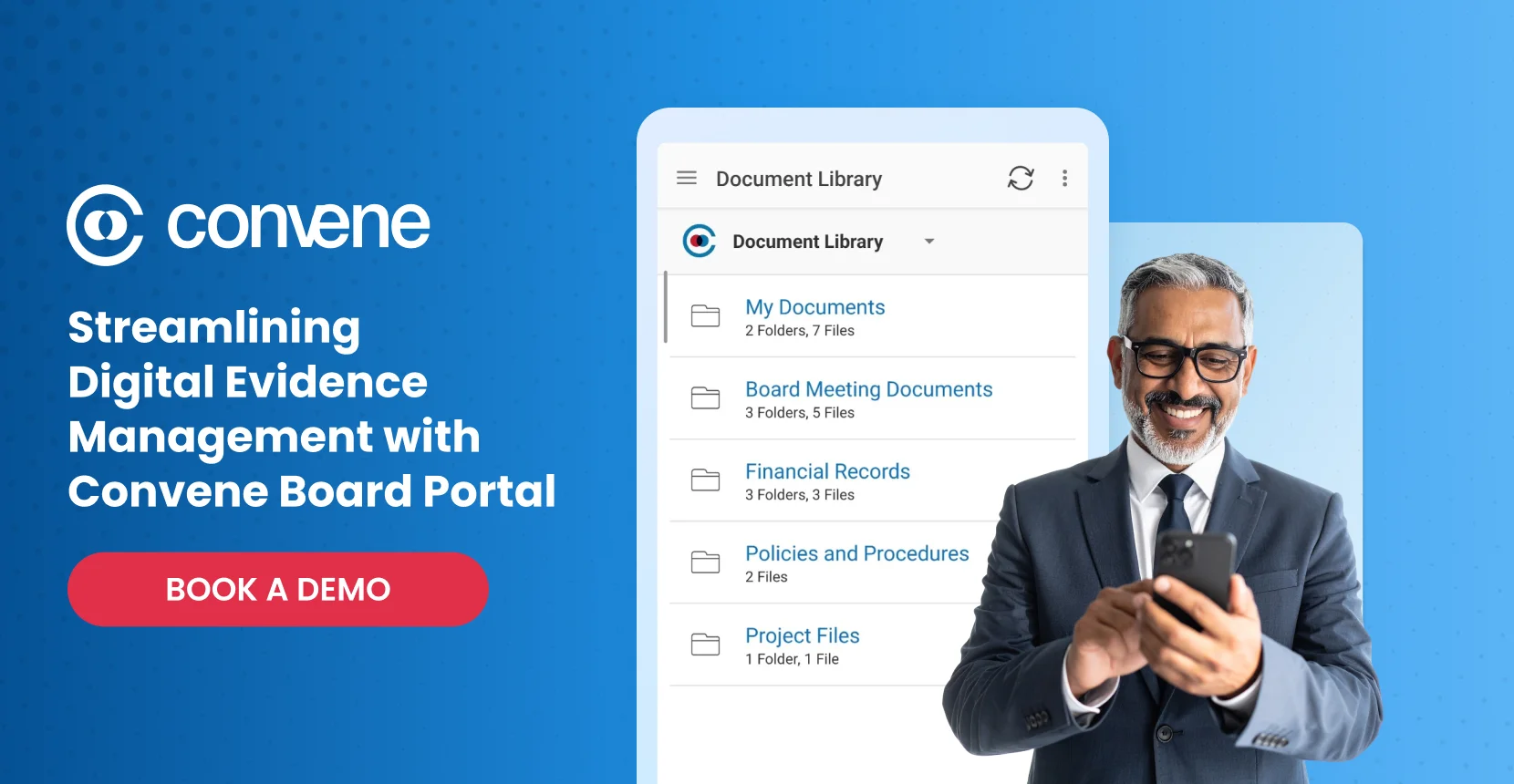
Convene Board Portal supports these efforts by providing a secure, centralised platform designed for modern governance. Key features include:
- Centralised board document management for a single source of truth
- Secure role-based access controls to protect sensitive information
- Built-in audit trails for tracking decisions and approvals
- Real-time collaboration and annotations for efficient board engagement
- Version control to ensure accuracy and consistency of records
- Enterprise-grade encryption and security for data protection
When boards have the right tools, organisations can strengthen compliance and improve their overall governance effectiveness.
Take the next step toward stronger, more transparent governance. Book a demo with Convene to see how your board can meet FRA compliance requirements with confidence.



Jess is a Content Marketing Writer at Convene who commits herself to creating relevant, easy-to-digest, and SEO-friendly content. Before writing articles on governance and board management, she worked as a creative copywriter for a paint company, where she developed a keen eye for detail and a passion for making complex information accessible and enjoyable for readers. In her free time, she’s absorbed in the most random things. Her recent obsession is watching gardening videos for hours and dreaming of someday having her own kitchen garden.
- Connect:
-