
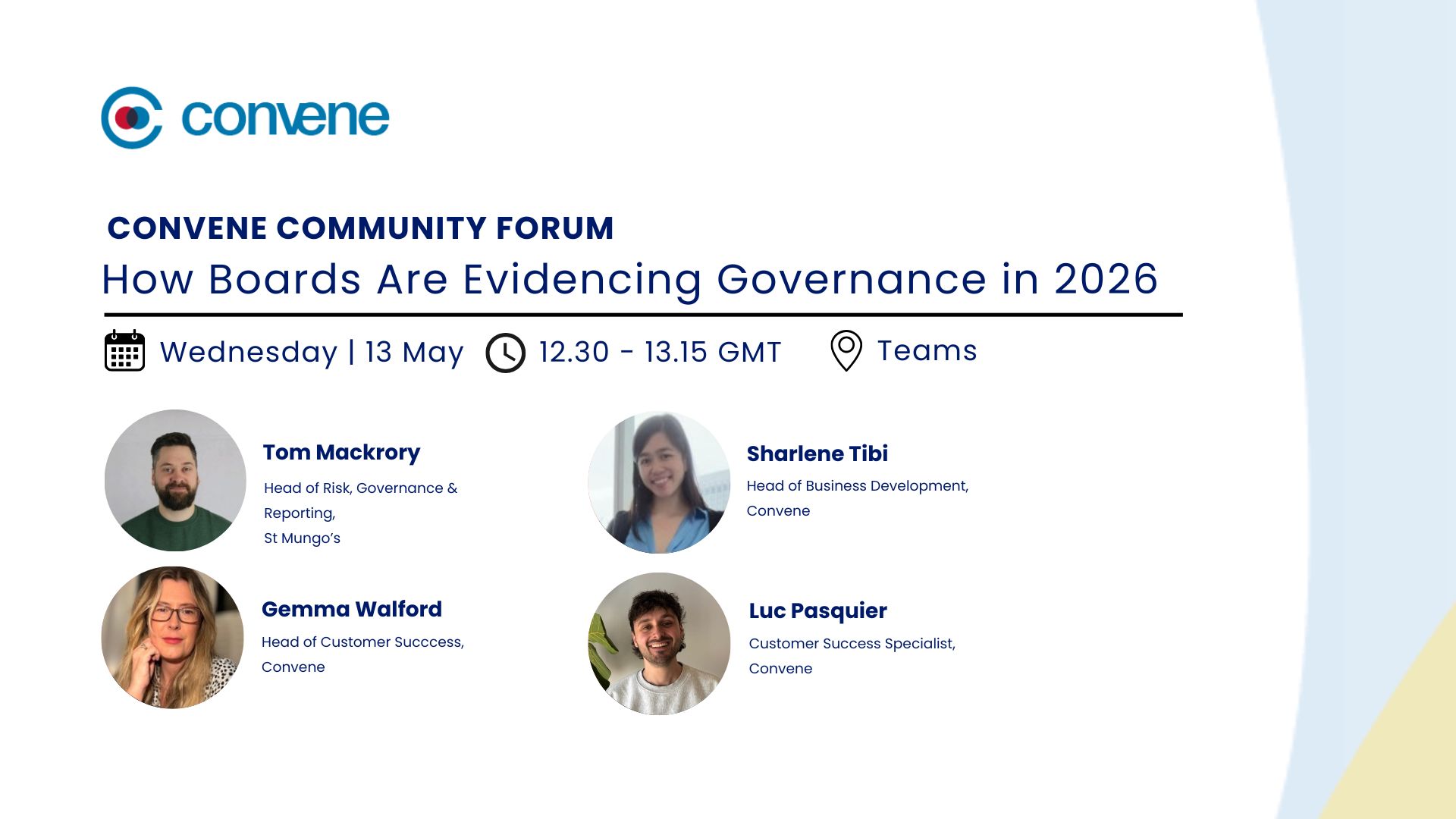


Thank you to everyone who joined us for our first Convene Community Forum. Whether you attended live or are catching up now, this blog covers the key themes, practical insights and product highlights from a valuable conversation about public sector governance in 2026.
The session was chaired by Gemma Walford, part of Convene’s Public and Voluntary Sector Customer Success Team. Joining her were Tom Mackrory, Head of Risk, Governance and Reporting at St. Mungo’s, Sharlene Tibi, Head of Business Development at Convene, and Luc Pasquier, Customer Success Specialist at Convene. Together they brought cross-sector governance experience and practical product knowledge to a room of governance professionals working across housing associations, charities, universities and the NHS.
The State of Public Sector Governance in 2026
Governance teams across the public and voluntary sector are navigating a landscape defined by one central mission. They are being asked to do more with less, while facing greater scrutiny than ever before.
Across housing associations, charities, universities and NHS trusts, regulators are raising expectations around transparency, assurance and accountability. The shift is significant and governance is no longer viewed simply as a compliance requirement. It is increasingly recognised as a key enabler of organisational confidence, resilience and reputation.
The question every governance team needs to be able to answer in 2026 is can you provide evidence for the following questions clearly, quickly and consistently?
- What did we know?
- When did we know it?
- What did we decide?
- What actions followed?
Secure and Flexible Access to Board Portals
Luc Pasquier outlined how Convene supports organisations that need both flexibility and security in how board members access their portal.
Web-based Convene removes the requirement for a separate app download, giving users full platform functionality via a browser. This reduces a common adoption barrier, particularly for board members who are less comfortable with app-based tools.
On security, Luc highlighted a striking finding. He shared that 83% of data breaches currently involve stolen login credentials and multi-factor authentication blocks 99.9% of those attacks.
Convene supports three core authentication methods:
- Device and browser registration, where new device sign-ins require approval from an already registered device
- Time-Based One-Time Password (TOTP), with authenticator apps such as Google Authenticator or Microsoft Authenticator
- SMS One-Time Password (OTP), fully controlled by system administrators
- Single Sign-On (SSO) is also available, allowing organisations to maintain one central login repository rather than managing credentials separately within Convene.
For organisations exploring AI within their governance workflows, all data within Convene remains within its existing security framework, powered by Amazon Web Services Bedrock. AI activity occurs over private internal channels with no public endpoints, and no data is used to train external models.
Streamlining Governance: Key Convene Features for 2026
Sharlene Tibi walked through a range of features that are helping governance teams reduce admin burden without losing control of their processes.
Agenda Planner
A single dashboard giving administrators visibility of up to eight meetings at once. Agenda items can be moved between meetings via drag and drop, and the tool tracks time spent on key governance topics, generating exportable reports useful for chairs and governance leads.
Review Room
A dedicated space for reviewing and annotating documents before they enter a formal meeting. Combined with live editing functionality, it creates a collaborative workflow from draft through to final pack. Once approved, documents copy directly into the chosen meeting. As a governance tool, the Review Room also creates a clear evidence trail of who reviewed what and when.
Convene AI
Available to both administrators and directors, Convene AI allows users to interrogate documents and agendas with specific questions, generate meeting minutes, and surface key decisions, risks and next steps. Critically, it draws only on information held within Convene rather than external internet sources, keeping sensitive data contained and reducing the risk of inaccurate outputs.
Additional Features
- Convene Connect Plus for generating MS Teams or Zoom links directly within the platform
- Hyperlinking to connect documents and pages across meetings and modules
- RSVP functionality to track attendance within the platform
- AI-generated minutes with customisable tone, structure and style
Guest Speaker: Tom Mackrory, St. Mungo’s
The session’s practical contribution came from Tom Mackrory, Head of Risk, Governance and Reporting at St. Mungo’s, a homelessness charity supporting people who are rough sleeping or at risk of homelessness across London and the South of England. St. Mungo’s operates across multiple regulatory frameworks, holding registered provider status with the Regulator of Social Housing, compliance with the Charity Commission and CQC-regulated services.
Tom identified four themes that shaped his contribution and generated the most discussion in the room.
1. Governance Means Evidencing Judgment
It is no longer sufficient to just record that a decision was made. Boards need to demonstrate that decisions were well-considered, properly documented and followed through. Tom’s view was that this does not have to mean more work. It means using existing tools more intelligently to build cleaner, more consistent audit trails.
2. Boards Need Better Information, Not More Information
Board papers that are too long, inconsistently formatted or full of operational detail are a persistent governance problem. To noted that ‘We need insight, not volume.’ Effective governance practitioners surface key risks quickly, distinguish assurance from operational detail and help boards stay focused on strategic decisions. Structured report templates, clearer executive summaries and intelligent use of hyperlinking all support this.
3. Digital Governance Platforms Must Be Actively Used
A board portal only delivers value if people are genuinely using it. Tom encouraged attendees to look at the usage data already available within Convene. Engagement patterns reveal a great deal about board culture and adoption without anyone needing to be asked directly. Who is reading papers thoroughly in advance? Who is opening the pack minutes before the meeting begins? That data is available and worth acting on.
4. Governance Needs to Stay Human
Strong governance depends on culture as much as the process. Psychological safety, trust between executives and non-executives, openness about risks and limitations, and clarity of roles all underpin governance that is genuinely effective. Tom highlighted that trustees and board members are often volunteers, giving their time in good faith, was a grounding note to close on.
How the Review Room Supports Governance Evidence Trails
A memorable topic in the Q&A was how the Review Room can be used as a governance tool beyond simple document approval.
Responding to a question, Tom explained that the Review Room creates a safe environment for board and committee members to engage with documents outside of a formal meeting. Members who might hold back in a room are often more willing to provide honest, considered feedback when they have the time and privacy to do so. The result is richer input, a stronger evidence base and a clear audit trail that sits within the platform.
What Comes Next?
Our next Convene Community Forum takes place in September 2026. We want the agenda to reflect what matters most to you, so please get in touch and share the topics you would find most valuable!
If you have questions from the session that were not covered, or would like a one-to-one conversation about how to get more from your Convene environment, the team would be delighted to hear from you.
Convene helps organisations become more proactive. Book a demo to see how it can help your board.
Frequently Asked Questions
What is the Convene Community Forum?
The Convene Community Forum is a peer-led session for governance professionals working across the public and voluntary sector, including housing associations, charities, universities and NHS trusts. It brings together Convene customers and subject matter experts to share practical insights, product updates and governance best practice.
How does Convene AI work?
Convene AI allows users to ask questions about documents and agendas, generate meeting minutes and surface key decisions and risks. It draws only on information held within the Convene platform rather than external sources, keeping sensitive data secure and outputs accurate and contextually relevant.
Is Convene secure for public sector organisations?
Yes. Convene is powered by Amazon Web Services Bedrock and supports multi-factor authentication including SSO, TOTP and SMS OTP. All data remains within Convene’s security framework, with no public endpoints and no use of organisational data to train external AI models.



- Connect:
-

