



Key Takeaways:
- A safety committee is a subgroup that consists of up to fifteen company representatives, tasked with overseeing and improving workplace safety and environment.
- A safety committee’s responsibilities range from identifying workplace hazards and recommending solutions to developing and reviewing company safety policies.
- Typically held monthly, a safety committee meeting is a regular gathering of members to review safety issues, check compliance, and suggest improvements to maintain a safe and healthy workplace.
- Some of the most critical topics to discuss during a safety meeting are policies and procedures, employee concerns, and emerging risks.
Every year, accidents at work cost businesses billions of dollars in damages. In 2023 alone, the total cost of work-related injuries in the U.S. has reached nearly $180 billion in lost wages, medical bills, and related costs, according to the National Safety Council (NSC). In addition to financial losses, workplace accidents can have long-lasting effects on those who are injured or affected.
This is where safety committees and their meetings become essential. No, they are not just about meeting compliance or checking off regulatory boxes. When done right, safety committees help make the workplace safer for everyone and create a culture of accountability.
In this guide, we’ll explore what a safety committee is and list common safety meeting topics to discuss. Discover also how digital tools like the Convene board portal can help your committee work more efficiently and transparently.
What is a safety committee?
A safety committee is a dedicated team within an organization responsible for overseeing and improving workplace safety. Like how different subcommittees work on specific areas like finance or operations, this group is primarily in charge of spotting and mitigating workplace risks and encouraging safe work habits.
Typically, a safety committee is made up of representatives from different departments, like HR and compliance. They meet regularly to talk about safety issues and suggest ways to prevent accidents. Most safety committees have between three and fifteen members, but the number of members and the structure depend on the size and complexity of the company.
Is it necessary for businesses to have a safety committee? The Occupational Safety and Health Administration (OSHA) says that, as of this writing, 14 states in the U.S. require some employers to maintain safety committees. But even where it isn’t mandatory, having one is considered a best practice.
Key Responsibilities of a Safety Committee
As a governing body, safety committees should be able to do the following:
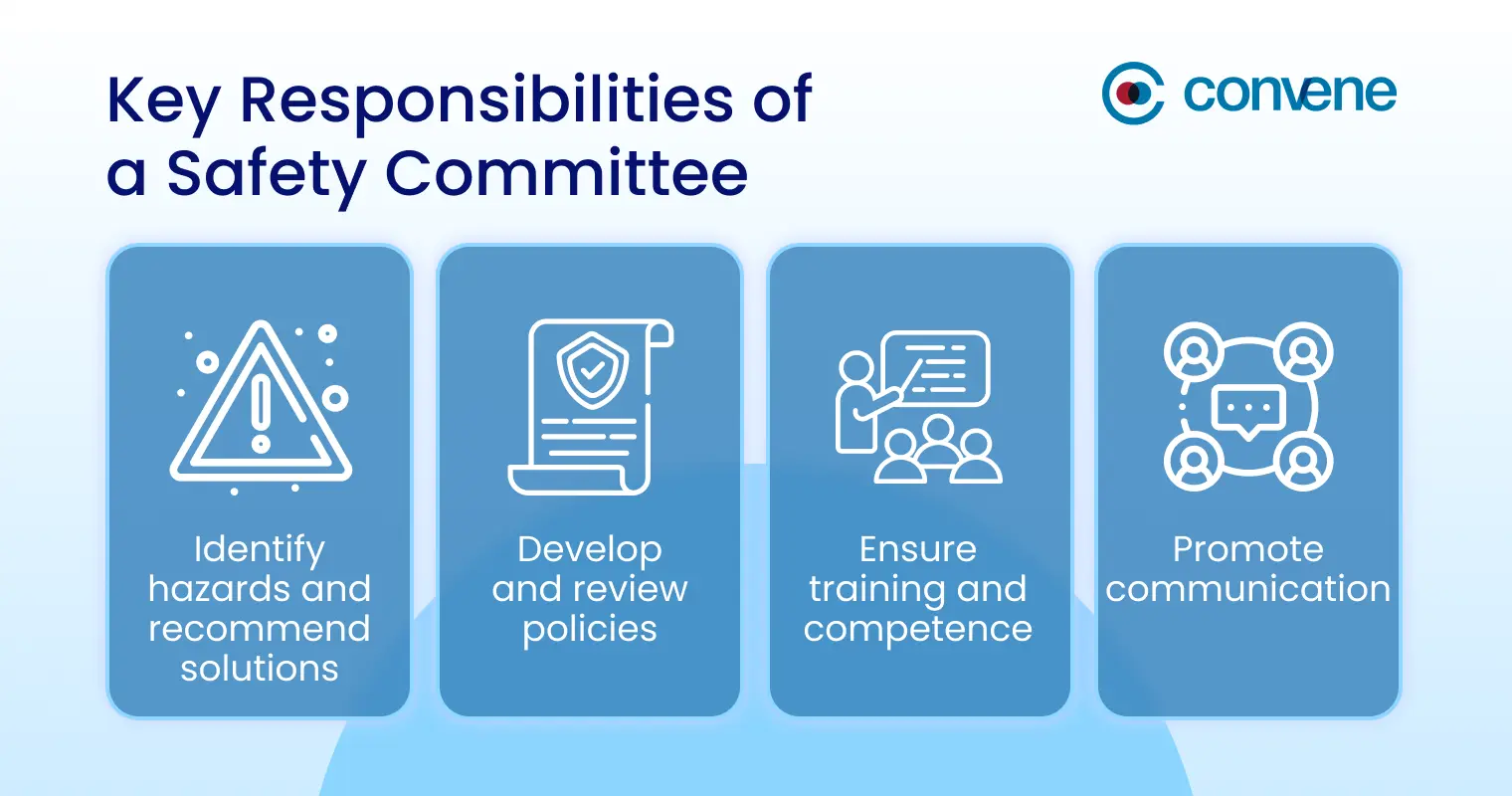
Identify hazards and recommend solutions
The primary responsibility of a safety committee is to identify potential risks before they turn into actual workplace incidents. Thus, the members must conduct regular workplace inspections, review audit findings, and most importantly, gather feedback from employees, as they are most directly exposed to the risks. The committee is also expected to analyze incident reports to detect unsafe conditions or recurring risks.
Once hazards are found, the committee must suggest practical ways to fix them (they do this during meetings). This might mean recommending new equipment or improving signs and emergency plans.
Develop and review policies
The safety committee cannot be complacent with the current framework and must consistently review and update the policies, including those in business continuity plans, to ensure they remain effective and relevant. This includes aligning with local, state, or national rules and using lessons learned from incidents or audits.
For example, Azeus Systems Limited upholds a stringent Occupational Health and Safety (OH&S) policy across its offices, supported by annual risk assessments, training, and mental health programs. Each office maintains a dedicated safety team to oversee compliance with local regulations, such as the Occupational Safety and Health Ordinance in Hong Kong and workplace safety programs in the Philippines, ensuring that employee well-being and safety remain a top priority.
Ensure training and competence
Safety policies only work if they are put into practice. The safety committee helps make sure all employees complete required training, from basic orientation to specialized courses for high-risk tasks. Doing so helps reduce workplace incidents, according to a ResearchGate study. The committee members are responsible for tracking who has completed training, finding any gaps, and working with HR or department heads to schedule refresher sessions. This approach helps make safety a shared responsibility across the organization.
Promote communication
One of the committee’s most important roles is to bridge communication between employees and management. They must create structured spaces, such as suggestion boxes and anonymous feedback channels, or conduct regular consultations where workers can voice safety concerns and suggest improvements without worrying about getting in trouble.
These responsibilities shape the agenda for safety committee meetings, keeping workplace safety an ongoing conversation throughout the organization.
What is a safety committee meeting?
A safety committee meeting is a regular gathering of committee members, usually held monthly or quarterly. The main goal is to review safety issues, check compliance, and suggest improvements. Not like ad hoc safety discussions, which usually arise after a sudden issue, these meetings are formal and documented, helping keep things on track. They usually include looking at recent incidents and checking on safety training to plan next steps.
7 Critical Safety Meeting Topics to Discuss with Your Team
A lot of the time, committees have trouble keeping meetings on track and useful. A clear agenda helps ensure time is spent on issues that truly improve safety. Assigning specific roles, such as a timekeeper to manage time limits and a note-taker to document key points, can also enhance meeting efficiency. Here are six safety meeting topics every safety committee should cover:
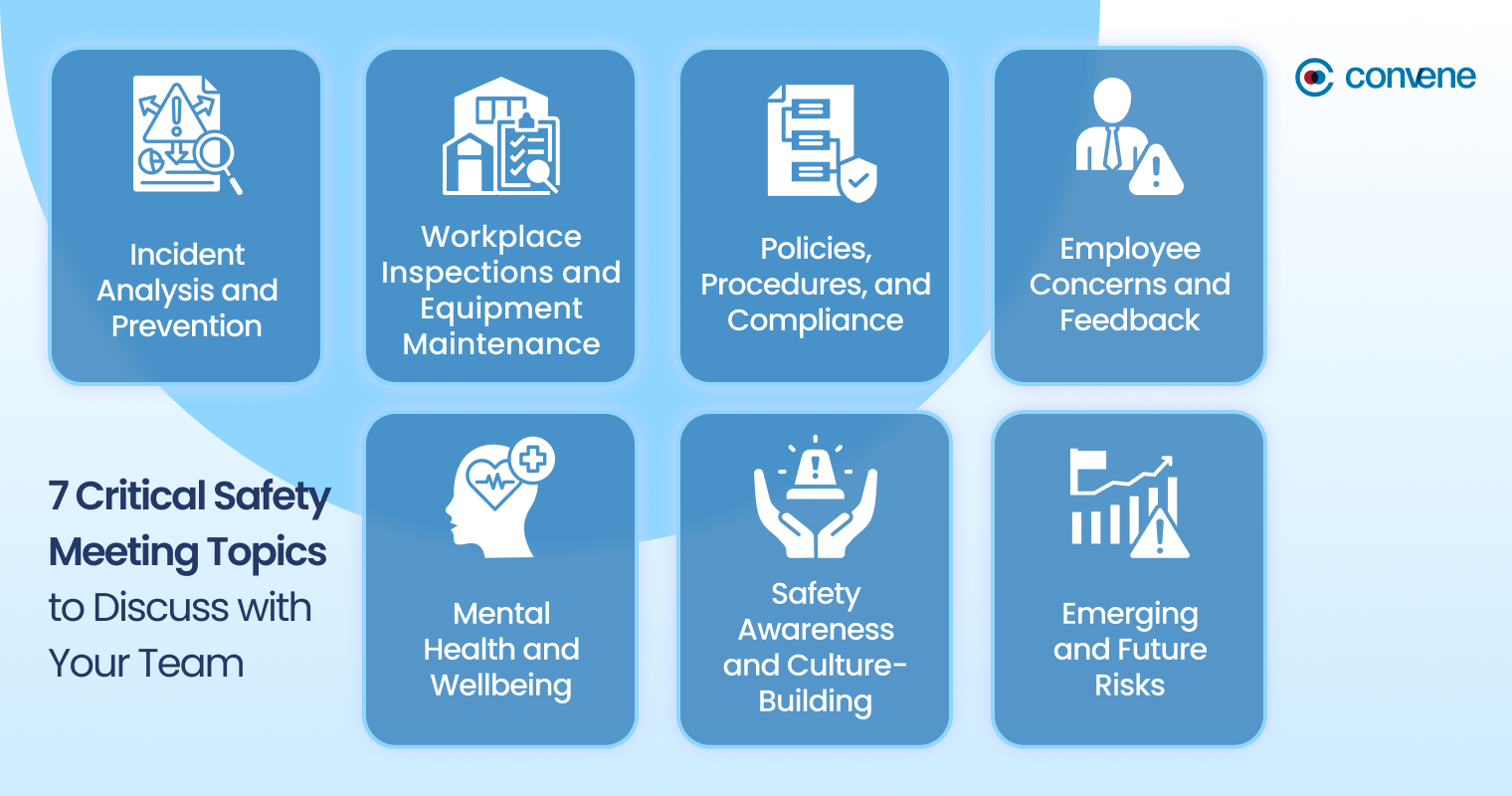
Incident Analysis and Prevention
As it is part of their main duties to identify hazards, each safety meeting should start with a review of recent incidents and unsafe observations. The goal is to find the root causes and stop problems from happening again, not to point fingers. Committees analyze and discuss what went wrong, which safeguards failed, and what can be improved. This includes reviewing near-miss reports, which OSHA considers an effective tool for preventing serious injuries.
Each analysis should result in clear action items, such as reinforcing procedures, adjusting equipment use, or updating emergency responses.
Workplace Inspections and Equipment Maintenance
Regular workplace inspections are essential for a strong safety program. During the meeting, committees should go over the results of recent walk-throughs and make sure that problems like broken machines or bad ergonomics are fixed as soon as possible. Issues like frayed electrical cords or malfunctioning printers and air conditioners may seem minor, but there’s a thin line between a small inconvenience and a potential safety hazard.
Equipment maintenance is just as crucial as outdated or broken equipment can cause injuries. By going over maintenance schedules, repair timelines, and facility conditions, the committee helps keep tools and workspaces safe and compliant.
Policies, Procedures, and Compliance
Safety policies need to change as regulations, technology, and workplace conditions change. Each meeting should include time to review and update policies to ensure they comply with OSHA and industry standards.
This means looking at reporting procedures, emergency plans, and updates from labor boards or compliance groups. For instance, as new digital tools and automation systems are introduced, safety guidelines must be updated to address cyber risks and ensure proper use of equipment. Similarly, as hybrid work becomes the norm, return-to-work policies should be revisited to support employees transitioning between home and office environments.
These continuous policy reviews help avoid fines and show the company’s commitment to employee safety.

Employee Concerns and Feedback
Employees are usually the first to notice unsafe conditions. Safety committee meetings should always include time for employee feedback, using surveys, suggestion boxes, or open discussions. During the meeting, the committee can review the submitted concerns and come up with a practical way to help resolve them.
It is also important to keep employees informed. Committees should plan how to share updates on safety initiatives and decisions, using newsletters, posters, or short team safety meetings. The goal is to make safety a two-way conversation.
Mental Health and Wellbeing
Physical safety is only one part of a healthy workplace. To make sure that everyone is supported and able to perform at their best, employees’ mental well-being must also be prioritized. This not only covers individual stress but also organizational factors that affect morale and mental health, like poor working conditions that tolerate discrimination, inequality, and excessive workloads.
The committee can use meeting time to discuss initiatives that support employee well-being, such as stress management programs, counseling services, and workload balance. Reviewing participation in mental health seminars or feedback from awareness campaigns can also help the committee identify areas where employees may need additional support. By openly addressing mental health at work, the organization reinforces a culture of care and encourages employees to seek help early.
Safety Awareness and Culture-Building
Building a strong safety culture requires ongoing reinforcement. Committees can set aside necessary time during regular meetings to plan awareness campaigns focused on recurring or seasonal risks, such as fire safety, proper lifting, fatigue management, or mental health. This is also an ideal time to review existing training materials, identify areas for improvement, and ensure that messages remain relevant and engaging for employees.
Fun and engaging methods like quizzes, friendly competitions, or recognition programs can help make safety more visible and memorable. These small steps keep safety top of mind in daily routines.
Emerging and Future Risks
Workplaces now face new challenges beyond physical hazards. That is why safety committee topics such as remote work ergonomics, stress management, automation safety, and cybersecurity are becoming more and more important and relevant in the boardroom. Fortunately, a proactive safety committee can anticipate risks. By discussing new challenges, organizations can prepare training, update policies, and allocate resources before problems grow.
Safety Meeting Agenda Template
Even the most prepared teams can overlook important safety details without a structured plan. That’s why having a clear agenda is essential for every safety meeting. Here is a sample safety committee agenda template to get you started:
MONTHLY SAFETY COMMITTEE MEETING
Date: I. Call to Order and Opening Remarks
II. Review of Previous Minutes and Action Items
III. Incident Reports and Hazard Review
IV. Safety Inspections and Audits
V. Training, Awareness, and Safety Campaigns
VI. Policy and Procedure Review
VII. Employee Concerns and Suggestions
VIII. Safety Performance Metrics
IX. New Business
X. Summary of Agreed Actions and Responsibilities
X. Adjournment |
Frequently Asked Questions
Who should be on the safety committee?
Ideally, a mix of management representatives, frontline employees, HR, and safety officers. Diversity ensures broader insights and shared accountability.
What’s the difference between a safety officer and a safety committee?
A safety officer is a specific job in a company that is in charge of keeping the company safe. A safety committee, on the other hand, is made up of employees who aren’t hired for that purpose but work together to make the workplace safer. While their roles differ, a safety officer may also serve on the committee, and both roles support each other.
How to establish a safety committee?
A lot of companies want as many employees as possible to be on safety committees. Depending on the company’s rules, employees can volunteer to join, be nominated or appointed by management, or be selected to ensure that all departments are represented.
How often should safety committee meetings be held?
The best practice is to meet monthly. However, some industries, such as manufacturing or healthcare, may require more frequent meetings due to a higher risk.
Optimize Safety Committee Meetings with Convene Board Portal

Safety committees do more than hold meetings. What they do inside the boardroom translates into lower risks and costs, boosted morale, and a stronger company reputation for safety. To work well, however, committees need clear structure, good records, and accountability.
Technology can make this much easier. A digital board portal like Convene helps by streamlining the whole process:
- Agenda management: The platform’s Agenda Builder lets committees make and share structured agendas with just a few clicks.
- Documentation: Minutes, reports, and action items are stored in one secure document library.
- Follow-ups and accountability: Task tracking ensures safety concerns don’t fall through the cracks.
- Accessibility: Convene makes sure that everyone is on the same page, whether they are in the office, on-site, or working from home, by offering features like real-time annotations, shared document access, and secure digital voting.
To make things even more efficient, Convene AI now offers smart summaries, agenda suggestions, and actionable insights that help teams stay on track and save time during and after meetings.
Book a demo today to see how Convene can help your committee work better.



Jess is a Content Marketing Writer at Convene who commits herself to creating relevant, easy-to-digest, and SEO-friendly content. Before writing articles on governance and board management, she worked as a creative copywriter for a paint company, where she developed a keen eye for detail and a passion for making complex information accessible and enjoyable for readers. In her free time, she’s absorbed in the most random things. Her recent obsession is watching gardening videos for hours and dreaming of someday having her own kitchen garden.
- Connect:
-