



Key Takeaways:
- The Chairman of the Board operates at the governance level (control, oversight, accountability), while the President handles execution (operations, coordination, performance). This separation defines how power and responsibility are distributed.
- The Chairman leads the Board of Directors and primarily focuses on the “big picture” rather than the company’s day-to-day operations.
- The President is responsible for implementing strategies (from the Board or Chairman), managing teams, overseeing budgets, and ensuring the company meets its goals.
- Many organizations separate the Chairman and President positions to prevent power concentration. Small companies, however, often combine these roles with one individual acting as Chairman and President.
The distinction between the Chairman and the President of a company does not only come from acknowledging the division of oversight from execution. While both sit at the top of the corporate hierarchy, these two roles operate in different control domains. In 2025, research shows that there’s been an increase in frameworks requiring or recommending the separation of board leadership (Chair) from executive leadership (President/CEO).
At a systems level, the difference between the chair vs president can be viewed as:
- Chairman: Control, oversight, and accountability layer.
- President: Execution, coordination, and performance layer.
Read on to fully understand the distinction between president vs chairman, particularly in their organizational function and authority design.
What is a Chairman of the Board?
A Chairman, often called a Chairperson, is the head of a company’s board of directors, in charge of leading the board and ensuring it fulfills its governance responsibilities. Instead of managing the company’s day-to-day operations, the Chairman operates at a higher level — concentrating on oversight, strategic direction, and accountability.
So, what does chairman mean in a corporate structure setting? The Chairman acts as a bridge between the board, shareholders, and executive management. Their main job is to ensure company operations are aligned with stakeholders’ interests.
In most corporations, the Chairman is elected by the board of directors, and may serve either in a non-executive capacity (only focused on governance). Or, in some cases, a Chairman may serve as an executive who possesses additional operational influence.
Role and Responsibilities
The role of a Chairman revolves around supervising the board and maintaining governance effectiveness. One of their most critical responsibilities is presiding over board and shareholder meetings. A Chairman must make sure all meeting discussions are not just structured and productive, but also aligned with the company’s objectives.
The Chairman is also responsible for:
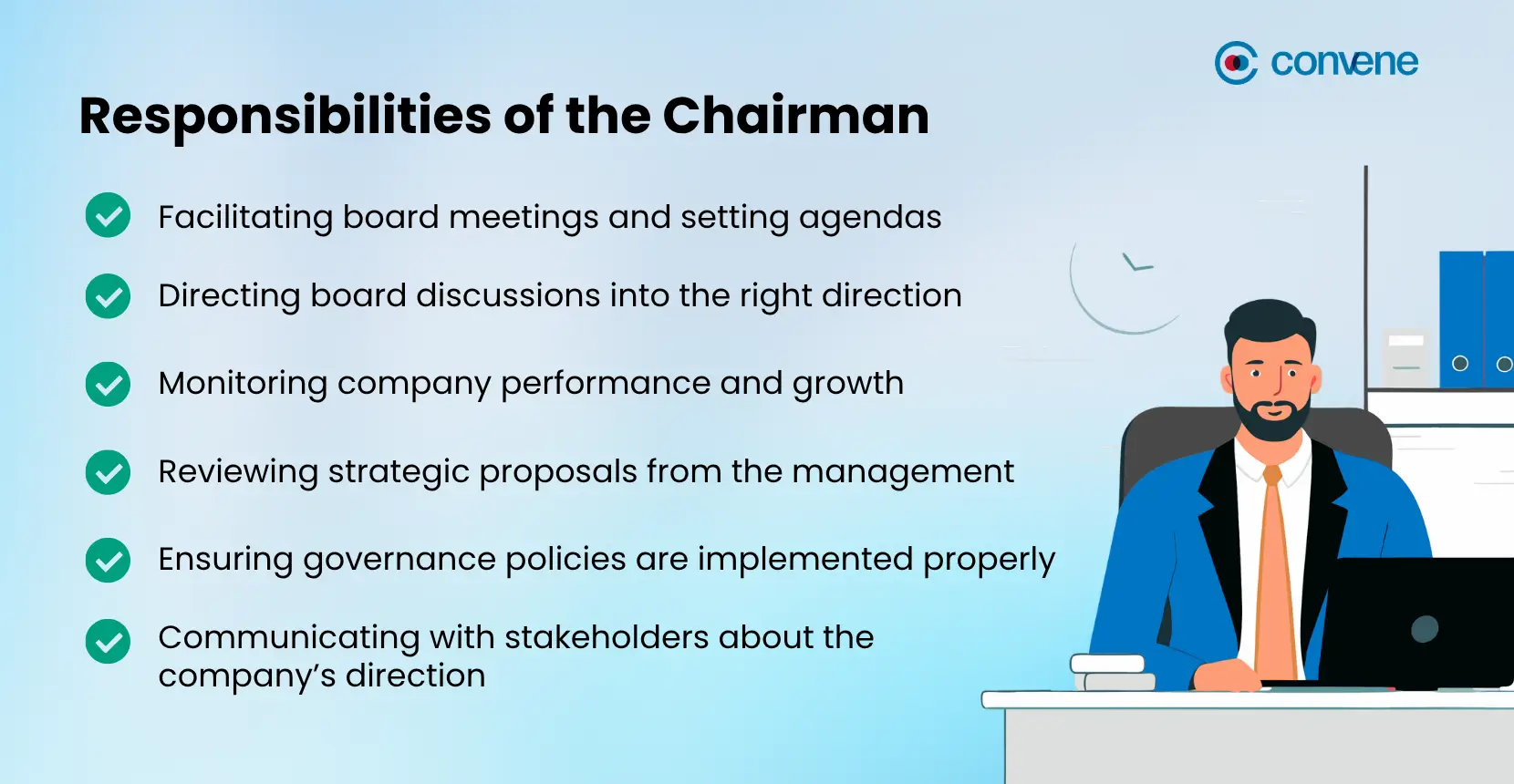
Most importantly, the Chairman also acts as the primary liaison between the board of directors and executive leadership, specifically the President or CEO.
Focus
Rather than operational, the Chairman of a company is all about being strategic and governance-oriented. Their position is primarily focused on the organization’s long-term direction. They also ensure all potential and existing risks are taken care of and that shareholder interests are attended to.
Compared to executives who typically deal with internal processes, the Chairman operates at a board level and focuses on:
- Long-term strategy
- Governance frameworks
- Board effectiveness
- Stakeholder relationships
That said, the Chairman usually has limited or no involvement in the company’s day-to-day operations. The good part is, this makes them independent and objective when assessing or evaluating management performance.
Authority
The authority of a Chairman is primarily supervisory rather than operational, and without direct power over the company’s operational processes and employees. Their authority lies in guiding, approving, and monitoring decisions made by the management. In a nutshell, a Chairman has the power to: (1) lead board decisions, (2) influence strategic direction, and (3) oversee and evaluate executive leadership.
Pay and Notoriety
It’s common knowledge that the Chairman ranks among the highest-paying positions in the corporate world, especially in large or publicly listed entities. As of March 2026, compensation data shows that the average annual salary for a Chairman in the U.S. is $409,636, which is equivalent to $197 per hour, $7,878 weekly, or $34,136 monthly. On average, the salary still varies widely, spanning from $300,000 to $500,000.
As for notoriety, the Chairman is often regarded as an entity’s highest-ranking figure. Normally, a chairman can be seen associated with pivotal developments, public shareholders meetings, or significant corporate governance communications — and remains far away from the day-to-day operations.

What is a President?
A President is a senior executive in charge of managing the company’s day-to-day operations and implementing the strategies. Compared to the Chairman (focusing on governance), the President primarily functions within the executive management structure. Depending on the structure of the entity they belong to, the President may either be the highest-ranking executive (only if there’s no CEO) or the second-in-command (working directly under the CEO).
To put it simply, the President is the one who makes sure that business operations or internal activities run efficiently, and that the company’s goals are achieved.
Role and Responsibilities
The role of the President is centered on execution and management. They are responsible for day-to-day operations and departmental management, which must operate according to the company’s strategic objectives. On top of that, they also manage executive teams and department heads while directing their organizational activities and overseeing resource distribution.
Furthermore, the President also performs significant financial functions. They are usually responsible for:
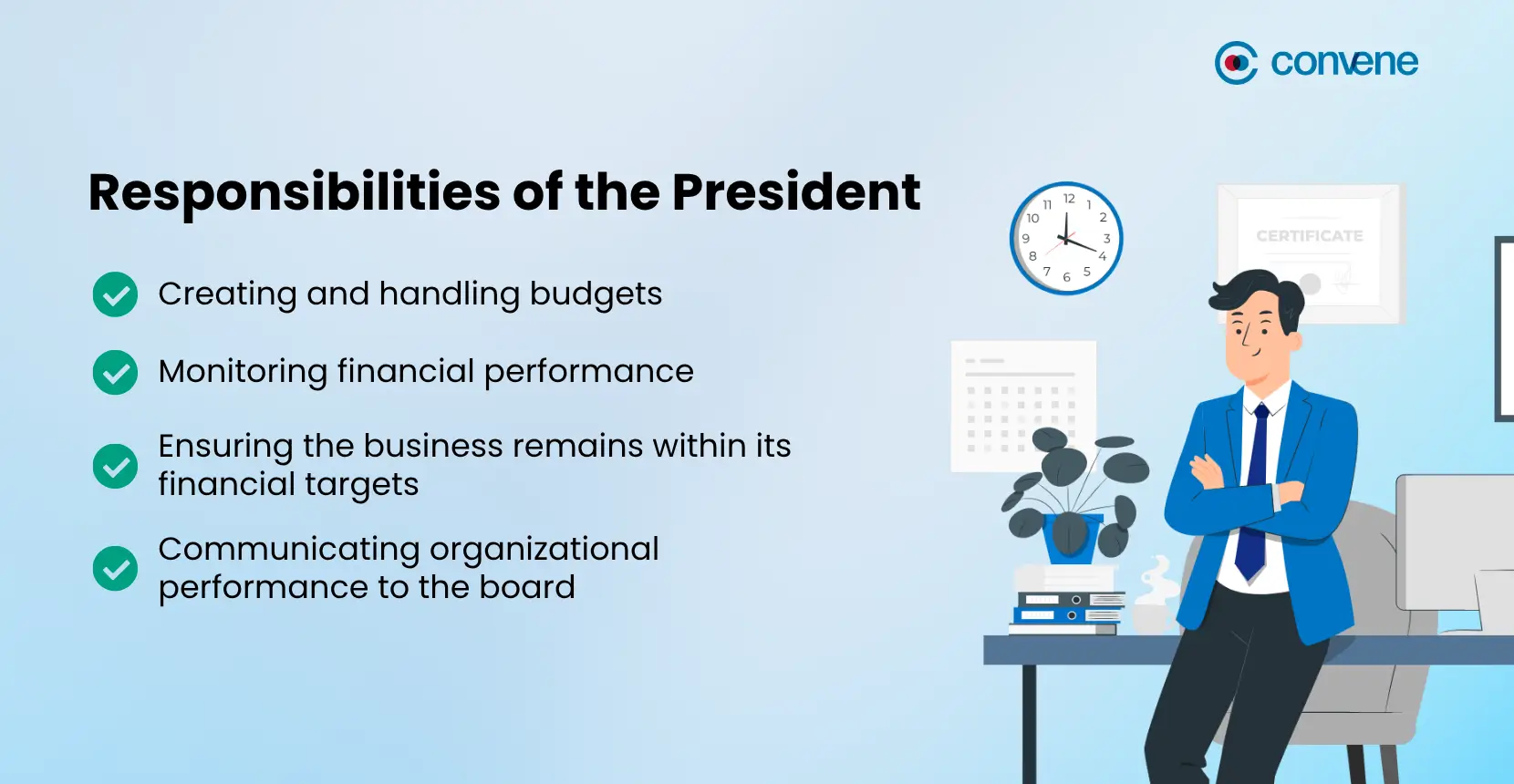
Lastly, the President is also responsible for turning strategies into actions. So, when the board (led by the Chairman) decides on the long-term goals, the President will take charge of implementing them into actual, concrete plans with measurable results.
Focus
The President’s focus is operational and performance-driven. Unlike the Chairman, who is generally about strategies, the President is the one actually involved in the company’s internal workings. Some major areas they concentrate on are:
- Execution of strategy
- Operational efficiency
- Financial performance
- Achievement of short- to medium-term goals
Since they directly influence how daily work gets done, the President is often referred to as the organization’s internal leader.
Authority
While the Chairman’s authority is supervisory, the President’s power is primarily executive and operational — often derived from the board or delegated through the CEO. With this authority, the
President can (1) make decisions about operations and resource distribution, (2) direct employees and management teams, and (3) implement policies and strategies.
In most organizations, the President also has a crucial decision-making power, specifically in areas related to execution and performance. This authority, however, is still subject to oversight of the board and the Chairman.
Pay and Notoriety
The salary of a President varies widely depending on the type of organization they belong to, whether it’s a mid-sized firm or a large multinational corporation. Recent data shows that the average salary for a President in the U.S. is around $154,824 per year, which is based on job postings as of early 2026. Such data, however, comes from a mix of companies, including smaller businesses. Hence, big corporations are more likely to have higher compensation.
According to Salary.com, corporate Presidents with more years of experience also tend to have higher compensation, reaching up to $790,875 for expert level (8 years). The wide gap in salary only proves that the President’s pay highly depends on organizational scale, experience, and even responsibility.
In terms of notoriety, the President is usually more visible within the company and its operations since they manage daily activities and lead internal teams. With that in mind, the President is typically associated with the company’s current performance. In some cases, the President also serves as CEO and may become the organization’s public face.
Chairman vs President: Overview of Key Differences 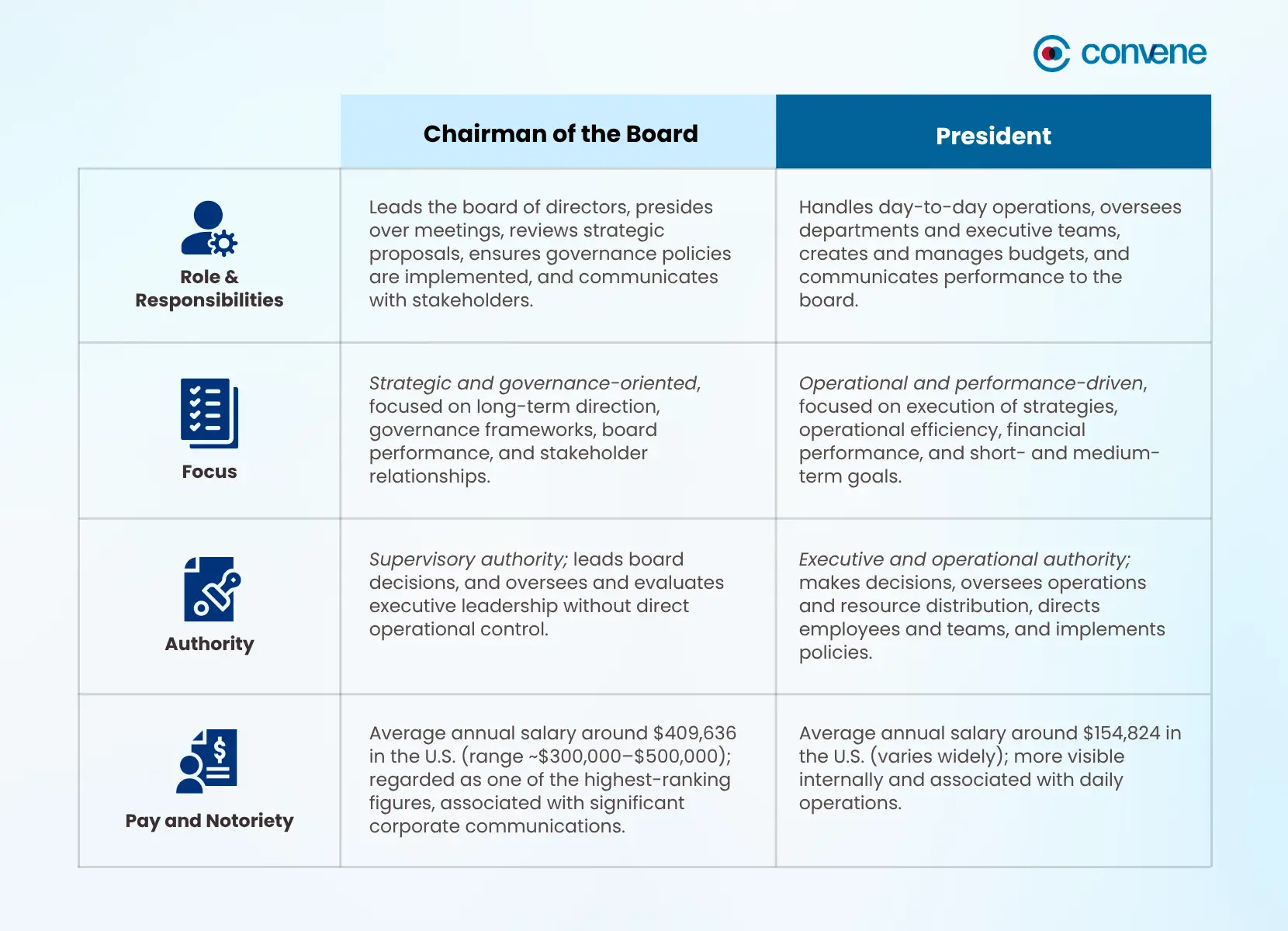 Frequently Asked Questions About Chairman vs President
Why is the Chairman often considered “above” the President?
This comes down to oversight vs execution. The Chairman leads the Board of Directors, which also represents the owners (or shareholders). Their job is not just to protect the company’s long-term interests, but also to oversee the executive team. The President, on the other hand, is an executive (or the highest-ranking “employee”).
Can a president also be a chairman?
Yes. This is common in many U.S. corporations, where one person holds both positions. Anyone can be a President and a Chairman, unless the company’s bylaws state otherwise. However, some organizations opt to separate such roles to prevent power concentration.
What happens when the Chairman and President disagree?
With the Chairman holding the higher card, they (and the Board) have the power to hire, fire, and set the compensation for the executive suite. Backed by the Board, a Chairman can overrule a President on major strategic shifts. However, a Chairman should only focus on the “big picture” while the President focuses on “getting it done”.
Is the President the same as the CEO?
Not necessarily, but they can be. The President is often the second-in-command, focusing on internal operations, while the CEO is the highest-ranking officer focused on strategy. Also, the President reports to the CEO, while the CEO reports to the Board of Directors. In smaller companies, however, these positions are typically held by one individual.
How do the reporting lines differ structurally?
Depending on the company’s structure, the chain of accountability generally looks like:
- The President reports to the CEO, with the typical goal of meeting quarterly and annual targets.
- The CEO reports to the Chairman and the rest of the Board.
- The Chairman (and the Board) reports to the shareholders, with a goal to increase the organization’s long-term value.
How Convene Board Portal Synchronizes Board and Management
A future-forward organization doesn’t just rely on good leadership, it relies on synchronized leadership. But in reality, alignment between leaders like the Chairman, the Board, and the President is often strained by fragmented communication—from missed updates, outdated reports, to inconsistent data. This is where Convene Board Portal comes in.
Designed as a single source of truth for board governance, Convene ensures all your operational insights, reports, and updates reach the Board seamlessly, accurately, and always up to date. Our board portal aims to remove information asymmetry leading to misalignment or tension—particularly between operations (the President) and the board (or the Chair).
With Convene Board Portal, organizations can:
- Orchestrate high-impact board meetings: Convene’s Agenda Builder gives you the ability to create structured agendas that align with board discussions. Private and shared annotations are also available for easy review of meeting materials or board packs.
- Centralize all board materials: With Convene’s Document Library, confidential board packs and company documents are stored and shared securely. The platform also guarantees easy retrieval of records for audits, compliance reviews, or a simple strategic reference.
- Accelerate decisions without compromise: Streamlining document reviews and approvals, even outside formal board meetings, is easy with Convene’s Review Room. Users also get access to features like proxy voting, weighted voting, and resolution structures.
- Streamlining secure, compliant signatures: Approving sensitive documents is more convenient than you think with Convene’s integration with digital signature solutions like Adobe Sign and DocuSign. No more manual signing, no more chasing signatures.
Learn more about Convene and its features. Book a demo with our team today!



Jielynne is a Content Marketing Writer at Convene. With over six years of professional writing experience, she has worked with several SEO and digital marketing agencies, both local and international. She strives in crafting clear marketing copies and creative content for various platforms of Convene, such as the website and social media. Jielynne displays a decided lack of knowledge about football and calculus, but proudly aces in literary arts and corporate governance.
- Connect:
-

-