



Key Takeaways:
- Bahrain Vision 2030 positions digital governance as a key enabler of economic diversification, competitiveness, transparency, and sustainable growth by strengthening decision-making, improving accountability, and supporting more efficient public and private sector governance.
- National initiatives such as the Digital Economy Strategy, Digital Government Policies, and AI framework are accelerating digital transformation across the public and private sectors.
- Digital governance tools help organisations improve decision-making, compliance, accountability, and board efficiency through secure document management, collaboration, audit trails, and action tracking.
- As Bahrain’s digital governance framework continues to mature, organisations that invest in modern board governance solutions, such as secure board portals and digital tools that support board meetings, document management, collaboration, and oversight, will be better prepared to meet rising governance expectations.
Home to one of the Gulf’s most established financial sectors, Bahrain hosts more than 350 licensed financial institutions, with financial services contributing 17.2% of GDP in 2024. This strong financial foundation gives the Kingdom a competitive advantage in the region. Sustaining that advantage, however, will require continued economic transformation.
How does Bahrain plan to achieve that? Bahrain Vision 2030 sets out a long-term strategy focused on economic diversification, competitiveness, and sustainability. Delivering on those ambitions starts with better governance — and better governance increasingly depends on digital tools that enable faster, more transparent, and more informed decision-making.
Understanding Bahrain Vision 2030: Building a Digital Economy
Launched in 2008, Bahrain Economic Vision 2030 is the Kingdom’s national development blueprint to shift Bahrain from an oil-dependent economy toward one that is more productive and sustainable. Over the past decade, the Vision has guided reforms across the public and private sectors, from improving the business environment and attracting investment to strengthening public sector performance and digital infrastructure.
One of the clearest examples of this commitment to digital transformation is Bahrain’s National Digital Economy Strategy (NDES), which brings together 49 initiatives developed with more than 20 public and semi-government entities. These initiatives span digital infrastructure, regulation, talent development, and emerging technologies.
For citizens and other businesses in the region, these initiatives are translating into faster and more efficient public services. Bahrain’s digital government ecosystem now delivers more than 700 eServices through online portals, mobile applications, and self-service kiosks. A recent government case study by the United Nations Development Programme also found that selected digitally transformed government processes reduced operating costs by up to 96% and transaction times by up to 68%, illustrating how digital transformation can improve efficiency and public service delivery.
Why is digital transformation central to Bahrain’s development agenda?
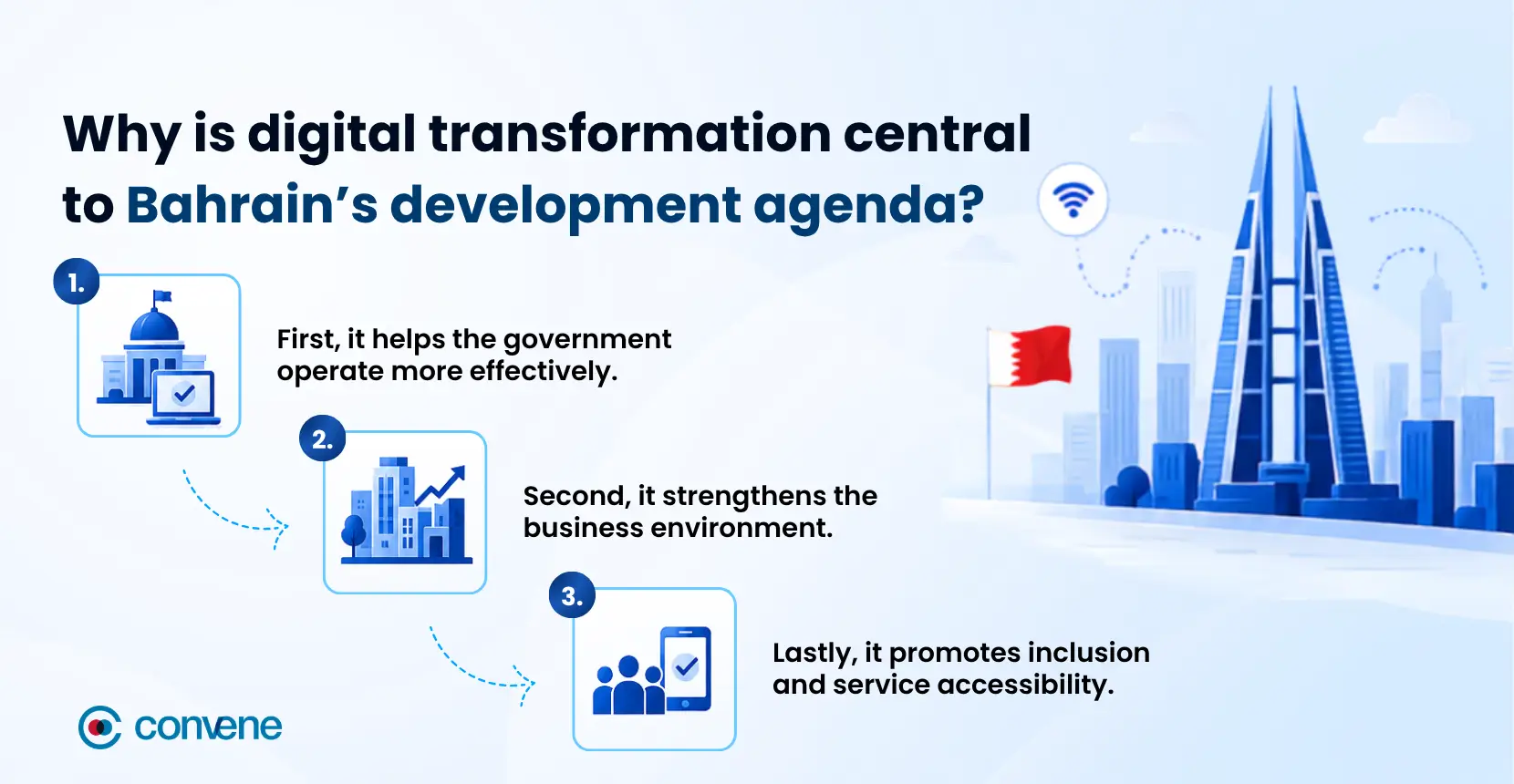
Bahrain’s digital transformation strategy supports long-term economic development by creating a more efficient government, a stronger business environment, and better digital services for citizens and businesses.
This approach is reflected across Bahrain’s national digital initiatives, where digital capabilities help advance the broader objectives of Bahrain Vision 2030.
- First, it helps the government operate more effectively. Bahrain’s Digital Government Strategy, through its Digital First policies, ensures that digital channels are the primary means of delivering services to citizens and businesses. It includes initiatives like the Sijilat e-service portal, the first in the region to use cloud technology for commercial registrations and the National Taxation System.
- Second, it strengthens the business environment. Bahrain’s NDES aims to build an agile government and position the Kingdom as a competitive global digital hub. By streamlining public services and improving the ease of doing business, digital transformation helps create conditions that attract investment and strengthen business confidence.
- Lastly, it promotes inclusion and service accessibility. The Kingdom’s digital economy agenda is guided by principles such as Digital Inclusion and Digital Government as a Right, with a focus on delivering accessible, user-centric services for citizens, residents, and businesses. This reflects Bahrain’s view that digital transformation should improve participation and quality of life, rather than simply modernise technology.
Key Policies Driving Digital Transformation in Bahrain
Several national policies and frameworks help explain why digital governance has become a strategic priority in Bahrain, including:
- National Digital Economy Strategy (2025) provides a more detailed roadmap for digital transformation, including measurable initiatives across infrastructure, regulation, skills, and emerging technology.
- Digital Government Policies (2021) provide the operational policy basis for implementing digital-first public services and governance practices.
- Open Data Policy (2025) and the Bahrain Open Government Data License (2025) reinforce transparency and the controlled sharing of public information.
- eParticipation Policy (2021) encourages public engagement in digital governance and reflects Bahrain’s interest in more participatory decision-making.
- General Policy for the Use of Artificial Intelligence (2025) signals that Bahrain is not only digitising existing processes but also preparing governance frameworks for more advanced technologies.
How Digital Tools Support Bahrain’s Digital Transformation
With the way things are going, digital governance is no longer just about digitising processes. It is about using technology to strengthen how institutions make decisions and manage risk. Digital governance tools are the platforms and systems that help institutions achieve that.
In Bahrain’s government context, these tools can support service delivery and citizen engagement. In an organisational context, they can help boards and leadership teams govern more effectively.
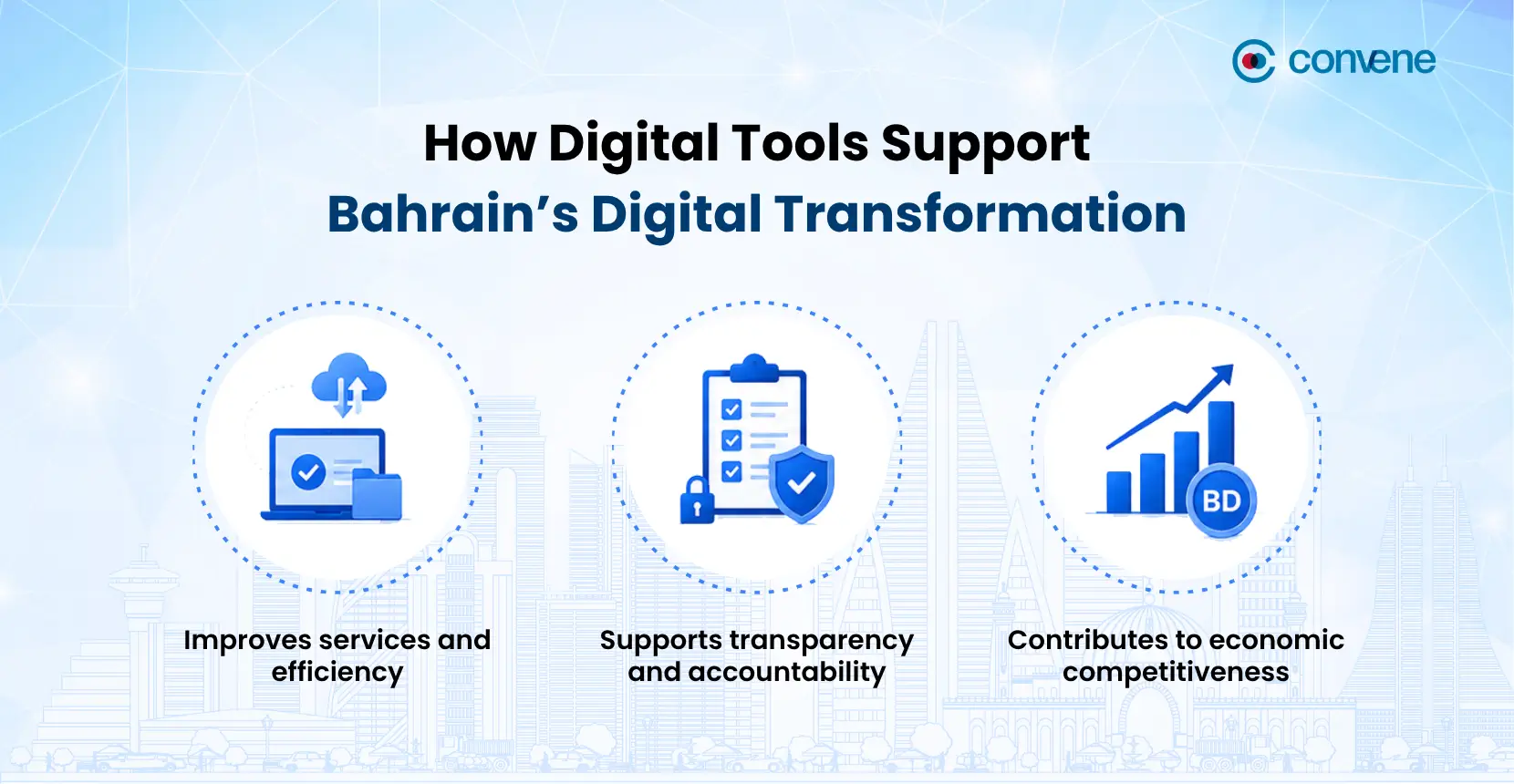
Digital governance tools improve services and efficiency
Digital governance tools improve efficiency by replacing fragmented and manual processes with centralised digital workflows. For boards and leadership teams, this can mean faster agenda preparation, easier document distribution, real-time access to board papers, secure approvals, and better follow-through on action items.
At the national level, Bahrain’s digital transformation experience shows the value of this approach. A practical example is the digitalisation of ID card services, where 95% of transactions are completed electronically. That figure illustrates how digital systems can shorten processing times and create more convenient service experiences.
Within organisations, the same principle typically applies. When board materials are scattered across email chains and static files, decision-making slows, and records become harder to manage. A digital governance platform helps ensure that directors and executives are working from the latest information, with less administrative friction and clearer accountability.
Digital governance tools support transparency and accountability
Transparency and accountability depend on more than good intentions. They require systems that create clear records, traceable actions, consistent access controls, and most importantly, timely reporting. Bahrain’s Vision 2030 specifically emphasises a predictable, transparent, and fairly enforced regulatory system, as well as a public sector accountable for delivering better-quality services.
Digital tools help support those goals in several ways:
- They create audit trails of decisions, approvals, and document access.
- They support version control, reducing confusion over which document is final.
- They enable secure information sharing, which matters when dealing with sensitive board or regulatory materials.
- They make it easier to monitor whether responsibilities, deadlines, and governance obligations are being met.
Bahrain also offers a public-sector example through Tawasul, a platform for real-time citizen feedback that helps strengthen responsiveness and visibility into service issues.
For boards, digital governance tools serve a similar purpose internally. They make governance more disciplined by preserving institutional memory, documenting deliberation, and reducing the chance that important decisions are handled informally or without proper records.
Digital governance tools contribute to economic competitiveness
Bahrain’s national strategy aims to position the country as a competitive tech leader, while Vision 2030 links high-quality public service and effective regulation to a strong business environment.
Digital governance contributes to this goal in three major ways:
- Lowering the cost of doing business: Faster approvals, better service delivery, and reduced bureaucracy make it easier for firms to operate and expand.
- Improving investor confidence: Transparent processes and reliable governance frameworks signal stability and professionalism.
- Strengthening strategic execution: Organisations that govern well can respond more quickly to market changes, compliance demands, and investment opportunities.
There are also sector-level signs of readiness. Bahrain’s digital economy agenda highlights investment in digital infrastructure, AI, cybersecurity, and talent development, all of which support a more innovation-friendly economy.
For private organisations, better board governance supports competitiveness in a quieter but equally important way: it improves strategic clarity, risk oversight, and decision quality at the top.

What Organisations Should Look for in a Digital Governance Solution
A digital governance solution is a secure platform that helps boards and committees manage the full governance work cycle, from preparing meetings and reviewing documents to recording decisions and tracking actions.
While national digital initiatives shape the broader governance landscape, boards remain ultimately responsible for ensuring their organisations can respond to evolving regulatory, operational, and strategic demands. Board governance solutions provide the digital infrastructure that enables directors to carry out these responsibilities more effectively.
For organisations in Bahrain, especially those operating in regulated or fast-changing sectors, the right solution should support both efficiency and governance integrity.
Key capabilities to look for include:
- Secure document management ensures that board packs, policies, and confidential files are stored in one controlled environment rather than across inboxes and shared drives.
- Agenda and meeting management to streamline preparation, reduce administrative work, and help meetings stay focused on strategic priorities.
- Real-time updates and version control allow directors to always work with the latest materials.
- Annotations and collaboration tools that allow board members to review documents efficiently before meetings.
- Action item and resolution tracking to make follow-through more visible and accountable.
- Role-based permissions and audit trails to strengthen security, transparency, and compliance.
- Mobile accessibility for directors and executives who need secure access while travelling or working across locations.
- Strong data protection and security standards, especially where confidential corporate, financial, or public-sector information is involved.
How will AI shape the future of governance in Bahrain?
Bahrain’s next phase of digital governance is likely to be shaped by deeper integration, stronger legal and policy frameworks, and the more advanced use of AI and data. The National Digital Economy Strategy (NDES) and Bahrain Vision 2030 already point toward a future in which digital transformation is more coordinated across sectors, supported by clearer targets and wider institutional alignment.
At the policy level, Bahrain has introduced newer frameworks around AI, open data, and digital economy development, signalling that the country’s agenda is moving beyond basic digitisation and toward more mature digital governance. These initiatives lay the foundation for organisations to adopt AI, while also promoting responsible innovation and effective governance.
Taken together, these developments reflect a broader shift in how Bahrain approaches governance. The focus is no longer limited to digitising public services but also to creating the policy and governance foundations needed to support emerging technologies such as AI.
For organisations, this means governance expectations are likely to rise. Boards will need to oversee AI adoption, make decisions in environments that are more data-rich, more regulated, and more digitally interconnected, and ensure that emerging technologies are used responsibly. As a result, digital governance tools will become less of a convenience and more of a strategic necessity.
How Convene Board Portal Supports Digital Governance in Bahrain
Bahrain’s Vision 2030 is not only a roadmap for economic diversification but also a call for better institutions, better decision-making, and better governance to create a better life for Bahrainis. Digital transformation supports this national ambition by making services faster and organisations more capable of operating in a competitive economy. As Bahrain continues to modernise, the real advantage will belong to institutions that can govern with the same speed, clarity, and accountability that the digital era demands.
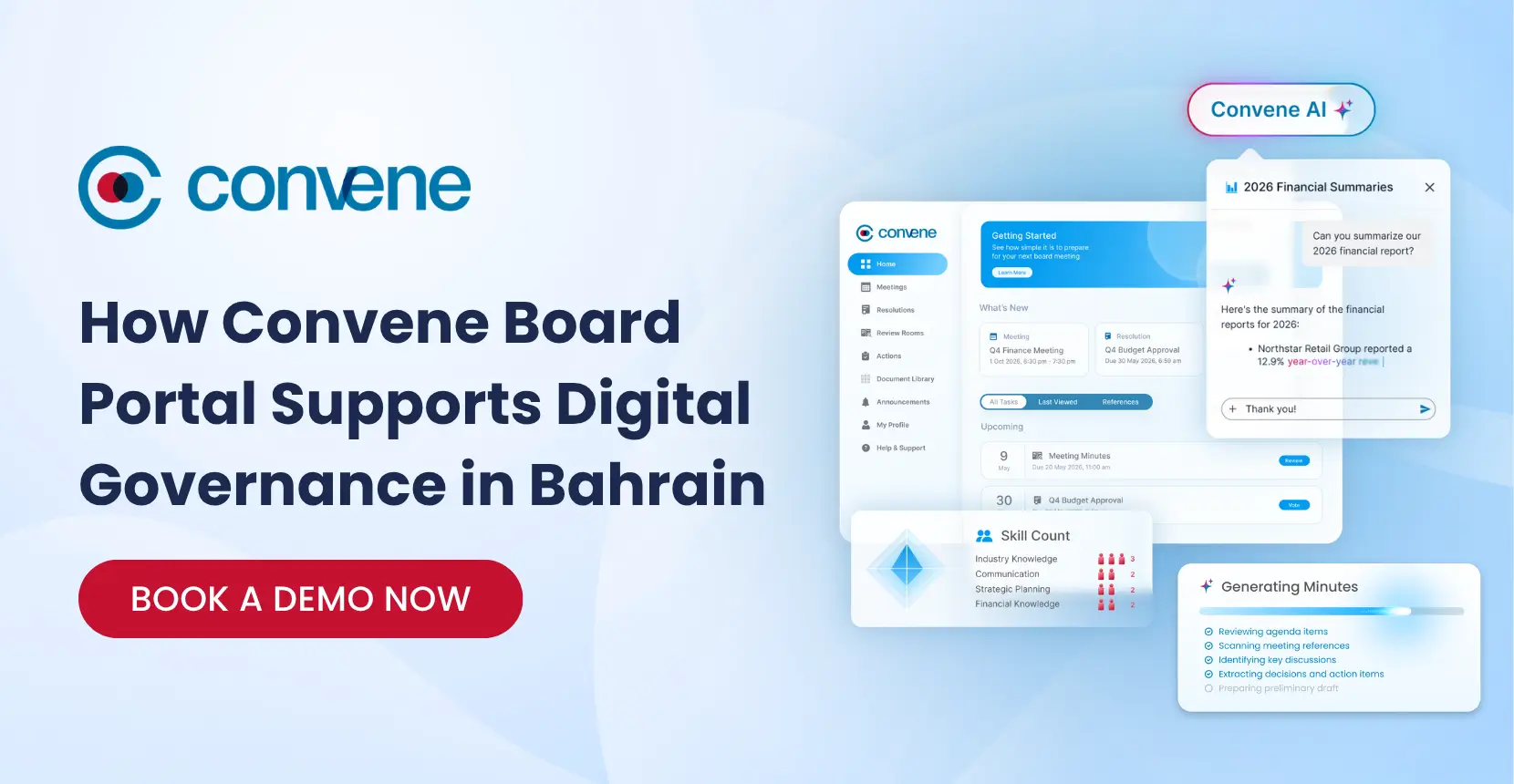
For boards, a digital governance platform such as the Convene Board Portal becomes especially relevant. As organisations navigate growing expectations around oversight, security, efficiency, and strategic execution, this solution can support and streamline the entire board process with features such as:
- Agenda and meeting management to simplify agenda preparation, securely distribute board packs, and keep directors aligned with the latest meeting materials.
- AI-powered meeting minutes to automatically capture discussions, resolutions, and action items, reducing manual work and improving accuracy.
- Decision-making and action tracking to record resolutions, monitor follow-ups, and strengthen board accountability.
- Enterprise-grade security with encrypted document sharing, role-based permissions, multi-factor authentication, and audit trails to protect sensitive board information.
Future-proof your organisation for Vision 2030. Book a demo with Convene to see how digital board governance can support smarter decisions and more future-ready leadership.



Jess is a Content Marketing Writer at Convene who commits herself to creating relevant, easy-to-digest, and SEO-friendly content. Before writing articles on governance and board management, she worked as a creative copywriter for a paint company, where she developed a keen eye for detail and a passion for making complex information accessible and enjoyable for readers. In her free time, she’s absorbed in the most random things. Her recent obsession is watching gardening videos for hours and dreaming of someday having her own kitchen garden.
- Connect:
-