
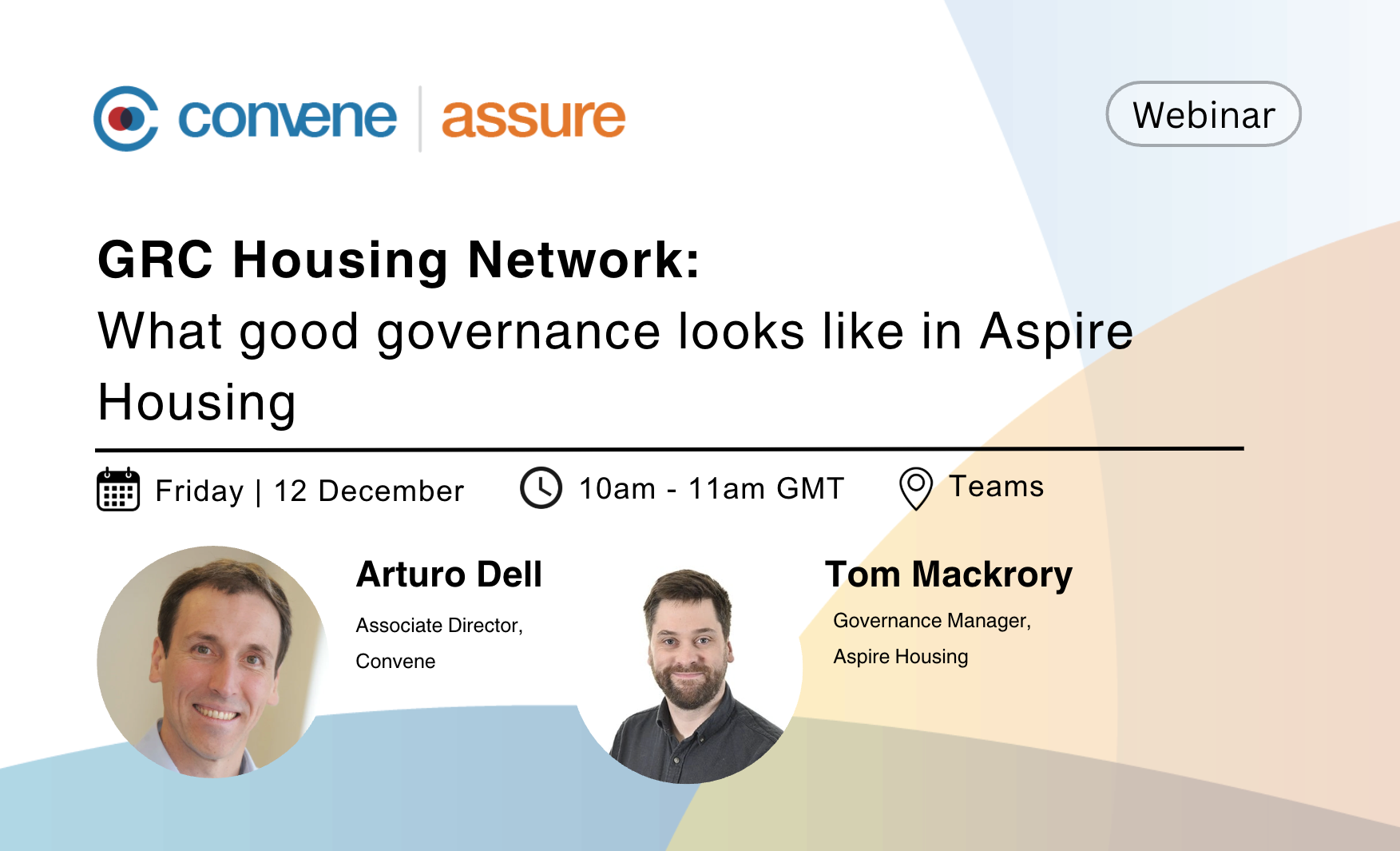


In the December Housing GRC Community webinar, Arturo Dell hosted a live Q&A with Tom Mackrory, Governance Manager at Aspire Housing, focused on what good governance looks like in practice and how organisations sustain strong performance over time.
Tom shared a Governance Manager view of what keeps governance effective in social housing when scrutiny is high and expectations keep evolving. The emphasis throughout was on habits and evidence, not labels – and on building a governance approach that holds up every month, not only at inspection time.
G1 as the baseline
A key theme was how top judgements should be treated once achieved. Tom described G1 as the floor, not the lofty heights – a baseline foundation rather than a ceiling you break through and then relax under.
That perspective is practical in housing governance because pressure rarely stays in one place. Focus shifts between financial resilience, safety and compliance, service performance, and consumer standards. Treating strong governance as the baseline keeps the organisation ready for those shifts.
Governance essentials
When Arturo asked what keeps governance strong in practice, Tom mentioned a small set of essentials that governance teams can use as a checklist.
Build a solid framework with clear roles and responsibilities
Show, don’t tell – demonstrate the evidence, assurance, and how challenge changes decisions
Maintain a golden thread from operational reality to board oversight
Stay open to strong committee and board challenge, backed by capable members
In practice, this is about whether the board can see what is happening, test it, and track what changes as a result.
Governance as a business partner
Tom also set out a clear view of how governance functions are most effective inside housing organisations. He described a business partnering approach where governance teams are less police with a clipboard and more business partners and business enablers.
That matters because many sector failures are not caused by missing policies. They come from weak escalation, unclear ownership, or cultural friction that stops risks from being surfaced early. Business partnering helps embed governance into how teams work, so assurance becomes part of business as usual rather than an inspection driven exercise.
Why red and amber matter
A recurring point was the risk of comfort in performance reporting. Tom highlighted how easy it is for reporting to drift towards green, and why amber and red indicators can be more useful as early warning signals.
He linked this to the discipline of dealing with the uncomfortable issues early, including the areas teams suspect will surface later through audit or regulatory scrutiny. He described this as eat the frog, tackling what is unpalatable before it becomes unmanageable.
The housing analogy was simple: reassurance comes from fixing the leak in the roof, not admiring the new carpet.
Risk oversight and assurance
Tom connected good governance to how organisations use assurance activity, not just how they document it. He referenced learning from stress testing and from internal and external audit, and using those signals to strengthen the golden thread and board confidence.
A related theme was assurance mapping and the importance of testing whether assurance is real. He described confidence coming from understanding how first, second, and third line assurance actually operates, and the discipline of checking the checkers with the right regularity and depth.
Making challenge easier
Tom’s view of board effectiveness focused on conditions for challenge rather than perfect paperwork. He described how board members can hesitate to ask questions that feel basic, but once one person asks, it often unlocks better scrutiny and shared understanding.
From a governance management perspective, that makes psychological safety a practical governance control. It helps boards challenge earlier, clarify faster, and reduce the chance of risks being missed because people stayed quiet.
He also shared a concrete way to make board effectiveness more observable over time: using board portal engagement data as an input into board and committee evaluation, including whether members are accessing packs early enough to prepare meaningful challenge.
Technology and AI in governance
Tom shared a practical example of reducing board pack overload without losing access to evidence. He described moving away from death by appendices and using Convene live linking, so deep dive documents remain accessible in the library while the pack stays focused on decisions and scrutiny. The impact is straightforward – board packs become more readable and easier to use in meetings, while supporting evidence remains available for deeper review between meetings.
He also discussed AI as both a governance risk and a practical support for board effectiveness. His view was that AI needs clear policy and monitoring, because staff and stakeholders are already using these tools. Used in a safe environment, he described AI as a potential partner in the room, helping members prepare by finding a jumping on point for questions and discussion, supported by procedures and mitigations.
Conclusion
Good housing governance is sustained through repeatable discipline – clear roles, evidence led reporting, and assurance that can be tested. The discussion also highlighted the practical value of governance teams operating as business partners, creating the conditions for honest challenge, and using technology to keep board information focused while maintaining access to underlying evidence.
Thank you to Tom Mackrory for joining us and to everyone who attended this webinar. We look forward to seeing you at our future GRC Network webinars. Don’t miss our first GRC webinar of 2026: “G1 Minds Think Alike: What Great Housing Governance Teams Do with Board Evaluations”. Date & Time: Friday, 23 January 2026 | 10-11am GMT.
Click here to secure your spot!
Convene GRC Network
The Convene GRC Network is a place for:
- Knowledge exchange: Share what you know and learn from experts for best practice.
- Questions: Ask questions in our trustworthy environment under the Chatham House Rule.
- Unique perspectives: A focused space where board members and officers can gather with mutual understanding.
- Community: Meet regularly via online webinars and in between meetings through LinkedIn.]
Join our GRC Housing Network community and follow us on LinkedIn, we’d love to hear from you!
To learn more about Convene and our range of products, book a demo with us here.



- Connect:
-

