

Key Takeaways
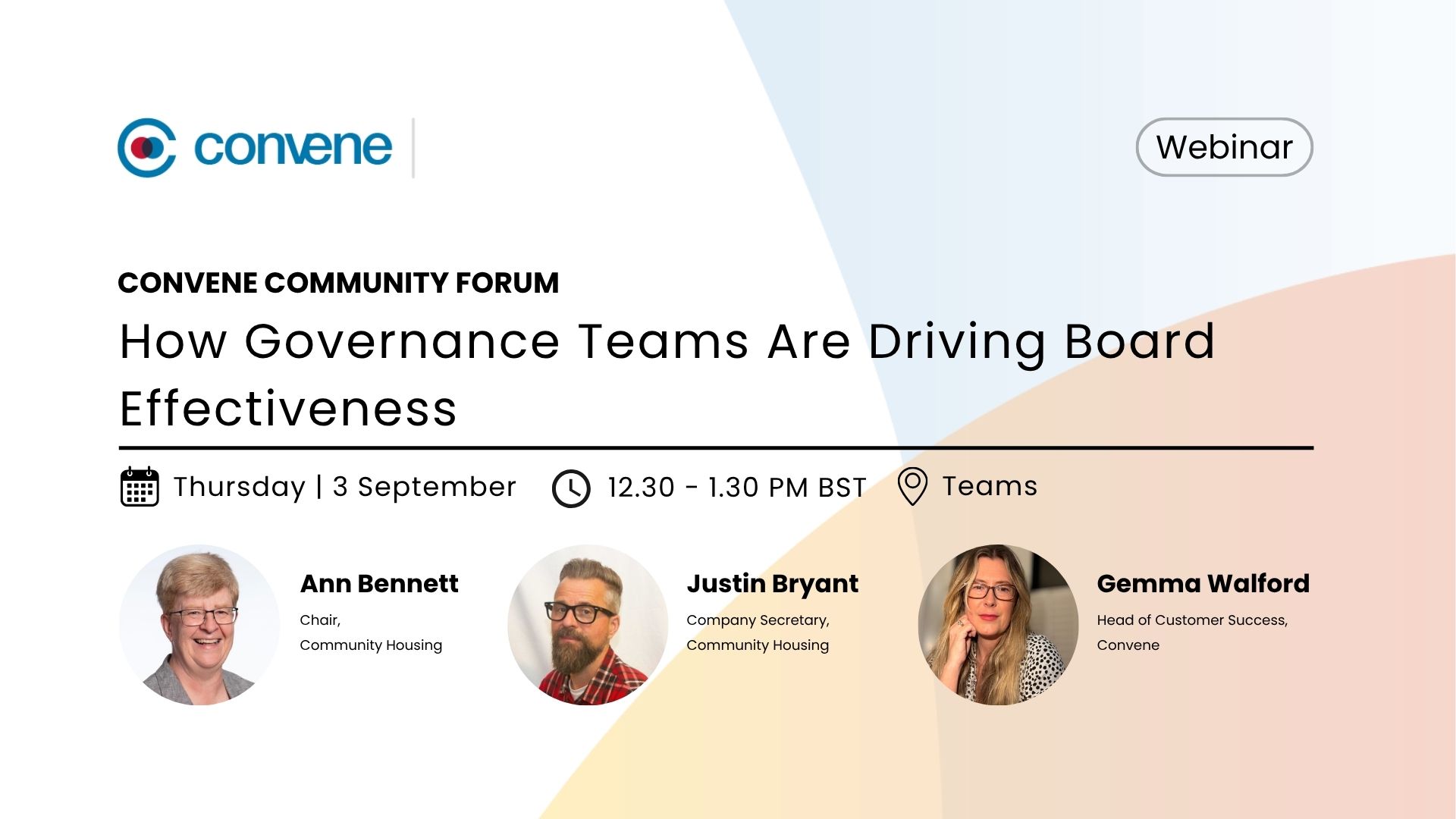
At our latest Convene Community Forum we heard how one housing association improved their board effectiveness. Ann Bennett, Chair, and Justin Bryant, Company Secretary, both from Community Housing, joined Gemma Walford, Head of Customer Success at Convene, to talk through the seven-stage framework they built this year and what has already changed as a result.
Thank you to Ann Bennett and Justin Bryant for so generously sharing how Community Housing built and refined their board effectiveness framework. Also, thanks to everyone who joined the session and brought such thoughtful questions, it made for a useful discussion for the whole community. We look forward to seeing you all next time!
Why Community Housing Built a Framework
Community Housing has 10 board members and Ann conducts most appraisals herself, with operations committee members appraised by that committee’s chair, and her own appraisal carried out by the vice chair.
Justin shared that Community Housing already ran effectiveness reviews, skills assessment and succession planning individually, and each worked well on its own, but the connections between them were not always visible in one place. Bringing everything into a single annual cycle was about gaining oversight.
The Seven-Stage Framework
The framework runs as a circular annual cycle, moving from assessment through appraisal, composition review, succession review, training and development, recruitment, and monitoring and assurance.
1. Assessment
Community Housing used a paper based, self-scored process for several years before adopting Convene Assure two years ago, running both side by side to validate the approach. This year they moved fully to Convene Assure, layering the effectiveness review and skills assessment against the corporate plan, risk profile and regulatory landscape.
2. Appraisal
Appraisals bring in relationships, attitudes and behaviours, alongside objectives, chair feedback, attendance and preparation. Ann shared that Convene Assure reports have given her a much clearer, evidence backed basis for these conversations.
3. Composition Review
This year, Community Housing set out what each board and committee actually needed, rating every skill from one to three, then mapped current members against that requirement. This confirmed the board broadly had the right skills in the right places. They found that the most knowledgeable committee is not always the most effective one. For example, an audit committee made only of finance leads risks losing people who ask the simple questions an expert might miss.
4. Succession Review
This stage maps the current skills picture, overlays future change from internal sources such as retirement plans and external sources such as the corporate plan, then turns that into concrete preparation.
5. Training and Development
Training plans are built from the skills profile rather than defaulting straight to a course, with a strong preference for developing skills internally first. The loop closes by checking whether the training or recruitment that followed actually delivered the intended change.
6. Recruitment
Community Housing has moved away from like for like replacement and now recruits against future needs, weighing internal development against a genuine external hire. Factors like diversity, lived experience and a tailored induction remain a clear priority.
7. Monitoring and Assurance
Activity used to be reported separately to different committees. The framework now creates a single line of sight through the People and Culture Committee to the board, culminating in an annual assurance statement covering all seven stages.
Where the Framework Changed a Decision
Community Housing had a vacancy coming up and initially expected to recruit a replacement chair for the investment committee. The latest appraisal results showed the organisation already had the internal skills to fill that role, so the recruitment need shifted to a board member with change management experience instead.
Buy-In and Early Challenges
The first year required both a paper and digital version of the assessment, alongside minor access issues since resolved, but there was no significant pushback, and seeing the effectiveness score improve gave the board tangible proof it was worth the effort.
Convene Assure asks several questions per competency from different angles rather than a single self-assessed score, reducing the scope to over or underestimate. A “not sure” response requires added commentary, which can prompt a follow up conversation with the chair.
How Key Skill Areas Are Identified
Justin pointed to committee terms of reference, the corporate plan, role profiles, and conversations with committee chairs, alongside two strategy days a year that identify what is changing across the sector. A recent example was recruiting a board member with experience of local government reorganisation in Worcestershire, to help the board understand its potential impact on social housing.
Individual Needs Versus Board Wide Needs
An individual training gap doesn’t necessarily show up as a board level gap if the rest of the board is already strong in that area, so it is addressed through the individual’s own development plan, with succession and tenure layered on top to catch gaps before they become urgent. One unplanned benefit was a clearer picture of board members’ preferred information style, pushing Community Housing towards more visual reporting.
What Convene Assure Adds to the Picture
The governance effectiveness assessment aligns to the code of governance relevant to each sector, broken into four modules covering mission and values, strategy and delivery, board effectiveness, and control and assurance. The skills assessment covers housing sector skills, professional skills, contemporary skills, and behavioural and leadership attributes, and individual responses roll up into a group view.
How Convene Assure Supports Board Effectiveness
Community Housing’s framework connected processes that already worked well individually into a single, evidenced view of where the board stands and where it needs to go next. It has already changed a recruitment decision, and the board can now see its effectiveness score moving year on year.
Convene Assure gives governance teams a structured way to run board evaluations, map skills against what each committee actually needs, and hold evidence ready for scrutiny at any point in the year, rather than only in the weeks before an audit or review.
If you want to see how this could work for your board, you can book a demo.
Frequently Asked Questions
What is a board effectiveness framework?
A board effectiveness framework is a structured, repeatable process that connects skills assessment, appraisal, board composition, succession planning, training, recruitment and assurance reporting into a single annual cycle, rather than running each as a separate activity.
What does Convene Assure do?
Convene Assure supports board evaluation and skills assessment, structured against sector specific governance codes, and rolls individual responses up into group level reporting that helps boards track effectiveness and succession planning over time.



- Connect:
-