


Key Takeaways
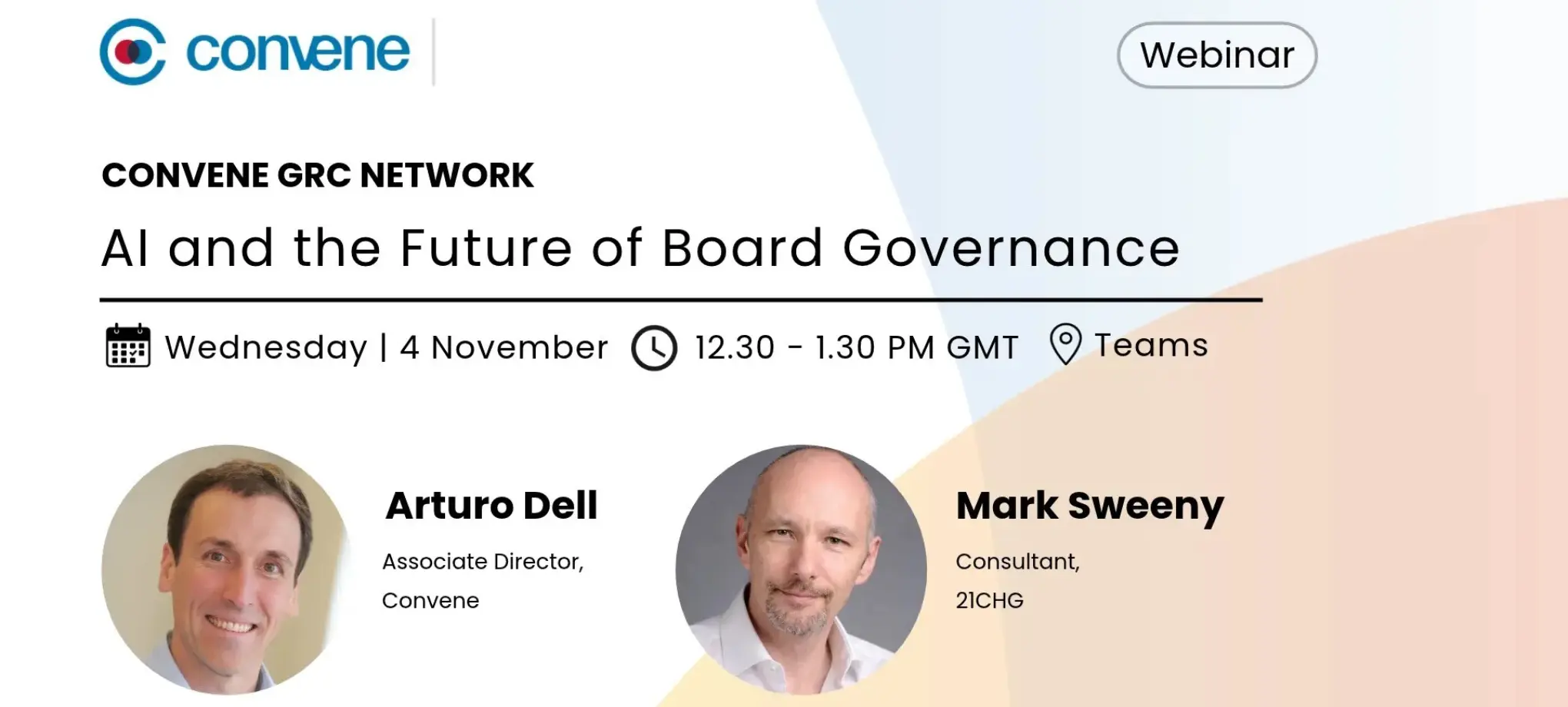
Most boards are already working out how to govern AI. In the webinar AI and the Future of Board Governance, our guest speaker Mark Sweeny explained why governance with AI matters far more than treating AI as one more business risk.
Mark is a director at Governance Intelligence who advises boards and governance teams on AI and writes extensively on the topic.
Hosted by Gemma Walford, Head of Customer Success, and Arturo Dell, Associate Director, the session explored what this means for UK boards.
Thank you to everyone who took part in the Q&A. We look forward to welcoming you again at our next session.
What is the difference between governing AI and governing with AI?
The difference between the two is that governing AI applies strategy and risk controls to an organisation’s own AI use, while governing with AI puts AI inside the governance process. Mark calls the first approach business as usual, because the boardroom stays untouched.
Mark’s view is that AI is probably already in most organisations, whether through point solutions or shadow use, where staff turn to personal AI tools for their work.
Read what boards should know about AI in governance.
What are the five impacts of AI on governance?
Mark set out five impacts that are very likely.
AI changes timing
Papers will no longer rely on last quarter’s data because business plans and budgets can stay connected to the AI. This means that executives and non-executive directors will see the same live insight.
AI changes information volumes
Your board must decide what it wants to know and what it needs to know so that limited time is not lost.
AI changes the kind of judgement
Experience and technical expertise will move into the system, which will leave boards with judgement and accountability. Mark asks you to imagine regulation and your own financial models embedded in the AI.
AI clarifies purpose
Purpose has to be stated clearly enough for AI to act on it.
In the Q&A, Mark shared an example of an organisation that wrote around 50 pages on who it is, which its AI reads before every answer.
AI changes accountability
Mark was clear that an AI cannot be held accountable, because it is not a person, so a human must always carry that responsibility. If it’s used well, the data will show what was decided and why.
How might AI change the company secretary and the board?
Mark argued that AI will sharpen the value of the governance professional as a trusted adviser, someone who knows how the organisation decides and how the board works. His advice was to work out what AI cannot do, because that points to the new company secretary role. On the board, he expects judgement to matter more than experience and technical expertise.
He also asks what happens when your AI starts talking to the regulator’s AI. Mark encouraged those in regulated sectors to consider what their own role will be in that conversation.
What should you tell your board about AI strategy?
You can tell your board to test whether your AI strategy is strategic. Mark suggests stripping out the acceptable use and procurement policies, then asking what is left.
What did the webinar Q&A reveal about AI and the board?
How much AI knowledge do boards need?
Mark described this as a transition period. For now, boards need to show stakeholders and regulators that they grasp both the risks and the opportunities.
Should AI ever sit on the board?
Mark was unequivocal that there will never be an AI board member, because an AI cannot be accountable. An AI adviser is a different matter. It could offer a regulator’s or a tenant’s view of a paper, as long as the board still exercises its own judgement.
Where should boards start with AI?
Mark suggested starting with point solutions such as minute taking and paper digestion. They teach you where AI is strong and where it falls short, including its tendency to hallucinate.
What should boards and executives ask each other?
Mark advised offering board members the space to admit to pasting board papers into public AI tools. He also suggested that a member who does not understand a paper should ask the executive, not the AI. Boards should ask executives for assurance that AI is used properly.
Where should your board start?
Start with one conversation about purpose and accountability before any decisions about tools. Mark closed with the old proverb about a journey of a thousand miles, then asked where you actually want to end up.
How does Convene support governance with AI?
Convene brings AI into the board portal, so your directors work inside the secure environment where board papers already sit.
Convene AI includes Automated Minutes, which turns transcripts and recordings into draft minutes, and AI Companion, an assistant across meetings and review rooms.
To see how Convene supports your next board cycle, book a demo with the Convene team.



- Connect:
-

