


Australian company secretaries have held administrative responsibility for years, from taking minutes to preparing board packs to noting who approved and signed what and when. Much of that work is repetitive, and it’s exactly the kind of task artificial intelligence (AI) tools can handle well. But as AI adoption grows, the profession is facing new opportunities and challenges.
In the Governance Institute of Australia’s 2025 AI Deployment and Governance Survey, 88% of participating organisations reported difficulties in integrating AI into existing systems. This suggests enthusiasm for AI is outpacing the practical work needed to make it reliable, and most organisations are adopting faster than they can properly govern.
That’s the gap purpose-built tools, like AI-powered board portals, are aiming to bridge. These platforms are designed to integrate into existing board governance processes, rather than attempt to retrofit them, and that’s where company secretaries can see the biggest gains in efficiency and reliability.
This article will discuss the evolving role of Australian company secretaries, what an AI board portal would actually do, and how secretaries can address the risks.
The Evolving Role of Company Secretaries in Australia
The Australian Institute of Company Directors (AICD) describes the company secretary as the officer responsible for administrative and governance support to the board, including managing statutory registers and Australian Securities and Investments Commission (ASIC) filings, and organisational aspects of board meetings and minute-keeping.
Since the Corporations Act 2001 came into effect, the role of the company secretary has evolved from administration to advisory. While the basic role hasn’t changed, company secretaries in Australia are increasingly expected to contribute to board effectiveness and serve as an important liaison between the board and executives.
Recommendation 1.4 of the ASX Corporate Governance Council’s Corporate Governance Principles and Recommendations (2019) specifically recognises the company secretary’s role in supporting the board’s effectiveness, stipulating that the company secretary is accountable to the board, through the chair, for all matters relating to the proper functioning of the board. The problem is that none of the old duties disappeared to make way for the new ones; statutory filings still need to be made, and the board meeting pack still needs to be put together the night before and handed out first thing in the morning. With the addition of strategic governance functions in the mix, the time dedicated to these administrative functions is now limited. For company secretaries, AI-assisted governance tools are seen as viable solutions to the evolving role and time constraints.
How AI Board Portals Support Company Secretaries
An AI-powered board portal is largely an intuitive extension to a board management platform, embedding AI capabilities in the day-to-day tasks that a company secretary in Australia would typically perform.
Within a board portal, AI enablement can mean:
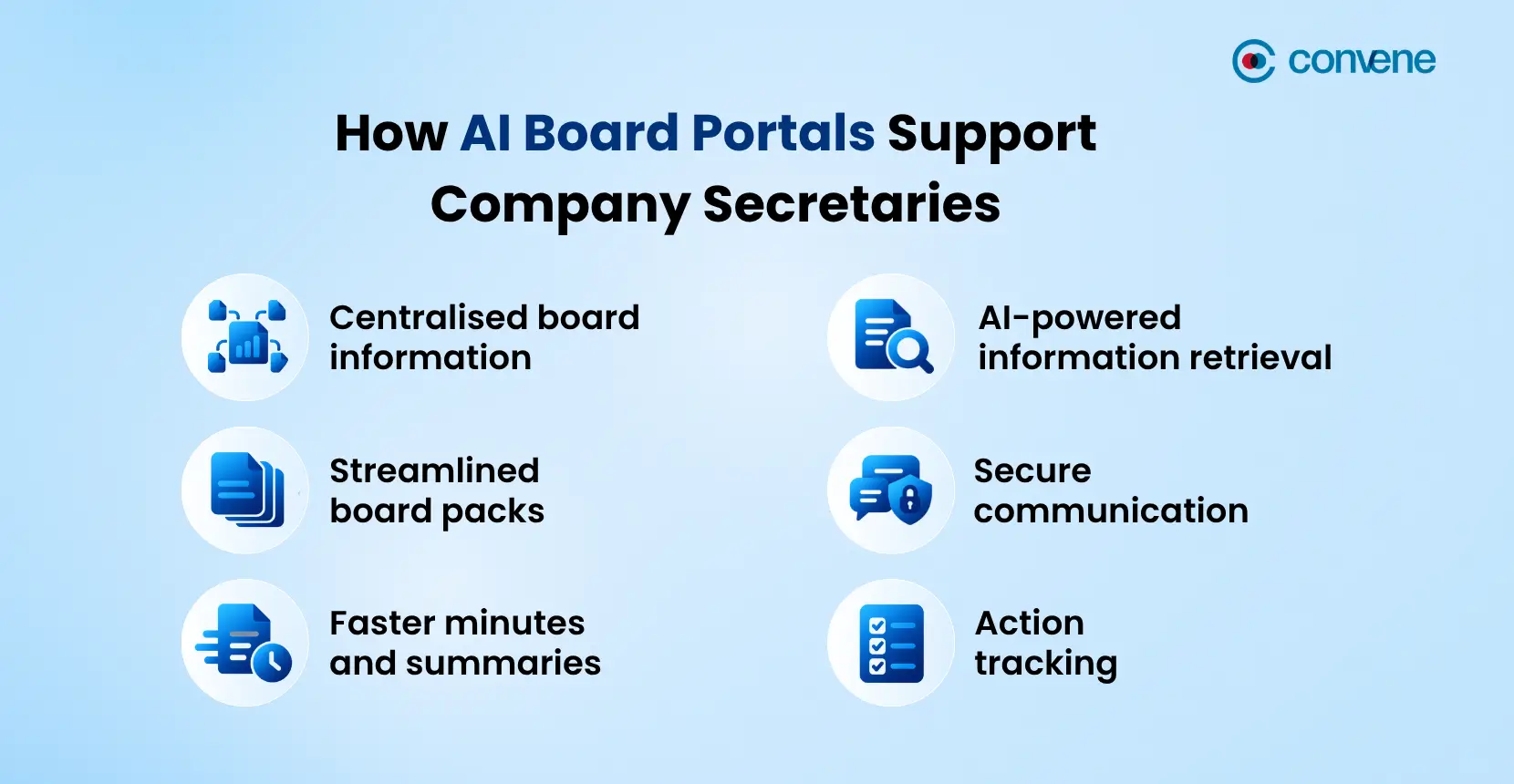
- Centralised board information: All of the policy, finances, and board minutes from the last few years can be obtained quickly and securely from a single source
- Streamlined board packs: Board packs can be compiled, formatted, and distributed in just a few clicks
- Faster minutes and summaries: The portal can provide a first pass on a summary or minutes from a recorded meeting, which can then be reviewed and finalised
- AI-powered information retrieval: Rather than digging through old files to find specific decisions or meeting details, the secretary can simply ask the AI for this information
- Action tracking: The company secretary board portal can also track outstanding action items, remind relevant parties, and keep a log of which items have been resolved
- Secure communication: Messaging and shared workspaces within the portal can decrease the need for using email for confidential communications
READ: How to Choose an AI-Ready Board Portal in Australia: Checklist for 2026
Benefits of Using an AI-Powered Board Portal for Australian Boards
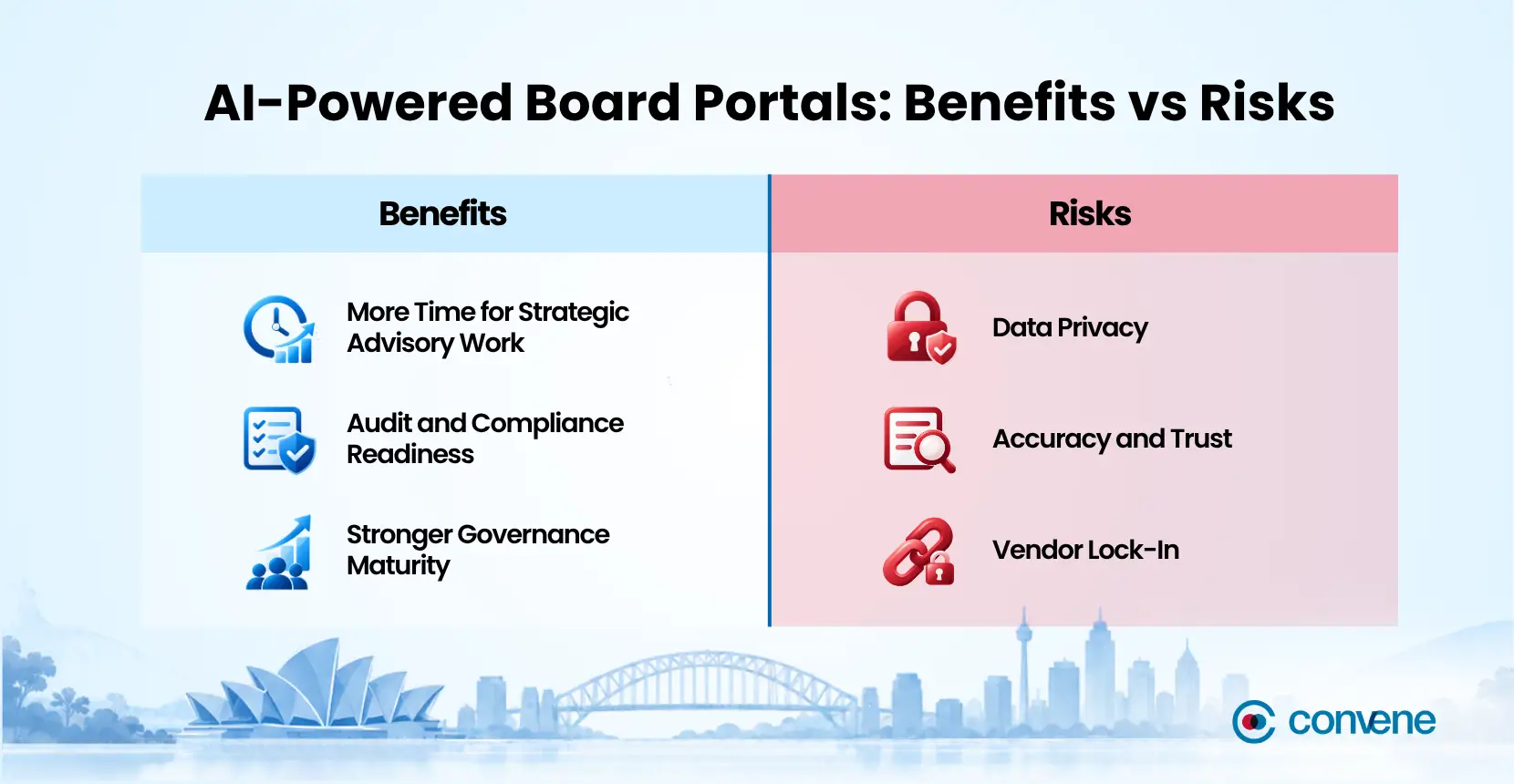
In addition to the benefits the technology brings about in and of itself, there are a few other benefits of adopting an AI board portal solution worth mentioning, including:
More Time for Strategic Advisory Work
Advisory work is becoming a stronger focus for company secretaries as their administrative duties are increasingly automated. This allows the secretaries to raise the level of their involvement in matters such as determining board skills and capability gaps, succession planning, and addressing potential conflicts of interest.
In addition, secretaries can spend more time offering informed advice to the directors, as they are the ones who see the board’s w ork, processes, and history firsthand. This gives directors more context to make better-informed decisions rather than relying on the secretary primarily to carry out administrative functions on their behalf.
Audit and Compliance Readiness
If a regulator, auditor, or external reviewer asks to see the rationale for a particular decision, a secretary can simply pull up the relevant document in the portal to show audit trails, rather than having to piece together evidence from scattered emails and files. Keeping these records in a secure, centralised environment also makes it easier to demonstrate how decisions were made and who was involved.
That readiness matters more as scrutiny of governance practices increases. ASIC reported that corporate governance concerns accounted for 40% of issues raised through misconduct reports in the second half of 2025, including failures to provide company records.
Maintaining a clear, accessible record of decisions can therefore help companies respond more efficiently to regulatory reviews and reduce organisational risks if such a review occurs.
Stronger Governance Maturity
For similar reasons, AI tools can also help boards get past a reactive approach to compliance and move to a more holistic approach to governance. Faster access to past decisions, meeting records, and relevant documents allows directors and secretaries to see the context behind current issues, while AI-assisted analysis can help bring together information across records to identify risks, opportunities, and patterns. The board can then make decisions and develop strategies based on these, rather than simply riding the tide of emerging compliance demands.

Risks of Using an AI-Powered Board Portal
With benefits come risks, and when it comes to AI board portals, Australian company secretaries should be aware of a few potential downsides before adopting one. Understanding these risks also helps organisations to put the right safeguards in place.
Data Privacy
Probably the most obvious issue is data privacy, as board materials and records can contain commercially sensitive or legally privileged information. Company secretaries and the organisation as a whole may have concerns about whether information fed into an AI system is stored by the provider, shared with third parties, or used to train AI models.
The issue is not purely theoretical. In 2024, the Office of the Australian Information Commissioner (OAIC) investigated reports that I-MED Radiology had provided patient scans and reports to an AI company for model training. Although the OAIC ultimately found that the data had been sufficiently de-identified and closed its enquiries in 2025, the case highlights the importance of understanding how data is handled when it is provided to an AI system.
To manage these risks, organisations must have appropriate security and privacy controls. This includes checking whether data is stored, shared, or used to train AI models, as well as reviewing the provider’s security standards and AI-specific controls. Choosing a reliable vendor with enterprise-grade security measures, such as Convene Board Portal, can also help reduce the risk of exposing sensitive board information.
Accuracy and Trust
AI-generated summaries, minutes, and recommendations can miss important nuances or misrepresent the intent of a discussion. Overreliance on AI can also lead a secretary to overlook errors or assumptions they would otherwise question. It doesn’t help that AI can sometimes produce hallucinations, generating information that sounds correct but is not supported by the underlying records, which makes overreliance on AI even more risky.
For this reason, AI-generated outputs should be treated as a first draft and reviewed by the secretary before being shared with the board. The secretary remains responsible for ensuring the final information is accurate and appropriate to rely on.
Vendor Lock-In
A final concern is the potential lock-in to a particular vendor after initial adoption, as some AI features may not integrate well with the company secretary’s existing compliance and statutory tools, and switching later may be more disruptive than helpful.
When considering adopting an AI-powered board portal, Australian company secretaries should ask potential vendors about how their tools handle data, how much human oversight is built into AI recommendations, and how often the AI’s own accuracy is tested.
So, is AI for company secretary a threat or a helpful tool?
AI can largely handle tasks that have traditionally been considered administrative or repetitive parts of the company secretary’s role. Preparing documents, gathering information, and producing preliminary meeting records can increasingly be automated, while tasks that require human judgement, discretion, and an understanding of the board’s circumstances remain the responsibility of the company secretary.
This does not mean AI eliminates the need for company secretaries. Instead, it is changing where their time and expertise are most valuable. The role is shifting towards one where secretaries work alongside AI rather than around it. This is also creating a need for greater AI literacy. As per the 2025 AI Deployment and Governance Survey, only 10% of respondents had advanced AI qualifications, while 46% had received no AI training at all. This skills gap needs to be addressed if company secretaries are expected to make effective use of AI.
AI should not be seen as something company secretaries need to compete with, but as a tool they need to learn to work with.
For Australian company secretaries, the likely future is therefore not one in which AI replaces the role, but one in which AI fluency becomes another core professional skill. Much like how spreadsheets and digital literacy became essential to modern office work, understanding how to use, review, and govern AI may become a routine part of the company secretary’s toolkit.
Frequently Asked Questions about Company Secretary Australia
What skills do modern company secretaries need?
In addition to administrative and compliance expertise, company secretaries must possess strong governance and advisory skills. Furthermore, as AI becomes more prevalent in boardrooms, proficiency in AI is now another skill that effective secretaries can offer.
What should company secretaries consider when selecting an AI board portal?
When selecting an AI-powered board portal, company secretaries should consider its security features, vendor oversight, AI accuracy controls, and compatibility with the organisation’s broader governance infrastructure.
How Convene Supports the Modern Company Secretary
As the company secretary’s role continues to evolve, the tools that support board and governance processes must also adapt. This is where Convene Board Portal comes in.
Convene is a board management software designed to bring the key activities involved in board and committee governance into one secure environment. With the integration of Convene AI, you can now enhance these established governance workflows with AI-assisted capabilities like:
- Generate meeting minutes: Create a first draft of meeting minutes from discussions and recordings, which the company secretary can review, verify, and finalise.
- Summarise and retrieve information: Summarise documents and surface relevant information across meetings and governance records, helping directors and secretaries find answers without manually searching through files. Meeting Assistant and App Assistant can further support quicker access to information during meetings and across the Convene platform.
- Track board skills: Maintain a centralised view of directors’ skills and capabilities, making it easier to identify gaps and support ongoing board capability and succession planning.
- Secure AI integration: Convene AI leverages AWS Bedrock to support its AI capabilities within a secure governance environment.
These features sit alongside the core board portal functions for preparing meetings, managing documents, tracking actions, and maintaining a secure record of board activity.
If your organisation is considering how AI can fit into its existing board processes, request a Convene demo to see how Convene AI can support your company secretary and board.



Jess is a Content Marketing Writer at Azeus Convene, where she mostly writes about board management and AI, and how the two intersect to support smarter board governance. Before joining Azeus, she produced cybersecurity and compliance content for an IT company, covering topics like data protection and industry regulations that, as it turns out, matter just as much in the boardroom. In her free time, Jess enjoys a good detective thriller and keeps up with her emotional support K-pop group.
- Connect:
-

-