


Quick Answer: The Public Finance Management Act (PFMA) is South African legislation governing how national and provincial government departments and public entities manage public finances. Under the Act, a public entity’s board acts as the “accounting authority,” which is accountable for the Act. Section 50 sets out the board’s fiduciary duties, whereas Section 51 sets out its operational responsibilities. Non-compliance can result in internal disciplinary actions and, in serious cases, criminal liability.
Key Takeaways
- The PFMA is binding legislation, not a voluntary code, and it applies to national and provincial public entities.
- A public entity’s board is its “accounting authority” under the Act, a distinct legal role from an accounting officer, who heads a government department.
- Section 50 sets the fiduciary standard for board members: utmost care, honesty and integrity, disclosure of interests, and no personal gain. Whereas, Section 51 sets the board’s operational duties: financial and risk management systems, expenditure control, asset safeguarding, disciplinary enforcement, and reporting.
- PFMA non-compliance carries two tiers of consequence: internal disciplinary proceedings for financial misconduct, and criminal liability under Section 86 for the most serious contraventions.
- Board governance software supports compliance through specific capabilities, including a secure document library, a conflict of interest register, e-signature workflows, and an audit trail.
South Africa’s Public Finance Management Act has always been seen by most boards as just a finance department’s concern. Yet, that shouldn’t be the case. Sections 50 and 51 of the Act clearly set out the fiduciary duties and operational responsibilities the board and the management must uphold.
Evidence suggests, however, that there is still a gap between the legislation and actual board practice. A study by the Accounting and Financial Control in 2025 found that around 71% of Limpopo public treasuries reported that no proper oversight was conducted with financial regulations. Moreover, approximately 85% stated that technology has not been used to support oversight.
This gap creates further problems for South African public entities. In this article, discover what PFMA is, what it requires from boards, what non-compliance triggers, and how boards can strengthen their compliance and governance practices.
What is the Public Finance Management Act (PFMA)?
The Public Finance Management Act, or PFMA, is a South African legislation established in 1999 that regulates financial management in national and provincial government departments and public entities. Its ultimate purpose is to ensure that public revenue, expenditure, assets, and liabilities are managed effectively and transparently in relation to the citizen’s needs.
The Act followed South Africa’s 1996 Constitution, built around accountability and outcome-based reporting, rather than line-item spending control.
PFMA groups institutions into schedules, determining their planning and reporting timelines.
- Constitutional institutions (Schedule 1): Bodies with institutional mandates to protect democracy.
- Major public entities (Schedule 2): Public entities operating as large state-owned companies, such as Eskom and Transnet.
- National public entities (Schedule 3A): National agencies and regulatory bodies funded fully or partly by the national revenue, such as the South African Revenue Service.
- National government business enterprises (Schedule 3B): Commercial entities at national level with self-generating funds.
- Provincial public entities and business enterprises (Schedule 3C and 3D): Provincial equivalents of the above.
Regardless of timelines, the duties under Sections 50 and 51 apply to any board acting as an accounting authority.
Accounting Authority vs Accounting Officer: Who is the board under PFMA?
PFMA’s Section 49 states that ‘Every public entity must have an authority which must be accountable for the purposes of the Act.’ This means that the entity’s board or controlling or other controlling body is its accounting authority. Otherwise, where no boards exist, the chief executive officer (CEO) assumes the role unless the relevant treasury or legislation appoints another individual.
In contrast, an accounting officer holds a separate statutory role, often the head of a national or provincial government depatrment, or a Director-General.
| Accounting Authority | Accounting Officer | |
| Actor | Board or other controlling body of a public entity, or the CEO if there’s no board | Head of a national or provincial department, like the Director-General |
| PFMA governing sections | Sections 49-55 | Sections 36-42 |
| Accountable to | Executive authority (Cabinet Minister or MEC); national or provincial treasury; Auditor-General; and the legislature | Executive authority (Cabinet Minister or MEC); national or provincial treasury; Auditor-General; and the legislature |
As the accounting authority, the board now assumes the duties and obligations set by the PFMA covering financial management systems, asset safeguarding, and reporting to authorities – not just to pass on to the management’s compliance responsibilities.
Section 50: The Board’s Fiduciary Duties Under the PFMA
Two of the PFMA sections governing the roles and responsibilities of accounting authorities are Sections 50 and 51. Under Section 50, board members are held to a standard of personal conduct regarding public finance management. Section 51, on the other hand, sets out the operational aspects that the entity must have in place to ensure proper management. Individual conduct first, then machinery.
Section 50 lays out the following fiduciary duties of accounting authorities:
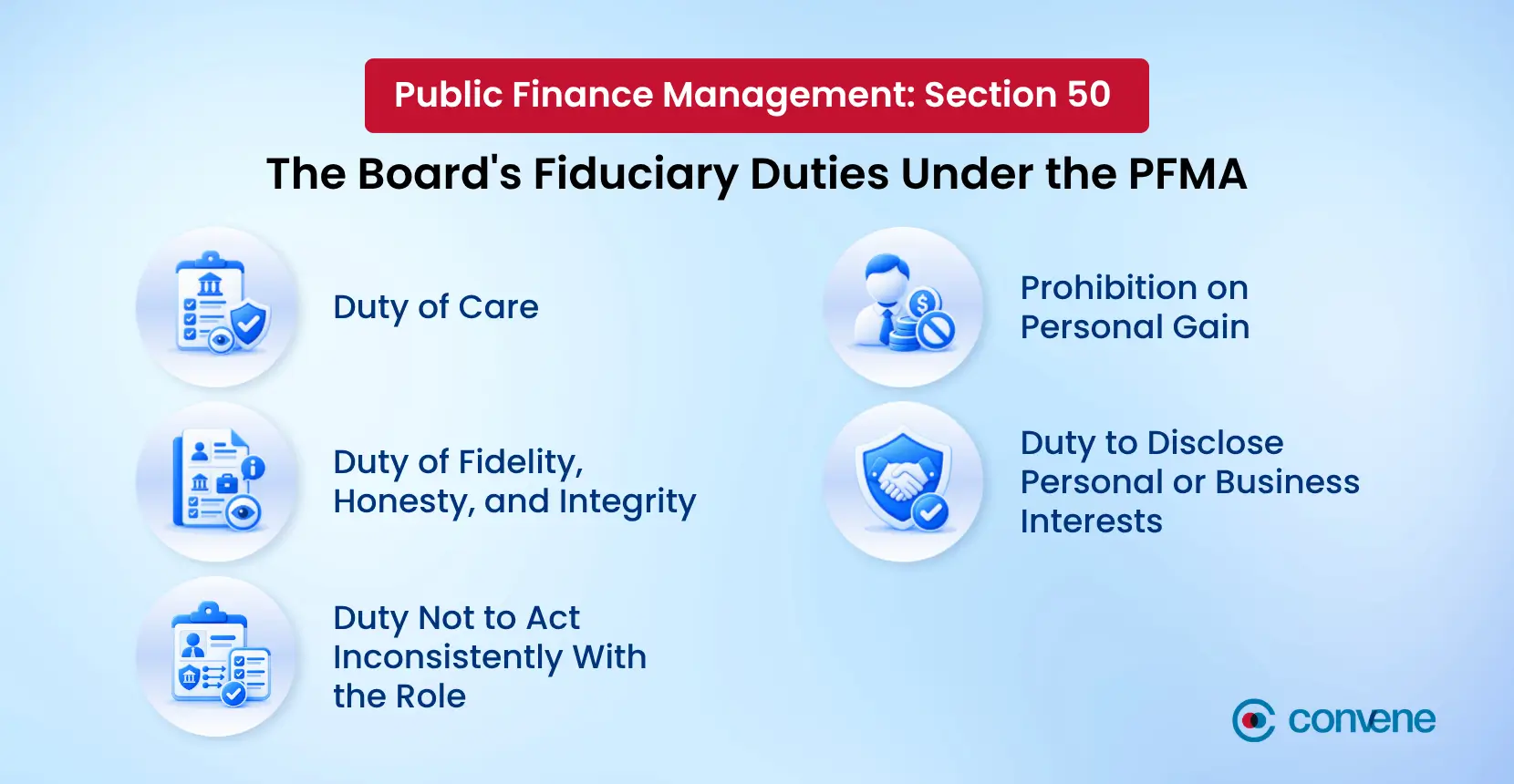 Duty of Care
The board must exercise the utmost care to ensure the entity’s assets and records are reasonably protected. A standard that goes beyond approving a policy and assuming that the entire entity will follow it.
Duty of Fidelity, Honesty, and Integrity
Board members must act in good faith and in the best interests of the entity. On request, members must also disclose any material facts to the executive authority or legislature, whether influential to their decisions or not.
Duty Not to Act Inconsistently with the Role
Members may not take positions or actions that conflict with the accounting authority’s responsibilities under the Act.
Prohibition on Personal Gain
Members may not use their position, or information obtained through it, for personal advantage.
Duty to Disclose Personal or Business Interests
Members with a direct or indirect interest in a matter before the board must declare it and withdraw from the discussion and the vote, unless the board considers the interest trivial.
Such compliance not only prevents institutional risks but also entails personal exposure for the board members. An irregular act under Section 51 is considered a breach of Section 50, as the board is primarily responsible for the controls and systems for public finance.
Section 51: The Board’s Core PFMA Responsibilities
Where Section 50 sets out the conduct standard for boards, Section 51 states the operational duties to manage public resources responsibly. It builds on the fiduciary standard set out in Section 50 above, translating it into concrete operational requirements.
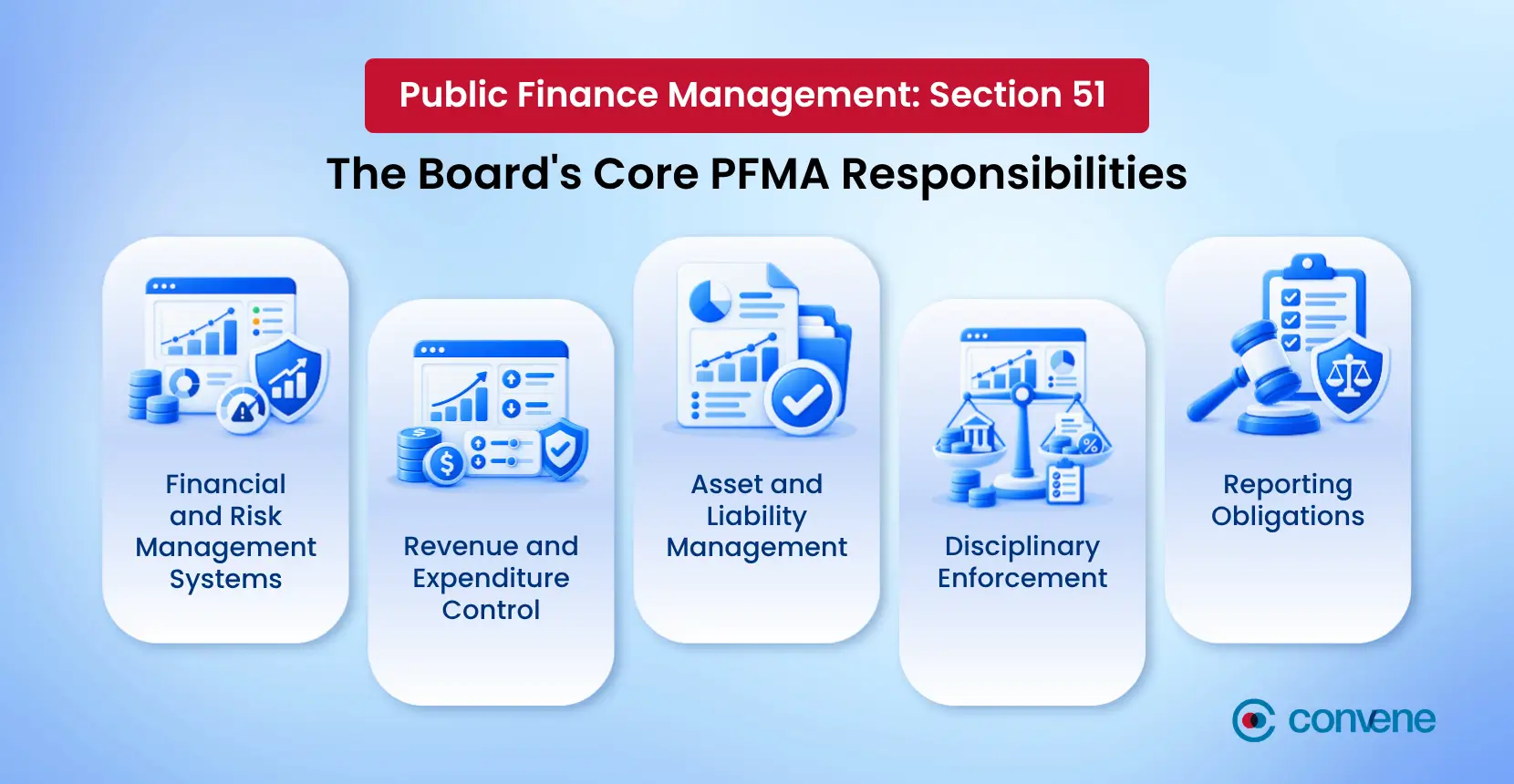
Financial and Risk Management Systems
The board must ensure the entity has effective, efficient, and transparent systems for financial and risk management. This includes establishing a system of controls and internal audits, following the regulations in Sections 76 and 77 (Treasury Regulations and Audit Committees). Alongside, boards are called to maintain a procurement system that is fair, equitable, transparent, competitive, and cost-effective.
In practice, entities should have documented standard operating procedures for all types of transactions they are entering into. The Auditor-General South Africa (AGSA) recommends covering the officials’ responsibilities, functions, tools, risk management, and automated controls – documented accurately to ensure proper mechanisms throughout the entity.
Revenue and Expenditure Control
Accounting authorities must take steps to (1) collect all revenue owed to the entity; (2) prevent irregular expenditure, fruitless and wasteful expenditure, and losses resulting from criminal conduct; and (3) manage available capital efficiently.
Consider a public entity with a budget of R40 million for a capital project that overspends to R58 million. Documented financial overruns do not prove proper oversight without the board asking the key governance questions, such as who authorised the changes and whether the Treasury has been notified. Control is not just paperwork; it is a duty.
Asset and Liability Management
Board members are responsible for safeguarding the entity’s assets and managing its revenue, expenditure, and liabilities. This extends to maintaining accurate asset registers, as well as ensuring assets are properly insured, tracked, and disposed of according to policy – rather than recorded just for year-end audit purposes.
In addition, compliance calls for tax obligations, pensions, and audit commitments as mandated by legislation.
Disciplinary Enforcement
For any contraventions of the Act or undermining of the entity’s financial management systems, the board must take effective and appropriate disciplinary measures.
For example, a supply chain manager bypasses competitive bidding procedures and creates an irregular expenditure. The board should be able to enforce an investigation and audit, proceeding to a formal disciplinary hearing and a sanction.
A 2023 qualitative study in the Issues in Social and Environmental Accounting stresses its importance, with its findings that poor enforcement of consequence management in government departments can result in organisation-wide tolerance to accountability, or worse, corruption.
Reporting Obligations
Public service obligations (PSOs) disclosure shows South African state-owned enterprises’ lack of accountability due to the absence of credible enforcement and clear internal roles, according to a 2026 study published in the Accounting Research Journal. Where obligations are not implemented properly, entities treat this instead as a technical complement to their existing reporting structures, rather than a substantive duty.
The Act’s Section 51 sets out the board’s responsibility in submitting all reports, returns, notices, and other information required under the Act or other legislation. PFMA’s Section 55 states the deadlines for annual financial statements (within two months of financial year-end) and annual reports with audited statements (to follow within five months).
Moreso, if the entity is to establish a new entity, it must promptly inform the National Treasury to allow sufficient time for a formal decision.
Regulations and Penalties for PFMA Non-Compliance
Non-compliance with the PFMA carries two tiers of consequence. Financial misconduct and minor offences are often dealt with through internal disciplinary processes. Whereas wilful conduct causing financial loss or acts of fraud are subject to crime under Section 86, carrying a fine, imprisonment, or both.
| Contravention Type | Governing Section(s) | Applies To | Consequence |
| Financial misconduct (e.g., failing to prevent irregular, fruitless, or wasteful expenditure) | Sections 81–83 | Accounting officers, accounting authority members, and officials | Internal disciplinary proceedings under the Public Service Act or Labour Relations Act, as applicable, with a mandatory investigation |
| Wilful or negligent contravention causing financial loss | Section 86(1) | Accounting officers and accounting authority members | Criminal offence, punishable by a fine, imprisonment (not exceeding five years), or both, at a court’s discretion |
| False statements, obstruction, or other serious offences | Section 86(2) | Any person | ACriminal offence, punishable by a fine, imprisonment (not exceeding five years), or both, generally carrying a higher maximum penalty than under Section 86(1) |
Such consequences take several forms depending on the gravity of the violation. Financial misconduct can result in written warnings, suspensions, dismissals, or civil claims for financial loss. At entity level, the effects include closer treasury scrutiny and potentially difficult lending discussions.
How can boards strengthen PFMA compliance?
Boards reduce PFMA compliance risk mainly by making oversight systematic rather than reactive: building committee structures, disclosure processes, and reporting calendars as part of board compliance.
- Constitute a functioning audit committee: The Treasury guidance created a compliance checklist setting a minimum of three committee members to meet at least twice a year. This is to actively review risk registers and audit findings rather than approving them without proper discussion.
- Maintain a live conflict-of-interest register: Every board member should disclose direct or indirect personal interests and formally recuse themselves from related matters. Declarations should be refreshed annually.
- Build a compliance reporting calendar: Missed deadlines are among the most visible compliance failures to Treasury and the Auditor-General. Plot the submission periods of annual financial statements and annual reports, and from there work backwards to set internal deadlines.
- Delegate tasks, not accountability: Delegation without oversight moves the point of failure, not the liability. Boards can assign day-to-day compliance tasks to management, but remain fully involved in oversight.
- Approve frameworks, not only policies: Section 51 expects documented frameworks for financial systems, risk management, revenue collection, and asset management, each with named owners, review cycles, and reporting lines back to the board.
- Conduct and document risk assessments regularly: New procurement models, cybersecurity, and third-party risks can surface from regular assessments. This ensures immediate adaptability and compliance.
- Investigate and record expenditure irregularities promptly: Boards must oversee the framework for investigation and sanctions to standardize disciplinary enforcement.
The Role of Board Governance Software in Strengthening PFMA Oversight
Board governance software does not discharge a PFMA duty on a board’s behalf. What it addresses is the evidence problem. Much of what Sections 50 and 51 require, including that interests were declared, that a decision was properly approved, and that a follow-up action was closed, depends on the board’s active oversight.
Several PFMA duties are supported directly by specific features. Software like Convene Board Portal addresses them as follows:
- Document Library, with document encryption and watermarking, keeps board and financial records secure and version-controlled, supporting the Section 50 duty to protect the entity’s assets and records.
- Conflict of Interest Register provides a structured place for members to declare direct and indirect interests, so Section 50 disclosures are recorded rather than relied on from memory.
- E-signature workflows and audit trails produce a verifiable record of who approved what and when, which is the evidence auditors request when testing resolutions and delegations.
- Actions Dashboard assigns action items to owners with due dates, giving the reporting obligations under Section 55 and the 30-day investigation requirement a tracked home.
- AI-Powered Summarization helps directors work through long board packs and financial submissions, which matters when quarterly reporting runs to hundreds of pages.
None of this replaces the board’s judgment or its committee structures. Instead, it reduces the administrative effort to ensure the board and management are aligned with PFMA and legislative compliance.
Frequently Asked Questions on PFMA
What happens if a board member fails to disclose a conflict of interest under the PFMA?
Non-disclosure of a personal or business interest breaches Section 50 in its own right, whether or not any money is lost. It can lead to disciplinary action against the member and removal from the accounting authority.
Can a board delegate its Section 51 responsibilities to management?
Day-to-day compliance work can be delegated, but accountability cannot. If a delegated task is not properly performed, the board remains legally responsible as the accounting authority. Adequate oversight of the delegations can be performed through reporting lines, committee review, and documented follow-up.
Does the PFMA apply to municipalities?
No. Municipalities and municipal entities fall under the Municipal Finance Management Act (MFMA), Act 56 of 2003. The PFMA governs national and provincial departments, constitutional institutions, and public entities. The two statutes share objectives but differ in budget cycles, oversight structures, and reporting deadlines.
Support PFMA and Public Sector Compliance with Convene Board Portal
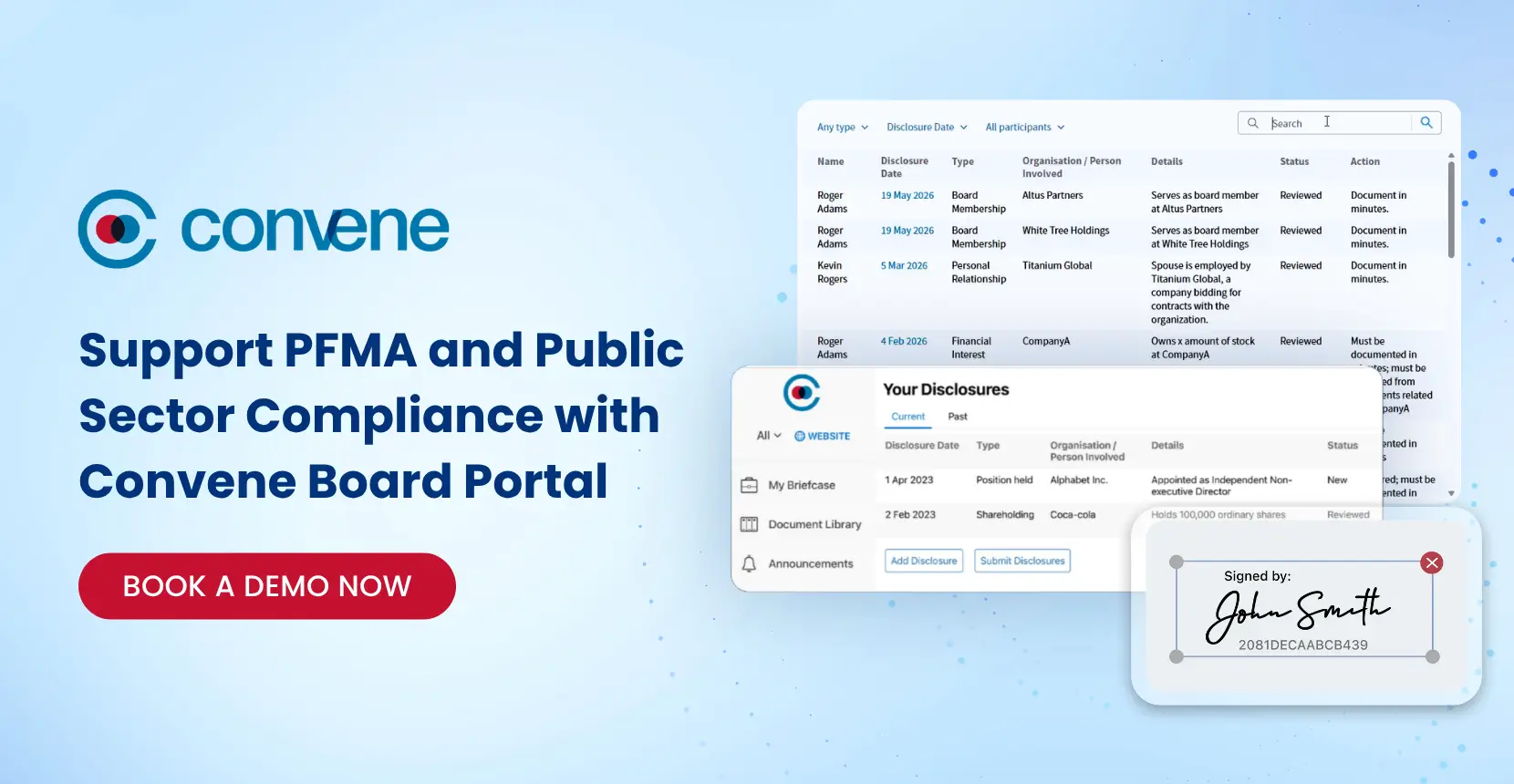
PFMA compliance is not an annual audit exercise. Boards that treat Sections 50 and 51 as standing operating requirements are in a considerably stronger position when the Auditor-General reviews their institution.
Convene Board Portal supports that discipline with capabilities built for public sector governance, including:
- A secure Document Library with encryption and watermarking to manage policies and financial records
- Conflict of Interest Register for Section 50 disclosures
- E-signature workflows for faster and more secure approvals
- Audit trails for activity tracking on records, documents, and meetings
- Convene AI for instant meetings and document summarization
Explore Convene’s features by booking a demo to see how it supports your entity’s compliance process.


Audrey is a Content Marketing Specialist at Convene, in charge of managing the production of quality content on the company’s website. A communication major keen on marketing, Audrey has been constantly seeking approaches to create tailored content—may it be about governance, digitalization, boards, or meetings—fit for the stakeholders. When not strategizing on the next ebook to produce, Audrey finds solitude in reading make-you-ugly-cry novels and listening to self-improvement podcasts.
- Connect:
-

-